
315mm HDPE Pipe Welding Machine: Specifications, Applications and Buying Tips
Table of Contents
315mm HDPE Pipe Welding Machine guide covering specifications, applications, machine types, price factors, quality checks, and buying tips for contractors, distributors, and project buyers.
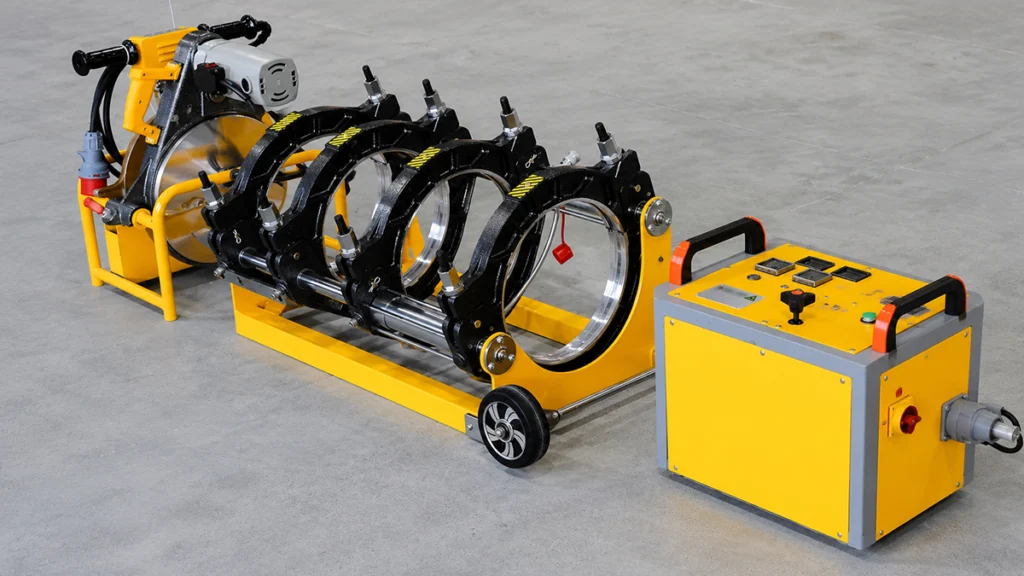
Built for mid-range infrastructure projects, a 315mm HDPE pipe welding machine is a specialized industrial tool that permanently joins high-density polyethylene (HDPE), polypropylene (PP), and PVDF pipes. It uses thermofusion to deliver the exact mechanical force and thermal precision needed to build seamless, leak-proof pipeline networks.
Core function in HDPE pipe butt fusion
At its heart, this equipment drives the butt fusion process. A precision-controlled heating plate simultaneously melts the flat ends of two thermoplastic pipes. Once the plastic reaches the perfect melt state, the operator extracts the heating element. The butt fusion welding machine then drives the pipe ends together under strictly calculated hydraulic pressure. This action physically merges the polymer’s molecular structure, creating a joint that often outlasts the native pipe itself.
Typical pipe diameter range and SDR compatibility
Manufacturers engineer this category specifically for the Dn160-315mm range, easily handling 160mm, 200mm, 250mm, and 315mm inserts. Crucially, the equipment must accommodate a wide variety of Standard Dimension Ratios (SDR9 to SDR41). Since pipe wall thickness shifts dramatically across different SDR classifications, the butt fusion machine’s hydraulic unit has to adjust joining pressures with pinpoint accuracy. Get this wrong, and you risk pipe collapse or a dangerously weak fusion bond.
Manual, Automatic, and hydraulic machine options
You’ll find these HDPE pipe jointing machines in several configurations: manual chassis, semi-automatic (hydraulic), and fully automatic (CNC) systems. However, when working with diameters approaching 315mm, hydraulic systems aren’t just recommended—they’re essential. The brute force required to mill, heat, and press a 315mm HDPE pipe goes far beyond human muscle. Trying to manually operate heavy-duty mainlines introduces massive risks, including poor alignment and totally inadequate joining pressure.
Key Specifications of a 315mm HDPE Pipe Welding Machine
Sizing up a 315mm HDPE butt fusion welding machine means digging into its technical parameters to guarantee it handles your project’s demands. Here is a breakdown of the standard specifications B2B buyers need to scrutinize.
| Component / Parameter | Standard Specification | Technical Purpose |
|---|---|---|
| Welding Range | 90mm – 315mm (or 160mm – 315mm) | Covers mid-to-large distribution lines |
| Temperature Range | 0°C – 300°C | Accommodates PE, HDPE, PP, PVDF |
| Total Power | ~4.95 kW | Ensures stable milling and heating |
| Voltage | 220V AC (Standard) | Compatible with standard site generators |
| Frame Material | ZL104 Aluminum Alloy | Balances rigidity with transportability |
Welding diameter range, commonly 90mm to 315mm
Even though it bears the 315mm label, this butt fusion machine gains serious versatility through a set of reducing inserts. The standard operational window usually spans 90mm to 315mm. Heavy-duty configurations, however, often optimize specifically for the 160mm to 315mm bracket. This flexibility gives pipeline contractors a major advantage: they can deploy a single pipe fusion machine across multiple project tiers, from lateral branches right up to primary distribution mains.
Heating plate temperature range and control accuracy
Operators can adjust the heating plate anywhere from 0 to 300°C. High-precision temperature control is absolutely non-negotiable here. According to DVS 2207-1 standards, HDPE demands a strict 200-220°C melting window. To keep things running smoothly, the plate utilizes a high-quality PTFE (Teflon) surface coating. This prevents molten polymer from sticking to the metal—a frustrating issue that degrades joint integrity and triggers costly equipment downtime.
Facing tool power, hydraulic pressure, and clamp structure
The facing tool (or milling cutter) typically draws about 1.1 kW of power. It drives high-speed carbon steel blades through a chain drive to guarantee perfectly parallel pipe ends. To handle immense pressure without warping, manufacturers cast the clamp structure from high-strength ZL104 aluminum alloy. Meanwhile, the hydraulic station—usually pulling 0.75 kW—relies on imported sealing systems and flat-type quick connectors. This setup delivers the stable, continuous pressure needed during the critical cooling phase.
Voltage, total power, machine weight, and transport size
A standard 315mm hydraulic rig consumes roughly 4.95 kW of total power and runs on a standard 220V AC supply. Because the ZL104 aluminum frame and hydraulic station are built for heavy-duty abuse, the total system weight adds up fast. You need solid logistical planning. Buyers should always verify transport dimensions beforehand to make sure standard utility vehicles or trailers can safely mobilize the equipment.
How a 315mm HDPE Butt Fusion Welding Machine Works
Step 1: Clamping and aligning the HDPE pipes
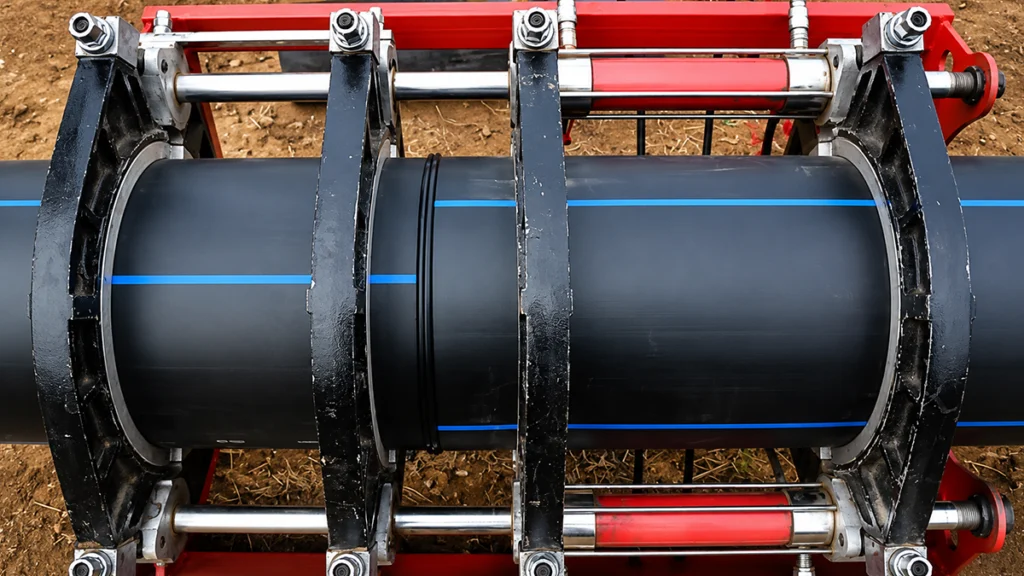
Everything kicks off by locking the pipe sections into the upper and lower pressure plates of the butt fusion machine’s chassis. Perfect alignment is everything. Any high-low misalignment between the pipe walls cannot exceed 10% of the pipe’s total wall thickness. The rugged ZL104 aluminum clamps do the heavy lifting here, ensuring the pipe stays perfectly cylindrical and axially aligned.
Step 2: Facing, heating, joining, and cooling
Next, the operator drops the electric milling cutter between the pipe ends, shaving the surfaces until they sit completely flat and parallel. Once facing is complete, the PTFE-coated heating plate steps in. The butt fusion machine presses the pipes against the heater until a uniform melt bead rolls back. The operator then rapidly pulls the heater out, and the hydraulic system slams the molten pipe ends together. The joint stays under continuous hydraulic pressure until it cools completely to ambient temperature.
Which welding parameters must be controlled?
Meeting international benchmarks like ISO 21307 and DVS 2207-1 means maintaining an iron grip on three main parameters: temperature, pressure, and time. The heating plate must distribute temperature evenly across its entire face. Operators must calculate hydraulic drag pressure and add it to the joining pressure to offset pipe friction. Finally, you have to strictly observe heat soak and cooling times based on the pipe’s specific SDR.
Common signs of a qualified fusion joint
A quick visual inspection gives you the first clue about fusion quality. A properly fused joint shows off a uniform, symmetrical double rollback bead circling the entire pipe. That bead needs to look smooth, free of any pores, and evenly sized. Spot an asymmetrical, V-shaped, or massive bead? That immediately points to severe mistakes in heating temperature, alignment, or hydraulic pressure.
Factory-direct pricing with technical consultation included
Get Your Free QuoteMain Applications for 315mm HDPE Pipe Welding Machines
Municipal water supply and drainage pipelines
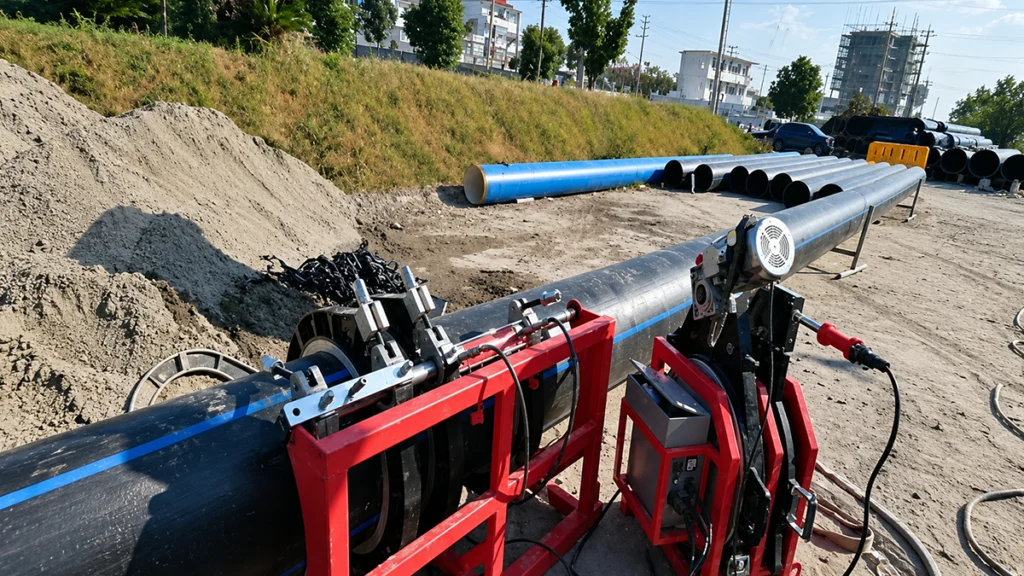
In the world of urban infrastructure, the 315mm format serves as the absolute backbone of water distribution. Municipal water supply and drainage projects lean heavily on these HDPE pipe welding machines to build high-pressure, leak-free networks. These pipelines must survive ground shifting and relentless traffic loads. Thanks to a highly reliable thermofusion process, contractors can confidently guarantee a 50-year service life for underground municipal assets.
Gas distribution and industrial fluid transfer
Natural gas distribution operates on a zero-tolerance policy for leaks. The 315mm HDPE pipe fusion machine delivers the rock-solid structural integrity required for high-pressure gas mains. Over in the industrial sector, crews use these machines to piece together pipelines for aggressive chemical transfer, wastewater management, and heavy slurry transport. In these harsh environments, the chemical resistance of a continuous, seamless HDPE line is mandatory.
Mining, irrigation, and infrastructure construction
Mining sites rely on these butt fusion machines to roll out dewatering lines and tailings transport systems across brutally abrasive environments. In the agricultural sector, they are the go-to tool for building massive irrigation networks. The rugged, heavy-duty build of hydraulic butt fusion machines ensures they keep running in dusty, off-road conditions where sudden equipment failure would otherwise grind operations to a dead halt.
When is a 315mm machine better than a smaller model?
You need a 315mm butt fusion machine the moment a project scales past 160mm lateral lines. A 160mm or 200mm model might technically fit smaller pipes, but they completely lack the clamp size, chassis rigidity, and hydraulic muscle required for heavy-duty 250mm and 315mm mainlines. Investing in 315mm capacity means pipeline contractors can confidently bid on—and execute—critical mid-range infrastructure jobs without worrying about equipment limits.
315mm HDPE Pipe Welding Machine Types Compared
Grasping the differences between equipment types is the key to matching your capital expenditure with actual project needs.
| Machine Type | Best Use Case | Advantages | Limitations |
|---|---|---|---|
| Manual | Low-pressure, non-critical systems | Low initial cost, lightweight | High physical strain, inconsistent pressure |
| Hydraulic | Municipal water/gas, mining | Consistent pressure, semi-automated | Requires power generator, heavier |
| CNC / Data-Logging | Strictly regulated gas/water contracts | 100% traceability, eliminates human error | Highest capital cost, requires training |
Manual vs hydraulic HDPE pipe welding machines
Manual butt fusion machines save money upfront, but they rely 100% on operator strength through a lever or handwheel. That makes them utterly useless for thick-walled 315mm pipes. Hydraulic machines step up with a semi-automatic control unit, generating the massive, sustained pressure needed for large-diameter fusions. If you are touching a 315mm application, hydraulic actuation is the absolute baseline for safety and joint integrity.
Workshop machines vs field butt fusion machines
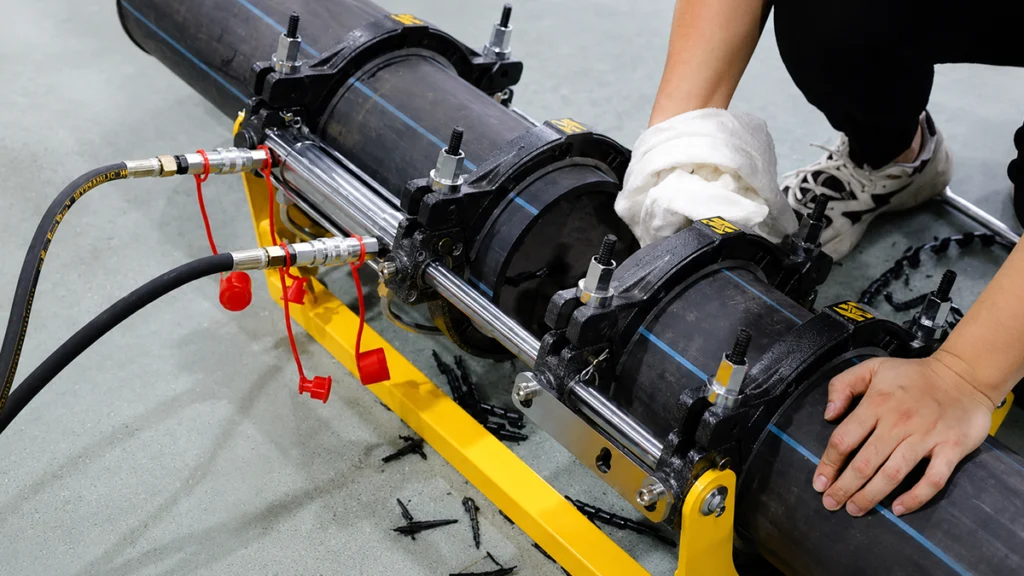
Workshop pipe fusion machines are stationary, highly automated beasts built to pre-fabricate fittings—like elbows and tees—in a strictly controlled factory setting. Field butt fusion machines are a different breed. They pack a detachable chassis, ruggedized frames, and long hydraulic hoses fitted with quick-connects. This clever design lets operators drop the clamps directly into tight construction trenches while leaving the power unit safely up on dry ground.
Data-logging and CNC options for quality traceability
Automatic Butt Fusion Machines leverage a PLC closed-loop design to flawlessly control and record every single fusion parameter: temperature, pressure, and time. This tech stops operators from cutting corners on cooling times and automatically generates digital fusion reports. When you are dealing with heavily regulated municipal gas and water contracts, this data-logging feature delivers 100% quality traceability.
Which type should contractors and distributors choose?
For distributors, stocking standard hydraulic models is a no-brainer—they hit the sweet spot of cost and performance for about 80% of the market. Contractors, however, need to evaluate their specific bids. If you’re working on highly regulated municipal gas lines or critical industrial fluid systems, investing in CNC or data-logging machines is non-negotiable. Project engineers will demand that level of strict compliance and reporting.
Get detailed specs and custom configuration options
Request Technical SpecificationsHow to Choose the Right 315mm HDPE Pipe Welding Machine
Match pipe size, SDR, and material grade to the machine
Smart procurement starts with the pipeline specs. First, make sure the butt fusion machine’s reducing inserts perfectly match your project’s outside diameters (OD). More importantly, double-check that the hydraulic cylinder can actually push out the required drag and joining pressure for high-SDR (thick-walled) pipes. Finally, your heating plate has to maintain the precise melt temperatures dictated by different material grades, such as PE100 versus PE80.
Check clamp rigidity, pressure stability, and heating accuracy
Get a close look at the physical hardware. The butt fusion machine frame needs high-grade ZL104 aluminum so it doesn’t deflect when clamping heavy 315mm pipes. Look at the hydraulic system next—it should use imported seals to lock in pressure stability during that agonizingly long cooling phase. As for the heating plate, demand a three-phase solid-state relay and a premium temperature controller to eliminate dangerous cold spots.
Consider site conditions, mobility, and power supply
Think about where this equipment will actually live. If your crew is doing deep trench work, grab a butt fusion machine with a detachable chassis and extended hydraulic hoses. Also, verify that your site power generators can easily absorb the 4.95 kW total power draw without sudden voltage drops. Power spikes can easily scramble PLC controllers or cause the heating plate temperature to wildly fluctuate mid-weld.
Evaluate operator skill level and training requirements
If your field crew doesn’t have a deep bench of experienced thermofusion welders, buying a CNC or data-logging HDPE pipe jointing machine is a brilliant risk-mitigation move. Automated systems take human guesswork out of the equation, stopping catastrophic joint failures before they happen. On the flip side, if you stick with standard hydraulic butt fusion machines, make sure you budget the time and money to train operators thoroughly on ISO/DVS standard parameter calculations.
Price Factors, MOQ, and Lead Time Considerations
What affects the price of a 315mm HDPE pipe welding machine?
The price tag primarily scales with the level of automation: manual is the cheapest, hydraulic sits in the middle, and CNC tops the chart. Secondary cost drivers include component origins. Imported hydraulic seals and high-end electrical relays will cost more than domestic parts. You’ll also pay a premium for a thicker PTFE coating on the heating plate and a superior metallurgical grade on the ZL104 aluminum chassis.
Standard model vs customized configuration costs
Standard, off-the-shelf hydraulic models will always give you the most aggressive pricing. Customizing your gear changes the math entirely. Whether you want ultrasonic scanning for built-in weld detection, custom fusion heads, or a ruggedized all-terrain wheeled chassis, expect your capital expenditure to jump and your manufacturing lead times to stretch out significantly.
MOQ, spare parts, packaging, and shipping factors
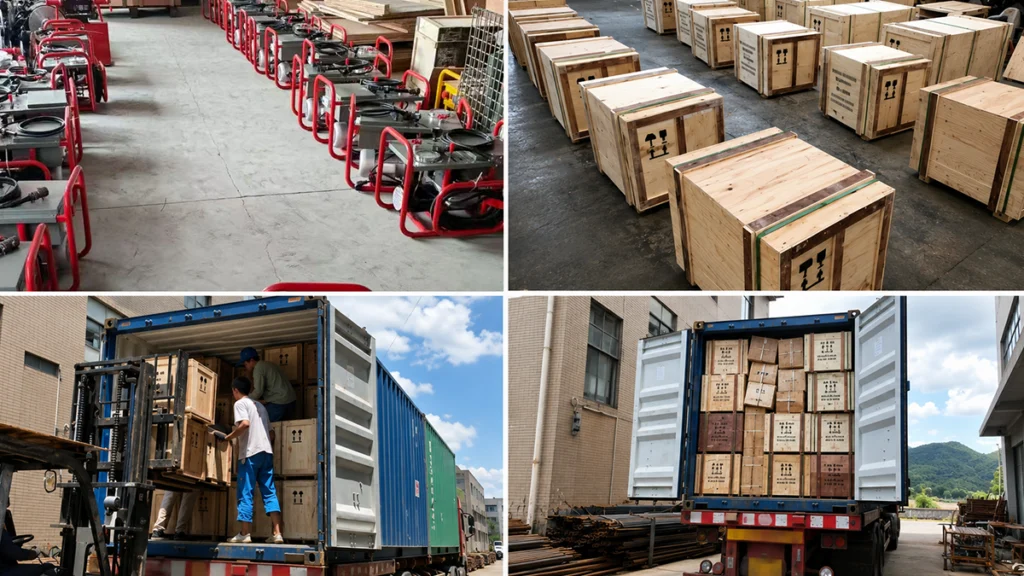
Usually, the standard Minimum Order Quantity (MOQ) for industrial pipe fusion gear is just one set. Smart B2B buyers, though, negotiate consumable spare parts right into the initial deal—think extra PTFE plates, carbon steel milling blades, and backup hydraulic seals. Don’t forget that proper export packaging (like fumigated wooden crates) and ocean freight logistics will heavily influence your final landed cost.
How buyers can request an accurate quotation
Vague requests get vague pricing. To get an accurate quote, hand your supplier exact technical requirements. Spell out the required pipe diameter range, the pipe’s SDR ratings, the core application (like municipal gas versus agricultural water), and your local voltage and frequency needs (such as 220V/50Hz). Providing these details ensures the supplier quotes a pipe fusion machine boasting the right hydraulic displacement and electrical setup.
Quality, Safety, and Certification Checks Before Buying
Machine frame strength and hydraulic system reliability
A flimsy frame will warp the second it tries to align a heavy 315mm pipe, leading straight to rejected welds. Always demand exact specs on the aluminum alloy grade used for the clamps. On the hydraulic side, insist on high-quality imported seals and flat-type quick connectors. These components stop hydraulic fluid leaks dead in their tracks and hold absolute pressure stability during the vital cooling phase.
Heating plate coating, temperature uniformity, and insulation
The heating plate is arguably the most vital piece of the puzzle. Check the aviation connectors closely to make sure they resist poor contact and electrical arcing. The PTFE coating must be flawlessly uniform and thick enough to survive brutal field conditions. Don’t hesitate to ask for thermal imaging data or calibration certificates that prove temperature uniformity across every inch of the 315mm plate.
Electrical safety, calibration, and documentation
Safety is paramount, especially in wet, muddy trench environments. Verify that the electric milling cutter features safety limit switches to stop it from accidentally firing up outside the chassis. Control panels should strictly mandate two-hand operation. Furthermore, the equipment needs real CE Certification for electrical safety, and your supplier should hand over factory calibration records that align perfectly with DVS or ISO standards.
Supplier support, warranty, spare parts, and after-sales service
Industrial equipment lives and dies by long-term support. Dig into the manufacturer’s track record for independent R&D and technical troubleshooting. A top-tier supplier hands over detailed operation manuals, offers a crystal-clear warranty (usually 12 to 18 months), and guarantees fast global shipping for critical spare parts like heating tubes and hydraulic valves to keep your project moving.
Common Buying Mistakes and Hidden Risks
Choosing only by lowest price
Procurement teams fall into the lowest-price trap constantly, buying unbranded or bottom-tier equipment. These budget butt fusion machines usually feature cheap cast aluminum that snaps under pressure and unreliable heating elements that die mid-weld. Any cash saved on capital expenditure vanishes the minute you have to excavate and fix a catastrophic pipeline leak caused by a faulty fusion joint.
Ignoring pipe SDR and working pressure requirements
Failing to align the butt fusion welding machine’s hydraulic capacity with the pipe’s SDR is a massive engineering blunder. Thick-walled, high-pressure pipes demand substantially more drag force and joining pressure than thin-walled drainage pipes. Hook up an underpowered hydraulic unit to high-SDR 315mm pipe, and you will end up with cold joints that instantly fail their hydrostatic pressure tests.
Overlooking spare parts and maintenance needs
Heating system issues—like burnt-out heating tubes or sliced sensor wires—are the top culprits behind field downtime. Purchasing from a supplier that lacks a deep, easily accessible spare parts inventory is a huge hidden risk. Contractors need to view consumable parts as a core piece of the initial capital investment, not an afterthought.
Buying without checking real project suitability
Buying a stationary workshop butt fusion machine for a rugged cross-country pipeline, or a manual butt fusion machine for a strict municipal gas contract, is a guaranteed way to delay your project. Buyers have to audit their exact field realities before pulling the trigger. Measure your trench widths, confirm your generator capacity, and review your regulatory reporting requirements before finalizing a butt fusion welding machine configuration.
Final Buying Tips for B2B Buyers
Recommended checklist before contacting a supplier
Before picking up the phone to start procurement, run through this internal engineering checklist:
1. Pinpoint the exact pipe material (HDPE, PP, PVDF).
2. Lock down the full diameter range (e.g., 160mm to 315mm).
3. Verify the maximum SDR (wall thickness) demands.
4. Evaluate the job site environment (trench vs. surface work, available power).
5. Double-check the project owner’s quality reporting mandates (CNC vs. manual logging).
Information to prepare for a faster quote
Want a faster quotation? Hand the supplier a highly structured RFQ (Request for Quote). Bundle your technical checklist, mandatory safety certifications (CE, ISO), ideal delivery timeline, and final destination port. Make sure you explicitly ask them to itemize the quote so you can see the exact cost breakdown for the main unit, recommended spare parts, and export packaging.
When to request technical support before ordering
If your upcoming project features non-standard pipe materials, brutal ambient temperatures (which heavily skew cooling times), or strict municipal data-logging requirements, ask for technical support right away. Demand technical documentation on their PLC closed-loop systems, and make sure they can actually provide remote engineering support during your first deployment in the field.
FAQ
Q1: What pipe sizes can a 315mm HDPE pipe welding machine usually weld?
With the correct reducing inserts, a standard 315mm HDPE pipe welding machine can usually weld pipe sizes from 90mm up to 315mm. Common working sizes include 90mm, 110mm, 160mm, 200mm, 250mm, and 315mm. Buyers should confirm the machine’s rated welding range, insert sizes, pipe SDR, and clamping structure before ordering.
Q2: Is a hydraulic 315mm HDPE pipe welding machine better than a manual model?
For 315mm HDPE pipe welding, a hydraulic butt fusion machine is usually more suitable than a manual model. Hydraulic machines provide more stable and measurable fusion pressure, which helps improve welding consistency for medium-diameter pipes, thicker pipe walls, and pressure pipeline projects. Manual machines may still be suitable for smaller pipe sizes, simple field work, or low-volume jobs.
Q3: What specifications should I check before buying a 315mm HDPE pipe fusion machine?
Before buying a 315mm HDPE pipe fusion machine, check the welding range, compatible SDR, heating plate temperature range, temperature control accuracy, facer motor power, hydraulic pressure capacity, total power requirement, voltage, and included reducing inserts. Buyers should also confirm the machine frame quality, operation manual, spare parts list, transport dimensions, and after-sales technical support.
Q4: How much does a 315mm HDPE pipe welding machine cost?
The cost of a 315mm HDPE pipe welding machine depends on the machine type, hydraulic system, automation level, component quality, voltage configuration, accessories, and spare parts package. Manual models are usually more economical, while hydraulic models provide better pressure control and are more suitable for professional pipeline projects. CNC or data-logging models cost more because they offer digital control and welding record functions.
Q5: Can one 315mm machine be used for both water and gas pipeline projects?
Yes, a 315mm HDPE pipe welding machine can be used for both water and gas pipeline projects if it meets the required welding range, pressure control, calibration, and project standard requirements. However, gas pipeline projects usually have stricter requirements for operator training, welding parameters, inspection, and welding records. For gas applications, buyers should confirm whether data logging, calibration documents, and project-required procedures are needed.
Q6: What accessories are normally included with a 315mm butt fusion welding machine?
A standard 315mm butt fusion welding machine package usually includes the main machine frame with clamps, a hydraulic control unit, a PTFE-coated heating plate, an electric facer, and a storage stand or support bracket for the heating plate and facer. Reducing inserts for smaller pipe sizes are also commonly supplied or selected according to the buyer’s required welding range.
Q7: How do I know if an HDPE pipe fusion joint is qualified?
A qualified HDPE pipe fusion joint should have a clean, continuous, and uniform double rollback bead around the pipe. The bead should not show obvious cracks, pores, gaps, severe misalignment, or irregular deformation. For pressure pipeline projects, joint quality should also be checked according to the selected welding procedure, project standard, visual inspection requirements, and pressure test requirements.
Q8: What information should I provide to get an accurate supplier quotation?
To get an accurate quotation, buyers should provide the required pipe size range, pipe material, SDR, voltage and frequency, machine type, project application, and required accessories. If CNC control, data logging, spare parts, or special packaging is needed, this should also be mentioned. Providing the destination port and order quantity helps the supplier estimate packaging, freight, and total landed cost more accurately.
Conclusion
Choosing the right 315mm HDPE pipe welding machine requires more than comparing the initial machine price. Buyers should consider the welding range, hydraulic pressure stability, clamp structure, heating plate temperature control, reducing inserts, voltage requirement, spare parts, and after-sales support.
For projects involving 160mm to 315mm HDPE pipes, a hydraulic butt fusion machine is usually a practical choice because it provides more stable and measurable fusion pressure than a manual model. If the project requires welding records, quality traceability, or stricter site management, a CNC or data-logging model may be more suitable.
Before ordering, buyers should confirm the pipe diameter, SDR, material grade, jobsite power supply, project standard, and required accessories. Working with a reliable supplier can help contractors select the right machine model, prepare essential spare parts, and improve the consistency of HDPE pipe fusion joints.
Let our experts help you choose the right equipment for your project
Contact Our Engineering Team