
Table of Contents
HDPE Pipe Welding Machine in Cameroon buyers can use this guide to compare machine types, specifications, applications, costs, and supplier factors for water, drainage, irrigation, and utility projects.
What Is an HDPE Pipe Welding Machine and Why Is It Used in Cameroon?
An HDPE Pipe Welding Machine in Cameroon serves as purpose-built industrial equipment designed to permanently fuse high-density polyethylene (HDPE) pipes. The process relies on a strict combination of heat, pressure, and cooling time. By melting the pipe ends and driving them together under precise hydraulic or mechanical force, the butt fusion machine forms a single, monolithic pipeline. Pipeline contractors, municipal engineers, and utility crews depend heavily on this gear for civil infrastructure, farming, and industrial builds across the region.
How HDPE pipe welding creates leak-resistant pipe joints
Thermofusion takes advantage of polyethylene’s unique molecular properties. Heat the pipe ends to a strict target—usually between 210°C and 230°C—and the rigid polymer chains transform into a molten state. The moment you remove the heating plate and press those ends together under controlled pressure, the polymer chains interlock. Let it cool, and the finished joint actually matches or exceeds the tensile strength of the original pipe. You don’t need mechanical couplings. You don’t need gaskets or chemical adhesives. The result is a continuous pipeline fundamentally immune to root intrusion and joint leaks.
Why HDPE pipes are common in water and utility projects
Modern infrastructure relies on HDPE pipe, particularly PE100 grade, for a few core reasons: high flexibility, massive impact resistance, and total immunity to galvanic corrosion. Steel and ductile iron eventually scale, rust, or degrade in aggressive soils or acidic water. HDPE ignores all of that. Its inherent flexibility lets the pipeline follow natural terrain contours and absorb ground shifts. That makes it incredibly reliable for subterranean water networks, gas distribution lines, and underground utility conduits.
Where HDPE pipe welding machines are used in Cameroon
Cameroon’s ongoing infrastructure expansion runs on robust pipeline networks. Right now, contractors are deploying HDPE pipe welding equipment to upgrade municipal water supplies in major hubs like Yaoundé and Douala. You’ll also find these butt fusion welding machines building rural borehole distribution networks and massive agricultural irrigation systems. Beyond water, the mining sector uses them to lay slurry transport lines. Telecommunications crews use them for fiber-optic ducting, and industrial zones rely on them to manage chemical and wastewater flows safely.
Manual butt fusion machines for small and medium pipe sizes
Manual butt fusion machines offer a highly practical solution for low-pressure applications and smaller pipe diameters, typically falling between DN40 and DN250. Instead of bulky hydraulic pumps, these units use a simple mechanical lever or hand-wheel to generate joining pressure. They weigh very little. You can carry them easily, and they don’t require heavy field generators. That makes them perfect for tight trenching, indoor plumbing jobs, and small-scale farm irrigation where precision hydraulic control just isn’t necessary.
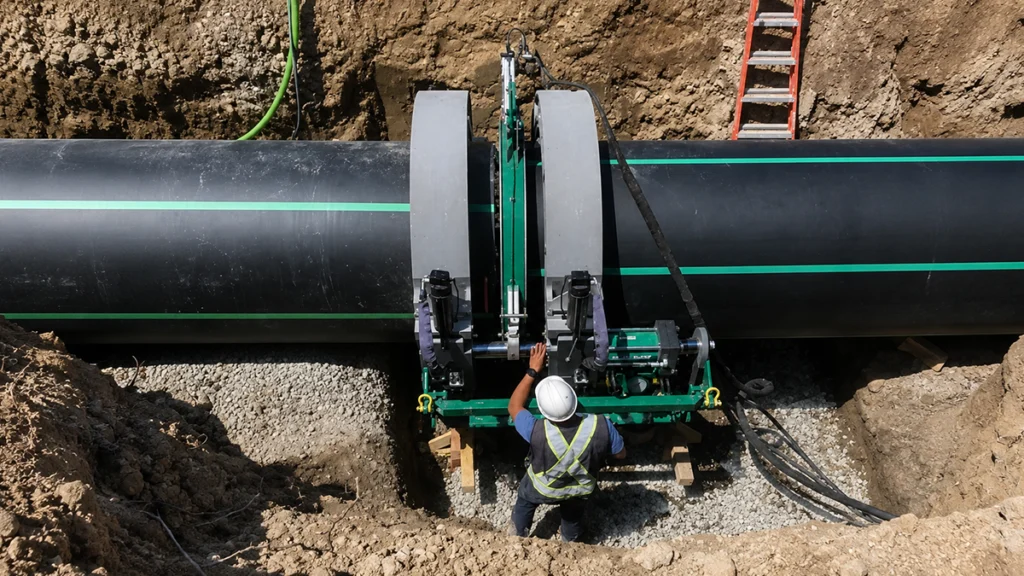
Main Types of HDPE Pipe Welding Machines for Project Contractors
Picking the right fusion technology comes down to pipe diameter, the required Standard Dimension Ratio (SDR), and the strictness of your project’s quality control standards. Here is a breakdown of the primary butt fusion machine types pipeline contractors use today.
| Machine Type | Best For | Pipe Size Range | Key Advantage |
|---|---|---|---|
| Manual Butt Fusion | Small plumbing, low-pressure irrigation | DN40 – DN250 | Highly portable, low cost, no hydraulic pump needed. |
| Hydraulic Butt Fusion | Municipal water, sewer, mining pipelines | DN63 – DN2250 | Consistent, measurable pressure; handles thick-walled pipes. |
| CNC Butt Fusion | Gas lines, highly regulated public utilities | DN63 – DN630 | Automated process, eliminates human error, logs weld data. |
| Electrofusion | Trench repairs, tight spaces, complex fittings | DN20 – DN1200 | Joins pipes in confined spaces without moving the pipe axis. |
Hydraulic butt fusion machines for municipal and utility projects
Medium to large-scale infrastructure projects treat hydraulic butt fusion machines as the gold standard. These units pack a hydraulic power pack capable of delivering precise, sustained pressure—often hitting 6 MPa or higher—throughout the heating and cooling phases. You absolutely need this measurable pressure to weld the thick-walled PE100 pipes used in high-pressure municipal water mains and deep sewer lines. The hydraulic system locks in a constant interfacial pressure, which stops cold welds and structural weaknesses in their tracks.
CNC or data-logging fusion machines for quality-controlled projects
When a project demands strict adherence to international standards like ISO 12176, contractors bring in CNC (Computer Numerical Control) fusion welding machines. These systems automate the entire welding cycle. The operator keys in the pipe diameter, material, and SDR. The butt fusion machine takes over, calculating and applying the exact temperature, drag pressure, soak time, and cooling duration. Better yet, CNC automatic butt fusion machines pack integrated data loggers. They spit out unalterable PDF reports for every single joint. For public utility and gas pipeline contracts, providing this data is usually mandatory for final project handover.
Electrofusion machines versus butt fusion machines
Butt fusion joins pipe ends directly. Electrofusion takes a different route, requiring a specialized fitting packed with embedded electrical resistance coils. The electrofusion welding machine fires a precise voltage into these coils, melting the inside of the fitting and the outside of the pipe at the same exact time. Because those specialized fittings cost more, electrofusion carries a higher price tag per joint. Even so, it remains absolutely vital for in-trench repairs, tie-ins, and any scenario where maneuvering a bulky butt fusion carriage is physically impossible.
Pipe clamping and alignment
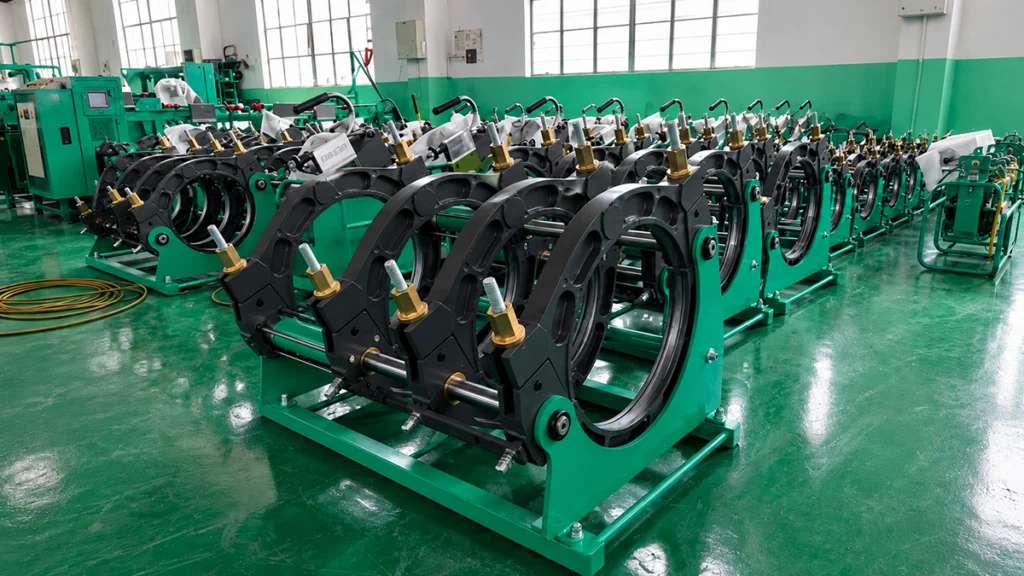
No matter what butt fusion welding machine you use, securing the pipe is always step one. The butt fusion machine’s carriage uses heavy-duty aluminum or steel clamps to lock the pipes perfectly on axis. Get the clamping right, and you prevent “high-low” misalignment—that frustrating scenario where pipe walls fail to meet flush. Misalignment shrinks the cross-sectional contact area of your weld. That concentrates stress and drastically drops the pipeline’s pressure rating. Premium butt fusion machines feature rugged clamping mechanisms strong enough to force out-of-round pipes back into perfect cylinders.
Factory-direct pricing with technical consultation included
Get Your Free QuoteHow an HDPE Butt Fusion Welding Machine Works
Butt fusion operates as a strict, sequential process. Rush a step or skip it entirely, and you destroy the molecular integrity of the joint.
Facing, heating, joining, and cooling stages
1. Facing: You insert an electric rotary planer (the facer) between the clamped pipes. It shaves the ends until they sit perfectly parallel, stripping away all oxidation and debris.
2. Heating: Pull the facer out and drop in a PTFE-coated heating plate. The pipes press against this plate until a specific bead of molten plastic forms. A low-pressure “soak” phase follows, driving heat deep into the pipe wall.
3. Joining: Extract the heating plate fast. Immediately push the molten pipe ends together under a calculated hydraulic pressure.
4. Cooling: Keep that joint under sustained pressure until the polymer matrix turns completely solid. Drop the pressure too early, and the joint will fail.
Which welding parameters affect joint quality?
Standards like DVS 2207 or ISO 21307 dictate the exact parameters required for joint integrity. Critical variables include the heater surface temperature (which must stay uniform across the plate), initial bead-up pressure, heat soak time, changeover time, joining pressure, and cooling time. Changeover time—the maximum seconds allowed to pull the heater and join the pipes—is especially unforgiving. Mess up any of these variables, like letting the molten ends cool during a slow changeover, and you guarantee a defective weld.
Why operator training matters for consistent fusion results
Top-tier hydraulic equipment still needs a skilled operator. Environmental factors heavily impact the weld. A stiff wind can strip heat from the plate in seconds, while blowing dust easily contaminates the molten polymer. Trained operators know exactly how to read a hydraulic gauge to offset “drag pressure”—the frictional drag of pulling a massive pipe through a dirt trench. Untrained operators misread visual cues like bead size and shape, paving the way for systematic pipeline blowouts.
Pipe diameter range and SDR compatibility
Every butt fusion machine carries a rating for a specific range of outside diameters (OD), like DN160 up to DN315. But diameter is only half the story. The butt fusion welding machine’s hydraulic capacity must also align with the pipe’s Standard Dimension Ratio (SDR). SDR measures the ratio of the pipe’s diameter against its wall thickness. A low SDR, such as SDR 9, indicates a very thick wall built for high-pressure use. Joining thick-walled pipes demands significantly more hydraulic force to hit the correct interfacial pressure.
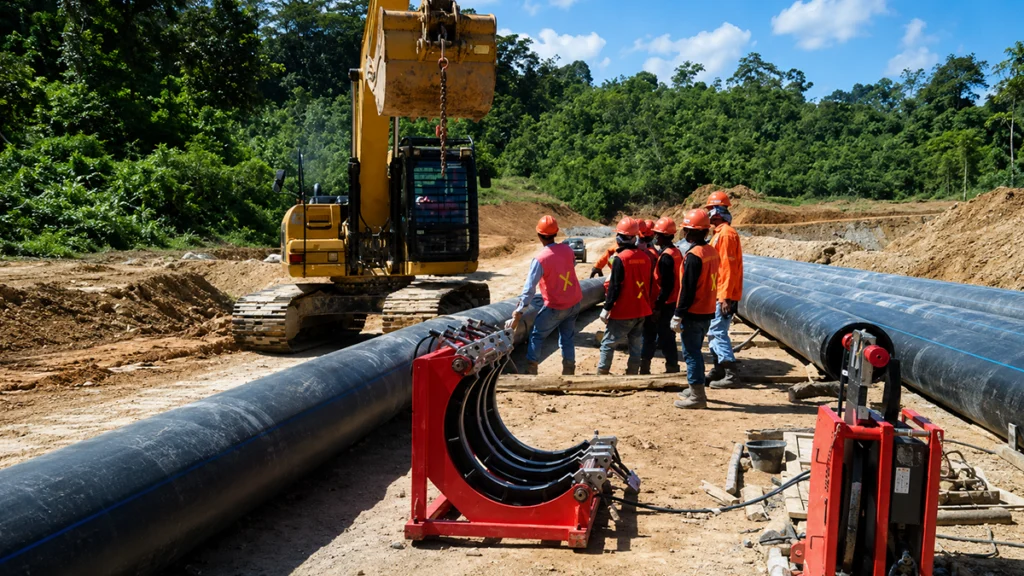
Key Specifications to Check Before Buying
Sourcing an HDPE Pipe Welding Machine in Cameroon demands rigorous technical evaluation. You have to match the butt fusion machine’s engineering specs directly to the harsh realities of your job site.
| Specification | Critical Parameter to Check | Impact on Project |
|---|---|---|
| Diameter Range | e.g., DN90 – DN315 | Determines versatility across different pipe sizes. |
| Max Hydraulic Pressure | e.g., 6.0 MPa | Higher pressure is required for thick-walled (low SDR) pipes. |
| Heating Plate Temp | 270°C Max (Adjustable) | Accurate PID control prevents polymer degradation. |
| Power Supply | 220V Single-phase or 380V Three-phase | Dictates the size of the diesel generator required on site. |
| Total Weight | e.g., 250 kg | Affects logistics, manual handling, and crane requirements. |
Heating plate temperature control and hydraulic pressure range
Your heating plate needs a premium, non-stick PTFE (Teflon) coating paired with an electronic PID temperature controller. This setup maintains a rock-solid surface temperature—usually hovering around 220°C—with a tight variance of just ±5°C. Unstable temperatures trigger uneven melting. On the mechanical side, the hydraulic unit must include a highly visible, calibrated pressure gauge alongside a reliable pressure-holding valve. If that hydraulic system bleeds pressure while the joint is cooling, structural compromise is inevitable.
Power supply, generator compatibility, and field portability
Stable grid electricity is a luxury rarely found on job sites in Cameroon. Portable diesel generators are mandatory. Before buying, calculate the total power consumption (in kW) of the heating plate, facer, and hydraulic pump combined. Your generator must deliver a continuous output at least 20% higher than the butt fusion machine’s peak demand to handle sudden motor startup surges. You also need to look at the carriage’s physical footprint and weight. Those numbers dictate whether your field crew can muscle it into position or if you need to hire heavy lifting gear.
Accessories, clamps, trimmers, inserts, and data recorders
Manufacturers build a standard HDPE pipe welding machine chassis to accommodate its maximum diameter (say, DN315). To weld smaller pipes like DN160 or DN250, the butt fusion machine relies on a set of aluminum reducing inserts, also known as liners. Always verify that your butt fusion welding machine ships with a full set of inserts covering your planned pipe sizes. Don’t ignore optional accessories, either. Stub-end device holders for welding flange adapters, electric hoists to manage heavy heating plates, and aftermarket data loggers will massively boost your crew’s daily efficiency.
Municipal water supply and rural water distribution
The end-use environment ultimately dictates which specifications matter most. Municipal water supply pipelines usually feature massive diameters (DN400+) and run at high pressures. That calls for heavy-duty hydraulic butt fusion machines equipped with data loggers to guarantee quality assurance. Rural water distribution projects flip the script. They rely on smaller pipes (DN63 to DN110) laid out in remote areas. In those scenarios, field portability and ultra-low generator power requirements become your defining purchasing factors.
Get detailed specs and custom configuration options
Request Technical SpecificationsBest Applications in Water, Drainage, Irrigation, and Utility Projects
Because HDPE pipe is remarkably versatile, civil engineering crews deploy fusion equipment across a massive spectrum of applications.
Drainage, sewer, and stormwater pipeline installation
Today’s drainage and sewer networks depend heavily on large-diameter corrugated or solid-wall HDPE pipes. Sewer lines flow via gravity, not high internal pressure, which makes the structural integrity of the joint critical to stopping ground subsidence and groundwater infiltration. Hydraulic butt fusion machines weld these massive pipes seamlessly. This completely eliminates the shifting and leaking that constantly plague old-school concrete bell-and-spigot joints.
Irrigation systems for farms and agricultural projects
Large-scale farming requires sprawling pipe networks to pull water from rivers or boreholes straight to the crop fields. These builds lean on medium-diameter pipes ranging from DN90 to DN250. Contractors on these jobs usually favor highly portable manual units or lightweight hydraulic butt fusion machines. You can toss them in the back of a pickup truck and haul them across rough, muddy agricultural terrain without breaking a sweat.
Utility ducts, mining support, and industrial pipeline work
The mining sector counts on HDPE pipelines to move highly abrasive slurries, acidic mine water, and high-pressure compressed air. Industrial chemical plants use them for aggressive fluid transport. Down in the cities, smaller diameter HDPE pipes act as armor for high-voltage cables and fiber-optic lines. These brutal environments demand flawless welds. To prevent catastrophic leaks, contractors turn to CNC automatic butt fusion machines or strictly monitored hydraulic fusion setups.
For one-time projects versus long-term contractor fleets
A local municipal department or a farm handling a single, clearly defined pipeline project should probably just buy a cost-effective, standard hydraulic butt fusion machine. Dedicated pipeline contractors play a different game. When building a long-term equipment fleet, they prioritize extreme durability, universal parts compatibility across all their butt fusion welding machines, and advanced features like data logging. Those high-end features are exactly what wins competitive public tenders.
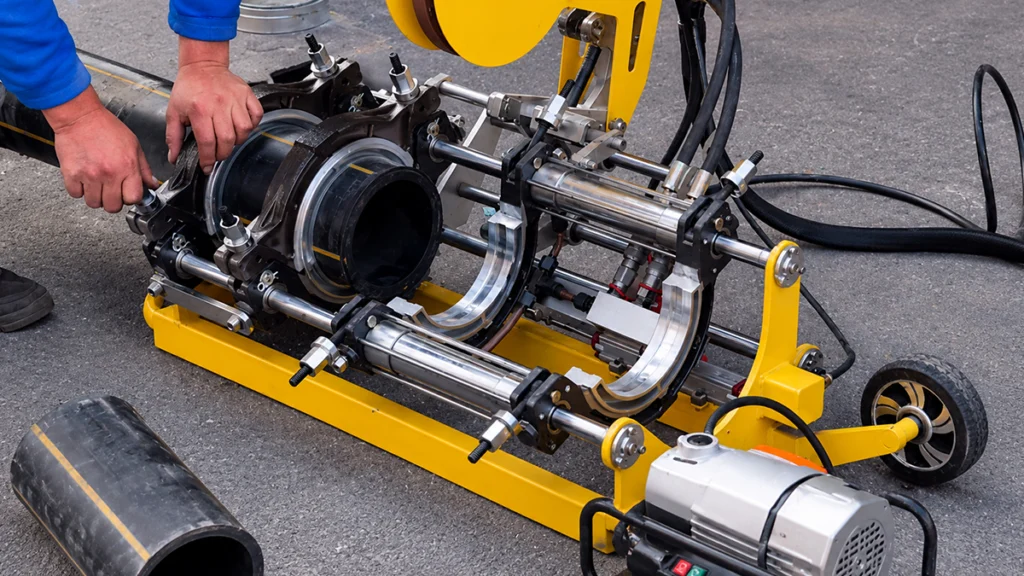
How to Choose the Right HDPE Pipe Welding Machine in Cameroon
Nailing down the perfect equipment means weighing what your current project demands against the contracts you want to win tomorrow.
For small pipe networks versus large-diameter pipelines
If your business strictly handles residential hookups, small boreholes, or fiber-optic ducts (DN20 to DN110), dropping cash on massive hydraulic equipment is a terrible waste of capital. Manual butt fusion welding machines or compact electrofusion units will serve you much better. Conversely, if you plan to bid on main municipal water transmission lines (DN315 to DN800), a heavy-duty hydraulic carriage featuring an integrated crane to lift the facer and heater is absolutely non-negotiable.
When should you choose hydraulic or CNC fusion equipment?
Stick with standard hydraulic equipment for general contracting, farm irrigation, and basic municipal water jobs where budget and ease of use matter most. Step up to CNC fusion equipment when the project owner—like a national utility company or a global mining firm—demands traceable, automated welding records. You also need CNC when laying high-pressure natural gas lines, where a simple human error could trigger a catastrophic safety failure.
Buying locally versus importing from an overseas supplier
Contractors constantly weigh the convenience of local procurement against the savings of direct importation. Buying locally gets the HDPE pipe jointing machine to your site immediately and simplifies warranty claims, but you will pay a steep markup. Importing directly from a proven international manufacturer slashes costs and opens up custom configuration options. The catch? You have to manage ocean shipping lead times and ensure the overseas supplier actually provides solid remote technical support and fast access to spare parts.
What affects HDPE pipe welding machine price in Cameroon?
The factory price of a butt fusion welding machine hinges on its maximum diameter capacity, the level of automation (manual, hydraulic, or CNC), and component quality—think German hydraulic seals versus cheap generic alternatives. But the factory price isn’t what you actually pay. Your total landed cost in Cameroon factors in ocean freight rates to Douala or Kribi, import tariffs, customs clearance fees, and the final inland transport to your job site.
Price Factors, MOQ, Lead Time, and Total Cost of Ownership
Smart procurement means looking way past the initial invoice. You need to calculate the Total Cost of Ownership (TCO) across the butt fusion machine’s entire working life.
Cost Breakdown Factors:
- Capital Expenditure (CapEx): Base HDPE pipe welding machine, insert sets, stub-end holders, and data loggers.
- Logistics: Ocean freight, insurance, port handling, and import tariffs.
- Operational Expenditure (OpEx): Diesel for generators, routine maintenance, and PTFE coating replacement.
- Risk Mitigation: Cost of spare parts inventory and potential downtime.
Machine size, automation level, and included accessories
A DN160 manual butt fusion machine barely registers as a capital expense, whereas a DN1200 CNC automatic butt fusion machine requires a massive asset investment. Always check if the quoted price actually includes the necessary reducing inserts. Some suppliers hook buyers with an incredibly low base price, only to gouge them on the inserts needed to weld smaller diameters, blowing up the final cost.
Shipping, customs, spare parts, and after-sales support
Expect lead times for imported HDPE pipe welding machinery to stretch anywhere from 30 to 60 days. To keep your TCO low, negotiate a heavy spare parts package upfront. Get extra heating elements, hydraulic seals, and facer blades packed right into the same wooden crate as the HDPE pipe jointing machine. Doing this saves you from the crippling cost and project delays of air-freighting a tiny replacement part to Cameroon right in the middle of a job.
How poor welding quality increases long-term project costs
Buying cheap, substandard equipment to save a few bucks on day one is a classic false economy. If your butt fusion machine fails to hold consistent hydraulic pressure or temperature, it builds weak joints. When that pipeline inevitably fails its hydrostatic pressure test, you pay a massive penalty. You have to pay a crew to dig up the trench, cut out the bad joint, buy fresh pipe, and weld the whole section all over again.
Common HDPE welding defects and their causes
- Cold Welds: Triggered by a low heating plate temperature or dragging out the changeover time.
- V-Notch/Misalignment: Caused by sloppy clamping or skipping the facing process.
- Excessive Melt/Slit: The result of cranking up the heating pressure too high or soaking the pipe too long, which destroys the polymer.
- Contamination: Happens when dust, moisture, or oil coats the pipe ends or the heating plate.
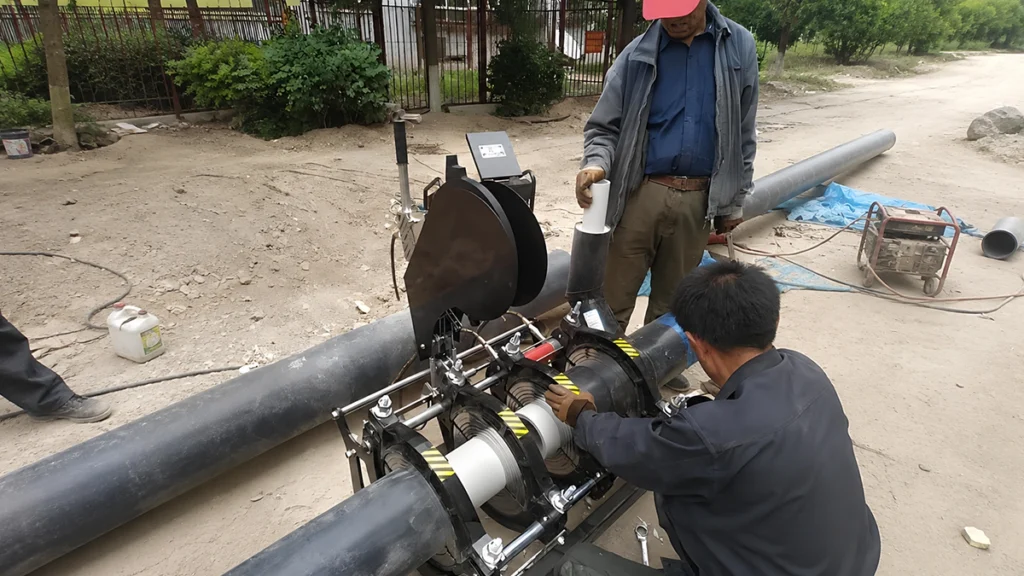
Quality Control and Welding Standards Buyers Should Consider
A pipeline’s long-term survival depends strictly on following international welding standards to the letter.
Why correct temperature, pressure, and cooling time matter
Standards like ISO 21307 treat thermofusion as an exact thermodynamic science. Run the temperature too low, and the polymer chains never mobilize enough to lock together. Crank the pressure too high during the joining phase, and you squeeze all the molten material right out of the fusion zone, leaving cold, un-melted plastic at the interface. Release the hydraulic pressure before the cooling timer hits zero, and you bake internal stresses into the joint that will crack the moment the pipe is pressurized.
Visual inspection and pressure testing after installation
Quality control starts with a hard look at the weld bead. A perfect bead rolls back smoothly against the pipe wall and maintains a uniform size around the entire circumference. Once the pipe is in the ground, the entire segment undergoes a hydrostatic pressure test. Crews fill the line with water and pump the pressure up to 1.5 times its standard operational rating. If the pressure holds, the joints are solid.
Using welding records for public and utility projects
Modern utility contracts don’t just ask for good welds; they demand documented proof. Data-logging butt fusion machines track the exact temperature, pressure, and time for every single joint, stamping the record with a GPS coordinate and an operator ID. Handing this data over to municipal authorities in Cameroon proves your crew followed engineering specs perfectly. It also shields the contractor from liability if the pipe eventually fails due to outside forces.
Questions to ask before requesting a quotation
Before you even reach out to a supplier, lock down your exact project parameters. Clear requirements ensure you receive a technical proposal that actually fits your job site.
Supplier Evaluation Checklist for Cameroon Buyers
Run potential suppliers of an HDPE Pipe Welding Machine in Cameroon through this exact checklist:
- [ ] Does the supplier provide a complete technical data sheet detailing power requirements and hydraulic parameters?
- [ ] Are the reducing inserts included in the quoted price, or sold separately?
- [ ] Does the heating plate use high-quality, durable PTFE coating?
- [ ] Can the supplier provide a recommended spare parts list for 2 years of operation?
- [ ] Is the operation manual available in English/French, and do they offer remote video training?
- [ ] What is the warranty period, and how are claims processed internationally?
Why spare parts and technical support are critical
Construction sites destroy equipment. Facer blades lose their edge, hydraulic hoses get crushed, and heating plate cables get sliced. You need a supplier who acts like a technical partner. They should offer fast troubleshooting over a video call and ensure that standard wear-and-tear parts are either packed in your initial shipment or ready to dispatch at a moment’s notice.
What documents should a reliable supplier provide?
A serious B2B supplier hands over a Proforma Invoice detailing clear incoterms (like CIF Douala), a precise packing list, CE or ISO manufacturing certificates, technical specification sheets, and a heavy-duty operation and maintenance manual. You need all of these documents just to get your butt fusion welding machine through customs without a headache.
How to compare two HDPE pipe welding machine offers
Never stack two offers side-by-side and just look at the final price. Compare the total weight of the butt fusion machines—heavier chassis usually mean thicker, tougher steel or aluminum. Check the brands behind the electrical and hydraulic components. See who includes valuable accessories like stub-end holders, and read the fine print on their warranty terms.
Choose capacity based on your largest planned pipe diameter
Say your current job calls for DN200 pipe, but you know you’ll be bidding on DN315 projects next year. Buy the DN315 butt fusion machine right now and use reducing inserts to handle the DN200 pipes. If you buy a HDPE pipe welding machine that maxes out at your current pipe size, you instantly bottleneck your future contracting potential.
Final Recommendation for Contractors and Project Buyers
Buying pipeline equipment isn’t just a purchase; it is a strategic move that dictates project margins and the lifespan of the infrastructure you build.
Prioritize stable welding quality over the lowest machine price
Think about the true cost of a catastrophic pipeline blowout. You pay for trench excavation, emergency labor, replacement materials, and a massive hit to your reputation. That total will easily dwarf whatever cash you saved by buying the cheapest butt fusion machine on the market. Put your money into equipment that guarantees rock-solid temperature control, aggressive hydraulic clamping, and dependable power management.
Request model matching before confirming the order
Stop guessing which butt fusion machine you need. Hand your supplier the exact pipe material grade (like PE100), your outside diameter range, the SDR/wall thickness, and the power limits of your job site. A top-tier manufacturer will process those inputs and point you directly to the specific hydraulic or CNC model built to handle your project flawlessly.
FAQ
Q1: What size HDPE pipe welding machine do I need for water supply projects?
The required butt fusion machine size depends on the pipe diameter, SDR, wall thickness, and project design. For municipal water supply pipelines, hydraulic butt fusion machines are commonly used for medium and large pipe sizes such as DN250 to DN800. For rural water distribution, irrigation, or secondary networks, smaller machines covering ranges such as DN63 to DN315 may be suitable. Buyers should confirm the maximum pipe outside diameter and SDR before selecting a machine.
Q2: How much does an HDPE pipe welding machine cost in Cameroon?
The cost of an HDPE pipe welding machine in Cameroon depends on the welding range, machine type, hydraulic system, automation level, voltage requirement, accessories, and spare parts package. Manual models are usually more economical, while hydraulic and CNC butt fusion machines cost more because they provide stronger pressure control and larger welding capacity. Buyers should also consider ocean freight to Douala or Kribi, import duties, local clearance costs, and spare parts support.
Q3: Is a hydraulic butt fusion machine better than a manual welding machine?
Hydraulic butt fusion machines are usually more suitable for medium and large-diameter HDPE pipe projects. They provide more stable and measurable fusion pressure, which helps improve welding consistency for thicker pipe walls and pressure pipeline applications. Manual welding machines may be suitable for smaller pipe sizes, simple field work, or low-volume jobs. The final choice should depend on pipe diameter, SDR, project standard, operator experience, and required welding quality.
Q4: Can one HDPE pipe welding machine handle different pipe diameters?
Yes. One HDPE pipe welding machine can usually weld different pipe sizes within its rated welding range. For example, a DN315 butt fusion machine can weld smaller pipes such as DN250, DN200, DN160, or DN90 when the correct reducing inserts are used. Buyers should check the machine’s minimum and maximum welding range, insert sizes, and clamping structure before ordering.
Q5: What power supply is required for HDPE pipe fusion equipment on site?
The required power supply depends on the machine model, heating plate power, facer motor, hydraulic unit, and local jobsite conditions. Smaller machines may use 220V single-phase power, while larger hydraulic butt fusion machines may require 380V three-phase power. On remote construction sites, a diesel generator is often needed. The generator capacity should be higher than the machine’s total power demand to support stable operation during heating, facing, and hydraulic movement.
Q6: How can contractors prevent HDPE pipe welding defects?
Contractors can reduce HDPE pipe welding defects by following the correct welding parameters for temperature, pressure, heating time, changeover time, and cooling time. Operators should keep the heating plate clean and free from contamination, protect the fusion zone from wind, rain, dust, and moisture, and face the pipe ends until they are flat and parallel. During joining and cooling, the required fusion pressure should be maintained according to the selected welding procedure.
Q7: What should I check before buying an HDPE pipe welding machine from a supplier?
Before buying an HDPE pipe welding machine, check the machine’s welding range, maximum pipe diameter, compatible SDR range, power supply, heating plate temperature control, hydraulic pressure capacity, and included reducing inserts. Buyers should also confirm the spare parts list, operation manual, warranty terms, after-sales support, and whether the supplier can provide technical guidance for butt fusion welding.
Q8: Do HDPE pipe welding machines require operator training?
Yes. Operator training is important for HDPE pipe welding quality. The machine provides heat, pressure, facing, and alignment support, but the operator still needs to understand pipe preparation, drag pressure, heating time, bead formation, changeover time, fusion pressure, and cooling requirements. Proper training helps reduce welding defects and improves the reliability of HDPE pipe joints.
Conclusion
Choosing the right HDPE pipe welding machine in Cameroon is important for water supply, drainage, irrigation, and utility pipeline projects. The right machine should match the pipe diameter, SDR, wall thickness, jobsite conditions, and required welding quality. For small pipe sizes and simple field work, manual butt fusion machines may be suitable. For larger pipe sizes, thicker walls, and pressure pipeline projects, hydraulic or CNC butt fusion machines can provide better pressure control and more consistent welding performance.
Buyers should look beyond the initial machine price and consider the total project cost. Power supply, reducing inserts, spare parts, operator training, technical documents, freight, and after-sales support all affect the final purchasing decision. A reliable supplier should help contractors choose the correct machine model, provide clear specifications, and support proper operation for stronger and more reliable HDPE pipe joints.
Let our experts help you choose the right equipment for your project
Contact Our Engineering Team