
315mm HDPE Pipe Welding Machine in South Africa: Buying Guide for Contractors
Table of Contents
HDPE Pipe Welding Machine in South Africa buyers can use this guide to compare 315mm machine types, specifications, price factors, supplier risks, and contractor buying criteria before requesting a quote.
What Is a 315mm HDPE Pipe Welding Machine?
A 315mm HDPE pipe welding machine acts as a heavy-duty industrial workhorse, specifically built to handle butt fusion welding on high-density polyethylene pipes reaching up to 315mm in diameter. If you manage pipeline construction or emergency repairs, this gear is indispensable. It delivers the exact mechanical force and precise thermal control you need to fuse pipes into a single, leak-proof line—completely eliminating the need for weak mechanical fittings or messy adhesives.
How butt fusion welding joins HDPE pipes
Butt fusion welding essentially melts thermoplastic pipes together. By heating the cleanly cut ends to a molten state, operators can press them together under strict mechanical pressure to form a permanent bond. The process kicks off by clamping the pipes tightly in the chassis. Next, a milling cutter faces the ends, ensuring they align perfectly parallel. You then insert a Teflon-coated heating plate. Once those pipe ends hit the sweet spot—typically a melting temperature of 210±10°C—you quickly pull the plate out. From there, the hydraulic system drives the molten faces together. The polymer chains physically entangle as they cool, producing a seamless joint that matches the structural integrity of the parent pipe itself.
What pipe sizes does a 315mm machine usually cover?
Don’t let the name fool you—a standard 315mm butt fusion machine handles far more than just a single pipe dimension. Manufacturers build these units with highly adaptable chassis systems and reducing clamp inserts to tackle a broad working range, usually spanning from DN160mm right up to DN315mm. Out of the box, the standard insert setup accommodates outer diameters (OD) of 160mm, 180mm, 200mm, 225mm, 250mm, 280mm, and 315mm. Because of this built-in flexibility, pipeline crews can rely on one piece of equipment to push through various phases of complex infrastructure builds.
Where contractors use 315mm HDPE welding machines
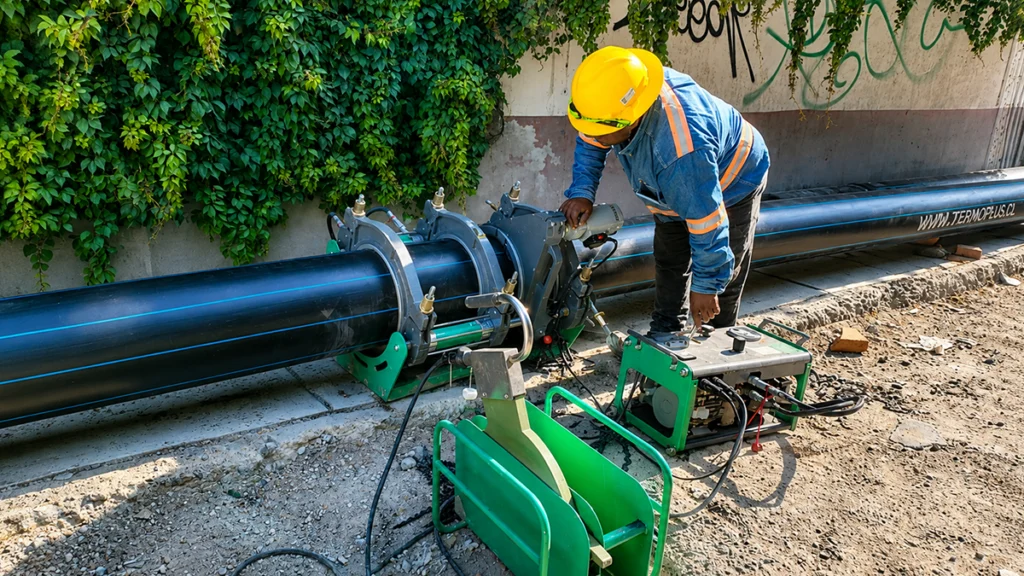
You will spot 315mm equipment working hard in trench operations, municipal water supply networks, massive agricultural irrigation grids, and heavy-duty industrial drainage systems. Field environments rarely offer much breathing room. To counter this, modern welders feature isolated clamping and operating platforms. This modular approach makes in-ditch work surprisingly straightforward. Crews simply lower the clamping carriage down into a tight trench, while the operator safely manages hydraulic pressure and temperature parameters from the surface.
Why 315mm HDPE Pipe Welding Machines Are Important in South Africa
The soaring demand for a reliable HDPE Pipe Welding Machine in South Africa stems directly from the nation’s aggressive push to expand water infrastructure, scale up mining operations, and upgrade gas distribution networks. The 315mm capacity happens to hit the absolute sweet spot for the dimensional requirements seen across most mid-tier infrastructure tenders.
Water supply and municipal pipeline projects
Within the municipal sector, 315mm stands as the go-to dimension for urban water transmission, bulk drainage setups, and secondary distribution grids. Municipalities don’t take chances; they demand strict compliance with SANS 10268 and ISO 21307 standards to combat non-revenue water loss. A quality 315mm welder delivers the exact hydraulic control required to ace the brutal pressure tests that South African civil engineering consultants enforce.
Mining, irrigation, and industrial pipeline applications
South Africa’s mining industry leans heavily on HDPE for slurry lines, harsh chemical transport, and deep-level dewatering. The material’s incredible resistance to abrasion and corrosion makes it a natural fit. Meanwhile, the agricultural sector banks on 315mm pipes to drive high-pressure irrigation mainlines. Operating in these unforgiving environments means a 315mm HDPE butt fusion welding machine for contractors has to perform flawlessly—shrugging off heavy dust, constant vibration, and brutal, non-stop usage cycles.
Why reliable fusion quality matters in remote job sites
Remote locations—think isolated mines in the Northern Cape or sprawling farms in arid zones—deal with wild swings in ambient temperature. If a joint is poorly fused, it will eventually fail, causing catastrophic leaks. Repairing a blown line out in the middle of nowhere costs exponentially more than getting the weld right the first time. When executed correctly, a butt fusion joint matches the exact pressure-bearing capacity of the parent pipe itself, guaranteeing zero maintenance over an expected 50-year design life.
Factory-direct pricing with technical consultation included
Get Your Free QuoteMain Types of HDPE Pipe Welding Machines for 315mm Pipes
Picking the right equipment architecture is a massive procurement decision. Currently, the market offers three core configurations. Each one targets specific budget constraints, operator experience levels, and stringent quality control demands.
Manual HDPE pipe welding machines
Manual butt fusion machine rely on hand-cranked or lever-operated mechanisms bolted to lightweight aluminum frames. Yes, they boast the lowest upfront price tag. However, they also introduce a much higher risk of pipe misalignment and spotty pressure application. Because they lack hydraulic force multiplication, these manual models only really belong in basic, non-critical setups or low-pressure gravity drainage systems where nobody is checking for strict DVS 2207 compliance.
Hydraulic HDPE butt fusion machines
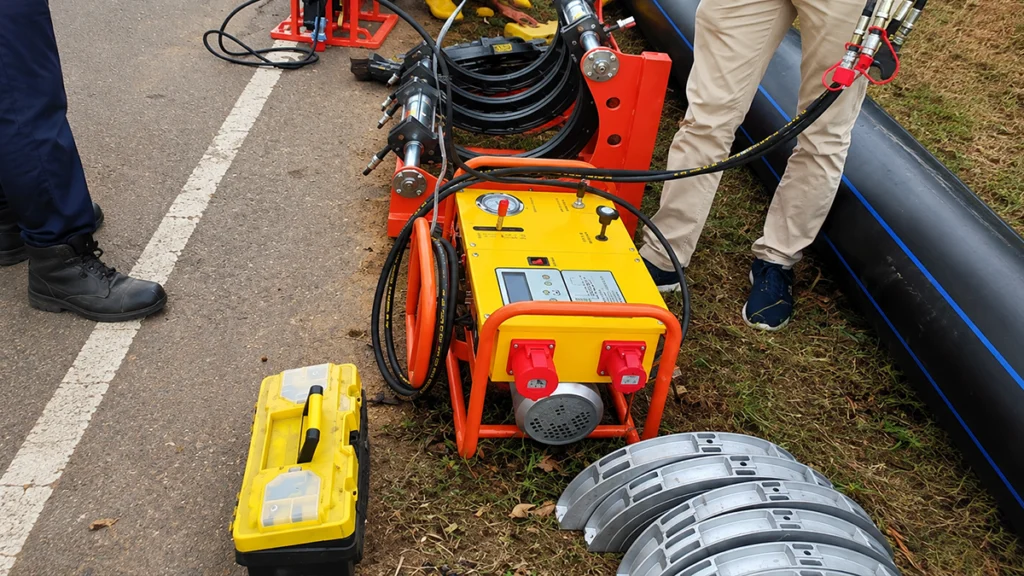
Hydraulic butt fusion machines serve as the undisputed gold standard for pipeline contractors. They break down into four main components: the hydraulic control box, a heavy-duty clamping carriage, the heating plate, and the milling cutter. The hydraulic station steps in to deliver consistent, highly measurable pressure throughout both the heat soak and critical cooling phases. This effectively removes human error from the force application equation. For most businesses, this setup delivers the perfect balance between capital expenditure and hardcore field reliability.
CNC or semi-automatic welding machines
CNC (Computer Numerical Control) or semi-automatic units take things to the next level by wiring intelligent data control instruments straight into the hydraulic station. These advanced automatic butt fusion machines calculate the exact pressure and time parameters you need based on the pipe diameter, SDR, and your chosen standard (like ISO or DVS). Better yet, they log every single data point during the weld. This creates a bulletproof paper trail, generating reports that prove every joint was executed perfectly within acceptable tolerances.
Which machine type is best for contractors?
| Machine Type | Best Application | Operator Skill Required | Capital Cost |
|---|---|---|---|
| Manual | Occasional, low-pressure gravity drainage | High (relies on operator feel) | Low |
| Hydraulic | Standard municipal, mining, and irrigation | Medium (requires parameter training) | Medium |
| CNC / Semi-Auto | High-spec gas lines, strict municipal tenders | Low (machine automates parameters) | High |
Hydraulic units easily remain the smartest choice for general pipeline contractors, combining rugged performance with exceptional ROI. On the other hand, CNC automatic butt fusion machines typically fall into the hands of specialized crews tackling highly regulated municipal or gas projects. In those arenas, digital weld data logging isn’t just a nice feature—it’s a strict tender requirement.
Key Specifications Contractors Should Check Before Buying
Before you put money down on a 315mm plastic pipe welding machine, you need to scrutinize a few technical specs. You want absolute certainty that the hardware can handle the brutal physical demands of thick-walled HDPE piping.
Pipe diameter range and clamp inserts
First off, the equipment must explicitly cover the 160mm to 315mm spectrum. You also need to verify that the carriage design locks in a butt joint deviation of ≤0.2mm or ≤0.3mm. Cheaply made clamping structures will actually flex when hit with high hydraulic pressure. That flex causes severe misalignment, guaranteeing an instant failure during visual weld inspections.
Heating plate temperature control
Pinpoint thermal management is completely non-negotiable. Look for a heating plate that offers a control range between 0-270°C and 0-300°C, backed by a tight temperature error margin of ≤±3°C across the full Teflon-coated surface. Since HDPE’s ideal welding temperature sits at 210±10°C, even a minor cold spot on that plate will disrupt the molecular fusion. The result? A blown joint down the line.
Hydraulic pressure range and welding force
A professional-grade 315mm hydraulic butt fusion machine needs a working pressure range of 0-6.3 MPa (roughly 0-80 Bar). You need this heavy pressure capacity for more than just shoving two pipes together. It is vital for maintaining the required drag force and interfacial pressure throughout the critical cooling phase—something that becomes especially difficult when wrangling heavy SDR 11 or SDR 9 pipes.
Power supply, generator compatibility, and job-site use
Let’s face it: field operations almost never have access to grid power. Typically, a 315mm welder runs on a 220V, 50Hz supply, pulling a total power draw somewhere between 3.7 KW and 5.85 KW (breaking down to roughly 2.0-3.0 KW for the heating plate, 1.0-1.5 KW for the cutter, and 0.75-1.1 KW for the hydraulic station). You must pair this setup with a highly stable 5-6 KVA generator. Wild voltage fluctuations will fry your temperature controller or wreck the hydraulic pump before the job is done.
Get detailed specs and custom configuration options
Request Technical SpecificationsHow to Choose the Right 315mm HDPE Pipe Welding Machine
Strategic procurement isn’t just about finding the best price. It requires carefully aligning the butt fusion machine’s capabilities with your actual site conditions, specific pipe specs, and the long-term goals of your contracting business.
What project volume justifies purchasing instead of renting?
Securing high-volume, long-term municipal or mining contracts makes it incredibly easy to justify capital expenditure over steep daily rental rates. If you are staring down a pipeline project that requires hundreds of joints over several months, those cumulative rental fees will blow right past the cost of buying a brand-new hydraulic machine. Plus, owning the gear outright eliminates the headache of project delays when rental yards run out of stock.
How pipe SDR and wall thickness affect machine choice
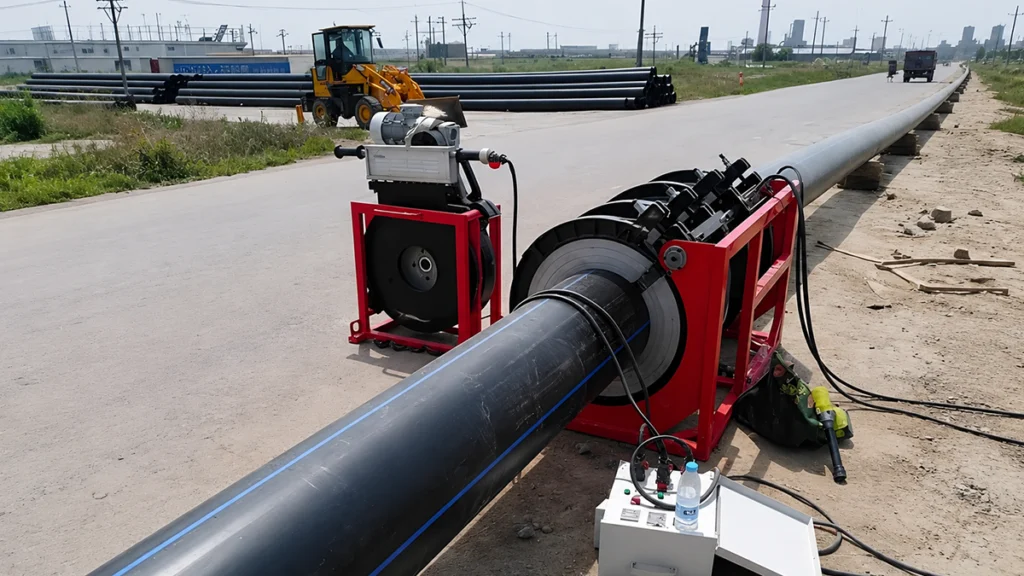
The Standard Dimension Ratio (SDR) and the pipe’s wall thickness dictate exactly how much hydraulic pressure you need to overcome drag and sustain the proper interfacial pressure. Thicker walls—like those found on SDR 11 pipes—demand longer heat soak times and significantly extended cooling periods under pressure. A good rule of thumb is to allow one minute of cooling for every millimeter of wall thickness. You absolutely need a robust hydraulic system capable of holding that pressure rock-steady for 20 to 30 minutes without a single drop in force.
When portability matters more than automation
When you hit rugged South African terrain, lugging around massive CNC track butt fusion machines becomes wildly impractical. Out in mountainous zones, thick bush, or exceptionally deep trenches, portability easily trumps automation. Equipment featuring separate clamping carriages and independent hydraulic operating systems shines here. You can drop the heavy carriage right into the ditch with an excavator, leaving the operator up on solid ground to safely manage the fusion process.
How to match machine capacity with future projects
The 315mm butt fusion machine perfectly targets the “sweet spot” of mid-sized infrastructure work (160-315mm). That makes it arguably the most versatile asset for general contractors. If you map out future project pipelines, investing in a 315mm unit effectively covers more than 70% of standard municipal water distribution sizes. It saves you from having to purchase a fleet of smaller, specialized HDPE pipe jointing machines for varying contracts.
315mm HDPE Pipe Welding Machine Price Factors in South Africa
Making sense of the 315mm plastic pipe welding machine price South Africa demands looking far beyond the initial sticker price. Your total capital outlay will shift based on technology tiers, complex logistics, and the availability of long-term support structures.
Machine type and automation level
The biggest factor driving the cost is the level of automation. Basic manual welders come in at just a fraction of the price of a hydraulic unit. While standard hydraulic models deliver the best ROI for mainstream contractors, CNC automatic butt fusion machines command a massive premium. You are paying for their advanced sensor arrays, automated hydraulic valves, and sophisticated onboard computers.
Included accessories, facer, clamps, and data logger options
Quotes fluctuate wildly depending on what actually ships in the crate. Slapping a digital data logger onto a standard hydraulic butt fusion welding machine—often necessary to hit ISO 12176-4 compliance—spikes the upfront cost. However, municipal tenders frequently mandate it. Always double-check that the quoted price includes the full set of reducing inserts, a durable electric facer, and the Teflon-coated heating plate.
Shipping, import duties, training, and spare parts
Procurement managers also have to calculate international shipping, hefty South African import duties, and inland freight charges. More importantly, roughly 60% of surveyed buyers stress the absolute necessity of stable spare parts channels. Paying a slightly higher upfront cost for a butt fusion machine backed by comprehensive operator training and locally stocked consumables always yields a better ROI than rolling the dice on a cheap, unsupported import.
Why the lowest quote may not be the lowest total cost
Jumping at the lowest quote usually leaves you stranded with unstable hydraulic pumps or cheap heating elements. Budget butt fusion machines notoriously lack hydraulic stability. They suffer pressure drops during the cooling phase, which ultimately leads to disastrous failures during hydrostatic pressure testing. True total cost of ownership factors in ongoing maintenance, replacement parts, and the brutal financial penalties tied to pipeline rework and site downtime. As a benchmark, a standard 315mm hydraulic butt fusion machine in South Africa generally retails around R61,995 Excl VAT for reliable, contractor-grade equipment.
Supplier Evaluation: What South African Buyers Should Ask
Choosing an HDPE pipe fusion machine supplier South Africa carries just as much weight as picking the equipment itself. Procurement teams have to vet these suppliers ruthlessly to guarantee solid post-sale reliability.
Does the supplier provide technical specifications and certificates?
Never issue a purchase order without demanding comprehensive technical documentation first. You must verify that the gear holds CE certifications and can reliably weld to ISO 21307 and DVS 2207 standards. If you show up on site without those certificates in hand, consulting engineers will likely ban the equipment from the project.
What warranty and spare parts support are available?
Across the industry, the baseline expectation is a solid 1-year warranty covering the main chassis and hydraulic components, backed by lifetime maintenance support. Your supplier needs to guarantee free replacements for any non-human-induced damage during that warranty window. Furthermore, they must keep an active, local inventory of high-wear components like Teflon plates, facer blades, and hydraulic seals.
Can the supplier support training and welding procedure guidance?
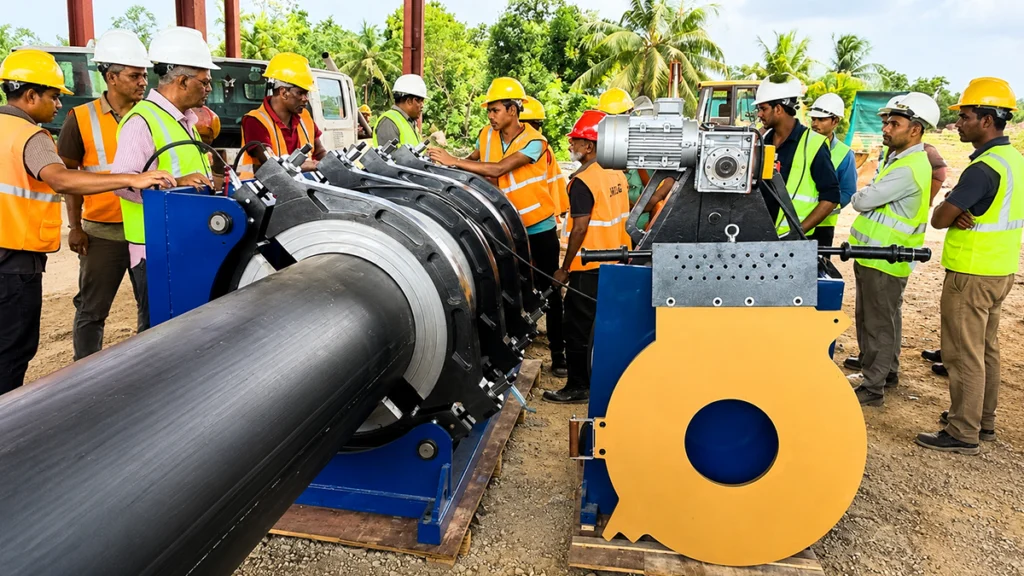
Put the best butt fusion machine in the world into untrained hands, and you will still get blown joints. Roughly 75% of construction crews need comprehensive operation manuals and detailed video tutorials the moment they unbox the equipment. A reputable supplier should hand over Level 2 maintenance record forms, crystal-clear operating instructions, and precise parameter charts calibrated specifically to that HDPE pipe jointing machine’s unique cylinder area.
How to compare local stock versus imported delivery
When pricing out an HDPE Pipe Welding Machine in South Africa, you have to balance the immediate availability of local stock against the tempting cost savings of a direct factory import. Local suppliers bring a lot to the table: expedited shipping, on-site troubleshooting, and access to backup equipment if things go sideways. Having that safety net heavily mitigates the risk of catastrophic project delays.
Common Welding Quality Risks and How to Avoid Them
The integrity of your pipeline hinges entirely on strict adherence to fusion parameters. The second a crew deviates from standard operating procedures, severe quality risks enter the picture.
Incorrect heating temperature or soak time
Temperature control is incredibly sensitive. If you overheat the pipe ends, the material degrades, leaving you with a brittle joint. Underheat them, and you create a “cold weld” where the molecules never fully entangle. Operators have to stay sharp and adjust their parameters when ambient temperatures plunge below 10°C or spike above 35°C, all while keeping that heating plate dialed strictly to 210±10°C.
Poor pipe alignment and contaminated pipe ends
Letting misalignment exceed 0.3mm will drastically compromise the joint’s ability to hold pressure. On top of that, surface contamination—whether it is dust, mud, or a little moisture—will completely sabotage the molecular bond. Crews must thoroughly clean the pipe ends with the right solvents before facing them. When they run the facing tool, it needs to peel off continuous, unbroken shavings to prove the alignment is dead-on.
Insufficient cooling time before handling
Popping the hydraulic pressure off prematurely ranks as a top cause of joint failure. The core temperature of that weld has to drop below 70°C before anyone touches the clamping pressure. If you release it too early, you literally shatter the newly formed molecular entanglement. This creates hidden voids inside the weld that are guaranteed to fail the moment you run a hydrostatic pressure test.
Why operator training reduces leakage and rework
Mixing up your welding standards is a fast track to disaster. For instance, trying to apply ASTM pressure coefficients on an ISO-calibrated butt fusion welding machine will generate completely wrong interfacial pressure calculations, guaranteeing a failed joint. Proper operator training ensures that your crews actually know how to read parameter charts, accurately calculate drag pressure, and stick to the precise timelines needed for flawless fusion.
Buying Checklist for Contractors Before Placing an Order
To keep procurement smooth and dodge expensive specification mistakes, contractors should always run through a structured checklist before finalizing any equipment orders.
Confirm pipe size range and project application
First, check that the quotation clearly states the HDPE pipe welding machine’s full capacity and includes every necessary clamp insert from 160mm up to 315mm. You also need to confirm that the carriage design makes sense for your specific project application—whether that means tight in-ditch trench work or open surface pre-fabrication.
Request a complete accessory and spare parts list
A working HDPE pipe jointing machine relies on multiple integrated components. Demand a detailed breakdown to confirm the crate includes the milling cutter, the Teflon-coated heating plate, heavy-duty hydraulic hoses, quick-connect fittings, and a basic tool kit. It is also highly recommended to buy spare facer blades and a backup heating plate right on the same invoice.
Check documentation, manuals, and service support
Don’t wait until delivery to ask for operational documentation; demand it upfront. Make sure you receive Level 2 maintenance schedules, clear operating instructions in English, and the pressure/time parameter charts calculated specifically for your butt fusion machine’s unique hydraulic cylinder area. Finally, clarify exactly how the supplier handles technical support and emergency troubleshooting.
Compare total ownership cost, not only machine price
Always look at the complete financial picture. You have to factor in the cost of a reliable 5-6 KVA generator, routine hydraulic oil changes, guide pillar lubrication, and the massive financial risk of site downtime if spare parts get delayed. Stomaching a slightly higher initial investment for a truly robust plastic pipe welding machine will drastically lower your total cost of ownership over the long haul.
Final Recommendation for Buying a 315mm HDPE Pipe Welding Machine
Nailing down the right equipment choice depends entirely on how often you take on pipeline projects, your quality control requirements, and the harshness of your operational environment.
Best option for occasional pipeline work
If your crew only handles infrequent, low-pressure pipeline installations, a basic 220V manual or entry-level hydraulic butt fusion machine makes good financial sense. These simpler units handle standard SDR ratings just fine, provided they are run by experienced operators who know how to manually manage alignment and track cooling times.
Best option for regular contractor projects
Mainstream civil, mining, and irrigation contractors should look straight at a robust 220V, ~4-6KW hydraulic butt fusion machine. Outfitted with a shock-resistant pressure gauge, a dual-channel timer, and a heavy-duty carriage, this setup delivers the rugged reliability and strict DVS/ISO compliance you need for relentless, heavy-duty site work.
Best option for high-volume or quality-sensitive projects
Bidding on strict municipal engineering tenders or high-pressure gas distribution networks changes the game. Here, contractors must step up to a semi-automatic or CNC hydraulic butt fusion machine. The built-in data logging offers indisputable digital proof of joint integrity. This is exactly what consulting engineers demand, ensuring full traceability and virtually eliminating the risk of rejected welds.
FAQ
Q1: What size pipes can a 315mm HDPE pipe welding machine weld?
A 315mm unit typically manages a working range from DN160mm up to DN315mm. By swapping out interchangeable reducing clamp inserts, the carriage securely grips and welds outer diameters of 160mm, 180mm, 200mm, 225mm, 250mm, 280mm, and 315mm. This makes it an incredibly versatile tool for mid-sized infrastructure jobs.
Q2: How much does a 315mm HDPE pipe welding machine cost in South Africa?
Pricing heavily depends on the build quality and automation level. A dependable, standard hydraulic butt fusion machine generally retails for about R61,995 (Excl VAT). If you need high-end CNC models or units with advanced data loggers, expect to pay a premium, whereas basic manual machines will cost significantly less.
Q3: Is a manual or hydraulic HDPE welding machine better for contractors?
Professional contractors should always lean toward hydraulic machines. Hydraulic systems deliver the consistent, measurable pressure required to meet DVS and ISO standards, guaranteeing leak-proof joints on thick-walled pipes. Manual units simply lack force multiplication and pressure stability, restricting them to non-critical, low-pressure gravity drainage work.
Q4: Can a 315mm HDPE butt fusion machine be used on mining and water pipeline projects?
Absolutely. A 315mm machine serves as the standard workhorse across these sectors. Assuming it has a robust hydraulic system, it easily handles the heavy SDR 11 and SDR 9 pipes required for high-pressure municipal water lines, agricultural irrigation, and brutal mining applications like slurry transport and dewatering.
Q5: What power supply is needed for a 315mm HDPE pipe welding machine?
You will need a stable 220V, 50Hz single-phase power supply. Between the heating plate, milling cutter, and hydraulic station, the total power draw runs from 3.7 KW to 5.85 KW. When working remotely, contractors must hook the machine up to a reliable 5 to 6 KVA generator to avoid damaging voltage drops.
Q6: Should contractors rent or buy an HDPE pipe welding machine?
Buying makes the most sense if you have high-volume, long-term municipal or mining contracts, because daily rental fees will quickly eclipse the purchase price. Ownership guarantees the equipment is available when you need it, improving your ROI. Renting only really makes sense for isolated, short-term emergency repairs where buying isn’t justified.
Q7: What accessories should be included with a 315mm HDPE pipe welding machine?
A comprehensive package should feature the main hydraulic operating platform, the clamping carriage, a full set of reducing inserts (from 160mm to 280mm), an electric milling cutter, a Teflon-coated heating plate, high-pressure hydraulic hoses with quick-connects, and a basic maintenance tool kit.
Q8: How can contractors check the quality of an HDPE pipe fusion weld?
Quality control starts with a visual inspection of the fusion bead. It should form a uniform, double-roll shape entirely around the pipe with no deep V-notches. After that, the line must pass a mandatory hydrostatic pressure test. Advanced CNC units also supply digital data logs to prove that exact temperature and pressure parameters were held during the weld.
Conclusion
Procuring the best HDPE Pipe Welding Machine in South Africa means looking past the initial price tag and focusing heavily on long-term operational reliability. A 315mm hydraulic butt fusion machine stands out as a highly versatile, critical asset for mid-tier infrastructure. It effortlessly bridges the gap between municipal water networks, high-pressure agricultural irrigation, and punishing mining applications. Ultimately, success in pipeline construction boils down to strict adherence to ISO 21307 and DVS 2207 standards. These protocols demand precise temperature control (holding steady at 210±10°C), stable hydraulic pressure (reaching up to 6.3 MPa), and highly disciplined cooling times dictated by the pipe’s wall thickness.
Evaluating your equipment goes hand-in-hand with evaluating the supplier standing behind it. Contractors need to prioritize machines that deliver rock-solid hydraulic stability to prevent dangerous pressure drops during the cooling phase. Furthermore, you need a supplier that provides accessible local spare parts, deep technical documentation, and solid operator training. By carefully matching the machine’s automation level—whether you choose a standard hydraulic setup or a data-logging CNC unit—to your specific project specs and SDR requirements, your procurement team can virtually eliminate the risk of joint failure. This proactive approach avoids disastrous rework costs and secures maximum return on investment for decades of pipeline installations.
Let our experts help you choose the right equipment for your project
Contact Our Engineering Team