
HDPE Pipe Jointing Machine for Water Supply Pipeline Installation
Table of Contents
HDPE Pipe Jointing Machine for Water Supply Pipeline Installation explains machine types, fusion workflow, key specifications, and buying criteria so contractors can choose the right solution and reduce leak risk.
What Is an HDPE Pipe Jointing Machine for Water Supply Pipeline Installation?
An HDPE Pipe Jointing Machine for Water Supply is specialized industrial equipment built to permanently fuse high-density polyethylene (HDPE) pipes through controlled thermal heating. Instead of relying on mechanical fittings that inevitably degrade and leak over time, these robust machines forge a monolithic, seamless pipeline infrastructure. When done correctly, the resulting network is engineered to last anywhere from 50 to 100 years.
How does it differ from a standard HDPE pipe jointing machine for water supply?
Standard metal welding equipment uses electrical arcs and consumable filler materials to bridge the physical gaps between pipes. An HDPE pipe jointing machine for water supply takes a completely different approach: heat fusion. The equipment applies highly precise thermal energy directly to the pipe surfaces, bringing the plastic polymer chains to a molten state. Once the material hits that optimal temperature, the butt fusion machine drives the pipe ends together using heavy hydraulic or mechanical pressure. The polymer chains interlock and cool into a single, continuous piece of plastic—no foreign filler required.
Which jointing methods are most common?
Pipeline contractors generally rely on two standardized techniques for HDPE fusion. Hot Plate Fusion, universally recognized as butt fusion, uses a flat, heated plate to melt the pipe ends before pressing them together under immense hydraulic force. Electrofusion serves as the second primary method. This technique uses specialized plastic fittings containing embedded electrical resistance coils. When the HDPE pipe welding machine applies an electrical current, the coils heat up, melting both the internal surface of the fitting and the external surface of the pipe simultaneously.
When is it used in a HDPE pipe jointing machine for water supply project?
Contractors deploy this equipment heavily across urban water supply networks, municipal drainage systems, and complex industrial fluid transport setups. Pipeline engineers mandate heat pipe fusion machines for one simple reason: they create joints with 100% leak-proof sealing capabilities. The finished weld actually possesses equal or even greater tensile strength than the native pipe itself. For high-pressure potable water distribution where a blowout is not an option, fusion is the only logical choice.
Why Joint Quality Matters in Water Supply Pipelines
How do weak joints cause failures?
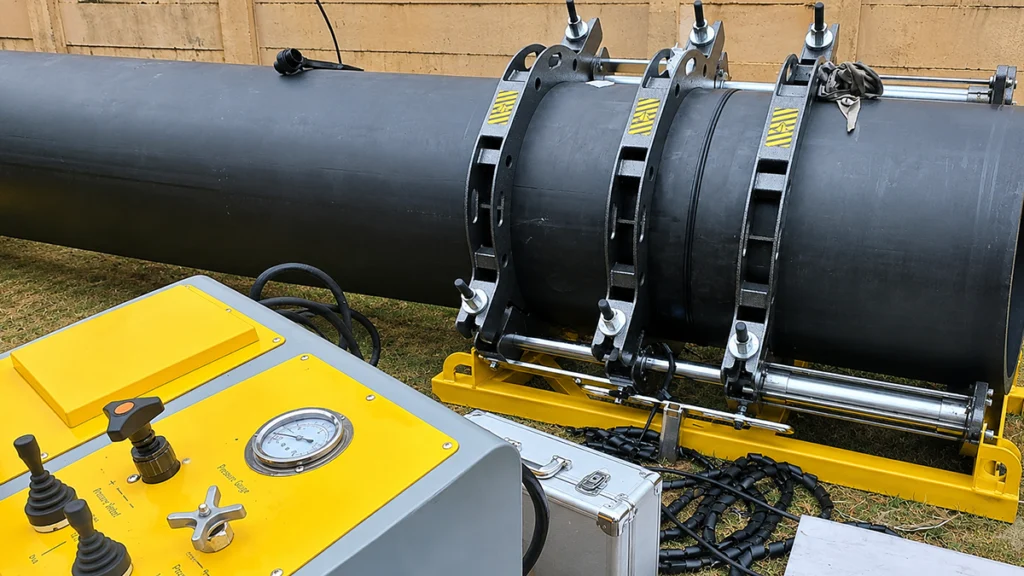
Weak joints in any water supply network almost always trace back to poor temperature or pressure control during the actual fusion cycle. Push the heating plate temperature past the specified threshold, and the plastic oxidizes, suffering severe material degradation. Drop the temperature too low, and the polymer molecules simply refuse to integrate. On top of that, if the plastic pipe welding machine fails to apply enough interfacial pressure during the joining phase, microscopic voids form at the weld seam. Under constant hydrostatic stress, those tiny voids eventually propagate into massive structural cracks.
Why is HDPE suitable for potable water?
High-density polyethylene stands as the undisputed global standard for potable water transport thanks to its rugged physical durability and complete resistance to corrosion. Steel and ductile iron scale, rust, and provide a breeding ground for biological growth. HDPE does none of these things. When fused with a high-quality HDPE pipe jointing machine, the material creates seamless joints that lock out groundwater infiltration and completely eliminate treated water exfiltration.
What project risks are linked to poor fusion?
Industry failure analyses paint a clear picture: roughly 39% of all HDPE pipe failures happen in 10-inch to 16-inch diameter pipes, with poorly executed butt fusion joints acting as the primary culprit. A single compromised joint on a major municipal trunk line triggers a domino effect of disaster. You are looking at massive water loss, sudden sinkholes, forced road closures, and potentially millions of dollars tied up in emergency excavation and liability claims.
Factory-direct pricing with technical consultation included
Get Your Free QuoteMain Types of HDPE Jointing Machines for Water Projects
Butt fusion machines for long-run pipelines
Think of butt fusion machines as the heavy-duty backbone of high-volume pipeline construction. These units physically clamp the pipe, precisely plane the ends, heat the surfaces, and drive them together under hydraulic pressure. Contractors prefer them for large-diameter PE pipes—ranging anywhere from 160mm up to a massive 3000mm—because they deliver maximum joint strength and unbeatable productivity across long, straight, unobstructed pipeline runs.
Electrofusion machines for tie-ins and repairs
Electrofusion welding machines are highly compact, electronically controlled power units designed to connect with pre-manufactured electrofusion fittings. Rather than dragging heavy pipe sections together under hydraulic force, the operator uses the machine to deliver a carefully calibrated electrical current to the internal heating coils of the fitting. Because this method offers strict electronic control over weld temperature and time, it is incredibly effective for smaller diameter pipes and tight workspaces.
Which type fits municipal or repair work?
Choosing the right technology comes down to your project phase and the physical constraints of your job site.
| Feature | Butt Fusion Machine | Electrofusion Machine |
|---|---|---|
| Primary Application | Municipal trunk lines, long straight networks | Tie-ins, emergency repairs, complex layouts |
| Space Requirement | High (requires trench space for carriage) | Low (can operate in tight trenches) |
| Pipe Size Range | 63mm to 3000mm+ | Typically 20mm to 1200mm |
| Consumables | None (direct pipe-to-pipe) | High (requires expensive EF fittings) |
| Structural Integrity | Excellent (monolithic pipe structure) | Excellent (reinforced by fitting thickness) |
How the Machine Works: Components and Fusion Cycle
Main components of the machine
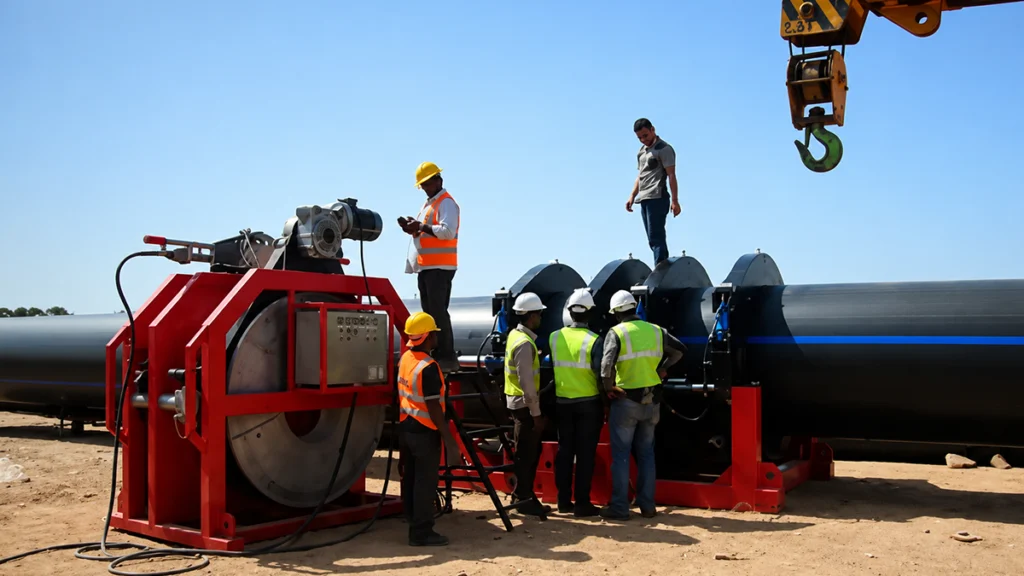
A standard hydraulic butt fusion machine designed for HDPE water pipelines features four critical sub-systems. First, the carriage utilizes heavy-duty clamps (jaws) to secure and perfectly align the pipe. Next, the facer acts as a rotating cutting tool to plane the pipe ends until they are perfectly square. The heating plate (or hot plate) delivers the necessary thermal energy. Finally, the hydraulic power unit (HPU) serves as the brain of the operation, delivering mechanical pressure while housing all operational valves and gauges.
How does the fusion cycle work?
Operators must follow a strictly regulated five-step procedure to guarantee a perfect weld:
1. Preparation: The HDPE welding machine clamps the pipes, and the facer planes the ends to create parallel mating surfaces.
2. Heating: The operator inserts the PTFE-coated heating plate and presses the pipe ends against it under alignment pressure.
3. Fusing (Melting): Pressure drops to a heat-soak level. This allows the thermal energy to penetrate the pipe wall, forming a molten bead.
4. Connecting: The operator quickly removes the heater and drives the pipe ends together under a specific fusion pressure.
5. Cooling and Curing: The joint remains under strict pressure until the plastic completely solidifies.
Which operator settings matter most?
Three specific parameters make or break the weld. First, the heating plate temperature must stay locked between 220°C and 240°C. Second, interfacial pressure requires precise calculation based on the pipe’s diameter and wall thickness—usually landing between 0.2 MPa and 0.4 MPa depending on ISO or ASTM standards. Finally, melting time follows a standard benchmark: multiply the pipe wall thickness (in millimeters) by 10 seconds.
Get detailed specs and custom configuration options
Request Technical SpecificationsKey Specifications to Compare Before Buying
Pipe size range, clamp design, and alignment
A butt fusion machine’s capacity dictates its overall utility on the job site. Small manual units easily handle outer diameters (OD) up to 630mm, while heavy-duty hydraulic beasts process massive municipal pipes reaching 3000mm. When evaluating an HDPE pipe jointing machine, pay close attention to the clamp design. The jaws must guarantee absolute zero slippage under extreme fusion force. Additionally, the carriage has to maintain flawless axial alignment to prevent any high-low mismatch at the final weld seam.
Temperature, pressure, and power requirements
Your heating plate needs a high-grade PTFE coating and the ability to maintain temperature stability within ±3°C across its entire surface. The hydraulic system isn’t just about raw power; it must accurately execute a mandatory three-stage pressure application profile (alignment, heat soak, and fusion/cooling). Don’t forget to verify power requirements before buying. Large units draw serious current and will require three-phase industrial generators on site.
Do you need manual, semi-auto, or fully automatic control?
Automation is rapidly transforming pipeline construction. Manual and basic hydraulic butt fusion welding machines rely heavily on operator skill and focus to calculate and apply pressure. CNC (Computer Numerical Control) automatic butt fusion machines, however, remove human error from the equation entirely. Fully automatic units dynamically control heat, drag, and pressure to achieve a staggering 99.2% weld success rate in hydrostatic pressure tests. They also provide ISO 12176-4 compliant data logging, giving project managers complete traceability.
HDPE Pipe Jointing Process for Water Supply Installation
Site preparation and pipe-end conditioning
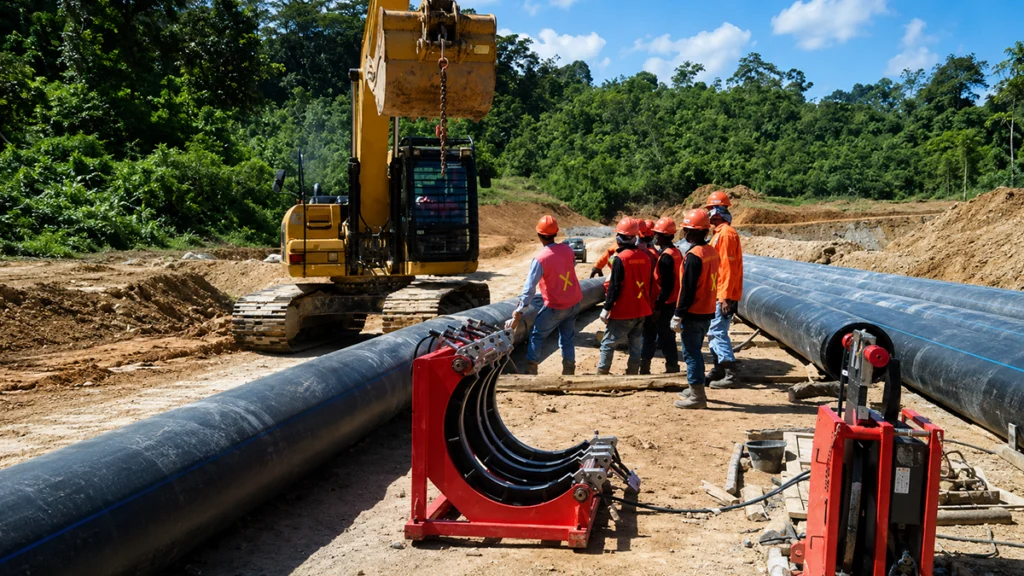
Before the butt fusion machine even touches the pipe, crews must secure the site and elevate the pipe ends on rollers to minimize drag force. The facer tool must cut the pipe ends perfectly square until continuous, unbroken ribbons of plastic peel away from both sides. After facing, operators must wipe the surfaces down with lint-free cloths and approved solvents. The plastic must be 100% free of dust, oil, and any other impurities.
Fusion, cooling, and handling steps
The moment the heating cycle finishes and the heater is extracted, the clock starts ticking. The operator has only seconds to execute the changeover and drive the pipes together. During the critical cooling phase, the HDPE pipe jointing machine must maintain interfacial pressure until the molten material cures completely. Applying external force, rough handling the pipe, or unclamping the jaws before the cooling cycle finishes will permanently destroy the weld’s molecular structure.
How is the joint checked before pressure testing?
Initial quality control always comes down to a rigorous visual inspection. A properly fused joint yields a uniform, double roll-back bead around the entire circumference of the pipe. This bead needs to be perfectly symmetrical—no deep V-grooves, no trapped bubbles, and zero visible contamination. Once the joint passes visual clearance and cures fully, the pipeline segment undergoes a hydrostatic pressure test. Crews typically pressurize the line to 1.5 times the designed operating pressure to verify absolute structural integrity.
Common Applications in Water Supply Pipeline Projects
Municipal trunk lines and branch networks
When building large-diameter urban water supply networks, butt fusion is the undisputed engineering standard. Heavy-duty hydraulic butt fusion machines provide the structural integrity required for primary trunk lines to survive decades of internal hydrostatic pressure, aggressive soil settlement, and heavy traffic loads without springing a single leak.
Rural water supply and temporary site lines
Contractors tackling rural infrastructure development and agricultural irrigation lean heavily on portable HDPE pipe jointing machines. These units deploy rapidly across punishing terrain. Because the butt fusion process is so fast, crews can lay thousands of meters of pipe per week. This speed allows contractors to knock out small-scale renovation projects quickly, slashing overall construction costs in the process.
When is electrofusion the better choice?
Electrofusion becomes mandatory in highly complex, space-restricted scenarios. If a crew needs to execute tie-ins to existing active water mains, navigate a maze of complex pipeline layouts, or work inside narrow, shored trenches where a bulky butt fusion carriage simply cannot fit, electrofusion is the only viable path forward. It also serves as the gold standard for emergency burst-pipe repairs, where speed and spatial constraints dictate every move.
How to Choose the Right Machine and Supplier
Project size, pipe diameter, and output needs
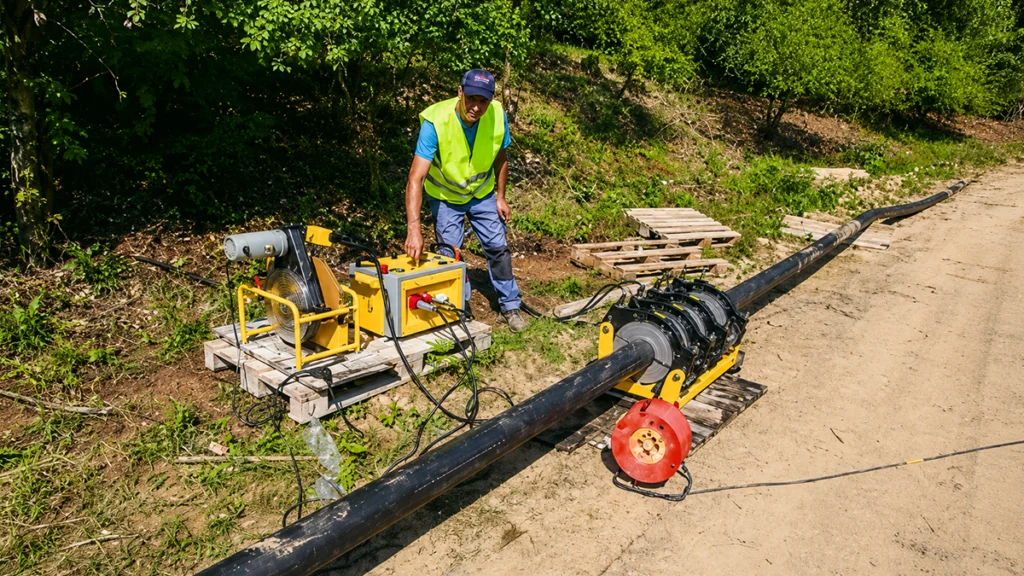
Smart procurement starts with capacity matching. Buyers need to align the butt fusion machine’s maximum OD capacity (like 1200mm, 2000mm, or 3000mm) exactly with the scope of their water supply project. Buying a machine that barely handles your maximum pipe size will eventually burn out the hydraulic system. On the flip side, lugging a massive, oversized butt fusion welding machine around to fuse small branch lines will tank your daily joint output.
Supplier support, warranty, and spare parts
An HDPE welding machine supplier needs to deliver far more than just raw hardware to infrastructure contractors. Top-tier manufacturers back their equipment with rock-solid 24-month warranties and guarantee lightning-fast spare parts availability. Global suppliers also offer OEM/ODM customization, tweaking regional voltage requirements, hydraulic fittings, and CNC language options to perfectly match the local workforce.
How should you compare quotations and lead time?
Procurement managers cannot afford to evaluate quotations based on upfront capital costs alone. Dig deeper. Assess the butt fusion welding machine’s Customer Effort Score (CES), its proven reliability under harsh field conditions, and the supplier’s technical problem-solving speed. Lead times require careful consideration as well. A cheap butt fusion machine delayed by two months will cost a pipeline contractor infinitely more in downtime than simply investing in a premium unit ready for immediate dispatch.
Common Mistakes, Maintenance, and Cost Factors
Common causes of weak or misaligned joints
When field failures happen, they rarely stem from the HDPE material itself. Procedural errors are almost always to blame. Common culprits include insufficient fusion pressure (leaving dangerous internal voids), incorrect heating temperatures (triggering thermal degradation), and dirty pipe ends that physically block molecular bonding. Failing to adjust the butt fusion machine’s clamps properly causes high-low misalignment, creating weak points highly susceptible to shear stress.
Maintenance tasks that extend machine life
Repeatable precision requires strict preventative maintenance. Operators must keep the working area clean to stop dust from destroying the hydraulic cylinders. The Teflon (PTFE) coating on the heating plate demands protection—never scratch it, and clean it only using wooden tools and alcohol. Checking hydraulic fluid levels, inspecting quick-release couplings for subtle leaks, and regularly calibrating the pressure gauges will dramatically extend the butt fusion welding machine’s lifespan.
How do cost and downtime affect total ownership?
Putting money into high-quality, automated equipment slashes labor hours and wipes out costly fusion errors. By matching advanced pipe handling systems with ultra-reliable pipe fusion machines, contractors routinely boost their output from 24-48 joints per day up to 40-70 joints per day on standard IPS pipes. This massive surge in productivity drives down labor and equipment rental costs. A reliable turnkey HDPE setup often achieves a full Return on Investment (ROI) in just 22 months, ultimately delivering a pipeline with a drastically lower Total Cost of Ownership (TCO) over a 50-year lifecycle.
FAQ
Q1: What pipe sizes can an HDPE pipe jointing machine handle?
Machine capacities vary widely based on the specific model and frame design. Small manual and lightweight hydraulic machines generally fuse pipes from 63mm up to 630mm. Heavy-duty hydraulic and CNC carriages built for major municipal trunk lines easily handle outside diameters (OD) ranging from 800mm all the way up to 3000mm.
Q2: Which is better for water supply pipelines: butt fusion or electrofusion?
Neither method is universally better; they simply serve different project phases. Butt fusion remains the most cost-effective standard for long, straight municipal trunk lines thanks to its high joint strength and zero consumable costs. Electrofusion shines in tight trenches, complex tie-ins, and emergency repairs where bulky machinery cannot physically fit.
Q3: How do you know if a fusion joint is strong enough for pressure service?
Field verification starts with a strict visual inspection of the weld bead. It must form a uniform, symmetrical double roll-back devoid of bubbles or deep V-grooves. True strength verification happens after the cooling phase via a hydrostatic pressure test, usually conducted at 1.5 times the pipeline’s maximum designed operating pressure.
Q4: What specifications matter most when buying a machine for municipal projects?
For heavy municipal work, prioritize hydraulic pressure stability, heating plate temperature consistency (holding within ±3°C), and a rugged clamp design that guarantees zero slippage. CNC automation and ISO 12176-4 compliant data logging are also critical—they ensure absolute traceability and eliminate operator error during the fusion cycle.
Q5: Can one machine be used for both potable water and drainage pipelines?
Yes. An HDPE pipe jointing machine fuses the plastic based entirely on its physical properties (diameter and wall thickness), regardless of what fluid the pipe will eventually carry. You can seamlessly move the same machine from high-pressure potable water mains to gravity-fed municipal drainage lines, as long as the pipe OD falls within the machine’s clamping range.
Q6: How long does an HDPE pipe fusion cycle take on site?
Cycle times depend heavily on the pipe’s wall thickness. The heating phase typically requires 10 seconds per millimeter of wall thickness. When you factor in facing, alignment, heating, fusion, and the mandatory under-pressure cooling phase, a single joint on a mid-sized pipe (like 315mm) usually takes between 20 and 35 minutes.
Q7: What maintenance does an HDPE pipe jointing machine need?
Routine maintenance involves cleaning the PTFE-coated heating plate with approved solvents to stop contamination, checking the facer blades for sharpness, monitoring hydraulic fluid levels, and keeping all quick-disconnect hoses free of dirt. You also need to perform an annual calibration of the temperature sensors and hydraulic pressure gauges to stay compliant with industry standards.
Conclusion
Choosing the right HDPE pipe jointing machine is a foundational engineering decision. It directly dictates the structural integrity and the ultimate 50-to-100-year lifespan of a municipal water supply system. Project success relies entirely on matching the machine’s specific capabilities—whether you are deploying heavy-duty butt fusion for miles of trunk lines or utilizing electrofusion for complex, tight-space tie-ins—to the diameter, pressure ratings, and spatial realities of your job site.
Contractors who strictly adhere to international fusion standards (like ISO 21307, DVS 2207-1, and ASTM F2620), maintain precise temperature controls, and execute flawless site preparation will consistently build 100% leak-proof networks. Putting capital into high-quality equipment featuring CNC automation and precise data logging does more than just eliminate the terrifying risk of joint failure; it maximizes daily on-site productivity. By prioritizing strong supplier support, rapid spare parts availability, and long-term equipment reliability, pipeline contractors can slash downtime, accelerate their project delivery, and secure a rapid return on their investment.
Let our experts help you choose the right equipment for your project
Contact Our Engineering Team