
HDPE Pipe Welding Machines: Price Factors
Table of Contents
Investing in a high-performance HDPE pipe welding machine is arguably the definitive strategy for guaranteeing leak-free HDPE and thermoplastic infrastructure. While manual fusion methods depend heavily on the steady hand of the operator, automation brings clinical precision to the process—controlling temperatures (200–230°C), managing fusion pressure (up to 0.25 MPa), and executing cooling cycles with exact timing. This significantly mitigates the risk of joint failure.
However, for procurement managers and contractors, the sticker price can be confusing. The gap between a basic hydraulic unit and a fully automated CNC system is substantial, often ranging from $3,000 to over $45,000 depending on the diameter and technical specifications.
In this guide, we break down the technical and economic drivers behind equipment pricing, including diameter capacity (DN40–DN1600), ISO 21307 compliance, and the value of onboard data logging. We will walk you through a comparative analysis of butt fusion versus electrofusion costs, operational ROI for the mining and gas sectors, and the often-overlooked lifecycle costs of maintenance. By the end, you will possess a clear framework for selecting the right equipment for your pipe schedule—helping you avoid both over-specification and costly procurement errors.
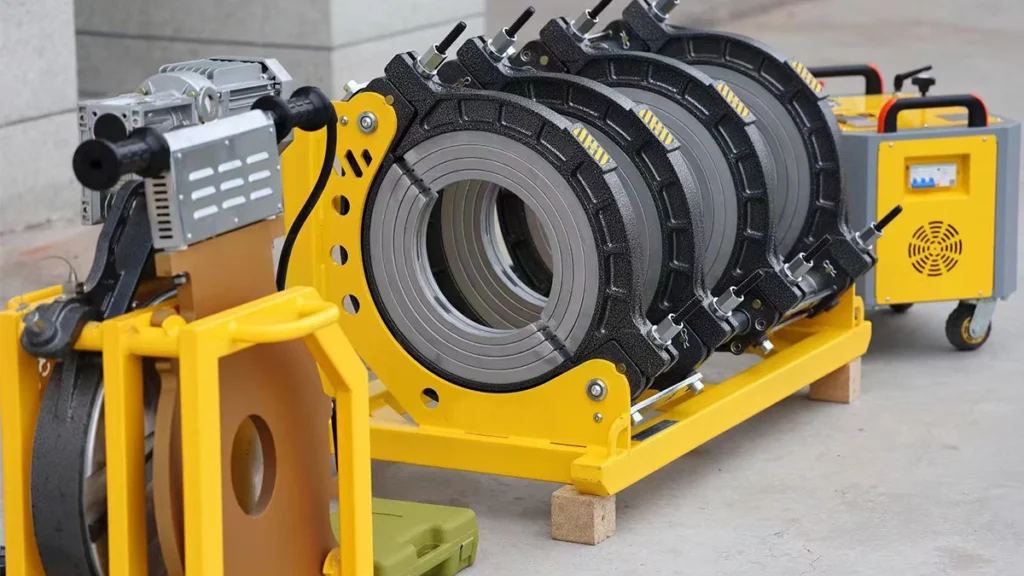
Key Factors Influencing Automatic Pipe Welding Machine Prices
The price tag on welding equipment is rarely arbitrary; it is a direct reflection of the engineering required to manage specific physical forces and meet compliance mandates. Understanding these cost drivers allows buyers to distinguish between a value-engineered asset and an underpowered liability.
Diameter Range Capabilities and Structural Engineering
The most straightforward determinant of price is the machine’s physical capacity. Naturally, a unit built for DN63–DN315 pipes requires less raw material and hydraulic force than a behemoth designed for DN1200–DN1600 pipes. However, the cost curve is not linear.
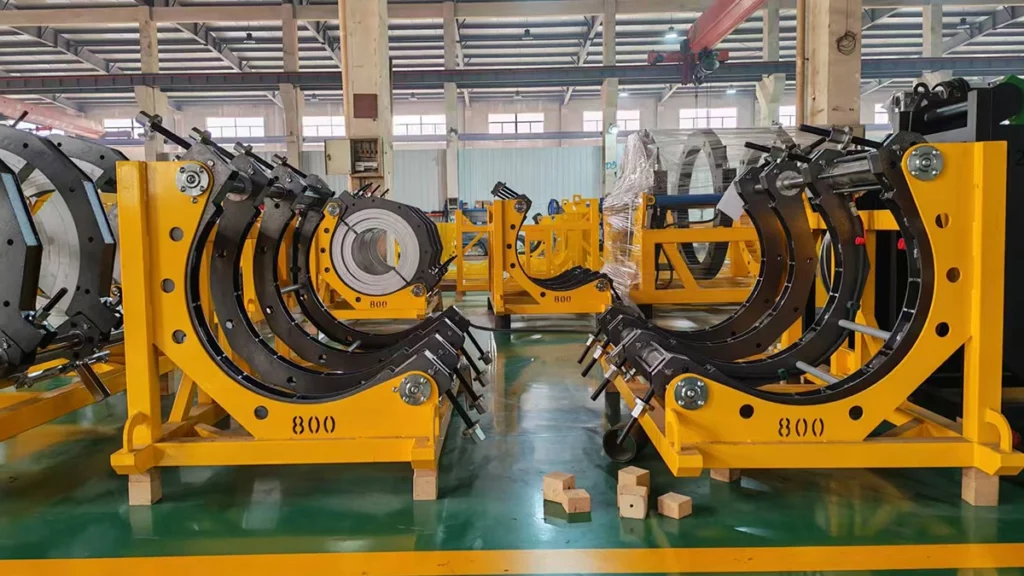
For small diameter units (up to 315mm), the chassis often utilizes lightweight aluminum casting. Once the range exceeds 630mm or 800mm, the machine must withstand immense drag forces and interfacial pressures. This necessitates heavy-duty steel framing, massive hydraulic cylinders, and reinforced clamping jaws. A 1600mm hydraulic butt fusion machine, for instance, may weigh over 2,600kg and requires a specialized hydraulic station capable of delivering clamping forces exceeding 15 MPa to drag heavy, thick-walled pipes. This structural reinforcement explains the steep price jump in the heavy-duty series.
CNC vs. Semi-Automatic Hydraulic Systems
The divide between semi-automatic and fully autonomous (CNC) systems represents a significant budgetary variable. Semi-automatic units rely on a hydraulic station where the operator manually actuates levers to achieve pressure. These are budget-friendly but leave the door open for human error.
A CNC automatic hdpe pipe welding machine integrates a PLC (Programmable Logic Controller), pressure transducers, and temperature sensors into a closed-loop system. The software automatically calculates drag pressure, bead-up height, and cooling time based on the selected standard (e.g., ISO 21307). This technology stack—comprising ruggedized computer hardware, proprietary software, and precise solenoid valves—adds a premium to the initial purchase price but removes the “operator variable” from the quality equation.
Compliance with ISO 21307 and DVS 2207
Equipment engineered to meet high-pressure welding mandates naturally commands a premium due to the performance requirements of the hydraulic systems. ISO 21307 “High Pressure” and ASTM F2620 standards call for interfacial pressures of roughly 0.52 MPa (75 psi), a significant leap from the 0.15 MPa typical of European low-pressure welding.
To achieve these pressures reliably, the butt fusion welding machine’s hydraulic pump, hoses, and cylinders must be rated for higher loads. Furthermore, adherence to German DVS 2207 standards often dictates specific chassis rigidity to prevent flexing during the cooling phase. Manufacturers like Ekberg Welding invest heavily in testing to ensure these compliance levels, a cost that is amortized into the machine’s final price.
Onboard Data Logging and Traceability Features
In modern utility projects—especially gas and water distribution—traceability isn’t optional; it’s a requirement. Basic butt fusion machines may lack data recording capabilities entirely. Advanced automatic models, however, feature integrated data loggers that capture:
- Operator ID and Job Site GPS coordinates.
- Heating plate temperature versus ambient temperature.
- Real-time pressure plots for bead-up, heat soak, and cooling phases.
This data is encrypted and generated into a PDF report for handover. Integrating GPS modules, Bluetooth connectivity for mobile apps, and tamper-proof logging software increases manufacturing costs but provides indispensable value for contractors who need to prove compliance to get paid.
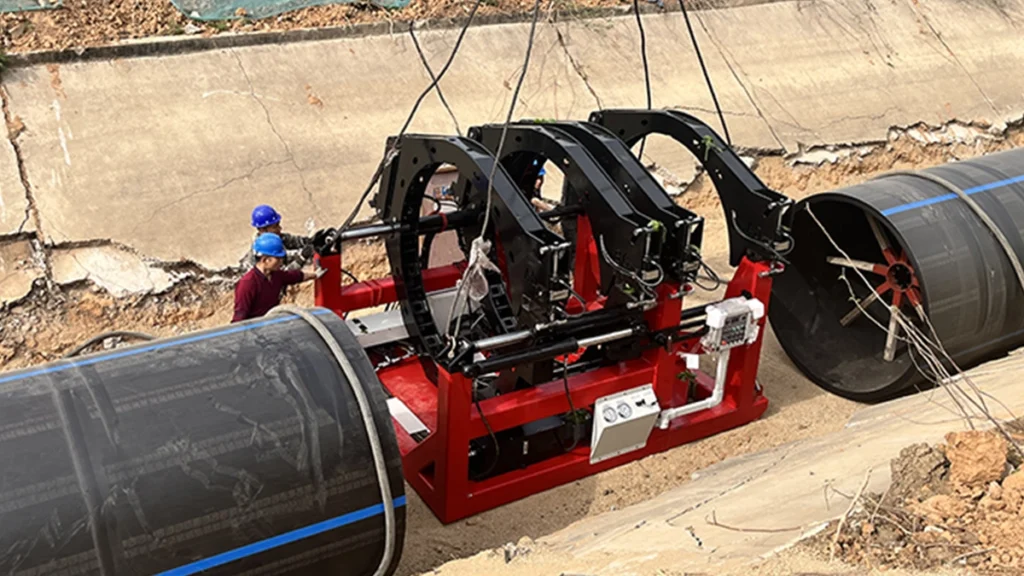
Comparative Analysis: Types of Automatic Welders & Cost Tiers
Selecting the right butt fusion machine requires analyzing the price-to-performance ratio across different welding technologies. Not every project demands a self-propelled crawler, nor is electrofusion always the cheaper alternative.
CNC Butt Fusion Machines: The Mainline Standard
For long-haul infrastructure (water mains, gas transmission), CNC automatic butt fusion machines deliver the superior long-term economy. While the upfront investment for a DN315 CNC unit might range from $8,000 to $15,000, the cost per joint is negligible—requiring only electricity and labor.
Unlike electrofusion, there are no expensive couplers to purchase for every connection. For a 10km pipeline requiring thousands of joints, the amortization of a CNC hdpe pipe welding machine is rapid. Automation ensures consistent cycle times, allowing contractors to accurately predict daily progress (e.g., 25–30 welds per day for medium diameters), which is critical for hitting project milestones.
Electrofusion Welders: Low Capex, High Opex
Electrofusion (EF) processors are far more accessible upfront, usually landing between $1,500 and $4,000. They are lightweight and ideal for tie-ins or repairs in tight trenches where a butt fusion carriage simply cannot fit.
However, the operational expenditure (OpEx) is high. Each joint requires a specific EF fitting containing embedded heating coils. For large diameters (e.g., DN400+), a single coupler can cost hundreds of dollars. Therefore, EF is generally not cost-effective for constructing long pipelines but remains an essential complementary tool for specific problem-solving scenarios.
Track-Mounted vs. Standard Workshop Models
Standard field butt fusion machines rely on a crane or excavator to lift them into the trench and position them between joints. Track-mounted (crawler) machines, such as the Ekberg Crawler Series, change this dynamic by featuring onboard diesel engines and tracks, allowing them to self-propel along the pipeline right-of-way.
These units command a premium price—often double that of a standard chassis—due to the added engine, hydraulics for locomotion, and complex drive systems. However, for remote cross-country pipelines, they eliminate the need for a dedicated support excavator, potentially saving the contractor over $1,000 per day in heavy equipment rental and fuel.
All-in-One Fitting Fabrication Machines
For workshops tasked with pre-fabricating elbows, tees, and wyes, standard linear carriages fall short. All-in-one fitting fabrication hdpe pipe welding machines feature pivoting jaws that allow for welding at various angles (e.g., 45°, 90°).
These are specialized, stationary capital assets. Their pricing reflects the complex mechanical engineering required to align segmented pipe sections precisely. While expensive, they allow distributors and large contractors to manufacture fittings in-house from straight pipe stock, drastically reducing costs compared to purchasing molded fittings.
ROI and Application-Specific Pricing Considerations
The “right” price is relative to the application. A butt fusion machine that is overpriced for an agricultural ditch may be dangerously cheap for a high-pressure gas line.
Municipal Gas Projects: The Cost of Traceability
Safety is the non-negotiable currency of the gas sector. Regulatory bodies often mandate 100% traceability (ISO 12176). Here, the ROI of a fully automatic butt fusion welding machine is binary: without it, you cannot bid on the project.
Although a CNC automatic butt fusion machine costs more than a hydraulic one, it automatically generates the required quality reports. Attempting to manually log data is not only prone to error but legally risky. The premium paid for automation acts as an insurance policy against compliance audits and liability claims.
Mining & Slurry Lines: Justifying Heavy-Duty Specs
Mining operations move abrasive slurries through thick-walled pipes (SDR 7 to SDR 11). These aren’t just pipes; they are heavy, stiff structural elements. A standard “medium duty” machine may physically fail to clamp the pipe round or slip under the immense drag pressure required.
Investing in a Heavy Duty automatic welder with reinforced jaws and high-pressure hydraulics is essential. The ROI here is measured in uptime. If a butt fusion machine chassis cracks mid-project in a remote mine, the cost of downtime (often thousands of dollars per hour) far exceeds the price difference between a standard and a premium machine.
Agricultural & Irrigation Scenarios
When dealing with low-pressure irrigation systems using thinner wall pipe (SDR 17 or SDR 26), the extreme rigidity required for mining isn’t as critical. Here, a semi-automatic or even a high-quality hydraulic butt fusion machine may offer a better price-to-utility ratio.
However, contractors should still weigh the “Cost of Failure.” Even in irrigation, a burst pipe destroys crops and wastes water. A basic hdpe pipe welding machine that ensures consistent pressure is often a smarter buy than a manual unit that relies on a tired operator guessing the cooling time.
The “Cost of Failure” Model
Smart buyers evaluate price through a “Cost of Failure” lens:
- Cost of Machine: $12,000 (CNC Automatic).
- Cost of Failed DN400 Joint: $15,000+ (Excavation, water damage, crew time, materials, fines).
- Conclusion: Preventing a single joint failure justifies the entire cost of the butt fusion machine.
Automation removes the variables that lead to failure—bad alignment, insufficient heat soak, or premature removal of pressure.
Maintenance, Warranty, and Lifecycle Costs
The purchase price is only the entry fee. The Total Cost of Ownership (TCO) over five years includes maintenance, calibration, and potential repairs.
Automatic Pipe Welder Service Life Expectancy
A robustly engineered hdpe pipe welding machine from Ekberg Welding typically boasts a chassis service life exceeding a decade. However, wearable components have shorter lifecycles:
- Hydraulic Seals: 5–7 years (depending on climate and storage).
- Heating Plates: 2–3 years before PTFE recoating is needed.
- CNC Electronics: 5–7 years (screen/sensor updates).
Proper storage is the biggest factor in life expectancy. HDPE pipe welding machines left uncovered in rain or mud will suffer from electronic corrosion, significantly shortening their life regardless of the brand.
HDPE Pipe Welding Machine Maintenance Guide
Preventing catastrophic electronic or hydraulic failure requires a disciplined maintenance regimen:
- Daily: Wipe down the heating plate with a clean cotton cloth (never abrasives) to protect the PTFE coating. Check hydraulic oil levels.
- Weekly: Inspect planer blades. Dull blades cause uneven facing, leading to poor fusion. Sharpen or flip blades as needed.
- Monthly: Check all electrical cables for fraying. Inspect hydraulic hoses for leaks or bulges.
- Annually: ISO standards require calibration of the pressure gauge and temperature probe. This validates that the machine’s “220°C” reading is actually 220°C.
HDPE Pipe Welding Machine Warranty Coverage
Warranty terms can be a minefield. Standard industry coverage usually spans 12 months on parts.
- What is typically covered: Hydraulic pumps, motor failures, frame welds, control box logic boards.
- What is NOT covered: PTFE coating on heater (consumable), planer blades, damage from dropping the unit, or voltage spikes from bad generators.
Ekberg Welding offers a comprehensive 1-year warranty coupled with lifetime maintenance support, meaning we provide labor and guidance for repairs indefinitely, charging only for parts after the warranty period expires.
Total Cost of Ownership (TCO)
Over a five-year horizon, a contractor should anticipate specific running costs:
1. Annual Calibration: ~$300–$500 per year.
2. Blade Replacement: ~$200 per year.
3. Heater Recoating: ~$400 every 2 years.
4. Hydraulic Oil Change: ~$50 per year.
These costs are minimal compared to the asset’s revenue generation, but neglecting them leads to premature machine replacement.
Comprehensive Buyer’s Selection Checklist
Before issuing a purchase order, verify that the machine meets the specific operational needs of your crew and project.
Control System Interface and Usability
- Language Support: Does the CNC interface speak your crew’s native language? Misunderstanding prompts is a leading cause of errors.
- Data Entry: Is the interface intuitive? Can you scan operator badges via RFID, or must data be typed manually?
- Screen Visibility: Is the screen readable in direct sunlight (high nits brightness)?
Required Certifications
Request the following documents from the manufacturer:
- CE Marking: Essential for safety compliance.
- EMC Testing Report: Ensures the CNC electronics will not interfere with or be affected by site radios and heavy machinery.
- ISO 9001: Proof of factory quality management systems.
After-Sales Support for HDPE Pipe Welding Machines
A butt fusion welding machine is only as reliable as the support network behind it.
- Remote Troubleshooting: Does the supplier offer video call support? Can they diagnose PLC issues remotely?
- Spare Parts Availability: Does the supplier stock seals, heaters, and inserts? Waiting six weeks for a seal kit can shut down a project.
Power and Voltage Compatibility
- Generator Stability: Automatic hdpe pipe welding machines are sensitive to voltage fluctuations. Ensure the hdpe pipe jointing machine can handle the output of your site generators (typically requiring a generator 1.5x to 2x the machine’s power rating).
- Plug Types: Verify the hdpe pipe welding machine comes with the correct industrial plugs for your region (e.g., 3-phase 415V vs. single-phase 220V).
Ekberg Welding: Manufacturing Excellence & Global Support
At Ekberg Welding, we bridge the divide between premium European engineering and accessible pricing through rigorous manufacturing control and direct-to-buyer logistics.
Factory Quality Control
Our manufacturing process begins with high-grade aluminum casting, ensuring porosity-free chassis components. Every hydraulic cylinder undergoes pressure testing at 1.5x the maximum operating pressure to guarantee seal integrity. We machine our facers and jaws on precision CNC centers to ensure alignment tolerances within ISO specifications (<10% wall thickness mismatch).
Rapid Spare Parts Deployment
We understand that downtime costs money. Ekberg maintains a “Rapid Deployment” inventory strategy. We stock critical components—control boards, hydraulic seals, heating plates, and planer blades—ready for immediate global dispatch. This minimizes the risk of long-term project stoppages due to minor component wear.
Training and Certification
An HDPE pipe welding machine is a precision instrument. To ensure our clients maximize their investment, Ekberg provides extensive training resources, including video tutorials, detailed operation manuals, and remote certification guidance. We empower your operators to become “Qualified Persons” under ISO 21307 standards.
Factory-Direct Logistics
By selling directly to B2B buyers and major distributors, we eliminate unnecessary middlemen markups. This allows us to offer premium CNC technology at a price point that delivers a faster ROI for contractors, supported by a logistics network capable of shipping heavy-duty equipment to any port globally.
Frequently Asked Questions
Q1: What is the average price difference between a manual and an automatic pipe welding machine?
A 160mm manual butt fusion machine typically costs between $1,000 and $1,800. A comparable fully automatic CNC model ranges from $5,000 to $8,000. While the automatic unit is roughly 3-4x the price, it provides data logging, eliminates operator error, and is often required for gas and municipal water projects, delivering a return on investment through compliance and speed.
Q2: How does the warranty coverage for automatic hdpe pipe welding machines differ from manual tools?
Automatic hdpe pipe welding machines contain complex electronics (PLC, sensors, screens) which carry different warranty terms than simple mechanical parts. Ekberg offers a 1-year comprehensive warranty on both hydraulic and electronic components, excluding consumables like PTFE coating or blades. We also provide lifetime technical support, whereas manual tools often have limited support once sold.
Q3: Can automatic butt fusion machines weld different materials like PP and PVDF?
Yes. High-quality automatic butt fusion welding machines allow operators to select different material profiles in the software. This automatically adjusts the heating temperature (e.g., higher for PVDF) and fusion pressures. However, welding PVDF often requires a specialized heating plate cloth or specific non-stick coating to prevent contamination, so always consult the manual before switching materials.
Q4: What is the expected service life of an automatic pipe welder under harsh field conditions?
With proper maintenance, the hydraulic chassis and mechanical frame can last over 10 years. The electronic control unit and sensors typically have a service life of 5–7 years before requiring updates or refurbishment. Regular cleaning and storing the butt fusion machine in a dry, protected container when not in use are the biggest factors in extending service life.
Q5: Is training required to operate an Ekberg CNC automatic HDPE pipe welding machine?
Yes. While the CNC system automates the pressure and timing, the operator must still understand the principles of pipe alignment, facing, and cleanliness. ISO 21307 requires operations to be performed by “Qualified Persons.” Ekberg provides training materials to ensure operators understand how to set up the HDPE pipe welding machine and interpret the data logs correctly.
Conclusion
The price of an HDPE pipe welding machine should be viewed not as a cost, but as an investment in infrastructure security. While the initial capital expenditure for a CNC system is higher than manual alternatives, the value is returned through operational speed, compliance with strict standards like ISO 21307, and the elimination of costly joint failures. In the high-stakes worlds of gas distribution, mining, and municipal water, the cost of a single leak far outweighs the price of premium equipment.
When selecting your equipment, prioritize manufacturers that offer transparent specifications, robust after-sales support, and readily available spare parts. Don’t let budget constraints force you into a “low-cost” butt fusion machine that becomes a high-cost liability in the field.
Ready to equip your fleet with reliable fusion technology? Contact Ekberg Welding today for a customized quote and technical consultation. Let us help you calculate the ROI for your specific pipe schedule and project requirements.