
Table of Contents
HDPE Pipe Welding Machine buyers can use this guide to compare large-diameter machine types, specifications, costs, supplier risks, and selection criteria before ordering equipment.
What Is a Large Diameter HDPE Pipe Welding Machine?
A large diameter HDPE pipe welding machine is a heavy-duty industrial tool built to permanently fuse high-density polyethylene (HDPE) pipes and fittings. It uses a highly controlled thermal process known as butt fusion. The result? A monolithic, homogeneous joint. This seamless connection is structurally vital for demanding applications like water mains, gas distribution, mining, dredging, and heavy industrial pipelines.
Core function of an HDPE pipe welding machine
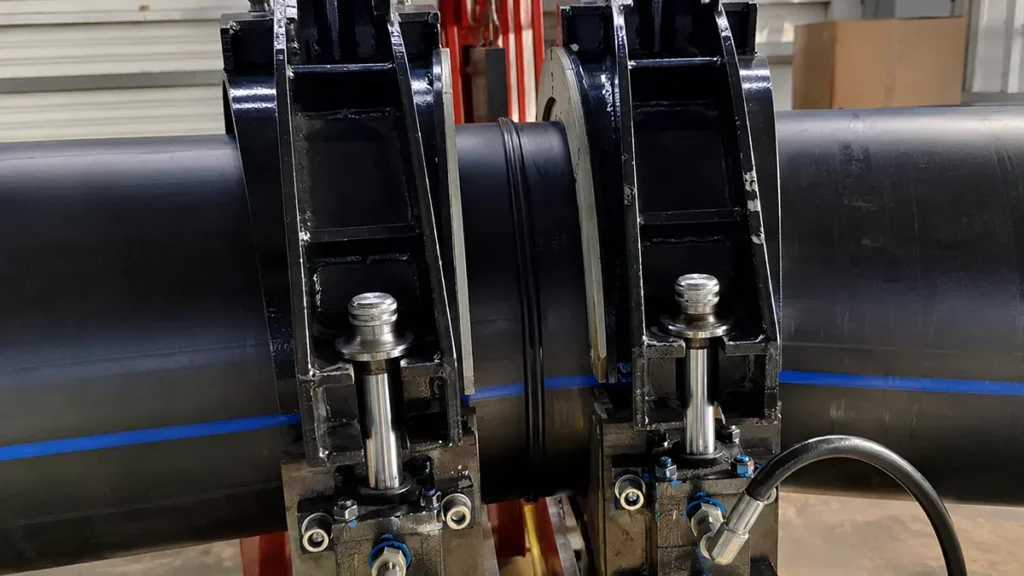
At its core, this equipment executes the butt fusion process with pinpoint accuracy. The machine aligns two pipe ends and shaves them down to guarantee perfectly flat surfaces. Next, a precisely calibrated heating plate melts the polymer. Finally, hydraulic cylinders force the molten ends together under calculated pressure. When done right, the finished joint is just as strong—if not stronger—than the original pipe. You don’t even need extra welding materials like flux or rods.
What pipe sizes are considered large diameter?
In the world of municipal, industrial, and mining pipelines, “large diameter” generally means pipes with an outside diameter (OD) spanning from 315mm to well over 1000mm. If you’re using the Imperial system, that translates to sizes between 24 inches and 65 inches (IPS standards). Maneuvering pipes of this sheer size requires serious machinery. The equipment must deliver massive clamping forces while maintaining perfectly uniform temperatures across huge surface areas.

Manual, hydraulic, and automatic welding control differences
We categorize these butt fusion machines based on how they are controlled:
- Manual: This setup relies completely on the operator’s physical strength. Because of the physical limitations, manual machines only make sense for small-diameter (under 160mm), low-pressure plumbing jobs.
- Hydraulic: These units use hydraulic cylinders to precisely dial in the welding pressure. The operator physically manages the valves to control heating duration, changeover speed, and cooling pressure.
- Automatic: Featuring full program automation and closed-loop control, these CNC units take the guesswork out of the equation. They automatically lift the hot plate, record displacement data, and guarantee repeatable procedures that meet strict international standards.
How welding accuracy affects pipeline service life
Even a slight misalignment between pipe ends or uneven clamping pressure can ruin a weld’s integrity. In high-stakes environments—think high-pressure gas transmission or abrasive mining slurries—a structural failure from a bad weld triggers catastrophic environmental damage. It also invites millions of dollars in liability. Precision alignment creates the flawless molecular bond required to ensure a pipeline lasts 50 to 100 years.
Why butt fusion Machine Selection Matters for Large Diameter HDPE Pipe Projects
Why large pipe welding needs stronger clamping and heating control
Large diameter pipes carry enormous weight. Worse, they tend to suffer from ovality (going out-of-round) during transit and storage. An industrial-grade HDPE pipe welding machine needs exceptionally powerful clamping systems to physically force these warped pipes back into a perfect circle. High-tensile strength clamps—standard on 1000mm to 1600mm butt welding machines—deliver the rigid support needed to stop any shifting during the crucial fusion phase.
Project risks caused by undersized or low-quality equipment
Bringing undersized equipment to a large pipe job is a recipe for disaster. If your hydraulic cylinders can’t hit the required interfacial pressure—especially during ISO 21307 High-Pressure welding on DN1200 pipes—you’ll end up with a weak, porous joint. Similarly, cheap heating plates suffer from uneven temperature distribution. This creates “cold joints,” which remain a leading cause of pipeline failure under heavy operational stress.
Factory-direct pricing with technical consultation included
Get Your Free QuoteMain Types of HDPE Pipe Welding Machines for Large Diameter Pipes
Hydraulic butt fusion welding machines
Standard hydraulic models rely on open-loop systems driven by manual valves. These hydraulic butt fusion machines are incredibly tough. They hold up beautifully in brutal field conditions while offering a great balance of performance and affordability. However, they demand skilled operators. The crew must manually watch pressure gauges and timers to pull off a weld that meets DVS 2207 or ISO standards.
Automatic data-logging fusion machines
Automatic fusion welding machines step up the technology with closed-loop systems, solenoid valves, electronic feedback sensors, and real-time parameter tracking. They completely eliminate operator guesswork. The butt welding machine handles pressure ramps and drag compensation automatically. If your project demands rigorous quality assurance and verifiable data logs for every single joint, these units are mandatory.
Workshop fitting fabrication machines
Unlike rugged field equipment, workshop fabrication machines stay put. These stationary units live in controlled factory environments. Engineers design them specifically to build complex segmented fittings like elbows, tees, and wyes by clamping and joining short pipe segments at precise angles.
Which machine type is best for field installation?
For sprawling, long-distance field installations, contractors almost always choose mobile hydraulic butt fusion machines. You have a couple of solid options. Self-propelled tracked butt fusion welding machines deliver unmatched mobility across rough, muddy terrain. Alternatively, modular wheeled units separate the clamping chassis from the operating station, making them perfect for tight, in-trench work.
Machine Type Comparison Table
| Machine Type | Control System | Best Application | Key Advantage |
|---|---|---|---|
| Hydraulic Butt Fusion | Open-loop, manual valves | General water/slurry pipelines | High durability, lower capital cost |
| Automatic CNC | Closed-loop, PLC controlled | Gas networks, critical infrastructure | Traceability, eliminates human error |
| Workshop Fabrication | Multi-angle clamping | Factory production of fittings | High precision for complex angles |
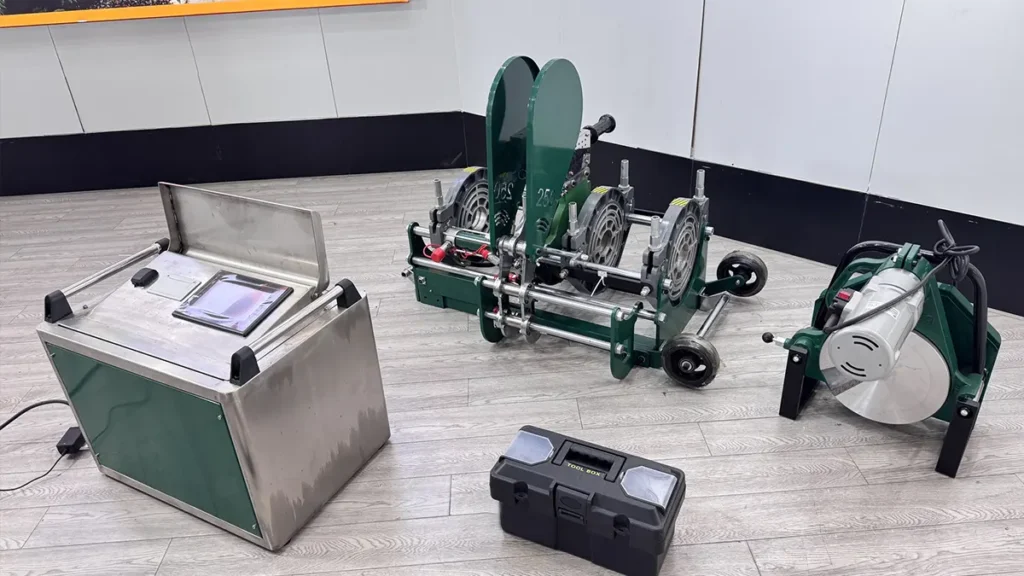
Key Technical Specifications to Check Before Buying
Pipe diameter range and SDR compatibility
A truly versatile HDPE butt fusion machine needs to handle multiple pipe diameters using layered inserts. Take a 1000mm machine, for example. It should easily weld pipes from 710mm up to 1000mm simply by swapping in 710, 800, and 900mm inserts. On top of that, the hydraulic system must pack enough punch to handle both thin-walled SDR 17 and heavy-duty, thick-walled SDR 11 pipes.
Heating plate temperature control and coating quality
When working with HDPE, the heating plate has to hold a strict temperature of 210±10℃. Premium butt fusion welding machines keep the surface temperature differential tightly controlled to ≤ ±3°C across the entire plate. You also cannot compromise on the coating. A high-quality PTFE (Teflon) layer is absolutely essential to stop the sticky molten polymer from ruining the weld surface.
Facing tool power, alignment accuracy, and clamping force
Power and precision metrics must be rock-solid for a typical 710-1000mm butt fusion machine. Total system power often hits 23.5 KW. That power gets split between the heating plate (17.5 KW), the milling cutter/facer (3.0 KW), and the hydraulic station (3.0 KW). The chassis and clamps need to lock down a maximum butt joint deviation of ≤0.2mm, backed by a pressure adjustment range spanning 0-16 MPa.
Power supply, hydraulic pressure, and operating environment
Heavy-duty equipment like this generally runs on a three-phase 380V, 50Hz power supply. You also need to think about where the welding pipe machine will actually operate. If your crew is working in freezing or high-wind conditions, you’ll need to push heating temperatures toward the upper limit of 220℃. Ideally, the pipe welding machine should also come equipped with weather-resistant hydraulic seals to survive the elements.
Get detailed specs and custom configuration options
Request Technical SpecificationsHow the HDPE Butt Fusion Welding Process Works
Step-by-step butt fusion process for large HDPE pipes
1. Preparation and Facing: First, the pipes are clamped tight. The facing tool planes the raw ends until it produces continuous shavings. This guarantees the surfaces are perfectly parallel.
2. Alignment Verification: The operator removes the facer and presses the pipe ends together. Maximum misalignment cannot exceed 10% of the wall thickness (or ≤0.2mm).
3. Preheating (T1 Stage): The heating plate drops in. The pipes are pushed against it until a specific melt bead forms.
4. Heat Soak: Pressure drops to almost zero, allowing the heat to deeply penetrate the pipe walls.
5. Changeover: The operator quickly pulls the heating plate out and rapidly brings the molten pipe ends together.
6. Fusion and Pressure Holding (P1): The butt fusion welding machine applies welding pressure and holds it steady.
7. Cooling Solidification: The joint cools down under pressure until the polymer fully crystallizes into a solid block.
What parameters must be controlled during welding?
Operators need to keep a close eye on theoretical welding pressure, bead-up time, heating duration, and changeover speed. Most importantly, the total welding pressure applied to the joint has to equal the HDPE pipe welding machine’s drag pressure (P2)—which is the physical force needed to move the heavy pipe—plus the theoretical interfacial pressure mandated by the standard.
How cooling time affects final joint strength
Releasing the pressure too early will destroy the weld. As a rule of thumb, calculate cooling time as “Wall thickness × 1 minute.” The hydraulic system must hold the pressure at the specified P1 level for this entire duration. If the pressure drops, the pipes can recoil, creating internal voids and permanently deforming the joint.
Application Scenarios for Large Diameter HDPE Pipe Welding Machines
Municipal water supply and drainage projects
City infrastructure relies heavily on large diameter HDPE networks for primary water transmission and sewage lines. Because these butt fusion welding machines produce seamless, homogeneous joints, they completely eliminate leaks. This prevents groundwater contamination and helps utility departments slash their non-revenue water loss.
Mining, dredging, and slurry pipeline systems
Mines constantly pump highly abrasive fine solids and aggressive chemical slurries. HDPE pipelines fused together with heavy-duty hydraulic equipment handle extreme internal wear and unstable, shifting ground far better than old-school bolted or flanged steel pipes.
Gas, industrial fluid, and agricultural irrigation networks
High-pressure gas distribution demands a zero-leak tolerance. That strict requirement makes automatic data-logging fusion pipe welding machines mandatory. Industrial chemical plants and sprawling agricultural irrigation networks also depend on these butt welding machines to construct continuous, highly corrosion-resistant fluid transport systems.
When should contractors use on-site welding instead of prefabrication?
On-site welding is the go-to method for continuous, long-distance runs like dredging lines or cross-country water mains. Hauling massive, pre-welded pipe strings over long distances just isn’t logistically viable. Prefabrication, on the other hand, makes sense for complex segmented fittings or pump station manifolds that demand workshop-level precision before arriving at the jobsite.
How to Choose the Right HDPE Pipe Welding Machine
Match the machine to pipe diameter, wall thickness, and project volume
Contractors need to pick a chassis size that handles their most common pipe diameters. If an upcoming job involves heavy SDR 9 or SDR 11 pipes, double-check that the hydraulic cylinders can actually push the high interfacial force required for ISO 21307 High-Pressure welding. This standard demands a lot more clamping power than standard low-pressure DVS guidelines.
Choose between standard hydraulic and automatic control models
For standard water and irrigation jobs run by experienced fusion crews, standard hydraulic butt fusion machines offer incredible cost efficiency. But if the project specs demand built-in welding standards, automatic drag pressure compensation, and zero margin for human error, you have no choice but to step up to an automatic model.
Evaluate transportability, frame strength, and jobsite setup time
Moving large butt fusion welding machines is a serious logistical hurdle. A typical 1000mm HDPE pipe welding machine weighs roughly 2600 kg, and its frame packaging measures about 2200x1800x1700mm. Before buying, assess whether your jobsite has the crane capacity and stable ground needed to maneuver this heavy iron. If not, a self-propelled tracked butt fusion machine might be your only option.
When is it worth paying more for data recording and traceability?
Paying for data recording is a must if you plan to bid on municipal gas, nuclear, or highly regulated infrastructure jobs. Systems that comply with TSG D2002-2006 offer displacement detection, printable data logs, and Beidou/GPS automatic positioning. These features protect contractors from crushing liability by proving every single joint met exact specifications.
Selection Checklist for Contractors:
- Verify maximum required pipe diameter and SDR thickness.
- Determine if the project requires ISO High-Pressure or DVS Low-Pressure fusion.
- Assess jobsite terrain for mobility requirements (wheeled vs. tracked).
- Check client specifications for mandatory data logging and GPS tracking.
Price, MOQ, Lead Time, and Total Cost Considerations
What factors influence HDPE pipe welding machine price?
The level of automation dictates the price tag. A fully CNC automatic butt fusion machine will cost three to four times more than a basic manual hydraulic rig. Why? Because you’re paying for PLCs, electronic sensors, and automated hydraulics. For large diameter gear (800mm-1000mm), expect prices to range from $10,000 for a bare-bones robust model up to $54,000+ for a premium, highly automated, self-propelled unit.
Common MOQ and customization considerations
Industrial welding equipment usually comes with a Minimum Order Quantity (MOQ) of just one unit. However, buyers rarely order a stock pipe welding machine. It’s common to customize the order with specific layered insert sizes, custom voltage setups (like 480V for certain regions), or upgraded data loggers.
Lead time, spare parts, packaging, and shipping costs
Expect a standard production lead time of about 30 days for large equipment. Shipping costs are a huge factor here. A single unit can weigh over 2.5 tons and requires specialized wooden crate packaging. When budgeting, always factor in sea freight, port handling fees, and the final inland transport to your jobsite.
How to compare total cost instead of only unit price
Smart procurement teams look at Return on Investment (ROI) rather than just the sticker price. On a standard 6-month pipeline job, swapping a highly paid manual welding crew for an automated butt fusion welding machine can save $20,000 to $30,000 in labor alone. Plus, an automatic butt fusion welding machine slashes the risk of failed welds. Avoiding just one catastrophic rework job will easily cover the pipe welding machine’s initial purchase price.
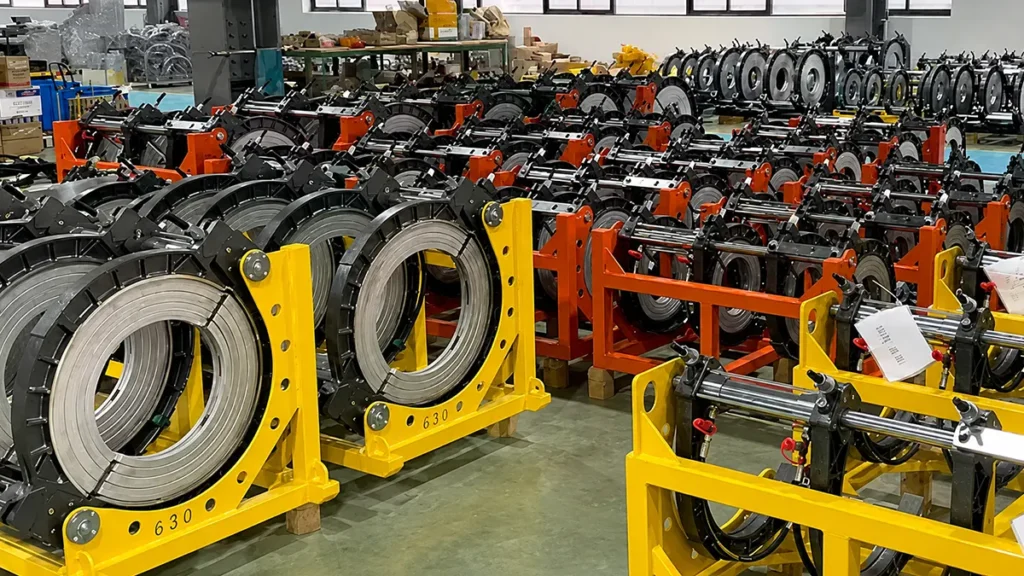
Supplier Evaluation and Quality Inspection Checklist
What documents should a reliable supplier provide?
A trustworthy manufacturer will gladly hand over documentation proving they meet international standards. Look for certifications covering ISO 12176-1 (Equipment for butt fusion jointing), ISO 21307, DVS 2207-1, or ASTM F2620. They should also include comprehensive operation manuals and detailed hydraulic schematics as standard practice.
Factory testing items to confirm before shipment
Never authorize a shipment without seeing factory acceptance testing (FAT) videos or reports first. You need to verify three main parameters: Pressure, Time, and Temperature. Have them physically test the heating plate surface with a pyrometer to prove the temperature variation stays ≤ ±3°C across the entire face.
Spare parts, training, warranty, and technical support
Pipeline project downtime drains thousands of dollars a day. Make sure your supplier includes a comprehensive spare parts kit packed with high-wear items like high-pressure hydraulic hoses, extra temperature sensors, and replacement milling cutter blades. Also, double-check the warranty length and ensure they offer remote technical support to help troubleshoot any PLC faults in the field.
Red flags when comparing HDPE pipe welding machine suppliers
Walk away from suppliers if their automatic models lack displacement detection. Other major red flags? Temperature errors swinging past ±5°C, visible hydraulic leaks during testing, a flimsy chassis that visibly flexes under pressure, or software that can’t easily export welding data logs.
Final Buying Recommendations forBuyers
Best choice for contractors handling multiple pipe sizes
If you bid on a wide mix of water and mining projects, a heavy-duty hydraulic butt fusion machine with a full set of layered inserts is your smartest move. Buying a 1000mm chassis that reliably steps down to 630mm via heavy-duty aluminum clamps gives your fleet maximum versatility and keeps the equipment working year-round.
Best choice for projects requiring welding records
Utility contractors and gas network installers really only have one option: fully automatic CNC butt fusion welding machines. The integrated quality detection, GPS coordinate tagging, and remote data transmission guarantee you stay fully compliant with strict engineering oversight and municipal codes.
Essential questions to ask before placing an order
Before you sign the purchase order, ask the manufacturer these three things:
1. “What is the maximum butt joint deviation under a full clamping load?” (The answer must be ≤0.2mm).
2. “Does the hydraulic station support both ISO/DVS low-pressure and ASTM high-pressure welding parameters?”
3. “Can you provide a thermal imaging report proving the heating plate temperature differential stays within ±3°C?”
Conclusion
Securing the right large diameter HDPE pipe welding machine demands a hard look at hydraulic power, temperature accuracy, and automation levels. Equipping your crew with the proper butt welding machinery guarantees structural integrity across critical pipeline infrastructure and slashes the severe risks tied to joint failure. Contractors who carefully match butt fusion welding machine specs—like SDR compatibility, clamping force, and data logging capabilities—to the realities of their municipal, mining, or industrial projects will see massive improvements in field efficiency. While stepping up to an automated CNC model does require more upfront capital, the resulting labor savings, precise parameter control, and bulletproof quality assurance consistently generate a superior long-term ROI in high-stakes engineering environments.
FAQ
Q1: What size HDPE pipe can a large diameter butt fusion welding machine handle?
These heavy-duty machines are built to tackle pipes starting at 315mm all the way up to 1600mm (or 24 to 65 inches IPS). A single machine won’t do it all, though. They cover specific ranges—like 710mm to 1000mm—using modular reducing inserts to securely grip different pipe diameters within that specific window.
Q2: Is a hydraulic or automatic HDPE pipe welding machine better for large projects?
It depends on the job. Hydraulic butt fusion welding machines are incredibly tough and budget-friendly, making them perfect for standard water and slurry lines. On the flip side, automatic butt fusion welding machines are the superior choice for critical infrastructure like gas networks. Their closed-loop CNC controls eliminate human error and generate the mandatory printable data logs required for every single fusion joint.
Q3: How much does a large diameter HDPE pipe welding machine cost?
Pricing swings wildly based on size and the level of technology. A basic imported hydraulic rig for 800mm pipes might start around $10,000. Meanwhile, fully automatic CNC models equipped with data logging, self-propelled tracks, and top-tier hydraulics can easily push past $54,000. As a general rule, adding full automation multiplies the baseline cost by three to four times.
Q4: What information is needed to choose the correct pipe fusion machine?
To get the right gear, you need to know the maximum and minimum pipe outside diameter (OD) and the thickest wall rating (SDR) you’ll be welding. You also need to confirm the required welding standard (ISO High-Pressure vs. DVS Low-Pressure), evaluate the jobsite terrain, and find out if the project owner demands GPS-tagged automated welding logs.
Q5: How can buyers check the quality of an HDPE pipe welding machine before shipment?
Always demand a Factory Acceptance Test (FAT) report or a live video demonstration. Have them use a pyrometer to prove the heating plate temperature variation is ≤ ±3°C. You also want to confirm the maximum alignment deviation stays ≤0.2mm, inspect the hydraulics for any pressure drops or fluid leaks, and make sure the facer shaves off continuous ribbons of plastic.
Q6: What spare parts are commonly needed for HDPE pipe welding machines?
Keep high-wear components on your truck to avoid crippling project delays. Your spare parts kit should include replacement milling cutter blades, high-pressure hydraulic hoses, quick-release hydraulic couplings, extra thermocouples (temperature sensors), and fresh non-stick PTFE fabric or spray for the heating plate.
Q7: Can one HDPE pipe welding machine work with different pipe SDR ratings?
Absolutely, but only if the hydraulic cylinders pack enough power. Fusing thick-walled pipes (like SDR 9 or SDR 11) takes substantially more drag and fusion pressure than working with thin-walled SDR 17 pipes. You must verify that the machine is rated to deliver the specific interfacial pressure needed for the heaviest wall thickness on your job.
Q8: What are the most common causes of failed HDPE butt fusion welds?
Weld failures usually boil down to bad equipment or operator mistakes. The most frequent culprits are uneven heating plate temperatures (which create weak, cold joints), weak clamping force that causes misalignment, dialing in the wrong fusion pressure, dirty pipe ends, or simply releasing the hydraulic pressure before the joint has properly cooled.
Let our experts help you choose the right equipment for your project
Contact Our Engineering Team