

Table of Contents
Butt Fusion Welding for HDPE pipe requires controlled alignment, heating, pressure, and cooling. This guide helps infrastructure teams understand procedures, parameters, quality checks, and supplier decisions.
What Is Butt Fusion Welding for HDPE Pipe?
Butt fusion welding serves as a core thermomechanical technique for joining High-Density Polyethylene (HDPE) pipes. By applying tightly controlled heat and pressure to the pipe ends, operators create a flawless connection. The method is straightforward yet highly precise: you heat two identically prepared pipe ends until they reach a viscous flow state using a specialized heating plate. Once you remove the heat source, hydraulic pressure forces the ends together. This forms a permanent, homogeneous bond.
How the butt fusion process creates a leak-resistant HDPE joint
Molecular entanglement drives the entire butt fusion process. When you heat HDPE pipe ends to a strict temperature target—usually 210±5°C using a PTFE-coated plate—the polymer chains shift into a viscous flow state. After extracting the heating plate, controlled hydraulic pressure drives the ends together. At this exact moment, the molecular chains from both sections diffuse across the boundary and lock together. The joint solidifies into a single, integrated structure as it cools under continuous pressure. Ultimately, this weld boasts a tensile strength and pressure rating that matches, and sometimes surpasses, the original pipe. You get a seamless system that aggressively resists leaks.
Where butt fusion welding is commonly used in infrastructure projects
Thanks to its unmatched reliability, this welding technique stands as the global benchmark for heavy-duty infrastructure. Contractors rely heavily on it for long-distance municipal water lines, gas distribution networks, industrial wastewater conduits, mining slurry pipelines, and sprawling agricultural irrigation systems. It handles an enormous variety of pipe sizes with ease. You can scale the process from a compact DN63 pipe all the way up to massive 2000mm trunk mains.
Why HDPE pipe requires controlled heat, pressure, and alignment
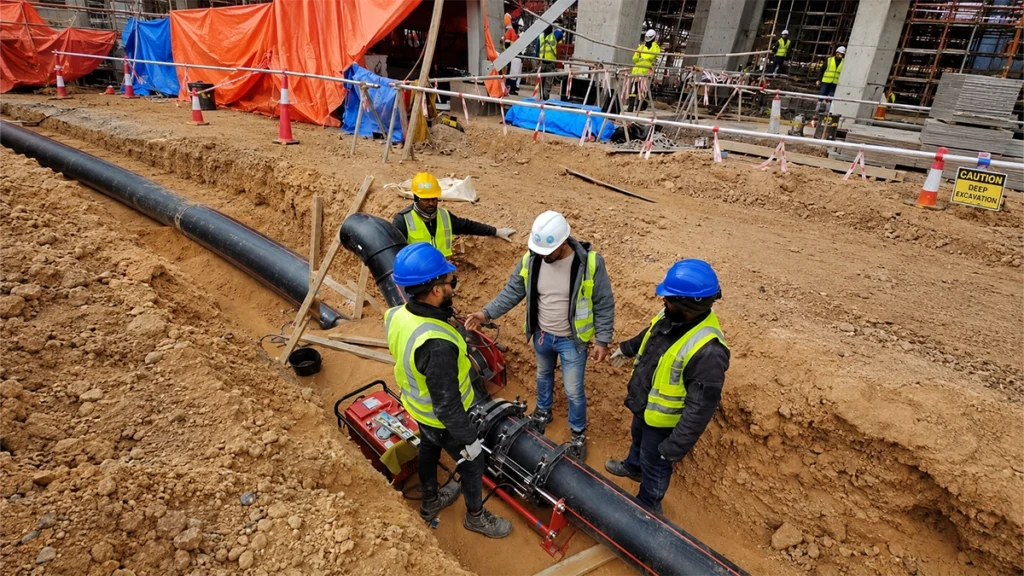
As a thermoplastic, HDPE reacts strongly to mechanical and environmental shifts during fusion. You must strictly control misalignment between the joined sections. In fact, axial deviation cannot exceed 10% of the pipe’s wall thickness. Push past that tolerance, and you introduce dangerous stress concentrations right at the joint interface, instantly compromising the pipeline’s pressure rating. Temperature demands the same level of discipline. Too little heat yields brittle “cold welds” that lack molecular diffusion, while excessive temperatures permanently degrade the polymer structure.
Long-term joint integrity and reduced leakage risk
A butt-fused HDPE pipeline functions as a single, continuous run of material when executed to recognized industry standards. This monolithic design strips away the mechanical joints, rubber gaskets, and threaded fittings that notoriously fail in traditional steel or ductile iron setups. What remains is a robust system boasting a 100-year design life. It completely ignores corrosion and slashes the risk of fluid infiltration or exfiltration to near zero.
Why Butt Fusion Welding Matters in Infrastructure Projects
Project cost impact of welding quality and rework prevention
Profitability on massive infrastructure jobs lives and dies by material and labor expenses. Butt fusion completely bypasses the need for the pricey, specialized fittings required by alternative joining methods. For sprawling municipal trunk lines, your fitting cost per joint practically drops to zero. Stepping up to automated CNC butt fusion machines also cuts human error out of the equation. Transitioning from manual hydraulic setups to fully automatic rigs often saves contractors upwards of $20,000 to $30,000 in labor and destructive rework over a standard six-month project.
When butt fusion is preferred for buried or pressure pipelines
Hydraulic efficiency is non-negotiable for buried high-pressure water and gas mains. Butt fusion delivers a perfectly flat internal joint surface, free of any flow-restricting protrusions or inner lips. This incredibly smooth interior drastically reduces flow resistance. It also stops particulates and biological growth from accumulating at the seam, ensuring the optimal hydraulic conditions necessary for high-velocity fluid transport.
Core components of an HDPE butt fusion welding machine
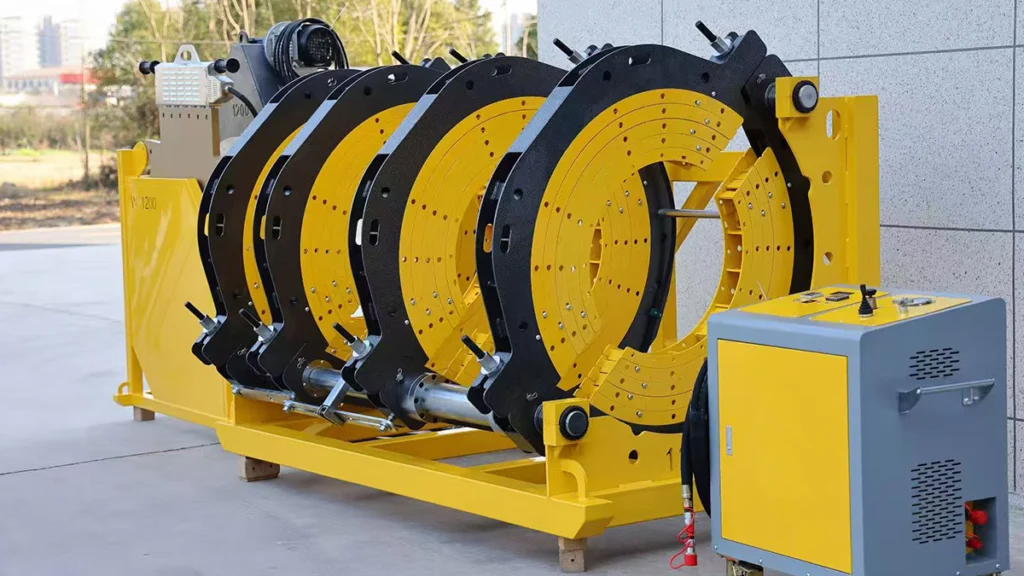
A dependable, field-ready welding rig features five primary components that operate in sync. You have a heavy-duty clamping frame (the chassis), a motorized milling cutter (facer), a thermostatically controlled heating plate, a hydraulic butt fusion machine control unit, and a data logger or displacement sensor. Equipment engineered by brands like Ekberg Welding is built to survive brutal jobsite environments while consistently delivering laboratory-grade precision.
Pipe clamps, facer, heater plate, hydraulic unit, and data logger
The pipe clamps lock the HDPE segments firmly into the frame, guaranteeing flawless axial alignment. Meanwhile, the facer uses rotating blades to shave the pipe ends until they are perfectly parallel. The heater plate then steps in, applying uniform thermal energy to melt the polymer face. Driving the physical movement, the hydraulic unit dictates the precise drag, soak, and fusion pressures mandated by international codes. Finally, the data logger serves as the system’s quality assurance brain. It tracks temperature, pressure, and time metrics for every single joint to produce a verifiable compliance report.
Factory-direct pricing with technical consultation included
Get Your Free QuoteButt Fusion Welding Equipment and Materials Required
Site preparation tools, cleaning materials, and safety equipment
Flawless fusion actually starts well before you power up the machinery. Operators must position the equipment on completely level, solid ground. This prevents the heavy clamping chassis from shifting during the high-pressure joining phase. You will need essential site tools like pipe roller supports to kill drag friction, alongside lint-free cotton cloths and 90%+ isopropyl alcohol to chemically prep the pipe ends. Safety is equally critical. Technicians must wear proper thermal PPE, especially heat-resistant gloves, to safely maneuver the 210°C heating plate.
What should be checked before mobilizing equipment to the jobsite?
Ignoring pre-mobilization checks is a fast track to expensive field delays. Technicians must confirm the jobsite generator delivers stable AC 220V or 380V power without dangerous voltage spikes. You also need to top off hydraulic fluid levels and thoroughly inspect every high-pressure hose quick-connector for leaks. Beyond that, calibrate the heating plate’s internal sensors. It has to accurately hold the target temperature range across every square inch of its surface.
Heating plate temperature range and why consistency matters
Thermal consistency dictates the ultimate strength of the weld. Operators must maintain the heating plate at a strict 210±5°C, although this target can shift between 200°C and 230°C depending on the pipe’s specific Standard Dimension Ratio (SDR). Drop below 200°C, and the polymer fails to reach a proper viscous flow state, creating weak “cold welds.” Push the heat past 230°C, and you scorch the material. This thermal degradation shatters the molecular structure and leaves the joint dangerously brittle.
Fusion pressure, drag pressure, and changeover time
Welding pressure changes dynamically throughout the process. Drag pressure acts as the baseline hydraulic force needed to overcome friction and physically move the heavy pipe along the chassis. Fusion pressure is the actual force applied to squeeze the molten ends together. Depending on your governing code, ISO/DVS requires “low-pressure” parameters at roughly 0.15 N/mm² (1.5 bar), whereas ASTM F2620 mandates “high-pressure” settings. Changeover time—also known as the switching cycle—is the brief, critical window you have to remove the heater plate and join the pipes before a restrictive “cold skin” forms over the melted polymer.
HDPE Pipe Butt Fusion Welding Parameters to Control
| Welding Parameter | Function & Control Target | Risk if Incorrect |
|---|---|---|
| Heater Temperature | Holds a steady 210±5°C for the ideal viscous flow state. | Cold welds (<200°C) or severe thermal degradation (>230°C). |
| Drag Pressure | Overcomes chassis friction and the dead weight of the pipe. | Under-pressurized joints if you fail to add drag to the baseline fusion pressure. |
| Soak Time/Pressure | Drives heat deep into the pipe's wall thickness. | Insufficient melt depth, which cripples molecular entanglement. |
| Changeover Time | The window to remove the plate and connect pipes (keep this brief). | A "cold skin" forms, actively blocking molecular diffusion. |
| Cooling Time | Lets the joint solidify under sustained hydraulic pressure. | Micro-cracking or brittle fracture if you release the pressure too soon. |
Cooling time requirements before handling or pressure testing
The pipe’s material grade and wall thickness strictly dictate the required cooling duration. Crucially, the joint must cool naturally while held under the hydraulic unit’s clamping pressure. Never use water, snow, or compressed air for forced cooling. Artificially accelerating the temperature drop triggers massive thermal shock. This creates internal stress concentrations that practically guarantee brittle fracture during hydrostatic pressure testing.
How pipe diameter and wall thickness affect welding settings
Required thermal energy and hydraulic force scale up directly alongside pipe diameter and SDR. Thick-walled pipes demand substantially longer heat soak times. The heat needs that extra time to penetrate deeply and form a sufficient melt bead. At the same time, the hydraulic unit must pump out a higher total force to hit that critical 0.15 N/mm² interfacial pressure across a much wider cross-sectional area.
Step 1: Inspect and clean the HDPE pipe ends
Start by aggressively inspecting the pipe ends. Look for deep gouges, UV damage, or heavy contamination. Next, wipe down both the inner and outer surfaces of the pipe ends using a lint-free cloth soaked in isopropyl alcohol. Do not skip this. Any lingering dust, mud, or oil will embed directly into the molten polymer, introducing fatal weak points in the finished weld.
Step 2: Clamp, align, and face the pipe ends
Load the prepped pipes into the machine chassis and lock them down with the clamps. Lower the motorized facer between the ends, and let the hydraulic unit push the pipes against the spinning blades. You want to mill the material until continuous, unbroken ribbons of HDPE peel away from both sides. Once facing is complete, bring the pipes together to verify alignment. The gap between these newly faced ends must stay under 0.3mm.
Get detailed specs and custom configuration options
Request Technical SpecificationsStep-by-Step Butt Fusion Welding Procedure for HDPE Pipe
Step 3: Heat the pipe ends under controlled conditions
With alignment confirmed, drop the heating plate between the pipe ends. The hydraulic system applies an initial burst of pressure to guarantee flush, full contact against the PTFE-coated surface. As soon as a preliminary melt bead forms, drop that pressure down to a near-zero “soak pressure.” The pipes then absorb heat for a specific duration based on their wall thickness, letting the polymer reach the perfect viscous state.
Step 4: Join, hold, cool, and release the welded joint
Once the soak phase wraps up, open the hydraulic carriage and quickly pull the heating plate out. Speed is vital during this switching cycle. Immediately drive the molten pipe ends together at the calculated fusion pressure. You must maintain this exact pressure steadily throughout the entire cooling phase. Do not release the hydraulic pressure or open the clamps to remove the pipe until the mandated cooling time has fully expired.
Visual inspection criteria for bead shape and uniformity
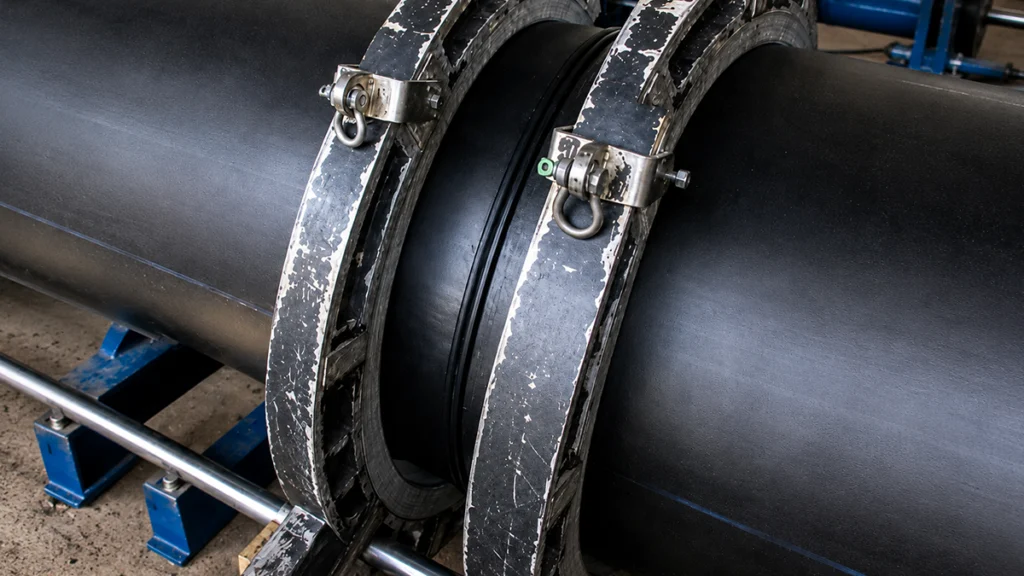
Visual inspection of the fusion bead remains your first line of defense for quality control. A structurally perfect joint displays a symmetrical, double-roll bead that maintains a consistent width and height around the entire circumference of the pipe. Inspectors also need to double-check that axial misalignment across the seam stays below 10% of the pipe’s wall thickness.
Common signs of poor fusion or contamination
Bad joints usually advertise their flaws. An asymmetrical bead points directly to uneven milling, bad alignment, or excessive drag friction during the joining phase. Spot a “V-notch” or deep groove between the two bead rolls? That typically means you didn’t apply enough heating pressure or shortchanged the soak time. Furthermore, if the bead looks dull, pitted, or spongy, you can guarantee that moisture or hydrocarbons contaminated the face during the heating cycle.
How to Inspect Butt Fusion Weld Quality
When to use destructive or non-destructive testing
Visual checks are mandatory, but physical testing actually proves your butt fusion welding machine calibration is accurate. Crews should run non-destructive testing (NDT), like a standard bend test, on a sample weld before every shift. For high-stakes critical infrastructure, destructive testing takes over. Technicians cut a 10–15mm strip right across the weld seam and submit it to aggressive peel and shear testing in a lab setting. This definitively verifies the molecular bonding strength.
How welding records and data logs support project acceptance
Today’s project owners and municipal engineers demand hard data to prove weld integrity. CNC Automatic butt fusion machines outfitted with data loggers handle this easily, ensuring compliance with strict ISO 12176 standards. The logger captures exact temperature, pressure, drag, and time metrics for each individual joint. It then compiles this data into a tamper-proof, downloadable report. This document acts as the ultimate proof for project acceptance and warranty validation.
Misalignment, ovality, and poor pipe end preparation
Improper storage often causes pipes to develop ovality, taking on an egg-like shape. If you fail to round out these oval pipes using the HDPE pipe butt welding machine’s clamps, the resulting mismatch generates massive internal stress. Poor end prep is just as damaging. Failing to mill the pipe faces until the gap drops below 0.3mm guarantees an asymmetrical bead and a fundamentally compromised joint.
Incorrect heater temperature or insufficient soak time
Neglecting the heating plate is the fastest way to cause a field failure. If the operator doesn’t mill off the entire oxide layer, or if the plate’s temperature dips below the 200°C threshold, the polymer simply cannot achieve molecular interlocking. You end up with a cold weld. It might look perfectly fine to the naked eye, but it will violently rupture the moment it faces operational hydrostatic pressure.
Common Butt Fusion Welding Defects and How to Prevent Them
| Defect Type | Primary Cause | Prevention Strategy |
|---|---|---|
| Cold Weld (Lack of Fusion) | Heater plate ran too cold (<200°C) or switching cycle dragged on. | Calibrate the heating plate daily; rely on automated CNC machines to cut down changeover time. |
| Asymmetrical Bead | Misalignment, pipe ovality, or severe drag friction on the chassis. | Deploy pipe roller supports; verify the gap after facing remains <0.3mm. |
| V-Notch Bead | Insufficient heating pressure or a rushed heat soak phase. | Strictly enforce the pressure and time parameters set by pipe SDR and ISO/ASTM codes. |
| Porous/Spongy Bead | Moisture, oil, or dust clinging to the pipe face. | Scrub pipe ends aggressively with 90%+ isopropyl alcohol before facing and heating. |
Contamination from dust, moisture, oil, or oxidized surfaces
Jobsites are inherently hostile to precision welding. Morning dew, windblown dust, and lingering hydraulic oil vapors easily settle on freshly milled pipe ends. If you heat and press these contaminants into the joint, they form microscopic voids that block molecular diffusion. Adhering to strict chemical cleaning protocols with isopropyl alcohol isn’t just a suggestion—it’s completely non-negotiable.
Premature movement during cooling and joint handling
Patience plays a massive role in successful fusion. The newly connected polymer stays in a fragile, semi-molten state for quite a while. Shifting the pipe, popping the hydraulic clamps early, or twisting the joint past a 5-degree deflection during cooling will permanently shear the entangled molecular chains. Joints compromised by premature movement will absolutely fail during hydrostatic testing.
Best use cases for butt fusion welding
For large-scale, open-trench infrastructure, this method remains the undisputed champion. It is the absolute best choice for cross-country gas transmission lines, long-distance municipal water mains, and heavy-duty industrial effluent systems. Because the process scales so effortlessly, it serves as the standard procedure for joining large-diameter pipes, easily handling anything from DN63 up to massive 2000mm profiles.
When electrofusion fittings may be more practical
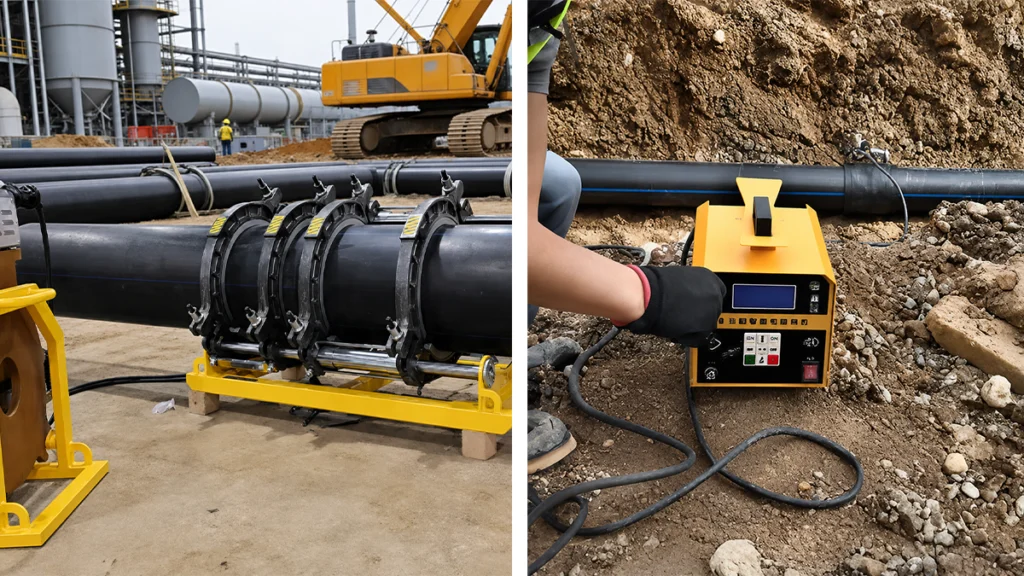
Despite its massive advantages, butt fusion demands a lot of operational real estate. You cannot easily squeeze a heavy hydraulic clamping frame into tight, confined spaces. In restrictive scenarios—like deep manholes, narrow urban trenches, emergency pipeline repairs, or vertical tie-ins—electrofusion takes the lead. Electrofusion uses a compact fitting packed with embedded resistance wires, requiring very little clearance to complete the weld.
Butt Fusion vs Electrofusion: Which Method Should You Choose?
Cost, equipment, speed, and access considerations
Choosing between these methods ultimately comes down to project scale and site accessibility. Butt fusion delivers a $0 fitting cost per joint, giving it the highest ROI for long, straight pipeline runs, though it does require a steeper upfront investment in heavy hydraulic gear. Electrofusion butt welding machines, on the other hand, are highly portable and cheap. However, the specialized fittings carry a steep per-joint material cost, which can easily run into the thousands for larger diameters.
Decision guide for trench, repair, and large-diameter pipeline work
When laying new, large-diameter pipelines (DN160 and up) across open terrain, butt fusion is the clear winner thanks to zero consumable costs and superior hydraulic flow. Conversely, if a crew is patching a ruptured DN110 water main under a busy city street, electrofusion becomes the only realistic way to finish the tie-in quickly without digging up a massive footprint.
Factors that affect butt fusion welding cost per joint
Even with zero consumable costs, operational efficiency dictates the true price per joint. Major factors include the hourly rates of certified operators, butt fusion welding machine depreciation, and the pipe’s SDR. Keep in mind that thicker pipes demand longer heating and cooling cycles, which inherently lowers your daily joint output. Extreme weather delays also heavily skew the final cost per weld.
Operator certification, welding standards, and documentation requirements
Exceptional weld quality relies heavily on operator skill and rigid adherence to global standards. Projects must strictly follow specific protocols, whether that is ISO 21307 internationally, DVS 2207-1 for European low-pressure, or ASTM F2620 for US high-pressure jobs. Operators need valid certifications and should operate CNC butt fusion machines that handle data logging automatically. This guarantees every single joint is compliant with ISO 12176 and fully documented.
Project Planning Considerations: Cost, Lead Time, Standards, and Supplier Selection
How pipe size, SDR, site access, and weather affect schedule
When building construction schedules, project managers have to account for material and environmental variables. Shifts in ambient temperature (from -5°C to +40°C) demand a fusion time correction factor of roughly 0.5–1% per degree Celsius. Damp weather or heavy rain makes protective welding tents mandatory. Ignore the tents, and operators will inevitably rush the process, leading straight to moisture contamination and failed joints.
Questions to ask before choosing a welding machine or contractor
Procurement teams need to put equipment suppliers under a microscope. Ask the hard questions: Are we looking at a manual hydraulic system, or is it a fully automated CNC unit with data logging? Does the gear carry CE/ISO certifications? Top-tier manufacturers like Ekberg Welding engineer rugged, high-performance hydraulic systems that perfectly bridge the gap between overpriced premium labels and cheap, unreliable manual tools. This approach delivers unbeatable ROI for infrastructure contractors.
Key checklist before starting each weld
Real consistency requires strict discipline. Before kicking off daily batch construction, operators must run through a non-negotiable checklist:
1. Verify the generator’s voltage stability.
2. Confirm the heating plate’s surface temperature using a digital pyrometer.
3. Inspect all hydraulic fluid levels and high-pressure hose connections.
4. Aggressively clean the pipe faces with isopropyl alcohol.
5. Execute a daily test weld and run a destructive bend test to prove butt welding machine calibration and account for environmental conditions.
Best practices for reducing rework and field failure
Rework silently destroys pipeline project profitability. The absolute best way to prevent it is by mandating the use of pipe roller supports. Rollers completely eliminate the unpredictable drag resistance you get from dragging heavy HDPE across dirt, ensuring the hydraulic unit delivers accurate fusion pressure. Furthermore, using the correct reduction inserts (clamps) guarantees perfect axial alignment and stops the pipe from slipping during the high-pressure cooling stage.
Final Recommendations for Reliable HDPE Butt Fusion Welding
When to request technical support or project-specific welding guidance
Even veteran contractors run into situations that demand specialized engineering support. You should immediately request technical guidance if you are trying to fuse incompatible materials—like attaching legacy PE80 pipe to modern PE100 pipe—because that requires highly customized parameter tweaks. Also, if your crew is transitioning to large-diameter CNC automated rigs, manufacturer-led field training is a must. It ensures your team actually understands how to leverage the equipment’s hydraulic feedback loops and data logging features.
FAQ
Q1: What temperature is required for butt fusion welding HDPE pipe?
The baseline heating plate temperature for butt fusing HDPE pipe sits at 210±5°C. However, depending on the specific resin grade and the pipe’s Standard Dimension Ratio (SDR), this target can shift anywhere from 200°C to 230°C. Drop below 200°C, and you risk creating weak cold welds. Push it past 230°C, and you will permanently degrade the polymer’s molecular structure.
Q2: How long should an HDPE butt fusion weld cool before pressure testing?
Cooling time relies entirely on the pipe’s wall thickness and the governing welding standard (like ASTM F2620 or ISO 21307). The joint absolutely must cool naturally while held under hydraulic clamping pressure. Never force the cooling process with air or water. You should only initiate hydrostatic pressure testing after the entire pipeline run has fully returned to ambient temperature.
Q3: What causes HDPE butt fusion weld failure?
The most frequent culprits behind weld failure are cold welds (caused by excessive changeover times or low heating temperatures), contamination (oil, moisture, or dust on the pipe faces), and poor alignment (axial mismatch passing the 10% wall thickness limit). Prematurely moving or twisting the joint during the delicate cooling phase is also a major cause of failure.
Q4: Is butt fusion welding stronger than electrofusion for HDPE pipe?
When executed flawlessly, both techniques produce joints that equal or exceed the strength of the original pipe. However, butt fusion yields a completely seamless, homogeneous internal surface. This lack of internal restriction makes it the superior choice for optimizing high-pressure flow dynamics in massive infrastructure pipelines.
Q5: What equipment is needed for HDPE pipe butt fusion welding?
A comprehensive setup demands a hydraulic clamping chassis, a PTFE-coated thermostatic heating plate, a motorized milling cutter (facer), a hydraulic pressure control unit, and a digital data logger. For site prep, you will also need pipe roller supports, a highly stable power generator, lint-free cloths, and isopropyl alcohol for chemical cleaning.
Q6: Can butt fusion welding be done in cold or wet weather?
Yes, but you must implement strict environmental controls. In windy or wet environments, operators have to deploy a protective welding tent to block moisture contamination and prevent uneven cooling. If temperatures drop below freezing, you must adjust your heating and cooling times using specific environmental correction factors, and you may even need to pre-heat the pipe ends.
Q7: How do inspectors check the quality of an HDPE fusion joint?
Inspectors start with rigorous visual checks to confirm the weld bead is double-rolled, perfectly symmetrical, and completely free of contamination or V-notches. They also check for axial alignment. For deeper quality assurance, inspectors analyze the CNC butt fusion machine’s digital data logs and execute destructive shear and peel testing on sample welds.
Q8: What standards apply to HDPE pipe butt fusion welding?
The major international codes include ISO 21307 for general procedures, DVS 2207-1 for European low-pressure parameters, and ASTM F2620 for US high-pressure settings. On the equipment side, ISO 12176 dictates the safety, performance, and data logging requirements for the fusion welding machines themselves.
Conclusion
Pulling off successful butt fusion welding on HDPE infrastructure demands absolute discipline regarding environmental, hydraulic, and thermal parameters. When contractors truly understand the mechanics of molecular entanglement—and strictly control variables like cooling time, drag pressure, and temperature—they can build monolithic pipelines designed to last a century. Stepping up from manual tools to advanced, data-logging CNC butt fusion machines drastically cuts down on human error. It wipes out the risk of catastrophic field failures while delivering the hard traceability that modern municipal engineers demand. Ultimately, investing in rugged, CE/ISO-certified equipment and doubling down on site prep—like using roller supports and rigorous chemical cleaning—guarantees high-efficiency operations and the best possible ROI for heavy-duty gas, water, and industrial pipeline builds.
Let our experts help you choose the right equipment for your project
Contact Our Engineering Team