
Butt Fusion Machine Training & Certification Guide
Table of Contents
Butt fusion machines operating at fusion pressures between 0.15 and 0.52 MPa demand precise operator competency to guarantee the structural integrity of high-pressure HDPE pipelines. In the infrastructure sector, the human element remains the single most volatile variable in project success. Even the most sophisticated hydraulic welding equipment cannot compensate for fundamental errors in parameter calculation or physical alignment.
With joint failure costs on DN400 lines potentially exceeding $15,000 per incident—factoring in excavation, environmental cleanup, and downtime—procurement teams must view Operator Qualification (OQ) as a priority equal to equipment specification.
In this guide, you will navigate the landscape of training providers, from OEM factory courses to third-party technical institutes, and explore the specific curriculum requirements dictated by ISO 21307 and ASTM F2620 standards. We will also analyze how selecting the right equipment—particularly automated CNC systems—can significantly lower the training barrier and operational risk. By the end of this article, you will possess a clear framework for selecting the right equipment for DN40mm–DN2600mm projects and ensuring your workforce is certified to minimize liability and maximize asset lifespan.

—
The Critical Importance of Operator Certification for Butt Fusion Machines
The structural integrity of a polyethylene piping system hangs entirely on the quality of the fused joints. Unlike mechanical fittings, a butt fusion joint creates a monolithic structure that is theoretically stronger than the pipe itself. However, achieving this requires strict adherence to the physics of flow and thermodynamics.
Research failure rates attributed to operator error vs. machine malfunction in HDPE pipelines
Industry data paints a sobering picture: approximately 26% of failures in small to medium-diameter HDPE pipelines are directly attributable to joint issues. While material defects and butt fusion machine malfunctions do occur, the overwhelming majority of these joint failures stem from operator error. Common pitfalls include miscalculating drag pressure, cutting short the heat soak times (leading to “cold joints”), or applying excessive force during the cooling phase, which introduces brittle stress points into the plastic.
When an operator lacks certification, they often default to “rule of thumb” timings rather than calculated parameters based on wall thickness ($e_n$) and ambient temperature. For instance, failing to compensate for drag pressure on a heavy DN630 pipe can result in an interfacial pressure far below the required 0.15 MPa minimum. The result is a joint that might pass a visual bead inspection but will fail catastrophically under hydrostatic testing. Certification programs drill the physics of these failures into operators, shifting their mindset from simple butt fusion welding machine operation to process engineering.
Analyze the legal and insurance implications of using uncertified operators on municipal and gas projects
For municipal water, gas distribution, and mining projects, the legal stakes are incredibly high. Regulatory bodies and insurance carriers increasingly classify the use of uncertified operators as negligence. If a pipeline failure results in environmental damage or loss of life, the absence of documented Operator Qualification (OQ) can void liability insurance policies and expose contractors to massive litigation.
In many jurisdictions—specifically within the European Union (under EN 12007) and North America (49 CFR 192 for gas)—proof of operator competency is a regulatory mandate, not a suggestion. Utility companies now routinely audit contractor certifications before awarding bids. Relying on uncertified labor is a false economy; the initial savings in training costs are negligible compared to the risk of contract termination or legal penalties following a joint failure.
Define the role of Operator Qualification (OQ) in meeting ASTM F2620, ISO 21307, and DVS 2207 standards
Standards such as ASTM F2620, ISO 21307, and DVS 2207 provide the “recipe” for a sound weld, but OQ ensures the cook actually follows that recipe.
- ASTM F3190 specifically outlines the standard practice for Heat Fusion Equipment (HFE) Operator Qualification, requiring operators to demonstrate proficiency in both manual and hydraulic butt fusion machine operation.
- ISO 21307 defines complex high-pressure and low-pressure fusion procedures. An operator must understand the nuance between a “Single Low Pressure” cycle and a “Dual Low Pressure” cycle to apply the correct standard to the pipe material (PE80 vs. PE100).
- DVS 2207 is notoriously rigorous regarding parameter control. Certification ensures operators can navigate these standards, select the correct fusion tables, and manually verify that the HDPE pipe welding machine’s output matches the standard’s strict requirements.
Explain how proper training maximizes the lifespan of butt fusion equipment and reduces maintenance costs
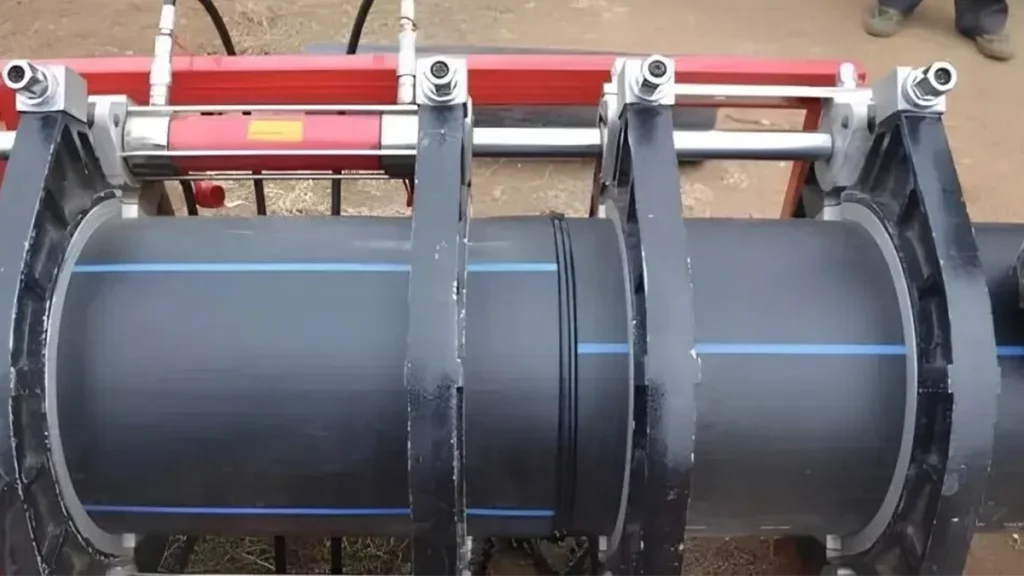
Beyond joint quality, training directly impacts the ROI of the butt fusion machines themselves. Untrained operators frequently abuse equipment through “rough handling”—a term defined in ISO 21307 regarding pipe movement, but equally applicable to butt fusion machine care. Common abuses include muscling hydraulic cylinders beyond their limit, contaminating heating plates with synthetic residues, or dragging the HDPE pipe jointing machine chassis across abrasive terrain without engaging the transport rollers.
Certified training programs cover preventative maintenance: how to clean facer blades, check hydraulic fluid levels, and protect the delicate Teflon coating on heater plates. An educated operator acts as the first line of defense against equipment degradation. Consequently, fleets operated by certified teams see significantly lower annual maintenance costs and longer intervals between major overhauls, preserving the asset’s value over its 5-10 year operational life.
—
Who Provides Training? Categorizing Butt Fusion Certification Providers
Navigating the certification landscape can be confusing for procurement managers. Training generally falls into three categories, each serving a different function in the compliance ecosystem.
Compare Manufacturer-Led Training (OEMs) vs. Third-Party Technical Institutes vs. Distributor On-Site Training
Manufacturer-Led Training (OEMs): Companies like Ekberg Welding provide deep-dive technical training focused on the specific mechanics and software of their equipment. This is critical for mastering advanced features like CNC automation and data logging. The primary advantage is depth; operators learn how to troubleshoot the specific hydraulic logic of the butt fusion machine they will use daily.
Third-Party Technical Institutes: Organizations independent of brands often offer “agnostic” certification. These courses focus heavily on the physics of polymers and general standards (ASTM/ISO). They are excellent for establishing a baseline of theoretical knowledge but may lack the hands-on specificity for operating complex, proprietary CNC interfaces.
Distributor On-Site Training: Local distributors often provide commissioning training. While convenient, the quality varies significantly based on the distributor’s technical depth. This is best suited for refresher courses or basic operational familiarization rather than comprehensive Operator Qualification (OQ).
HDPE Pipe Welding Training: General Course vs Machine-Specific Training
A general HDPE Pipe welding course teaches the concept of fusion: “Heat the HDPE pipe until a bead forms.” A butt fusion machine-specific course teaches the *execution*: “On the Ekberg 1000mm Hydraulic Series, navigate to the parameter menu, select PE100, input the SDR rating, and verify the drag pressure sensor is calibrated to <0.2 bar variance.”
General courses often fail to address the software menu navigation of modern automatic butt fusion machines. An operator might know they need 220°C, but if they cannot program the PLC (Programmable Logic Controller) to maintain that temperature within a ±3°C tolerance, the theoretical knowledge is useless. Machine-specific training bridges the gap between polymer science and hydraulic application.
List key industry associations (e.g., Plastic Pipe Institute, PE100+ Association) that endorse specific certification programs
Credibility in training is driven by industry associations.
- The Plastics Pipe Institute (PPI): In North America, PPI guides the curriculum for many training programs, emphasizing ASTM standards.
- The PE100+ Association: Globally, this group focuses on high-quality polyethylene materials and endorses training that ensures the integrity of PE100 pipe networks.
- DVS (German Welding Society): Offers some of the most rigorous certification guidelines in the world, often required for projects in Europe and parts of Asia.
Any reputable training provider should reference these bodies in their curriculum materials.
Evaluate the pros and cons of online theoretical training vs. hands-on field certification for heavy-duty hydraulic machines
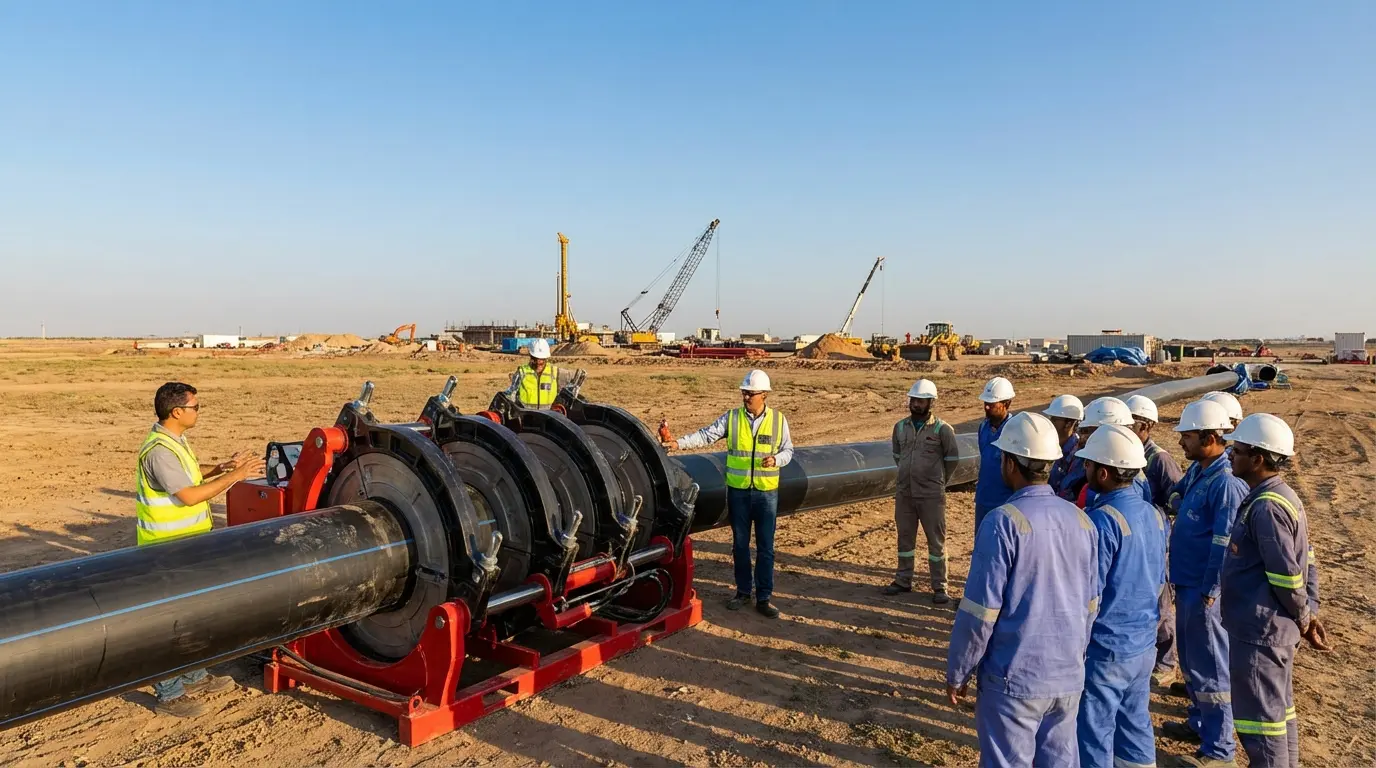
Online training has grown in popularity for the theoretical component—teaching the fusion cycle phases and safety protocols. It is cost-effective and scalable. However, for butt fusion machines—especially heavy-duty models ranging from DN630 to DN1600—online training is insufficient for full certification.
You cannot simulate the physical feedback of a hydraulic lever or the visual nuance of a bead rolling back properly through a screen. Hands-on field certification is non-negotiable for OQ. Operators must physically demonstrate they can align two tons of pipe, face the ends until continuous shavings appear, and manage the transition time (often <10 seconds for large diameters) safely and efficiently.
—
Core Curriculum: What a Certified Butt Fusion Operator Must Master
A robust certification program transforms a general laborer into a skilled technician. The curriculum must cover physics, mathematics, and data analysis.
Detail the physics of the fusion cycle: Interfacial pressure calculation, bead formation, heat soak, and cooling times
Operators must understand that fusion is a thermodynamic process, not just a mechanical one.
1. Bead Up: Applying pressure until the pipe ends conform to the heater plate.
2. Heat Soak: Reducing pressure to near zero to allow heat to penetrate the pipe wall without displacing molten material.
3. Transition: The critical removal of the heater plate.
4. Fusing/Cooling: Joining the pipes under calculated pressure.
The curriculum must teach the calculation of Interfacial Pressure (force per unit area) versus Gauge Pressure (what the machine reads).
Research standard operating parameters for HDPE (e.g., heating plate temperature 200-230°C, drag pressure calculation)
Measurable parameters are the language of certification. For HDPE (PE100), the standard heating plate temperature is typically 200–230°C (ISO 21307 specifies 215 ± 15°C). However, the most critical skill is drag pressure calculation.
The operator must learn to measure the pressure required to move the carriage *before* welding adds this to the theoretical fusion pressure.
- Formula: P₍gauge₎ = P₍theoretical₎ + P₍drag₎
- If the theoretical pressure is 0.15 MPa and drag pressure is 0.05 MPa, the gauge must read 0.20 MPa. Failing to add drag pressure results in a weak joint.
Explain the training required for Data Logging systems (inspecting joint reports, identifying false positives)
Modern infrastructure projects demand traceability. Training must cover the operation of Data Loggers—devices that record temperature, pressure, and time. Operators must learn to interpret these graphs. They need to identify “false positives,” such as a joint that looks correct on the pressure graph but where the operator failed to clean the pipe ends, resulting in a contaminated weld. Competency includes inputting operator IDs, job codes, and GPS coordinates into the system accurately.
Outline safety protocols for handling large-diameter hydraulic butt fusion machines (DN1000 to DN2600)
Safety training for large-diameter HDPE pipe welding machines is distinct from small-bore equipment. A 1600mm hydraulic butt fusion machine weighs several tons and involves hydraulic forces exceeding 100 bar. Curriculum points include:
- Crush Zones: Staying clear of the carriage movement.
- High Voltage: Managing 380V power supplies in wet field conditions.
- Stored Energy: Safely releasing hydraulic pressure before disconnecting hoses.
- Lifting: Proper rigging techniques for craning heavy chassis units into trenches.
—
Selecting the Right Butt Fusion Machine: A Prerequisite for Operational Success
The complexity of the machine dictates the difficulty of the training. Smart procurement can simplify the certification process.
Create a checklist for matching machine features (Manual vs. CNC) with operator skill levels
- Entry-Level Operators: Require CNC/Automatic machines. The machine handles the calculations and process steps, reducing the risk of human error.
- Expert Operators: Can effectively use manual butt fusion machine or hydraulic butt fusion machines. They have the experience to manually calculate drag and adjust pressure valves.
- Mixed Fleets: Standardizing on one control system (e.g., all Ekberg Hydraulic Series) simplifies cross-training.
Research how automatic CNC butt fusion machines reduce the training burden by automating the pressure/time cycle
Automatic butt fusion machines drastically reduce the “learning curve.” Instead of teaching an operator how to calculate drag pressure and manually adjust a relief valve, the training focuses on menu navigation.
For example, an Ekberg CNC automatic butt fusion machine automatically measures drag pressure and adds it to the fusion pressure. It also locks the hdpe pipe butt welder if the heater plate is not within the correct temperature range (e.g., ±3°C). This “poka-yoke” (mistake-proofing) design means the training can focus on safety and material handling rather than complex math.
Compare the learning curve for different machine chassis designs
The physical design impacts training time.
- Track-Mounted Systems: (Like Ekberg’s self-propelled units) are easier to position in rough terrain, requiring less training on external lifting equipment.
- Rolling Machines: Require more skill to stabilize and align in a trench.
- Removable Chassis: Systems where the heating plate and facer can be stripped down for tight spaces require training on assembly/disassembly to avoid damaging hydraulic couplers.
Analyze the importance of intuitive hydraulic control units and digital displays in shortening operator training time
An intuitive interface is a training accelerator. Butt fusion machines with clear, digital displays showing real-time pressure (bar/MPa), temperature, and countdown timers are far easier to learn than analog gauge systems.
Ekberg’s control units feature step-by-step visual prompts. If the butt fusion welding machine prompts “Open Carriage” or “Insert Heater,” the operator is guided through the process. This reduces the cognitive load and allows new operators to reach competency in days rather than weeks.
| Feature | Manual Machine | Automatic (CNC) Machine |
|---|---|---|
| Pressure Control | Manual Valve Adjustment | Auto-Calculated & Controlled |
| Temp Monitoring | Visual Check of Thermometer | Digital Interlock (Won't weld if cold) |
| Data Logging | External Device Required | Integrated & Auto-Uploaded |
| Training Time | High (2-3 Weeks) | Low (3-5 Days) |
| Human Error Risk | High | Low |
—
Ekberg Welding: Factory Capability, Technical Support, and Global Service
While certification is crucial, the support ecosystem provided by the manufacturer ensures that training translates to field success. Ekberg Welding positions itself not just as a hardware vendor, but as a partner in operational competency.
Describe Ekberg’s approach to operator empowerment through comprehensive digital manuals, video guides, and 24/7 remote technical support
Ekberg Welding integrates training directly into the ownership experience. We provide comprehensive digital manuals and step-by-step video guides that are accessible via QR codes directly on the butt fusion machine chassis. This allows operators to refresh their knowledge in the trench, right when they need it. Furthermore, our 24/7 remote technical support means that if a certified operator encounters an anomaly—such as a pressure fluctuation they haven’t seen before—they can transmit data to Ekberg engineers for immediate analysis, effectively extending the classroom into the field.
Detail the manufacturing quality control (ISO 9001) that ensures every Ekberg machine behaves predictably
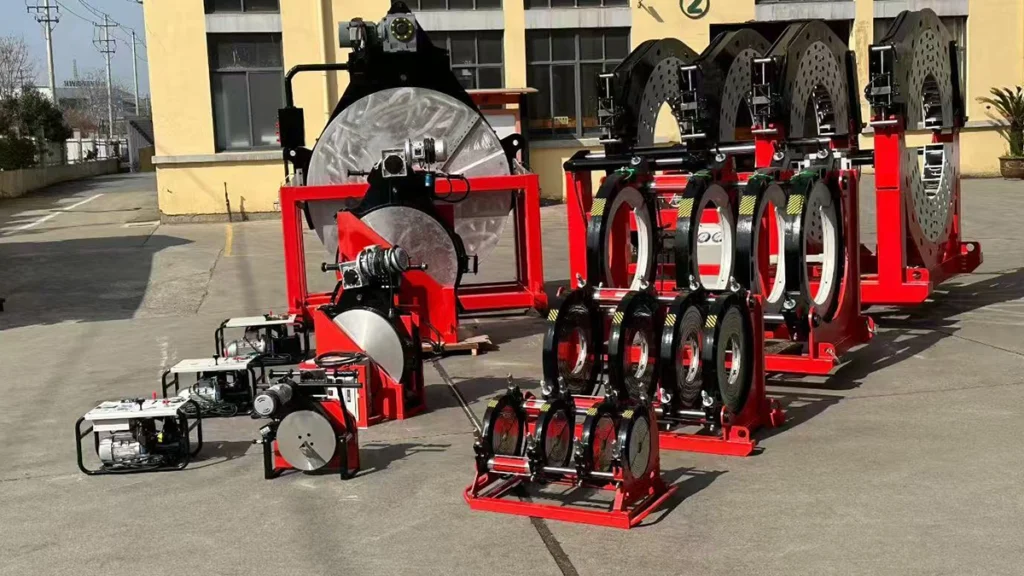
Standardized training requires standardized equipment. Ekberg operates under strict ISO 9001 quality control protocols. Every hydraulic cylinder, heating element, and control board is tested to ensure identical performance. This predictability is vital for training; an operator trained on an Ekberg 630mm hydraulic butt fusion machine in Dubai can fly to a project in Chile and operate an Ekberg 1000mm hydraulic butt fusion machine with the exact same interface and behavioral characteristics. This consistency reduces the need for retraining on every new asset.
Research Ekberg’s global logistics network and ability to provide spare parts (facers, heater plates) to training centers and job sites
Training centers and job sites cannot afford downtime. Ekberg’s global logistics network ensures that critical consumables—facer blades, heater plates, and hydraulic seals—are available rapidly. We actively support training centers by providing spare parts to ensure students are learning on fully functional, well-maintained equipment. A training course on a broken butt fusion machine is detrimental; Ekberg ensures that never happens.
Highlight the availability of multi-language interface options on Ekberg CNC machines to support diverse operator teams
Global infrastructure projects often involve multinational crews. Language barriers are a major training hurdle. Ekberg butt fusion machines feature multi-language CNC interfaces. An operator can toggle between English, Spanish, French, and other languages instantly. This feature ensures that the critical safety prompts and parameter data are understood clearly, regardless of the operator’s native tongue, drastically improving the effectiveness of on-site training.
—
Frequently Asked Questions
Q1: How often do butt fusion machine operators need to renew their certification?
Typically, certification remains valid for 1 to 3 years, depending on the specific standard (e.g., ASTM vs. ISO) and local regulations. However, if an operator has not performed a weld for a period exceeding 6 months, many standards require a refresher course or requalification weld to ensure their skills remain sharp and compliant with current safety protocols.
Q2: Can an operator certified on one brand of butt fusion machine legally operate an Ekberg machine?
Legally, yes, provided the certification covers the general fusion standard (e.g., ISO 21307) and the HDPE pipe welding machine type (hydraulic butt fusion). However, operational competency is specific. While the physics remain the same, the control interface differs. We strongly recommend a “bridge” training session to familiarize the operator with Ekberg’s specific CNC navigation and safety interlocks to ensure maximum efficiency.
Q3: What is the difference between destructive testing and data logger verification in certification courses?
Destructive testing (bend/tensile tests) physically breaks a sample joint to prove its strength and is essential during initial operator qualification. Data logger verification is a non-destructive process used in the field, analyzing the digital record of pressure and temperature to verify the joint was made according to parameters. Certification covers both: how to weld a test coupon and how to interpret digital data.
Q4: Does Ekberg Welding provide on-site commissioning and training for new machine purchases?
Yes. For significant fleet purchases or large-diameter custom butt fusion machines, Ekberg Welding offers on-site commissioning options. Our technical consultants travel to your job site to set up the equipment, calibrate the hydraulics for your specific environment, and provide hands-on training for your welding crew to ensure immediate operational readiness and warranty compliance.
Q5: What are the typical prerequisites (experience, education) for attending an advanced butt fusion technician course?
Prerequisites generally include a basic understanding of pipeline construction and mechanical aptitude. For advanced CNC or Data Logging courses, basic literacy and math skills (for pressure calculations) are required. No university degree is needed; the focus is on practical skill, attention to safety detail, and the ability to follow strict procedural standards without deviation.
—
Conclusion
The success of any high-pressure pipeline project rests on three pillars: high-quality butt fusion machines, strict adherence to global standards (ISO/DVS), and certified, competent operators. While various entities provide training—from third-party institutes to manufacturers—the effectiveness of that training is intrinsically linked to the equipment you choose.
Selecting reliable, automated equipment like Ekberg’s hydraulic series transforms the operator’s role from manual laborer to process technician. By automating critical calculations like drag pressure and providing intuitive, multi-language interfaces, Ekberg butt fusion welding machines reduce the risk of human error and simplify the path to certification.
Don’t leave your joint integrity to chance. Equip your team with butt fusion machines designed for compliance and ease of use.
Contact Ekberg Welding today for technical specifications, operation manuals, or to request a quote on our latest hydraulic fusion technology. Let us help you build a safer, more efficient pipeline project.