
Precision Butt Fusion Machine: ISO-Compliant Solutions for Global Pipelines
Table of Contents
For pipeline contractors and utility engineers, the objective is universal regardless of the geography: achieving joints that don’t leak and code compliance that doesn’t falter. Plastic Pipe Welding is the answer, acting as the critical intersection where material science meets mechanical precision. In the unforgiving environments of municipal water distribution, high-pressure gas transmission, and industrial mining slurry lines, a pipeline’s integrity hangs on its weakest weld. A single joint failure isn’t just a leak; it’s a recipe for environmental catastrophe, massive financial penalties, and crippling downtime.
While the industry leans on two dominant joining methods—Butt Fusion and Electrofusion—success relies entirely on rigorous engineering standards and the caliber of the equipment used. Whether you are fusing a massive DN1000 water main in a trench or running a DN63 gas service line, the margin for error is effectively zero.
This article acts as a definitive engineering guide for selecting, operating, and ensuring quality in plastic pipe welding processes. We will break down the technical specs of the modern butt fusion machine, navigate the complexities of international standards like ISO 21307, and offer a practical framework for building zero-defect pipeline networks.

—
The Fundamentals of Butt fusion Machine: Principles & Standards
Define and Differentiate: Butt Fusion vs. Electrofusion
To select the right methodology for your project, you first need to understand the core mechanisms of thermoplastic joining.
Butt Fusion Welding is a thermal fusion process. Here, pipe ends are heated against a coated plate and then driven together under controlled hydraulic force. The process is a four-phase cycle: facing (trimming ends until parallel), heating (soaking against a ~210°C plate until a bead forms), changeover (removing the plate), and joining/cooling (pressing ends together). The magic happens through co-crystallization; as the molten zones mix and cool under pressure, polymer chains entangle across the interface, forging a joint effectively as strong as the virgin pipe.
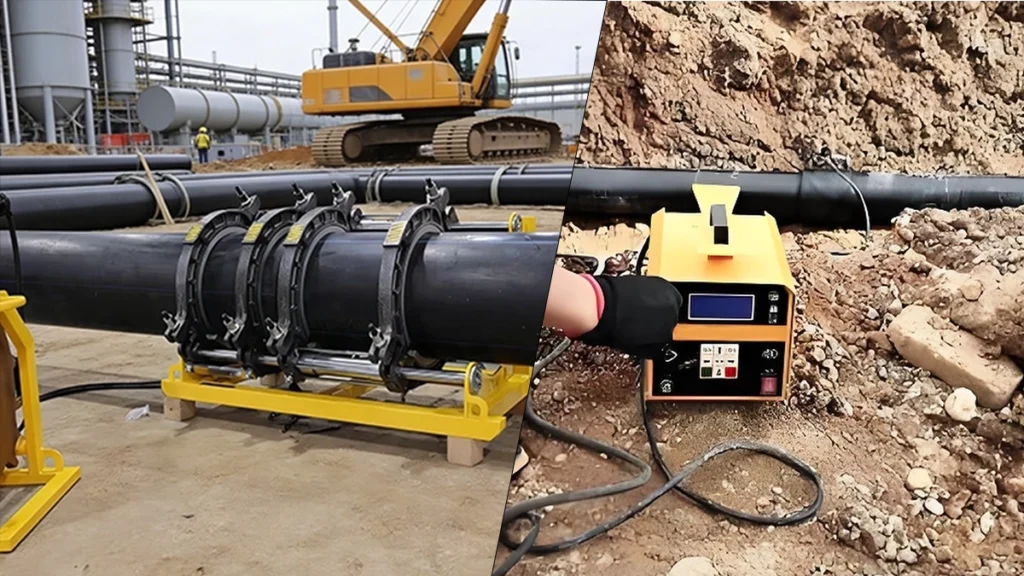
Electrofusion Welding takes a different approach, utilizing a specialized fitting with an embedded resistive heating coil. Pipe ends slide into the fitting, and an electrofusion control unit delivers a precise voltage to that coil. This generates heat, melting the fitting’s inner surface and the pipe’s outer surface. The material expands, generating its own joining pressure within that confined zone. While butt fusion is the go-to for long, straight runs and larger diameters due to cost-efficiency (no fittings needed), electrofusion machine is the hero of tie-ins, repairs, and tight corners where a hydraulic butt fusion machine simply won’t fit.
International Standards Governing Plastic Pipe Welding
In modern infrastructure, compliance isn’t just a checkbox; it is the currency of trust. The global plastic welding landscape is ruled by strict standards that dictate parameters, equipment performance, and operator chops.
ISO 21307 stands as the primary global authority for butt fusion of polyethylene (PE) pipes. It outlines specific process variants—Single Low Pressure (SLP), Dual Low Pressure (DLP), and Single High Pressure (SHP)—defining the exact pressure and time calculations needed for a sound weld.
EN 12007 is vital for European gas supply systems, setting the safety protocols for polyethylene pipelines. Meanwhile, DVS 2207, from the German Welding Society, is often viewed as the gold standard for stringency, detailing specific heating times and pressures that many high-performance industrial projects adopt as their benchmark.
In North America, ASTM F2620 dominates, focusing on the heat fusion joining of PE pipe and fittings. Knowing which standard your contract demands—whether it’s the high-pressure speed of ISO 21307 or the conservative soaking times of DVS 2207—is step one in equipment selection.
Thermoplastic Materials: Grades and Characteristics
The material dictates the butt fusion welding machine settings. High-Density Polyethylene (HDPE) is the most common, categorized by grades like PE 80, PE 100, and the newer PE 100-RC (Resistant to Crack).
PE 100 is the industry workhorse for pressure pipes, boasting a higher strength-to-density ratio than older generations. It generally demands a heating plate temperature of 210±5°C. PE 100-RC is engineered for abusive environments, such as trenchless installation or laying without sand bedding. It requires precise thermal control to preserve its resistance to slow crack growth.
MDPE (Medium Density Polyethylene) appears frequently in gas distribution (usually yellow or orange pipes). Its Melt Flow Index (MFI) differs from HDPE, meaning it flows more readily when heated. Consequently, welding pressures and cooling times must be dialed in to prevent the molten material from squeezing out of the joint entirely. A butt fusion machine without fine-grain pressure control can easily ruin MDPE joints by applying too much force.
Surface Preparation and Environmental Controls
Even the most sophisticated CNC automatic butt fusion machine cannot fix poor preparation. The integrity of a fusion joint is decided before the heating plate even touches the plastic.
Surface Preparation involves two non-negotiable mandates:
1. Square Cutting: Pipe ends must be planed perpendicular to the axis to guarantee 100% contact during the heating phase.
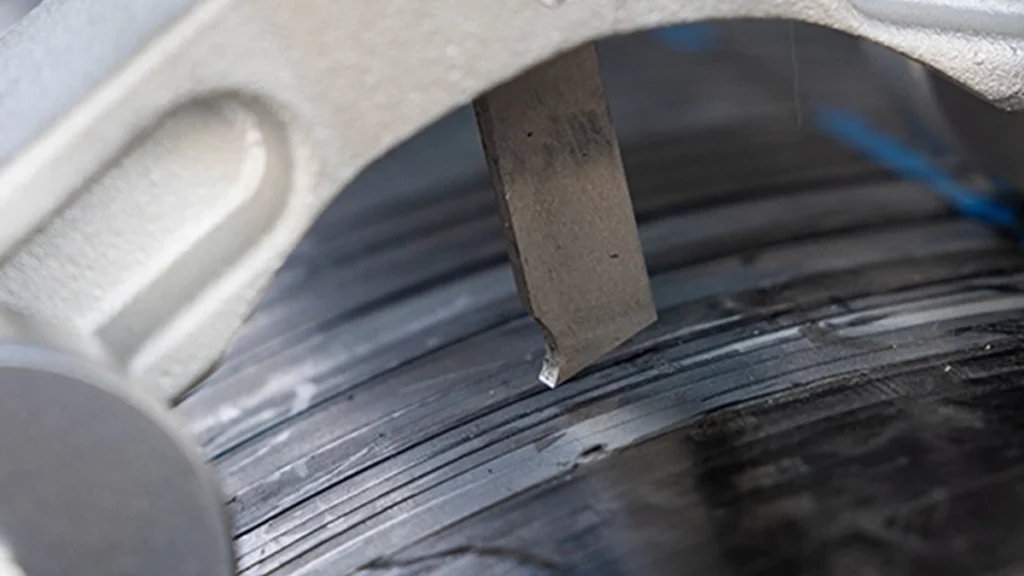
2. Oxidation Removal: All PE pipes develop an oxidation layer from UV and air exposure. This layer acts as a barrier to molecular fusion. You must use rotary scraping tools to peel off 0.2mm to 0.3mm of the outer surface. Alcohol wipes finish the job by removing dust and grease.
Environmental Controls are just as critical. Standards usually cap the ambient temperature range at -5°C to +40°C. Welding outside this window requires sheltering or pre-heating. Wind is the enemy; a stiff breeze can unevenly cool the heating plate or the molten pipe end, causing “cold joints.” Welding tents and end-caps aren’t optional accessories—they are mandatory for thermal stability.
—
The Plastic Pipe Welding Equipment Ecosystem: A Buyer’s Checklist
Comparison Matrix: Manual vs. Hydraulic vs. Automatic
Choosing the right butt fusion machine is a balancing act between budget, pipe diameter, and data integrity requirements.
| Feature | Manual Machines | Hydraulic Machines | Automatic (CNC) Machines |
|---|---|---|---|
| Typical Diameter Range | DN 40 – DN 250 | DN 40 – DN 2600 | DN 63 – DN 630 |
| Pressure Application | Hand-wheel / Lever | Hydraulic Pump (Manual Control) | Computer-Controlled Hydraulics |
| Data Logging | None | Optional (via external logger) | Integrated & Mandatory |
| Consistency | Operator Dependent | High (with skilled operator) | Extremely High (Process Repeatability) |
| Primary Use Case | Low-pressure drainage, small irrigation | Mainline water/gas, industrial | Critical gas/water infrastructure, mining |
| Cost Profile | Low | Medium | High |
For critical infrastructure, project owners are increasingly mandating Automatic (CNC) butt fusion machines. These units eliminate human error from the pressure/time cycle and automatically generate the weld record.
Selection Criteria for Electrofusion Welders
When picking an electrofusion control unit, specs need to match modern traceability demands. A robust unit should offer:
- Universal Compatibility: The ability to weld fittings from any manufacturer (plugs are typically 4.0mm or 4.7mm).
- Barcode/RFID Scanner: Essential for reading the 24-digit ISO 12176-4 compliance code on fittings, which automatically programs the weld time and voltage.
- Voltage Compensation: Site generators are notorious for fluctuating. High-quality welders stabilize input voltage (8V to 48V output range) to guarantee consistent energy delivery.
- Ambient Temperature Sensor: The butt fusion welding machine must tweak energy input based on air temperature to prevent under- or over-heating.
- Memory & Export: The capacity to store thousands of weld records (CSV/PDF) for transfer via USB or Bluetooth.
Essential Auxiliary Tools
A butt fusion machine is just the engine; you still need the rest of the car. The ecosystem requires auxiliary tools to ensure compliance.
- Pipe Cutters: Guillotine or rotary cutters are necessary for a perfectly square pipe end. Hacksaws are never acceptable; they create gaps the facing tool may not fully correct.
- Pipe Rollers: These support the pipe on either side of the butt fusion welding machine, reducing drag force (the effort needed to move the pipe) and ensuring alignment. Without rollers, the HDPE pipe welding machine fights ground friction, skewing pressure readings.
- Re-rounding Clamps: Large diameter HDPE pipes often ovalize during transport. Re-rounding tools force the pipe back into a perfect circle to match fittings or the opposing pipe end.
- De-beading Tools: Used to strip the internal or external weld bead for inspection or flow improvement.
Project-Based Selection Flowchart
Engineers should follow this decision logic to select the right gear:
1. Project Location: Trench installation or pre-fab?
- Trench: Needs rugged, compact butt fusion machines (e.g., track-mounted butt fusion units).
- Factory: Stationary workshop butt fusion machines with higher automation.
2. Criticality & Media: High-pressure gas or gravity sewer?
- *Gas/Water:* Requires Data Logging (CNC or Hydraulic + Logger).
- *Sewer:* Standard Hydraulic or Manual often suffices.
3. Diameter Scope:
- < DN 110: Electrofusion is often faster and cheaper.
- DN 110 – DN 315: The competitive zone; Butt fusion becomes more economical per joint here.
- > DN 315: Butt fusion is the standard choice for structural integrity and cost control.
—
Mastering the Welding Process: Parameters, Procedure & Quality Control
Critical Welding Parameters
A successful butt fusion weld hangs on adhering to parameters defined by the pipe’s diameter (DN) and Wall Thickness (SDR). A butt fusion machine must control three variables:
1. Temperature: For HDPE, the heating plate surface must sit at 210°C ± 5°C. Too low, and the material won’t plasticize; too high, and the polymer degrades.
2. Pressure:
- *Drag Pressure:* The hydraulic force needed just to move the carriage and overcome friction. This must be measured *before* every weld and added to the theoretical joining pressure.
- *Bead-up Pressure:* High pressure applied initially to ensure full contact with the heater plate.
- *Heat Soak Pressure:* Near-zero pressure (just enough to maintain contact) during the heating phase, allowing heat to soak deep without displacing material.
- *Joining Pressure:* The final force applied to fuse the molten ends.
3. Time:
- Heat Soak Time: Roughly 10 seconds per millimeter of wall thickness (standard dependent).
- Changeover Time: The critical window (often < 10 seconds) to remove the plate and smash the pipe ends together. Delay here allows the molten surface to cool and oxidize.
- Cooling Time: The joint must remain clamped under full pressure until the core temperature drops to roughly 60°C. Releasing early invites brittle failure.
Step-by-Step Qualified Procedure (WPS)
A Welding Procedure Specification (WPS) isn’t a suggestion; it’s a rulebook.
1. Environment Check: Verify temperature, wind, and dryness. Erect shelter if needed.
2. Equipment Calibration: Check heater plate temp with a digital pyrometer. Verify hydraulic oil levels.
3. Preparation: Clean pipe ends. Insert into clamps. Plane (face) the ends until a continuous ribbon of plastic is produced.
4. Alignment: Check for “High-Low” misalignment. It must not exceed 10% of the wall thickness.
5. Heater Insertion: Insert plate. Apply bead-up pressure until a uniform bead (approx. 1-2mm) appears around the circumference.
6. Heat Soak: Drop pressure to drag + soak value. Start the timer.
7. Fusion: Remove plate quickly (Changeover). Ramp up pressure smoothly to Joining Pressure.
8. Cooling: Hold pressure. Do not handle or stress the pipe until the cooling time is complete.
Visual and Destructive Testing
Quality control starts with the eyes. A good butt fusion weld displays a double rollback bead that is symmetrical and smooth. The width of the bead (“K” value) should be consistent.
- Fail Criteria: Voids, pores, misalignment >10%, or a bead that curls excessively (overheating) or looks square/sharp (underheating).
For critical projects, destructive testing is performed on test coupons:
- Tensile Test: Pulling the joint until failure. Ductile failure (stretching) in the pipe body is a pass. Brittle failure at the weld interface is a fail.
- Bend Test: Bending a strip of the weld to 160-180°. Any cracking at the fusion line signals a lack of fusion.
- McElroy McSnapper / Peel Test: Impact testing to see if the joint separates.
Weld Data Logging and Traceability
In the Industry 4.0 era, data is as valuable as the physical weld. Utilities increasingly demand full traceability. A modern butt fusion machine records:
- Operator ID and Certification Number.
- GPS Location of the joint.
- Pipe Material, Diameter, and SDR.
- Real-time graphs of Temperature, Pressure, and Time for every phase.
- Pass/Fail status based on the selected standard (ISO/DVS).
This data is encrypted and uploaded to asset management systems, creating a “birth certificate” for every joint in the network.
—
Manufacturing Excellence, Quality Control & Global Support
In-House Manufacturing and QC
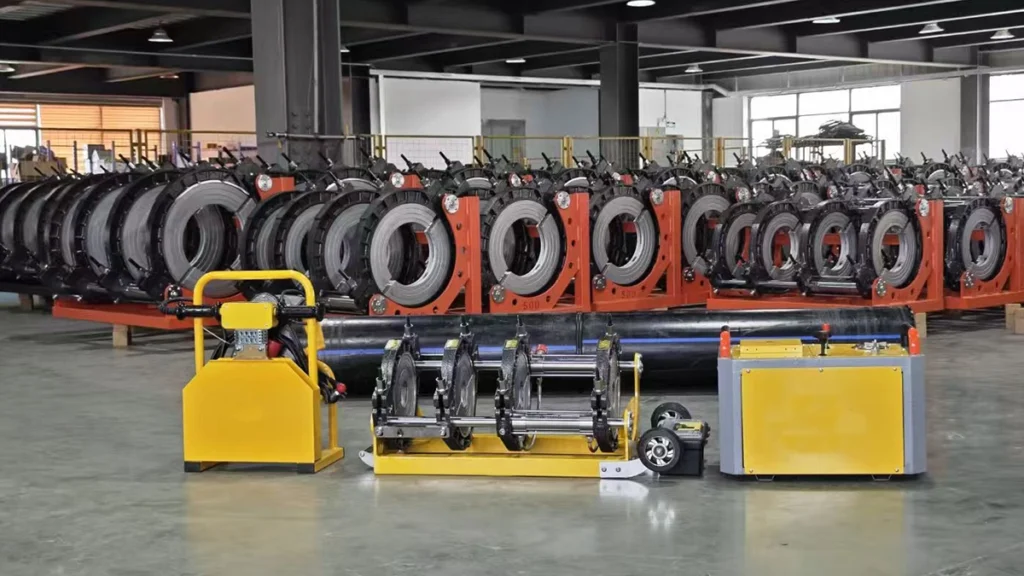
At Ekberg Welding, we treat a butt fusion machine as a precision instrument, not just heavy machinery. Our manufacturing process involves rigorous CNC machining of the chassis to ensure perfect clamp alignment—a deviation of even a millimeter can compromise a weld.
Every hydraulic system undergoes pressure testing at 1.5x maximum operating pressure to sniff out leaks. Heating plates are thermally mapped to ensure temperature uniformity across the entire surface; “cold spots” are not tolerated. We validate our software logic against ISO 21307 algorithms to ensure that when the butt fusion machine says “weld complete,” the physics back it up.
Structured Training and Certification
Owning the hdpe pipe welding machine is half the battle; knowing how to drive it is the other. We offer tiered training programs:
- Level 1 (Basic): Safety, butt fusion machine setup, and basic maintenance.
- Level 2 (Operator): Hands-on welding procedures, parameter calculation, and visual inspection.
- Level 3 (Supervisor): Data analysis, troubleshooting, and QA/QC management.
Certificates are valid for a specific period (typically 2 years) and serve as proof of competence for project owners.
Global After-Sales Service
Pipeline projects often happen in the middle of nowhere. Support must be accessible. Ekberg provides:
- Spare Parts Availability: We stock critical wear parts like planing blades, hydraulic seals, and electronic boards for immediate dispatch.
- Remote Diagnostics: Our automatic butt fusion machines can often be diagnosed remotely via data uplink, allowing our engineers to troubleshoot software or sensor issues without booking a flight.
- Calibration Services: ISO standards require annual calibration of pressure sensors and temperature probes. We offer rapid turnaround calibration services.
Engineering Support for Complex Projects
For non-standard applications—like welding thick-walled pipes for high-pressure mining slurry or retrofitting existing lines—our engineering team steps in. We provide Procedure Qualification Records (PQR) and develop preliminary Welding Procedure Specifications (pWPS). We also assist in site layout planning to optimize butt fusion welding machine movement and workflow, ensuring high productivity on large-scale installations.
—
Frequently Asked Questions
Q1: What is the main difference between butt fusion and electrofusion, and when should I choose one over the other?
Butt fusion joins pipes by heating ends and pressing them together, requiring no additional fittings. It is the cost-effective winner for long, straight pipelines (DN 63 and up). Electrofusion uses fittings with built-in heating coils. It is ideal for confined spaces, repairs, tie-ins, or when the butt fusion machine cannot physically access the pipe. However, electrofusion generally costs more per joint due to the fittings.
Q2: How critical is pipe scraping, and what happens if the oxidation layer is not fully removed?
Pipe scraping is non-negotiable. Polyethylene oxidizes when exposed to air and UV light. This oxide layer acts as a contaminant that prevents molecular fusion. If you don’t remove it (0.2-0.3mm depth), the joint may look fine visually but will have zero structural strength and will likely fail under pressure (brittle failure). Alcohol wipes alone won’t cut it; physical removal is mandatory.
Q3: Can I weld pipes from different manufacturers or of different PE grades together?
Generally, yes, provided they are compatible materials (e.g., both PE 100) and have the same Melt Flow Index (MFI) range. ISO standards allow welding PE 80 to PE 100, though the lower strength material limits the system’s rating. However, welding pipes with different wall thicknesses (SDRs) requires special techniques or machining to match the bore; otherwise, stress concentrations occur. Always consult the pipe manufacturer’s guidelines first.
Q4: What are the most common causes of weld failure, and how can they be prevented?
The usual suspects are poor surface preparation (skipping the scrape), contamination (dust/grease), misalignment, and incorrect parameters (wrong pressure or cooling time). “Cold joints” caused by taking too long during changeover are also common. Prevention is simple: rigorous operator training, using calibrated automatic butt fusion machines, and adhering strictly to the clean-scrape-align-weld protocol.
Q5: Do your machines come with pre-set welding parameters, and can they be customized?
Yes. Ekberg automatic butt fusion machines come pre-loaded with parameters for major standards like ISO 21307, DVS 2207, and ASTM F2620 for all standard pipe diameters and SDRs. Furthermore, the software allows for “User Defined” modes where specific parameters can be manually input if a project requires a specialized, non-standard procedure approved by an engineer.
—
Conclusion
Successful plastic pipe welding is not simply a construction task; it is a controlled manufacturing process performed in the field. It demands a synergy of three pillars: a deep understanding of polymer science, strict adherence to qualified procedures, and the use of high-precision equipment. Whether you are using a manual unit for irrigation or a fully automatic butt fusion machine for a high-pressure gas main, the goal remains the same: a joint that outlasts the pipe itself.
At Ekberg Welding, we are committed to providing not just the machinery, but the technical ecosystem—from training to traceability—that ensures your infrastructure stands the test of time.
Ready to upgrade your projects? Contact Ekberg’s engineering team today for a personalized equipment consultation, request a quote for our ISO-compliant fusion systems, or schedule certified operator training for your crew. Ensure your next project is leak-free and built to last.