
ISO & ASME Standards That Influence Pipe Welding Machine Pricing
Table of Contents
Introduction
An automatic pipe welding machine that holds stable fusion pressure at 220°C isn’t just a tool; it is the primary firewall against joint failures that can drain a contractor’s budget by upwards of $15,000 per incident. For pipeline engineers and procurement officers, the initial sticker price often overshadows the complex engineering required to satisfy strict safety codes. However, when a DN400 water main bursts because of a cold weld, the upfront savings on non-compliant gear evaporate instantly. You are left with the crushing costs of excavation, environmental cleanup, and a damaged reputation.
This guide breaks down the technical and regulatory factors driving equipment costs, specifically how ISO 21307, DVS 2207, and ASME B31 standards dictate the engineering of hydraulic and control architectures. We will examine the hardware necessary for compliance, compare the CAPEX of plastic fusion against metal orbital systems, and offer a framework for calculating ROI based on failure mitigation. By the end, you’ll have a solid method for conducting an automatic pipe welding system cost analysis to select equipment that balances fiscal responsibility with absolute pipeline integrity.
—
Decoding the Regulatory Landscape: How ISO & ASME Standards Drive Engineering Costs
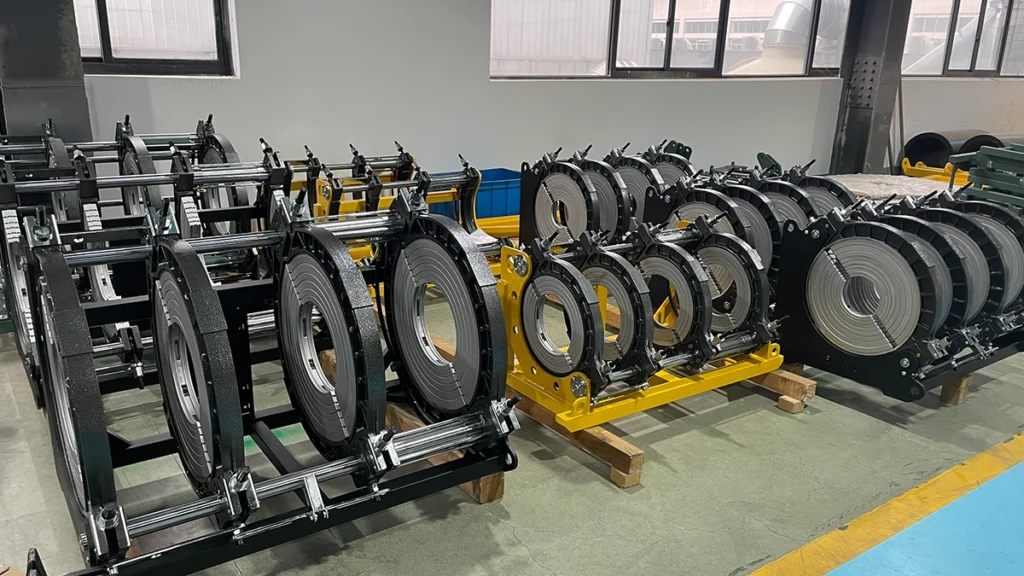
The price tag of an automatic pipe welding machine depends heavily on its ability to reliably execute the complex fusion algorithms mandated by international bodies. Manufacturers can’t simply bolt a heater and a hydraulic pump to a metal frame; the equipment must be engineered to replicate specific pressure curves and thermal cycles without human interference. The price gap between a generic welder and a compliant butt fusion machine comes down to the precision of these control loops.
ISO 21307 & DVS 2207: The Benchmark for Plastic Pipe Fusion
ISO 21307 and DVS 2207 are the bibles of HDPE butt fusion, imposing rigorous demands on pipe welding machine performance. ISO 21307 outlines three distinct fusion procedures: Single Low Pressure, Dual Low Pressure, and Single High Pressure. The “Single High Pressure” method is particularly demanding, requiring the HDPE pipe welding machine to exert significantly higher interfacial pressures (up to 0.52 MPa in certain applications) to slash cooling times.
To hit these targets, the butt fusion machine’s hydraulic system must be over-engineered. A standard pump designed for low-pressure fusion will overheat or lose pressure during the cooling phase if pushed to “High Pressure” limits. Furthermore, DVS 2207 requires strict adherence to heat soak times, calculated as $10 \times \text{Wall Thickness (mm)}$. The machine’s PLC (Programmable Logic Controller) must be programmed to physically lock the chassis, preventing the operator from opening the clamps before the calculated cooling time—often 20 to 40 minutes for thick-walled pipes—is finished. This level of software logic and hydraulic stamina drives up base engineering costs but guarantees a joint capable of meeting the pipe’s 100-year design life.
ASME B31 Codes: Relevance to Pressure Piping Systems
While ASME B31.1 (Power Piping) and B31.3 (Process Piping) are usually linked to metal piping, their influence runs deep in the plastic fusion sector, especially for industrial and nuclear applications. These codes establish a safety culture demanding traceability and procedure qualification. For an automatic pipe welding machine to survive in an ASME-governed environment, it must support the execution of a written Welding Procedure Specification (WPS).
This means the machine cannot merely operate; it must verify operation. The equipment needs the capability to restrict parameters to a pre-set range defined by the WPS. If an operator tries to fuse a DN250 pipe at 190°C when the WPS calls for 220°C, the system must lock out. Integrating this level of “poka-yoke” (error-proofing) requires advanced software development and sensor integration, transforming the equipment from a simple mechanical device into a smart compliance tool.
The Cost of Compliance: Data Logging and Traceability
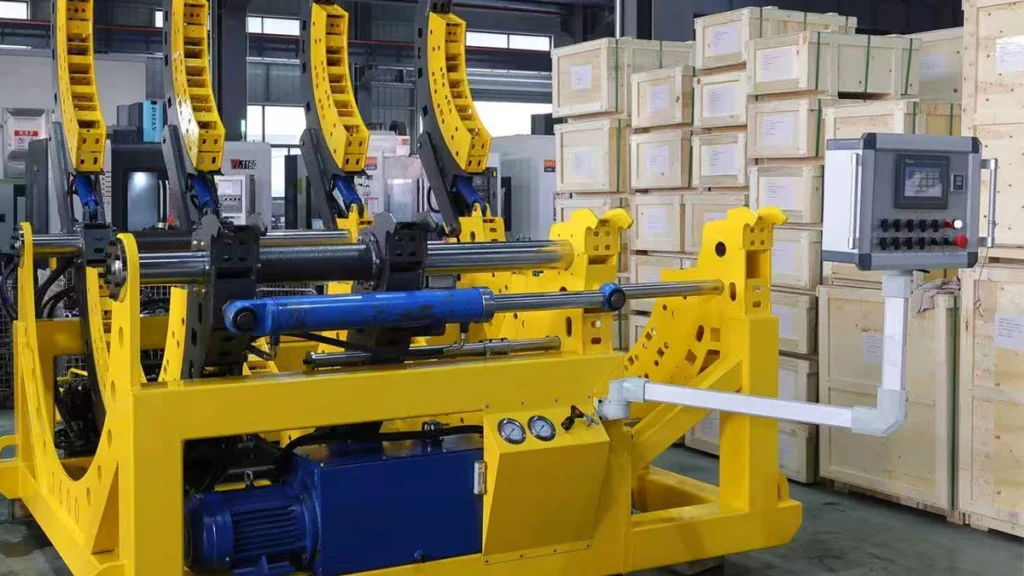
Compliance with ISO 12176-3/4 regarding data traceability is a massive driver in automatic pipe welding machine price factors. Modern infrastructure projects demand a “birth certificate” for every joint. This necessitates integrating onboard data loggers that record Operator ID (often via barcode scanner), Job Number, GPS location, ambient temperature, drag pressure, and the exact pressure/time curve of the fusion.
Implementing this requires robust hardware: industrial-grade touchscreens that survive -5°C to +50°C environments, internal memory for over 10,000 records, and connectivity modules (USB/DTU) for cloud transmission. A basic HDPE pipe jointing machine uses simple analog gauges; a compliant pipe welding machine uses digital pressure transducers and thermocouples that feed data into a secure, tamper-proof log. You aren’t just paying for sensors; you are paying for the guarantee that the data handed to the inspector is accurate and unalterable.
—
Automatic Pipe Welding Machine Price Factors: A Technical Breakdown
When conducting an automatic pipe welding system cost analysis, buyers need to look under the hood. The pricing disparity between premium manufacturers and budget options is usually found in the quality of control systems, chassis rigidity, and the thermal stability of heating elements.
Control Systems: PLC Sophistication and Sensor Accuracy
The brain of an Ekberg automatic welder is typically a Siemens S7-200 PLC or an equivalent industrial controller. Budget machines often rely on basic relay logic or proprietary, low-cost microcontrollers that lack processing power and stability. A high-end PLC allows for closed-loop control, meaning the system constantly monitors hydraulic pressure and adjusts pump output in milliseconds to maintain the target setpoint.
If a hydraulic leak springs or the pipe slips, a sophisticated PLC detects the pressure drop immediately. It triggers an alarm or aborts the weld to prevent a defective joint. Furthermore, the A/D (Analog-to-Digital) conversion modules used to translate sensor data into digital records must be high-resolution to ensure the recorded pressure matches the actual interfacial pressure. This electronic architecture represents a significant chunk of the butt fusion welding machine’s material cost but provides the reliability required for critical gas and water lines.
Hydraulics and Chassis Construction: Durability Under Load
The chassis is the automatic pipe welding machine’s skeleton. During the fusion cycle—particularly the bead-up and cooling phases—the butt fusion machine exerts tons of force to press pipe ends together. If the chassis flexes or warps under this load, pipe alignment shifts. This results in a “high-low” mismatch exceeding the $<10\%$ wall thickness tolerance allowed by ISO standards.
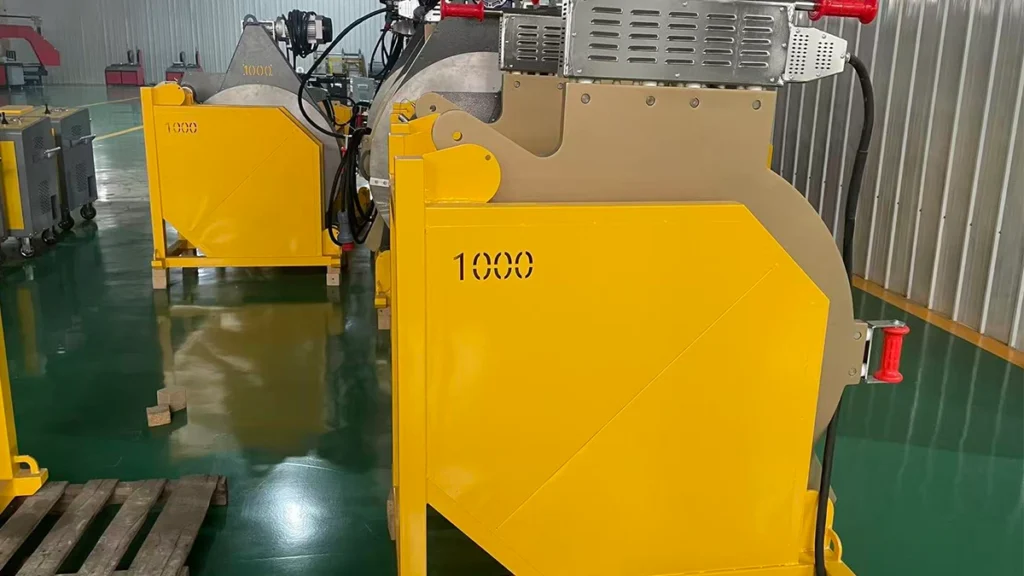
To prevent this, high-quality automatic pipe welding machines utilize heavy-duty aluminum alloy inserts and a rigid steel frame structure. The hydraulic cylinders are equipped with high-grade seals capable of holding pressure for hours without “weeping” (slow leaks). Cheap HDPE pipe welding machines often use lower-grade steel susceptible to bending or hydraulic components that lose pressure over time, compromising weld integrity during the critical cooling phase.
Heating Element Technology: Temperature Stability vs. Cost
Temperature control is non-negotiable. For HDPE (PE100), the heating plate must maintain a surface temperature between 200°C and 230°C. More importantly, the temperature distribution across the entire plate surface must be uniform, with a tolerance of $\le \pm3°C$.
Achieving this requires a high-quality heating element with a complex internal coil design and a multi-layer industrial PTFE (Polytetrafluoroethylene) coating. Budget heating plates often suffer from “hot spots” and “cold spots” due to poor coil layout. Worse, they may use thin PTFE coatings that wear off after a few hundred joints, causing plastic to stick to the heater. An industrial-grade heater also includes a mechanism for automatic pop-up/retraction, removing human reaction time from the changeover phase—a critical parameter in DVS 2207.
—
Comparative Market Analysis: Metal vs. Plastic Automation Costs
To understand the value proposition of HDPE equipment, it helps to look at the broader welding market, specifically comparing the orbital pipe welding machine cost breakdown for metal against plastic fusion systems.
Orbital Pipe Welding Machine Cost Breakdown vs. Butt Fusion
Automated orbital TIG welding systems for steel pipelines are marvels of engineering, but they carry a massive price tag. A complete system (power source, weld head, cooler, wire feeder) often ranges from $30,000 to over $50,000. In contrast, a high-spec, ISO-compliant automatic pipe welding machine for HDPE (e.g., in the DN315 range) typically costs between $9,000 and $12,000.
This price disparity—roughly 20-30% of the cost of metal automation—allows contractors to deploy larger fleets of HDPE fusion machines for the same capital expenditure. For a 50km water pipeline project, a contractor could purchase five automatic butt fusion machines for the price of two orbital steel welding setups, significantly accelerating the project timeline through parallel workflows.
TIG vs MIG Automatic Welding Machine Price Context
In the metal world, the TIG vs MIG automatic welding machine price debate often centers on speed vs. quality. MIG is faster and cheaper but less precise; TIG is cleaner but expensive and slow. HDPE butt fusion bypasses this trade-off entirely.
Because butt fusion is an autogenous process (fusing parent material with no filler), there are no consumable costs. An orbital metal welder requires shielding gas (Argon/Helium), tungsten electrodes, and filler wire—costs that accumulate daily. An HDPE automatic welder requires only electricity and occasional hydraulic oil changes. When calculating Total Cost of Ownership (TCO), the lack of consumables makes the plastic welding system exponentially cheaper to operate over a 5-year period.
System Integration Costs: Power Supply and Site Logistics
The hidden cost of automation often lies in power requirements. A heavy-duty orbital welding system for steel often demands 3-phase power or large 20kW+ diesel generators to maintain a stable arc.
Conversely, an Ekberg automatic pipe welding machine is remarkably energy efficient. A DN250 machine typically consumes around 3.7 kW. This allows contractors to use smaller, portable 5-8 kW generators (Honda or similar), reducing fuel logistics and rental costs. For remote mining or agricultural irrigation projects, this logistical simplicity translates directly to bottom-line savings.
—
ROI Calculation: When Does Automation Pay for Itself?
Moving beyond the initial purchase price, the ROI of an automatic pipe welding machine becomes clear when analyzing labor efficiency and risk mitigation.
Labor Savings and Efficiency Gains
Manual fusion requires the operator to monitor a stopwatch and manually adjust pressure valves. This often leads to “cooling time guessing,” where operators unclamp the pipe early to speed up the job. An automatic pipe welding machine eliminates this variable.
By automating the changeover and cooling phases, the butt fusion welding machine ensures the exact ISO-mandated cycle time is met—no more, no less. On a large-scale project like a 50km pipeline, saving just 2 minutes of “fumbling time” per joint across 4,000 joints equals 133 hours of labor saved. Furthermore, because the butt fusion machine handles the cooling cycle autonomously, the operator can prepare the next pipe segment or log data during the wait, effectively doubling productivity.
Reducing the Risk of Human Error and Rework
The most significant ROI factor is risk mitigation. The cost of a single failed joint in a buried municipal water line includes excavation, dewatering, cutting out the bad section, and re-welding. Industry estimates place this cost between $5,000 and $15,000 per incident, depending on depth and location.
If an automatic pipe welding machine prevents just two human-error-induced failures (e.g., insufficient pressure or cold fusion) over its lifespan, it has effectively paid for the price difference between a manual and an automatic unit. The pre-programmed welding recipes lock out the possibility of using the wrong parameters for a specific pipe SDR (Standard Dimension Ratio).
Long-Term Equipment Lifespan and Resale Value
ISO-compliant HDPE pipe welding machines with verifiable data logging capabilities retain their value significantly better than manual units. As regulations tighten, many utility companies are refusing to allow manual butt fusion machines on job sites. Consequently, a used automatic pipe welding machine with a maintenance history and calibration certificate commands a high resale value in the secondary market, whereas obsolete manual machines are becoming scrap metal.
—
Selection Checklist: Matching Machine Specs to Project Needs
When evaluating quotes, use this checklist to ensure you are comparing apples to apples in your automatic pipe welding system cost analysis.
Verifying Certification and Calibration Reports
Ask the manufacturer for the calibration protocols. A reputable vendor like Ekberg provides a calibration certificate traceable to national standards for pressure transducers and temperature probes. Verify how often recalibration is required (typically annually) and if the manufacturer offers a simple method for field verification.
Assessing Software Interface and Usability
The most advanced PLC is useless if the operator cannot understand it. Look for HDPE pipe jointing machines with multi-language support and an intuitive, icon-based interface. The software should guide the operator step-by-step: “Scan Operator ID” -> “Select Pipe Standard” -> “Confirm Diameter” -> “Start Cycle.” Complex, text-heavy interfaces increase the likelihood of setup errors.
Spare Parts Availability and Modular Design
In remote environments, a blown hydraulic hose shouldn’t stop the project for weeks. Evaluate the pipe butt welder for modularity. Are the hydraulic couplers standard ISO sizes? Are the seals commercially available industrial parts? Ekberg designs pipe welding machines with modular components to ensure that minor repairs can be performed in the field, minimizing downtime.
—
Ekberg Factory Capability: Quality Control & Global Support
In-House Manufacturing & Strict QA Protocols
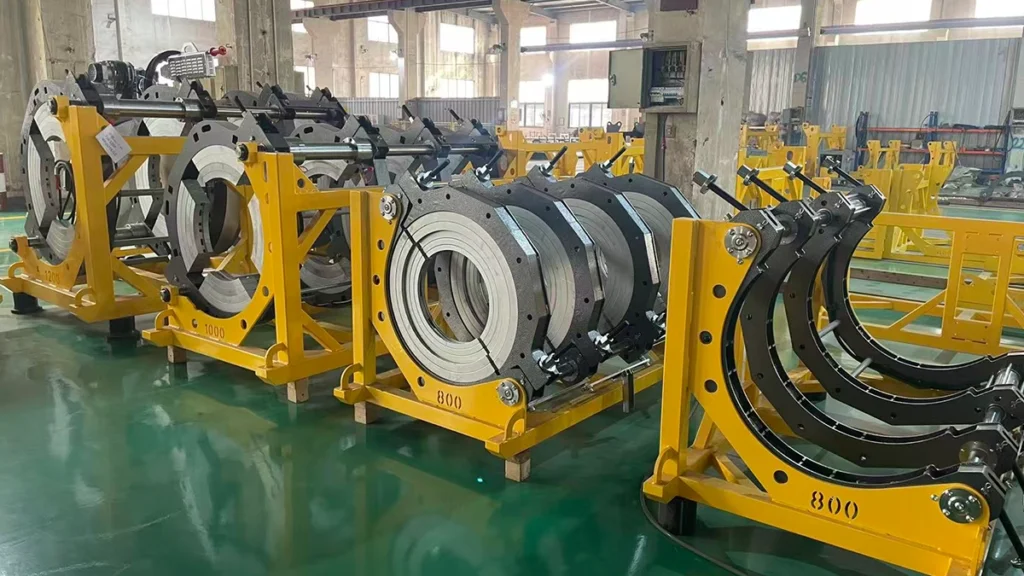
At Ekberg, we don’t just assemble components; we manufacture compliance. Every automatic pipe welding machine undergoes a rigorous Factory Acceptance Test (FAT). This includes a 24-hour pressure hold test to guarantee hydraulic integrity and thermal mapping of the heating plate to ensure the $\pm3°C$ uniformity required by DVS 2207. We welcome third-party inspections (TPI) to validate these metrics before shipment.
Direct-from-Factory Pricing Advantage
By purchasing directly from Ekberg, buyers eliminate the 30-40% markup typically added by regional distributors. This allows you to acquire premium, ISO-compliant technology at a competitive price point. We provide a transparent automatic pipe welding machine price structure that separates the machine cost from optional add-ons like data loggers or specialized inserts.
Technical Training and After-Sales Service
Owning the machine is half the battle; knowing how to use it is the other. Ekberg provides comprehensive training resources, including video tutorials on specific ISO procedures and remote troubleshooting via the machine’s DTU (Data Transfer Unit). We certify operators on our equipment, ensuring they understand not just which button to press, but why the pipe welding machine is reacting the way it is.
—
Frequently Asked Questions
Q1: How much does a standard automatic butt fusion machine cost compared to a manual one?
A standard ISO-compliant automatic pipe welding machine (e.g., DN315) typically ranges from $9,000 to $12,000, whereas a manual machine of the same size may cost between $800 and $1,500. The price difference reflects the addition of the PLC, hydraulic automation, sensors, and data logging hardware. However, the automatic machine drastically reduces labor costs and the risk of joint failure, offering a better long-term ROI.
Q2: Why is ISO 21307 compliance important for my welding machine purchase?
ISO 21307 dictates the specific pressure, time, and temperature parameters required to achieve a joint as strong as the pipe itself. A machine that cannot sustain the “Single High Pressure” or “Dual Low Pressure” parameters defined in the standard will produce weak joints. Compliance ensures your infrastructure meets global safety benchmarks and protects you from liability in the event of a pipeline failure.
Q3: Can Ekberg automatic pipe welding machines be used for both gas and water high-pressure pipelines?
Yes. Ekberg automatic pipe welding machines are engineered to meet the stringent requirements of both gas (highly regulated, often requiring DVS 2207) and water (ISO 21307) applications. The software allows operators to select the specific standard and pipe material (PE100, PE80, PP, PVDF), automatically adjusting the fusion parameters to meet the safety codes relevant to the medium being transported.
Q4: What is the typical maintenance schedule for an automatic pipe welding system?
Routine maintenance involves checking hydraulic fluid levels daily and inspecting the PTFE coating on the heating plate for scratches. A full calibration of pressure sensors and temperature probes should be performed annually to maintain ISO compliance. Hydraulic oil should typically be changed every 6-12 months depending on usage intensity. Ekberg butt fusion machines feature modular designs to make these service tasks quick and simple.
Q5: How does the butt fusion welding machine handling of cooling time affect the overall project speed?
The butt fusion welding machine enforces the exact cooling time required by the standard based on wall thickness. While this prevents operators from “cheating” and unclamping too early (which weakens the joint), it actually improves overall project speed by eliminating rework. Furthermore, because the machine holds pressure automatically, the operator is free to prepare the next joint or perform other tasks, optimizing workflow efficiency.
—
Conclusion
The price of an automatic pipe welding machine is a reflection of three critical factors: regulatory compliance (ISO/ASME), automation technology (PLC/Hydraulics), and material durability. While the upfront cost is higher than manual alternatives, the investment pays dividends through labor efficiency, risk mitigation, and project data traceability.
Buyers should look beyond the sticker price and consider the “Cost of Non-Compliance.” A machine that cannot verify its own work is a liability in modern infrastructure projects. By choosing equipment engineered for standards like ISO 21307 and DVS 2207, you aren’t just buying a welder; you are buying an insurance policy against failure.
Ready to equip your project with ISO-compliant welding technology? Contact Ekberg Welding today for a custom quote and a detailed automatic pipe welding system cost analysis tailored to your project needs.