
Why Automatic Pipe Welding Machine Deliver Higher ROI in 2026
Table of Contents
Operating at precise ISO 21307 parameters, an automatic pipe welding machine can slash joint failure rates by more than 60% compared to manual fusion, directly protecting project margins. For pipeline contractors dealing with tightening compliance mandates and shrinking delivery windows, the equipment in the trench is no longer just a tool—it is the deciding factor in profitability. While manual hydraulic units have been the industry standard for decades, the hidden costs of operator error, inconsistent cooling times, and failed pressure tests have become a liability in today’s infrastructure market.
This guide breaks down the economic and technical case for upgrading to CNC fusion technology. We will walk through a detailed ROI analysis regarding labor optimization, examine how automation enforces strict engineering standards like DVS 2207 and ISO 21307, and provide a transparent look at pricing factors for 2026. Furthermore, we analyze distinct application scenarios—from high-pressure gas networks to abrasive mining slurry lines—where the cost of a single failure dwarfs the initial equipment investment. By the end, you will have a clear, data-backed framework for selecting the right equipment for DN63–DN1600 projects, helping you avoid costly specification errors.
—
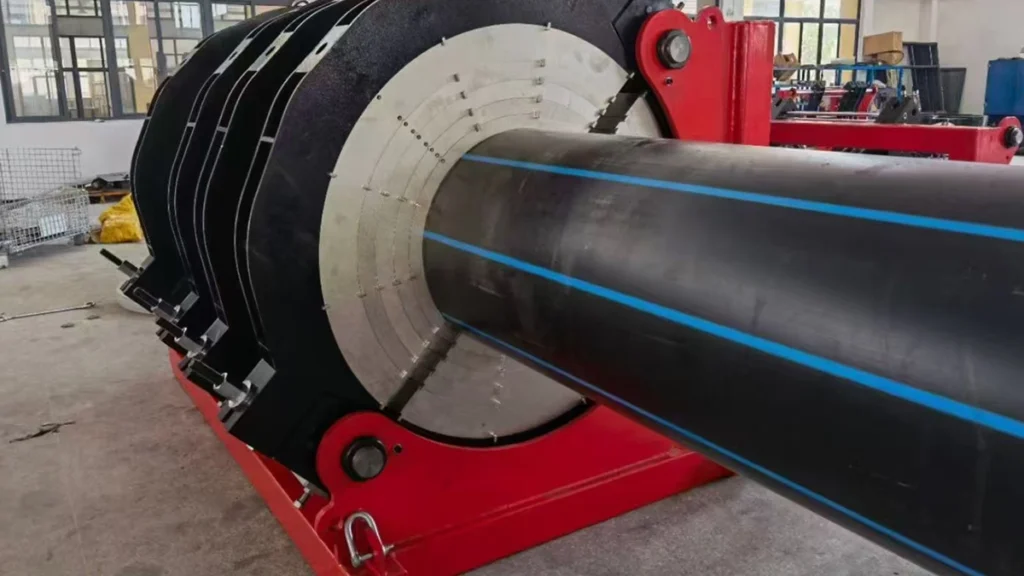
The Economics of Automation: Analyzing ROI and Labor Savings
Procurement teams often hesitate at the initial capital expenditure (CapEx) of an automatic pipe welding machine. However, when you view the purchase through the lens of Total Cost of Ownership (TCO), automation typically proves its value within the first 12 to 18 months. This rapid ROI is driven by three specific economic vectors: labor optimization, risk mitigation, and asset longevity.
Reducing Operator Dependency and Labor Costs
In a traditional manual welding setup for a 1km DN315 HDPE pipeline, success relies heavily on the “artistry” of the welder. The operator must mentally calculate drag pressure, watch a stopwatch for heat soak, and physically feather a hydraulic lever to maintain fusion pressure. This demands a highly skilled, highly paid technician—and often an assistant to manage logistics—bloating the crew size.
In contrast, an automatic welder with a CNC hydraulic station manages the entire fusion cycle programmatically. The butt fusion machine pulls exact parameters based on the pipe diameter and SDR (Standard Dimension Ratio). This reduces the reliance on “master” welders, allowing contractors to deploy operators with standard certification levels while maintaining superior output. Field data suggests that on long-distance projects, automated crews can cut labor hours by roughly 15-20% simply by eliminating the micro-pauses and hesitation inherent in manual calculations. Over a six-month timeline, the reduction in overtime wages and crew size significantly offsets the machine’s premium price tag.
Eliminating the Cost of Failed Joints
The strongest economic argument for automation is failure avoidance. Industry analysis places the cost to repair a single failed butt fusion joint underground—factoring in excavation, dewatering, cutting, new material, and re-welding—anywhere from $4,000 to over $15,000, depending on depth and location.
If a manual operator gets tired and releases clamping pressure two minutes early during the cooling phase, the joint might pass a visual check but fail under hydrostatic testing—or worse, rupture years later. An automatic pipe welding machine physically locks the hydraulic pressure during the cooling phase (maintaining, for example, 0.15 MPa + drag pressure) and refuses to release the clamps until the countdown hits zero. Preventing just two or three failed joints on a major municipal project covers the cost difference between a basic hydraulic unit and a fully automatic CNC system.
Speed and Efficiency Metrics
Welding speed isn’t just about heating time—physics and standards dictate that—but about the transition and preparation phases. Automatic butt fusion welding machines dominate the “changeover” time (removing the heating plate). Under ISO 21307, the maximum open time for a DN315mm pipe is roughly 8-10 seconds. A manual operator has to physically separate the pipes, heave a heavy heating plate out of the way, and bring the pipes back together.
Ekberg’s automatic systems use an auto-ejection mechanism for the heating plate, consistently executing this transition in under 5 seconds. Moreover, the HDPE pipe welding machine immediately applies the correct fusion pressure without the “ramp-up” delay common with manual pumping. Over 500 joints, saving 1-2 minutes per cycle on setup, transition, and data logging accumulates into days of saved project time, allowing contractors to hand over infrastructure ahead of schedule.
Long-term Asset Value
Finally, buyer strategy must account for resale and depreciation. Manual pipe welding machines are often treated as consumables; they endure rough handling and hold little resale value after 3-5 years. CNC automatic butt fusion machines, however, are viewed as capital assets. Because the control box records usage data and error logs, a used automatic machine comes with a verifiable “health history.”
The secondary market for verified, well-maintained automatic pipe butt welders remains robust. Contractors can often recover 40-50% of their initial investment after five years, provided the hydraulic and electronic systems have seen annual calibration. This residual value drastically lowers the effective annual cost compared to manual units that are frequently scrapped.
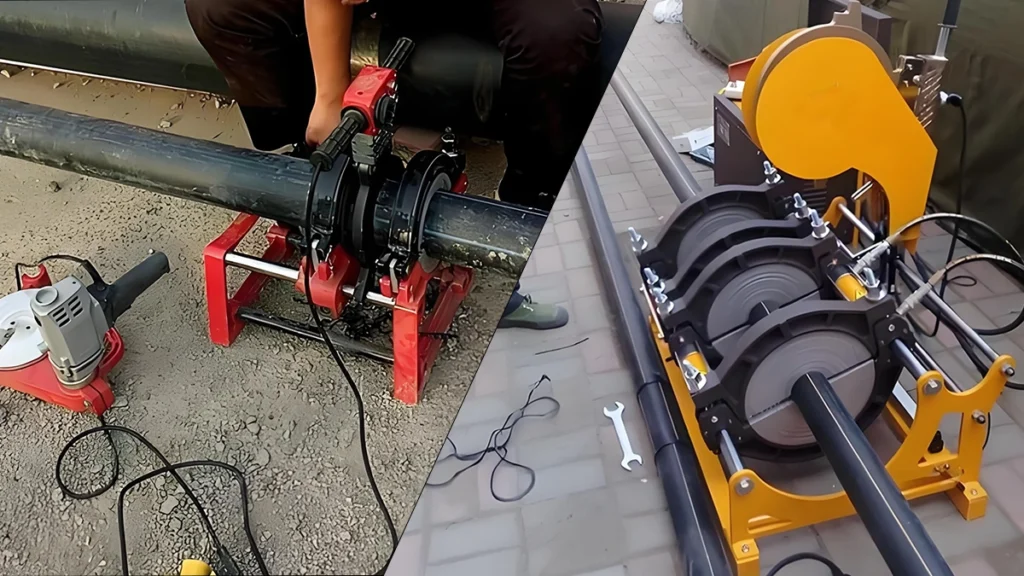
Technical Superiority: How Automatic Control Ensures Compliance
In 2026, compliance is not optional. Utility companies and auditors demand verifiable proof of quality for every meter of pipe installed. This is where the technical superiority of an automatic pipe welding machine acts as the project’s safety net.
Meeting ISO 21307 and DVS 2207 Standards
Welding standards like ISO 21307 (Global), DVS 2207 (German), and ASTM F2620 (North American) mandate precise windows for temperature, pressure, and time. For instance, ISO 21307 outlines Single High Pressure (SHP) fusion at roughly 0.52 MPa interfacial pressure, and Single Low Pressure (SLP) at roughly 0.15 MPa.
Hitting these targets manually is incredibly difficult. A manual gauge might flutter, or the operator might misread the parallax on the dial. Ekberg automatic machines come pre-loaded with these standard libraries. When the operator inputs “DN315, SDR 11, PE100,” the CNC unit automatically sets the heater plate to 220°C ±10°C and calculates the exact hydraulic force required in Newtons or Bar. The machine enforces these parameters without deviation, ensuring a joint welded at 8:00 AM matches the quality of one welded at 4:00 PM.
Data Logging and Traceability
For gas distribution and potable water networks, traceability is paramount. Modern automatic welders feature integrated data loggers that record critical variables for every joint:
- Ambient temperature
- Drag pressure (dynamic resistance of the carriage)
- Bead build-up pressure and time
- Heat soak time and temperature
- Fusion pressure and cooling time
This data is encrypted and stored internally. If a pipe fails five years later, the utility company can audit the specific weld ID to see if the parameters were correct. This level of forensic traceability protects the contractor from liability if the failure stems from material defects rather than installation error. Manual logging (handwritten notes) is increasingly rejected by project owners due to the risk of falsification or human error.
Precision Pressure Control Systems
The heart of the Ekberg automatic welder is its closed-loop hydraulic control system. During the cooling phase, plastic pipe shrinks, which naturally causes a drop in interfacial pressure. A manual operator would need to watch the gauge and pump the handle to compensate—a process prone to over-pressurization or neglect.
The automatic system uses sensitive pressure sensors to detect drops as small as 0.1 bar. The hydraulic station automatically engages micro-pumps to compensate and stabilize the pressure instantly, maintaining the required fusion force throughout the entire cooling cycle. This “smart pressure maintenance” prevents voids or brittle spots in the fusion zone, ensuring the joint achieves full tensile strength.
Error Detection Capabilities
Beyond maintaining parameters, the machine acts as a site supervisor. Modern CNC units are equipped with multiple alarm systems. If the heating plate temperature drops below the set threshold (perhaps due to strong wind or power fluctuation), the machine prevents the welding cycle from starting. If pressure drops suddenly during fusion (indicating a hydraulic leak or pipe slip), the cycle aborts and logs an error.
These safety cut-offs are critical. In a manual setup, an operator might try to “make it work” despite a temperature drop to avoid delays. The automatic machine prioritizes joint integrity over speed, preventing a sub-standard weld from ever being buried.
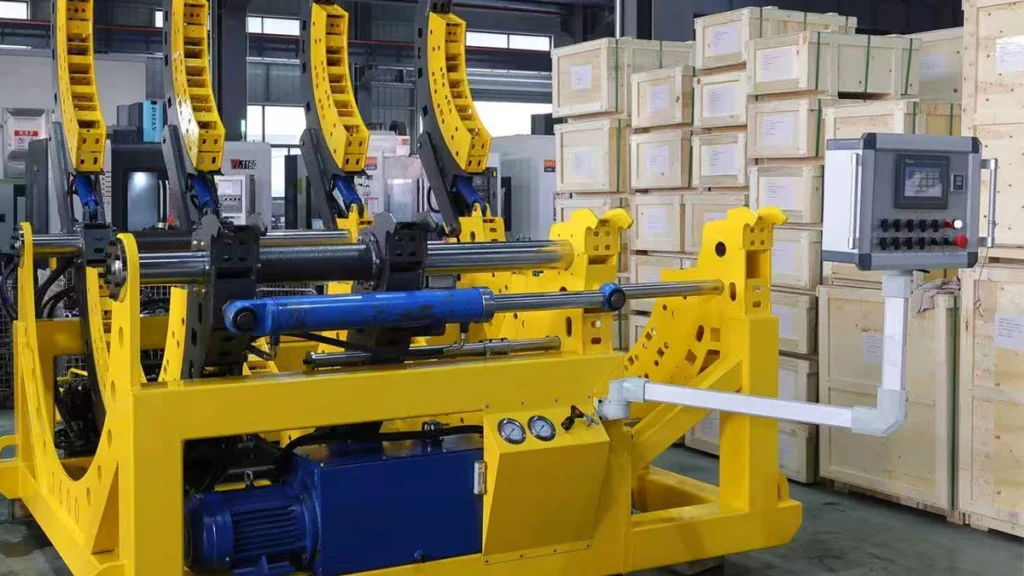
Breakdown of Automatic Pipe Welding Machine Cost Factors
Understanding the automatic pipe welding machine price breakdown is essential for procurement officers building a budget. The cost isn’t arbitrary; it reflects the integration of heavy mechanical engineering with sophisticated software control.
Understanding the Base Machine vs. CNC Unit Costs
Equipment price generally splits into two categories: the mechanical chassis and the control unit. The mechanical chassis (frame, clamps, planer, heater) accounts for roughly 50-60% of the cost. This covers high-grade steel framing to resist bending under high pressure and PTFE-coated heating elements.
The remaining 40-50% lies in the CNC hydraulic station. This unit houses the logic board (PLC), touch screen interface, data storage modules, and high-precision hydraulic valves. Unlike a manual pump, which is a simple mechanical device, the CNC unit is a computer capable of driving industrial hydraulics. This component drives the primary price difference between manual and automatic models.
Impact of Size Range on Pricing (40mm to 2600mm)
Pricing scales non-linearly with size. For smaller pipe welding machines (e.g., DN40mm–DN315mm), the gap between manual and automatic might be $4,000–$10,000. However, as you move to large-diameter pipes (DN630mm–DN2600mm), the stakes increase.
A DN1200 pipe is extremely heavy and requires massive fusion pressures that are physically impossible to manage manually with precision. Therefore, almost all large-diameter welding is automated or semi-automated. The cost for these butt fusion machines reflects the massive hydraulic power packs and reinforced steel structures required to manipulate tons of pipe. While the upfront cost is high, the cost of a single failed DN1200 joint (requiring cranes and road closures to fix) justifies the investment immediately.
Certification and Calibration Costs
When researching the cost of automatic pipe welding machine with certification, buyers must account for compliance. Reputable manufacturers like Ekberg include CE certification and initial ISO calibration in the purchase price. However, maintaining this certification requires annual calibration of pressure sensors and temperature probes.
While this adds a small recurring operational cost (OpEx), it is often a prerequisite for bidding on government or utility tenders. A machine without a valid calibration certificate is frequently disqualified from critical gas or water projects.
2024-2026 Price Trend Analysis
Looking at the automatic pipe welding machine price list 2024 and projecting into 2026, several factors influence costs. Raw material prices for steel and aluminum have stabilized, but the global semiconductor market affects CNC control units. As chips become more advanced to support cloud connectivity and IoT features, electronic component costs have seen a slight uptick.
However, logistics costs are normalizing. For 2026, we project a stable pricing environment, though buyers should anticipate longer lead times for butt fusion machines with specific custom software requirements. Locking in orders early is the best strategy to mitigate inflationary adjustments.
| Feature | Manual | Automatic / Hydraulic |
|---|---|---|
| Primary Cost Driver | Mechanical Frame & Pump | CNC Logic & Sensors |
| Operator Skill Needed | High (Master Level) | Moderate (Process Level) |
| Data Logging | Manual or Add-on | Integrated & Encrypted |
| Pressure Control | Manual Valve | Active Closed-Loop |
| Typical Range | DN40 – DN250mm | DN63 – DN2600mm+ |
| Est. Failure Rate | Variable (User Dependent) | < 1% (System Controlled) |
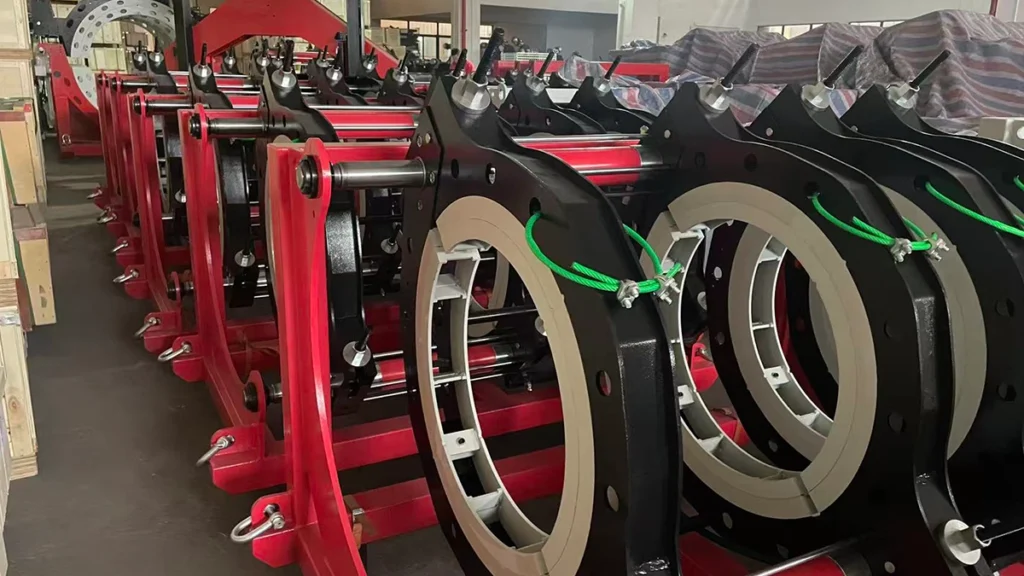
High-ROI Application Scenarios for Ekberg Automatic Welders
Not every project requires automation, but for high-stakes infrastructure, the industrial automatic pipe welding machine cost factors are negligible compared to the operational risks.
Critical Gas Distribution Networks
Natural gas pipelines operate under high pressure and pose severe safety risks. A leak here isn’t just an inconvenience; it’s a catastrophe. Consequently, utility companies globally mandate 100% data logging. An automatic pipe welding machine ensures that every joint meets specific “bead up” and “heat soak” requirements. The ability to download a PDF report of the day’s welds allows for real-time quality assurance, ensuring no trench is ever backfilled over a suspect joint.
Municipal Water and Desalination Projects
In large-scale water transmission (DN630+), the volume of water moving through the pipe is immense. A rupture can wash away road foundations and flood neighborhoods. Municipalities increasingly specify automatic fusion to guarantee the longevity of these assets (often expected to last 50-100 years). The precise cooling control of automatic pipe welding machines ensures the polyethylene structure crystallizes correctly, maximizing the pipe’s life expectancy.
Mining and Slurry Pipelines
Mining environments are brutal. Pipelines carrying slurry (ore mixed with water) face internal abrasion and external rough handling. Downtime in a mine can cost tens of thousands of dollars per hour. Ekberg automatic welders are designed with ruggedized chassis to withstand dust, heat, and vibration. Automation ensures welds remain consistent even when operators work long shifts in difficult conditions, preventing premature wear at the joint interface.
Agricultural Irrigation Upgrades
Modern agriculture relies on massive irrigation grids. While pressures are lower, the sheer volume of welds (thousands of joints per project) makes speed critical. An automatic butt fusion welding machine with auto-ejection can shave 2-3 minutes off every cycle. Multiplied by 2,000 joints, this accelerates project completion by weeks, allowing farmers to bring irrigation systems online before the growing season peaks.
Buyer’s Guide: Selection Criteria for Automatic Butt Fusion Machines
Selecting the right equipment requires looking beyond the brochure. Here is a checklist for procurement officers.
Evaluating Control System Interface
The best technology is useless if the operator cannot understand it. Look for machines with a multi-language interface and an intuitive, step-by-step graphical UI. The Ekberg system prompts the user through the process (e.g., “Insert Pipe,” “Milling,” “Check Alignment”), reducing the training barrier for new crew members.
Hardware Robustness Checklist
Inspect the physical build:
- Heating Plate: Is the PTFE coating double-layered to prevent sticking?
- Planer: Does it use reversible blades to double service life?
- Hydraulics: Are quick-couplers flat-faced to prevent dirt ingress?
- Seals: Are cylinder seals rated for the temperature extremes of your job site?
Compatibility with Third-Party Data Systems
Data is only valuable if it is accessible. Ensure the machine can export data via USB or Bluetooth. Advanced buyers should check if the output format (usually CSV or PDF) is compatible with their project management software. Ekberg machines support cloud connectivity, allowing off-site engineers to review welding parameters in real-time.
Warranty and Spare Parts Availability
An automatic machine is a complex system. Verify the manufacturer’s warranty terms (standard is 1 year) and, crucially, their spare parts logistics. A cheap machine becomes expensive if you wait six weeks for a replacement circuit board. Ekberg maintains a global inventory of critical spares—sensors, screens, and seals—to ensure rapid dispatch.
Ekberg Factory Capability: Manufacturing Excellence & Global Support
When you invest in an Ekberg automatic pipe welding machine, you are buying into a manufacturing ecosystem designed for quality.
In-House CNC Machining and QA
Unlike assemblers who buy parts off the shelf, Ekberg butt fusion machines the hydraulic cylinders and steel frames in-house. This vertical integration allows us to control the tolerances of the clamping mechanism, ensuring perfect alignment of the pipe ends—a critical factor for passing ISO visual inspections.
Rigorous Testing Protocols
Every HDPE pipe jointing machine undergoes a strict testing regime before crating. This includes a 24-hour pressure holding test to detect micro-leaks in the hydraulic system and thermal mapping of the heating plate to ensure temperature uniformity across the entire surface. We do not spot-check; we validate every unit.
Global Logistics and After-Sales Service
We understand international commerce. Our logistics team handles customs clearance documentation and ensures robust crating for sea or air freight. Post-purchase, our technical support team is available for remote diagnostics. Via the machine’s data port, our engineers can often troubleshoot software or sensor calibration issues remotely, saving the cost of a site visit.
OEM/ODM Customization
For large distributors and rental fleets, we offer deep customization. This ranges from branded paint schemes to custom software parameters that lock machines to specific project standards.
Frequently Asked Questions
Q1: What is the main difference between a semi-automatic and a fully automatic pipe welding machine?
A semi-automatic hydraulic butt fusion machine (often called “Data Logger Ready”) requires the operator to manually move hydraulic levers to apply pressure, though a computer records the data. A fully automatic pipe welding machine uses a CNC hydraulic station to physically control movements, pressure application, and timing without operator intervention during the weld cycle. This removes human physical error from the pressure application process.
Q2: How does the automatic pipe welding machine price compare to manual models for DN315 sizes?
For a standard DN315 model, a fully automatic CNC butt fusion machine typically costs 3 to 4 times more than a basic manual hydraulic unit. However, this price includes the computer, sensors, and automated hydraulics. When factoring in the cost of a data logger (often sold separately for manual units) and labor savings, the price gap narrows significantly, with ROI often achieved within one year.
Q3: Can Ekberg automatic machines be updated with new welding standards (e.g., if ISO standards change)?
Yes. The Ekberg CNC control system runs on updatable firmware. If ISO 21307 or DVS 2207 standards are revised, or if a new material type (like a new grade of PP-R) is introduced, the machine can be updated via the USB port. This ensures your asset remains compliant with future regulations without needing hardware replacement.
Q4: What are the maintenance requirements for the CNC hydraulic station?
The CNC station requires clean, dry hydraulic oil, typically changed annually. The most critical maintenance is calibrating the pressure sensor and temperature probe, which should be done once a year to ensure accuracy. Additionally, electrical connections should be inspected for corrosion, and cooling fan filters cleaned to prevent overheating.
Q5: Does the machine generate welding reports automatically for project handovers?
Yes. After every joint is completed, the machine generates a welding report including the date, time, operator ID, weld parameters (pressure, time, temperature), and a Pass/Fail result. These reports can be exported as encrypted PDF or CSV files via USB or Bluetooth, ready for immediate submission to project inspectors or utility auditors.
The Bottom Line
The shift toward automation in pipeline infrastructure is driven by a simple equation: precision equals profitability. While the upfront investment in an automatic pipe welding machine is higher than traditional manual units, the return on investment is secured through reduced labor costs, faster project completion, and the elimination of expensive joint failures.
In 2026, as project owners demand stricter adherence to ISO 21307 and verifiable data logging, reliance on manual “best guesses” is a liability contractors can no longer afford. The industrial automatic pipe welding machine cost factors are heavily outweighed by the asset’s ability to deliver zero-defect networks, ensuring you get paid faster and avoid retention penalties.
Ready to future-proof your fleet? Contact Ekberg Welding today for a customized ROI consultation and to receive our latest automatic pipe welding machine price list. Let us help you select the precise configuration that meets your project’s technical and budgetary requirements.