
HDPE Pipe Welding Machine MOQ Guide for Buyers
Table of Contents
Introduction
Choosing the right HDPE pipe welding machine for high-pressure gas or water lines is more than a procurement task; it is a decision that directly impacts project safety and profitability. When a contractor is staring down a strict deadline, the equipment’s ability to hold a heating plate temperature at exactly 220°C ±5°C—and maintain precise fusion pressure—is the only thing standing between a successful pressure test and a catastrophic joint failure. A single failed weld can easily cost $15,000 in excavation and rework. Yet, procurement teams often find themselves navigating a maze of confusing pricing structures, Minimum Order Quantities (MOQ), and rigid customization rules.
This guide is designed to cut through that noise. We will explore the technical differences between semi-automatic and CNC systems, break down exactly where your money goes in unit costs, and look at how to calculate the real ROI of automation through labor savings. We will also clarify sourcing logistics, explaining how Ekberg’s flexible manufacturing policies work for everyone—from the contractor needing a single unit for a rush job to the distributor stocking a fleet. By the end, you will have a solid framework for selecting the right equipment for DN63–DN1600 HDPE projects, helping you avoid costly specification errors.

Defining the HDPE Pipe Welding Machine Landscape
Before signing a purchase order, it is vital to understand the equipment hierarchy. While the market offers manual, semi-automatic, and fully automatic options, industrial infrastructure projects typically demand a choice between hydraulic semi-auto and CNC (Computer Numerical Control) systems.
Distinguishing Between Semi-Automatic and Fully Automatic (CNC) Systems
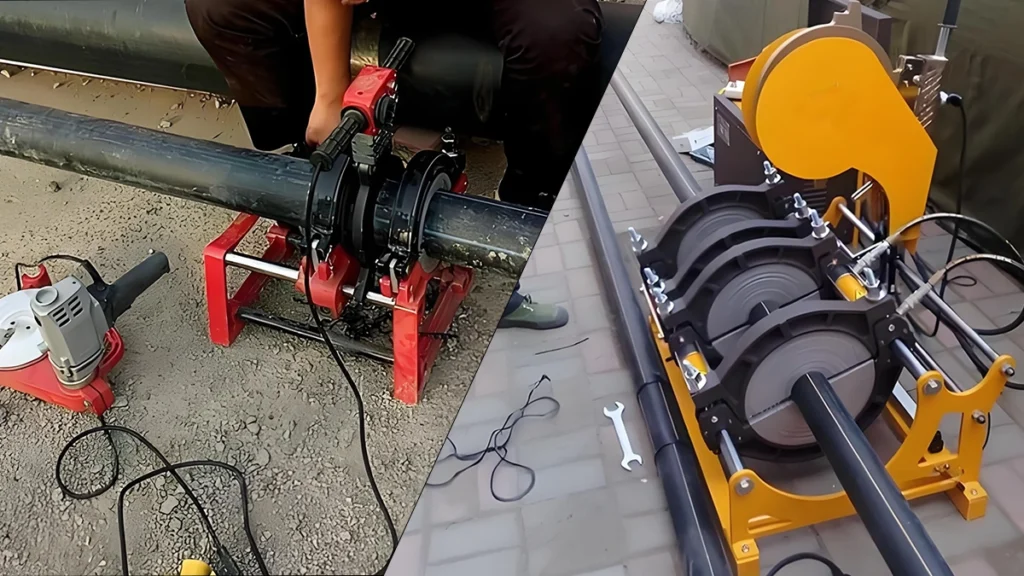
A semi-automatic hydraulic butt fusion machine is cost-effective, but it relies entirely on the operator’s skill. The hydraulic station provides the muscle, but the human operator must toggle the levers to move the chassis and manually time the heat soak and cooling phases. This introduces a significant variable: human error. Maintaining consistent drag pressure manually is difficult, even for experienced technicians.
An automatic hdpe pipe welding machine (CNC) eliminates this guesswork by using a closed-loop control system. The operator simply inputs the pipe parameters—such as diameter (e.g., DN315) and SDR rating—and the machine’s PLC (Programmable Logic Controller) takes over. It calculates the required fusion pressure, heat soak duration, and cooling time based on standards like ISO 21307. The system electronically controls the hydraulic valves, keeping pressure stable within 0.01 MPa of the target. For buyers, the trade-off is clear: semi-automatic units offer a lower entry price, while CNC systems guarantee the consistency and compliance increasingly mandated by municipal utilities.
Core Components Driving Machine Capabilities
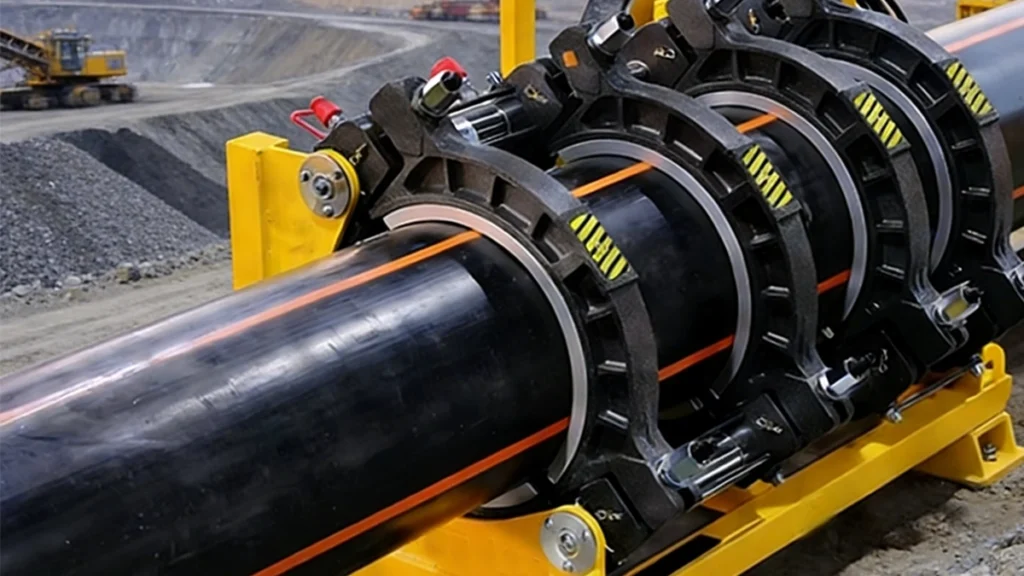
A butt fusion machine is only as good as its components: the chassis, planing tool (trimmer), heating plate, and hydraulic station. For large diameter welding (up to 1600mm), chassis rigidity is the most critical factor. Ekberg uses high-strength ZL104 aluminum alloy castings. This is a non-negotiable spec; under high fusion pressures (often exceeding 60 bar), inferior aluminum grades can warp, causing pipe misalignment and weak joints.
The heating plate is equally critical. It must deliver uniform heat across its entire surface. High-end automatic units use independent dual-channel temperature controls and premium PTFE coatings to prevent molten plastic from sticking. If that PTFE layer fails, or if the temperature drifts by more than 10°C across the plate, the weld may develop brittle spots, compromising the entire pipeline.
Industry Applications and Material Compatibility
Automatic butt fusion machines are the workhorses for thermoplastic pipes like HDPE (High-Density Polyethylene), PP (Polypropylene), and PVDF (Polyvinylidene Fluoride). In the gas distribution sector, ISO 4437 compliance is rigorous. Inspectors often demand digital traceability for every weld, making the data-logging features of automatic butt fusion welding machines essential. Similarly, for municipal water projects under ISO 4427, contractors must prove that every joint was fused at the correct pressure for the mandated time.
Comprehensive Cost Breakdown and Factors Affecting Price
When analyzing an automatic hdpe pipe welding machine cost breakdown, buyers need to look past the sticker price. The landed cost is a combination of raw material quality, technology, and logistical realities.
Analyzing Raw Material and Component Costs
The base cost tracks closely with commodity prices, particularly aviation-grade aluminum and copper. A butt fusion welding machine built for DN630 pipe requires a massive amount of aluminum casting to remain rigid. Using virgin ZL104 alloy ensures the chassis survives years of field abuse, but it costs significantly more than the recycled scrap aluminum found in budget models.
Hydraulic components—pumps, valves, and seals—are another major cost center. Ekberg uses imported seals and quick-connect flat-type fittings to guarantee a leak-proof system. Cheaper seals might save $200 upfront but often fail within months under 100+ bar pressure, causing fluid leaks and project downtime. Additionally, high-torque motors with pure copper windings ensure the planing tool cuts through thick-walled HDPE without stalling, a frequent complaint with under-powered economy units.
The Impact of Control System Technology on Pricing
Moving from semi-auto to fully automatic requires a significant investment in electronics. A standard unit uses mechanical valves and analogue gauges. An automatic unit, however, integrates a PLC, pressure sensors, temperature probes, and a touchscreen.
Developing the software that drives the welding logic—ensuring strict adherence to DVS 2207 or ISO 21307—requires R&D. The price gap between a standard hydraulic unit (e.g., $1,500 for a 160mm model) and its CNC counterpart (e.g., $3,500) is largely driven by this automation. However, this premium buys “set-and-forget” capability, allowing the butt fusion welding machine to manage the critical cooling cycle autonomously.
Logistics, Shipping, and Import Duties
For international buyers, logistics is a hidden cost driver. HDPE pipe welding machines are dense and bulky; a DN1600 unit requires specialized crating.
Ordering a single unit usually means Less than Container Load (LCL) shipping, which incurs higher handling fees and robust crating costs. Conversely, distributors ordering Full Container Loads (FCL) can optimize packing density. A 20ft container can hold roughly 40-50 units of 315mm hydraulic butt fusion machines, drastically lowering the freight cost per unit. Buyers must also factor in import duties, which fluctuate based on the HS code and country of origin.
ROI Calculation: Justifying the Investment in Automation
Procurement managers are often under pressure to minimize Capital Expenditure (CapEx). However, running an automatic hdpe pipe welding machine roi calculation usually shows that the higher upfront cost pays for itself quickly through efficiency and risk reduction.
Labor Savings and Efficiency Gains
The biggest return comes from labor optimization. In manual welding, the operator is effectively tied to the butt fusion welding machine during the cooling phase to maintain pressure. For large pipes, this can take over 45 minutes per joint.
With an automatic butt fusion machine, once the fusion phase locks into the cooling cycle, the operator is free to prep the next joint or handle other site tasks. The HDPE pipe jointing machine holds the pressure automatically. If automation saves 20 minutes of idle time per weld, and a contractor does 10 welds a day, that recovers over 3 hours of labor daily. Over a six-month project, this efficiency alone can offset the cost difference between manual and automatic units.
Reducing Project Risk and Rework Costs
The cost of a failed weld isn’t just the plastic fitting; it’s the excavation, the cut-out, and the re-weld. In a buried municipal water line, one joint failure can cost a contractor between $10,000 and $50,000 in damages.
Automatic butt fusion machines with data logging provide an insurance policy. If a joint fails, the digital record proves whether the weld followed parameters. If the HDPE pipe welding machine detects a deviation (like a pressure drop) during the process, it alerts the operator immediately, preventing a bad weld from ever being buried.
Equipment Lifespan and Resale Value
Durability drives long-term ROI. HDPE pipe welding machines featuring high-quality PTFE coatings and corrosion-resistant chassis materials simply last longer. A well-maintained Ekberg butt fusion machine can serve for 5-10 years. Furthermore, branded automatic HDPE pipe welding machines with data logging hold their resale value better than generic manual units, as second-hand buyers also need compliance features.
Navigating MOQ Policies: Single Units vs. Distributor Fleets
At Ekberg, we know procurement needs differ. A contractor fixing an emergency leak has different requirements than a distributor stocking a warehouse. Our MOQ policies are flexible to accommodate both, while rewarding volume.
Standard Machine MOQ Policies for Contractors
For standard models (manual and automatic) in common sizes like 160mm, 250mm, and 315mm, Ekberg maintains a project-ready policy with a Minimum Order Quantity (MOQ) of 1 unit. We realize contractors often need a specific machine for a specific job. Forcing a purchase of three units when a project only requires a DN630 welder is impractical.
We stock semi-finished components for these standard sizes, allowing us to assemble, test, and ship single-unit orders within 3-7 days. This agility ensures end-users get the specific automatic hdpe pipe welding machine they need without carrying unnecessary inventory.
Volume Discounts and Distributor MOQ Tiers
For distributors and large infrastructure firms, we offer tiered pricing. Generally, orders exceeding 5 units of a specific model trigger wholesale pricing. This protects distributor margins while allowing for competitive local pricing.
Volume orders also open the door for HDPE pipe welding machine price list negotiations. Committing to a quarterly volume or a Full Container Load helps us optimize production planning, savings that we pass directly back to the buyer.
Customization MOQs: OEM Branding and Special Colors
Many distributors want to market butt fusion machines under their own brand. Ekberg offers full OEM services, including custom chassis colors (like safety orange or corporate blue) and logo integration on the software interface.
Since custom painting requires specific powder coating setups, the MOQ for private labeling is higher—typically starting at 5 to 10 units depending on butt fusion welding machine size. This ensures the setup time doesn’t disproportionately inflate the unit cost.
Technical Selection Criteria for Buyers
Buyers must be specific when requesting quotes. A vague request for a “pipe welder” can result in a butt fusion machine that is totally unsuited for the site requirements.
Compliance with International Welding Standards
Your butt fusion welding machine’s software must support the project’s specific standards. The two most common global standards are ISO 21307 (covering High and Low-Pressure fusion) and DVS 2207-1 (German standard). Ensure the automatic HDPE pipe welding machine you select has these pre-loaded. The controller should automatically adjust pressure and time curves based on the selected standard and pipe SDR.
Critical Specs: Welding Pressure and Temperature Control
Always verify the technical data sheet for precision.
- Temperature: The heating plate must hold the set point (e.g., 220°C) with a maximum deviation of ±5°C.
- Pressure: The hydraulic system must maintain fusion pressure (often 0.15 MPa – 0.25 MPa interface pressure) without dropping. Look for butt fusion machines with a hydraulic accumulator; this component maintains pressure during cooling without the pump running constantly, saving energy and reducing noise.
Data Logging and Reporting Features
For utility projects, data logging is non-negotiable. Modern CNC automatic butt fusion machines should offer:
- Internal Memory: Capacity for 2,000+ weld records.
- Connectivity: USB ports for PDF/Excel export. Wi-Fi is becoming standard for real-time cloud uploads.
- Report Detail: Reports must include operator ID, location, pipe material, ambient temperature, and a pressure/time graph.
| Feature | Standard Manual/Hydraulic | Automatic (CNC) |
|---|---|---|
| Pressure Control | Manual Lever & Gauge | Auto-Calculated & PLC Controlled |
| Data Logging | None (Manual recording) | Integrated (USB/WiFi Export) |
| Cooling Cycle | Operator monitored | Automatic Locking & Timing |
| Standards | Operator dependent | Pre-loaded (ISO 21307/DVS 2207) |
| Typical Appl. | Drainage, Irrigation, Conduit | Gas, Potable Water, Mining |
Ekberg Factory Capability: Quality Control & Global Support
The reliability of an automatic HDPE pipe welding machine is forged on the factory floor. Ekberg’s manufacturing philosophy relies on vertical integration and rigorous testing.
In-House Manufacturing and Testing Protocols
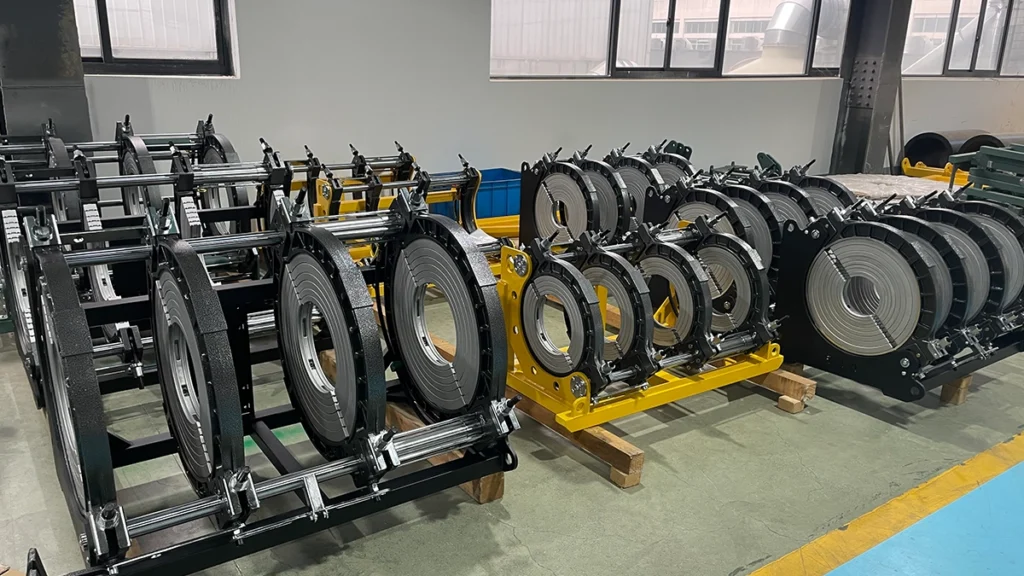
Unlike assemblers who simply bolt purchased parts together, Ekberg manufactures key components in-house, including aluminum die-casting and machining. This gives us total control over tolerances. Before any butt fusion machine ships, it faces a strict testing protocol:
1. Hydraulic Pressure Test: The system is pressurized to 1.5x maximum operating pressure to expose any leaks.
2. Temperature Uniformity Check: Thermal sensors measure multiple points on the heating plate to ensure even distribution.
3. Software Simulation: The CNC controller runs a simulated weld cycle to verify all sensors and logic circuits are responsive.
Supply Chain Stability and Lead Time Management
We maintain a strategic buffer of raw materials, including ZL104 aluminum ingots and electronic components. This allows us to absorb supply chain shocks and keep lead times stable. We can often ship standard units within 48 hours for emergencies. For larger custom orders, our production planning system provides transparency, giving buyers weekly status updates.
After-Sales Service and Spare Parts Availability
A butt fusion welding machine is only as good as the support behind it. Ekberg offers a standard 1-year warranty on non-wear components. More importantly, we stock standardized spare parts. If a hydraulic seal fails or a heating plate gets damaged, we can dispatch replacements immediately. Because we use standard industrial components, parts remain compatible even years later. We also offer video tutorials and remote troubleshooting to help field techs resolve error codes fast.
Frequently Asked Questions
Q1: What is the standard MOQ for an Ekberg automatic HDPE pipe welding machine?
For standard models (e.g., 160mm to 630mm range), our MOQ is 1 unit. We understand contractors often have immediate, project-specific needs. However, for custom OEM branding or special color schemes, the MOQ is typically 5 units to account for the setup costs of powder coating and software customization.
Q2: How does data logging impact the price?
Data logging is the heart of the CNC system. While it raises the initial investment compared to a manual hydraulic unit (typically by 1,500 – 3,000 depending on size), it isn’t just an “add-on.” It represents a shift to a fully computerized control system (PLC) that automates the entire fusion process, drastically cutting labor costs and liability risks.
Q3: Can I order a machine with my company’s specific color?
Yes, Ekberg offers full OEM customization. You can request chassis colors to match your corporate branding and have your logo embedded in the software. The standard MOQ for this service is 5 units. Lead times for custom orders are generally 15-25 days to allow for the specialized painting and assembly.
Q4: How do you calculate the ROI for upgrading to automatic butt fusion machines?
ROI is measured by labor savings and risk reduction. Automatic butt fusion machines let operators multitask during long cooling cycles, potentially saving 2-3 man-hours daily. Furthermore, preventing a single failed joint (which can cost $15,000+ to repair) instantly covers the price gap between manual and automatic units.
Q5: What are the lead times for single units vs. container orders?
Single unit orders for standard stock models are typically dispatched within 3-7 days. Full Container Load (FCL) orders, which are manufactured in batches, generally have a lead time of 20-30 days. We recommend distributors plan inventory 4-6 weeks in advance to optimize shipping costs.
Conclusion
Sourcing butt fusion equipment requires balancing technical specs with economic reality. While the upfront cost of the HDPE pipe welding machine is higher than manual alternatives, the investment is justified by the precision of CNC control, the labor savings from automated cooling, and the risk mitigation of ISO-compliant data logging.
For buyers, the choice of partner is as important as the choice of butt fusion machine. Ekberg’s flexible MOQ policies ensure that whether you are a contractor needing a single DN315 unit for a rush job, or a distributor planning a container load, your needs are met with factory-direct efficiency. We prioritize long-term performance, using aviation-grade aluminum and rigorous testing to ensure every weld holds under pressure.
Don’t leave your pipeline integrity to chance or your budget to inefficient procurement. Contact Ekberg Welding today to request a custom HDPE pipe jointing machine price list, discuss your specific project requirements, or get a consultation on upgrading your fleet to fully automatic technology.