
Butt Fusion Machine Maintenance Tips for Longer Service Life
Table of Contents
Introduction
Ignoring the upkeep of butt fusion machines operating at hydraulic pressures up to 6.3 MPa is the fastest way to turn a profitable pipeline project into a financial liability. When a DN400 joint fails due to equipment misalignment or temperature drift, the cost goes far beyond a replacement pipe section. You are looking at $15,000+ per day in crew downtime, excavation rework, and potential contractual penalties.
This guide outlines the rigorous inspection protocols necessary to maintain hydraulic integrity, methods for preserving delicate Teflon heating surfaces, and troubleshooting frameworks for common field failures. We will navigate the technical nuances of selecting hydraulic oil based on ambient temperature, verifying calibration for ISO 21307 compliance, and evaluating equipment durability during the procurement phase.
By the end of this article, you will have a clear framework to extend the operational lifespan of your welding fleet and ensure every fusion joint satisfies the strict demands of municipal and industrial inspectors.

Routine Inspection Protocols: The Daily and Weekly Grind
The difference between a butt fusion machine that survives a decade and one that fails in three years often comes down to the rigor of the pre-start checklist. For butt fusion machines, mechanical precision is synonymous with welding accuracy. A minor deviation in frame geometry or clamp pressure translates directly to joint weakness.
Standard Pre-Operation Checklists
Before the generator is even fired up, the operator must verify the mechanical alignment of the chassis. For models like the Ekberg SHBD series, which handle HDPE pipe diameters from 110mm to 250mm, the alignment of the fixed and movable clamps must be coaxial. If the clamps are misaligned by even 10% of the pipe wall thickness, the resulting weld will suffer from “high-low” mismatch. This creates stress concentrators that inevitably lead to long-term pipeline failure.
Operators must physically check clamp bolts and inserts. Vibration during transport frequently loosens these components. Loose inserts cause slippage during the fusion phase, preventing the HDPE pipe welding machine from maintaining the required interfacial pressure (typically 0.15 N/mm²). A visual check of the chassis frame for hairline cracks—particularly near the hydraulic cylinder attachment points—is mandatory, especially after rough transport across mining or agricultural sites.
Electrical Safety for Heating Plates and Facers
The heating plate is the most electrically vulnerable component. Inspectors must examine the aviation plugs and cables connecting the heating plate to the control unit. Frayed insulation or exposed copper is an immediate “stop work” condition. Beyond operator safety, unstable voltage delivery causes temperature fluctuations that ruin welds.
Grounding continuity is critical. Use a multimeter to verify that the heating plate chassis is properly grounded. In damp trench environments, a lack of grounding can lead to dangerous shocks or damage to delicate PID temperature controllers. Similarly, inspect the facing tool’s motor cables. The high torque required to shave oxidized HDPE creates significant vibration, which can wear through cable strain reliefs over time.
Cleaning the Chassis and Guide Rods
Debris is the enemy of drag pressure accuracy. The guide rods (shafts) upon which the movable carriage slides must be immaculate. Mud, sand, or hardened plastic shavings on these rods increase friction. When the butt fusion welding machine calculates drag pressure [P(drag)] to add to the theoretical fusion pressure, excessive friction results in a false reading. The butt fusion machine “thinks” it is applying the correct force to the pipe ends, but much of that force is wasted overcoming friction, resulting in a cold weld.
Clean the chassis and guide rods daily with a clean rag and a non-corrosive solvent. Avoid using pressure washers directly on the electrical control box or hydraulic seals; high-pressure water can ingress into IP54-rated enclosures and corrode contacts.
Lubrication Strategy
Lubrication depends entirely on the environment. For guide rods, avoid heavy, sticky greases if you are working in sandy or dusty environments, such as mining or desert irrigation projects. Heavy grease traps grit, turning the lubricant into a grinding paste that scores the hardened steel shafts.
Instead, use a light butt fusion welding machine oil or a dry PTFE-based lubricant spray for the guide rods. These provide slick movement without attracting contaminants. For pivot points and clamp swinging mechanisms, standard lithium-based grease is appropriate to prevent seizing. However, never allow lubricant to touch the heating plate surface or the pipe ends; hydrocarbon contamination effectively prevents polyethylene fusion.
Hydraulic System Maintenance: The Butt Fusion Machine’s Muscle
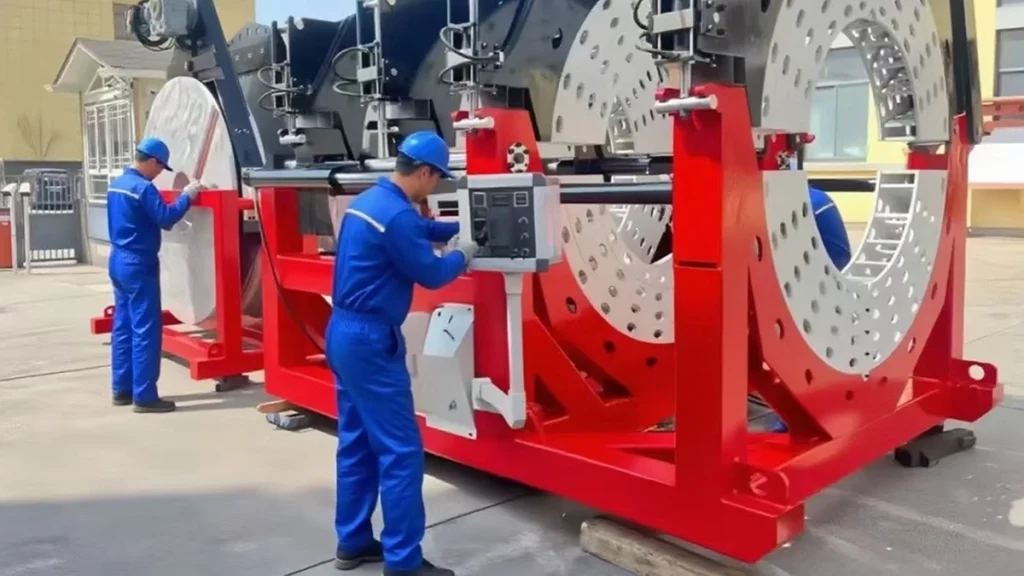
The hydraulic station is the muscle of butt fusion machines, responsible for delivering the precise force required to bead and fuse the pipe. A compromised hydraulic system makes compliance with standards like ISO 21307 or DVS 2207 impossible.
Optimal Hydraulic Oil Selection
Hydraulic fluid viscosity changes with temperature, affecting the pump’s ability to build and hold pressure. Using the wrong oil is a common procurement error.
- Standard Conditions (<40°C): For most European and North American climates, ISO VG 46 anti-wear hydraulic fluid is the standard. It balances flow at startup with film strength at operating temperature.
- High Heat (>40°C): In Middle Eastern or Australian summer pipeline projects, ISO VG 46 may become too thin, leading to internal pump slippage and pressure loss. Switch to ISO VG 68 to maintain viscosity.
- Extreme Cold (<-20°C): In Arctic or winter conditions, standard oil turns to gel, causing cavitation that destroys pumps. ISO VG 15 or specialized synthetic low-temp fluids are required.
Changing Hydraulic Oil
Hydraulic oil is not a “fill and forget” consumable. It should be changed every 6 to 12 months, or sooner in high-dust environments. Over time, the oil absorbs moisture (turning milky) and particulates which abrade rubber O-rings and cylinder walls.
When changing the oil, the system must be fully drained, including the cylinders (by cycling the carriage back and forth). The suction filter and return filter must be replaced—not just cleaned—during this interval. A clogged filter starves the pump, causing loud whining noises and rapid failure. Always fill the reservoir to the center of the sight glass; overfilling causes foaming, while underfilling leads to air entrainment and “spongy” pressure control.
Diagnosing Pressure Drops
If the pressure gauge drops during the cooling phase (when the motor is off), joint integrity is compromised. This is known as “leak-down.” To diagnose, pressurize the system and clamp the lines if possible to isolate the cylinders from the station.
1. Quick Couplers: These are the most common failure points. Dirt prevents them from sealing. Clean them thoroughly; if they still leak, replace the internal O-rings.
2. Relief Valve: If debris is stuck in the relief valve seat, oil bypasses back to the tank. Disassemble and clean the valve.
3. Cylinder Seals: If external components are dry, the piston seals inside the cylinder may be worn, allowing oil to bypass internally from the high-pressure side to the low-pressure side. This requires a cylinder rebuild kit.
Accumulator Maintenance
For larger butt fusion machines or those designed for high-pressure fusion, a hydraulic accumulator is vital. It acts as a pressure battery, maintaining clamping force during the long cooling phase (which can last 20–40 minutes for thick-wall pipes) without the motor running constantly.
If the accumulator bladder loses its nitrogen pre-charge, the hydraulic pump must cycle on and off rapidly (“short cycling”) to maintain pressure. This causes heat buildup in the oil and premature wear on the motor starter. Check the nitrogen pre-charge annually against the manufacturer’s spec (usually 60–70% of the system operating pressure).
Protecting the Critical Interface: Heating Plates and Facers
The heating plate and facing tool (trimmer) determine the physical quality of the pipe interface. No amount of hydraulic pressure can fix a joint where the pipe ends are not planar or the plastic is contaminated.
Preserving Teflon (PTFE) Coatings
The heating plate is coated with Polytetrafluoroethylene (PTFE) to prevent molten plastic from sticking to the metal heater. This coating is fragile. Operators should never use metal scrapers, wire brushes, or knives to clean the plate. Only use clean cotton cloth or paper towels to wipe the plate while it is still warm.
If the PTFE coating is scratched, the exposed aluminum will oxidize and stick to the molten PE, potentially causing the pipe to pull away from the heater unevenly during the changeover phase. If scratches cover more than 10% of the active welding zone, or if they are deep enough to catch a fingernail, the plate must be recoated by a specialist or replaced. Field repair sprays are generally ineffective for industrial durability.
Facing Tool Blade Maintenance
The facing tool must shave the pipe ends to be perfectly parallel. Dull blades do not cut; they scrape and smear the plastic, creating heat and leaving a rough surface that traps air.
- Inspection: Check the shavings. They should be long, continuous ribbons (0.2–0.5mm thick). If the facer produces chips, dust, or powder, the blades are dull.
- Sharpening: Most Ekberg facer blades are double-edged. Before buying new ones, unbolt the blades, clean the seat, and flip them to the fresh edge.
- Planarity: Periodically bring the facer blades together (without pipe) to ensure they are aligned. Misaligned blades create a stepped pipe end, resulting in a mismatch even if the clamps are aligned.
Temperature Calibration
ISO standards require the heating plate surface temperature to be within a specific range (e.g., 200–230°C for PE100). The digital display on the controller may drift over time. verify calibration monthly using a calibrated digital surface pyrometer. Measure the temperature at four points around the perimeter and one in the center. The variance should not exceed ±3°C. If the center is significantly hotter than the edges, the heating element may be failing, or the internal insulation has degraded. Do not rely solely on the HDPE pipe welding machine’s display without external verification.
Storage Requirements
The heating plate should never be placed directly on the ground. Dirt, stones, and moisture will damage the coating and the electrical connections. When not in use, it must be stored in the insulated stand (holster) provided with the butt fusion welding machine. During transport, use a dedicated padded box or the hdpe fusion machine’s specific storage slot to prevent the heavy hydraulic chassis from impacting the delicate heater.
Field Troubleshooting: Solving Mechanical and Electrical Glitches
When a butt fusion machine goes down in the field, technicians need a logical path to diagnosis. Randomly replacing parts wastes time and budget.
Diagnostic Flowchart: “Machine Fails to Build Pressure”
1. Check Oil Level: Is the sight glass showing oil? If empty, check for catastrophic hose rupture.
2. Motor Rotation: If powered by a 3-phase generator, is the phase sequence correct? If the motor runs backward, the pump builds no pressure.
3. Relief Valve Open: Is the pressure regulation valve fully open? Turn it clockwise to build pressure.
4. Pump Failure: If the motor runs and the valve is closed but the gauge reads zero, disconnect the pressure line. If no flow exists, the pump shaft key may be sheared or the pump gears destroyed.
Uneven Heating Plate Temperature
If one sector of the heating plate is cold (e.g., <180°C) while the rest is at 220°C, a heating element is likely burnt out. Most large plates use multiple internal resistance coils. A multimeter resistance test on the coil pins can confirm an open circuit (infinite resistance). If the entire plate fluctuates wildly (e.g., 190°C to 240°C), the thermocouple is loose or the solid-state relay (SSR) in the controller is failing to switch rapidly enough.
Misalignment of Pipe Ends
If the pipe ends do not meet flush:
1. Check Inserts: Are the aluminum reduction inserts clean and seated correctly? A 1mm pebble behind an insert causes significant misalignment.
2. Check Pipe Ovality: The pipe itself may be out-of-round. Rotate the pipe in the clamp to match the “high” spots.
3. Chassis Warping: Place a straight edge along the fixed and moving clamps. If the chassis is bent from drop damage, it cannot be repaired in the field and requires factory jig realignment.
Electrical Fault Codes (Automatic Butt Fusion Machines)
For automatic butt fusion machines, specific error codes guide repairs:
- Sensor Fault: Usually a broken wire to the pressure transducer or temperature probe.
- Parameter Error: The input welding parameters (pipe diameter, SDR, material) result in a pressure calculation that exceeds the butt fusion machine’s hydraulic limit.
- Voltage Error: Generator fluctuation. Automatic butt fusion machines are sensitive to voltage spikes; ensure the generator has an AVR (Automatic Voltage Regulator).
Smart Procurement: Selecting High-Durability Fusion Equipment
Maintenance begins with procurement. Buying a hdpe fusion machine designed for serviceability reduces Total Cost of Ownership (TCO).
Aluminum Alloy vs. Steel Frames
- Aluminum Alloy (Ekberg Standard): Used for the chassis body. It is lightweight for portability and naturally corrosion-resistant. It is rigid, maintaining alignment well, but can crack under catastrophic impact.
- Steel Frames: Cheaper butt fusion machines often use painted steel. While strong, they are significantly heavier (increasing injury risk) and prone to rust once the paint chips in trench conditions. Rust on the sliding surfaces destroys accuracy.
The Value of Branded Components
The longevity of butt fusion machines depends on the sub-components. Ekberg specifies industrial-standard seals and high-torque motors rather than generic alternatives.
- Seals: High-quality polyurethane seals resist extrusion under high pressure and tolerate heat better than cheap rubber.
- Electrical Contacts: Silver-plated contacts in switches and relays prevent arcing and carbon buildup, a common cause of heater failure.
Modular Design Benefits
In remote mining or agricultural sites, shipping the whole butt fusion machine back for repair is impossible. Modular design allows the hydraulic station, heating plate, and facer to be swapped out individually. Look for plastic pipe welding machines where the hydraulic cylinders are bolted, not welded, allowing for field replacement of seals.
Buyer’s Checklist for Support and Spares
Before signing the PO, verify:
- Does the manufacturer use standard ISO hydraulic fittings, or proprietary sizes?
- Are spare heating plates available for immediate dispatch?
- Is there a detailed service manual with exploded diagrams and part numbers?
- Is technical support available via video call for field troubleshooting?
| Feature | Ekberg SHBD Series | Generic Competitor | Impact on Maintenance |
|---|---|---|---|
| Chassis Material | Al-Mg Alloy (Cast) | Welded Steel | Alloy resists corrosion; steel rusts and seizes. |
| Guide Rods | Hard Chrome Plated | Galvanized | Hard chrome resists scoring from sand/grit. |
| Hydraulics | Quick-Change Seals | Integrated/Welded | Serviceable cylinders reduce repair costs by 80%. |
| Heater Coating | Double-Layer PTFE | Single Spray PTFE | Double layer lasts 2x longer before recoating. |
The Ekberg Advantage: Factory Capability and Global Support
At Ekberg Welding, we understand that a butt fusion welding machine is only as good as the support behind it. Our manufacturing process is designed to minimize your maintenance burden.
Rigorous Quality Control (QC)
Every hydraulic cylinder is pressure-tested at 1.5x operating pressure to ensure seal integrity before assembly. Heating plates undergo a 24-hour burn-in cycle to verify temperature stability and eliminate infant mortality of electronic components. We don’t just assemble parts; we validate performance.
Inventory and Spare Parts
We maintain a massive inventory of standardized spare parts for the SHBD series and other models. From specific diameter inserts (110mm, 160mm, 200mm) to replacement facer blades and hydraulic seal kits, we ensure rapid global dispatch. Our goal is to ensure you never wait weeks for a $5 O-ring while a project stalls.
Training and Compliance
Ekberg provides digital maintenance manuals and video tutorials that empower your technicians to perform field repairs. Our equipment carries CE certification and is manufactured under ISO 9001 quality management systems, ensuring that every hdpe pipe welding machine meets the rigorous safety and performance standards required by global infrastructure projects.
Frequently Asked Questions
Q1: How often should I calibrate my butt fusion machine’s pressure and temperature sensors?
For projects requiring strict compliance (like gas or municipal water), calibration should be performed every 12 months or per the specific project specification. However, you should perform a verification check (using a separate pyrometer and pressure gauge) weekly to ensure the butt fusion machine hasn’t drifted. If the verification shows a variance >5%, schedule a formal calibration immediately.
Q2: Can I repair a scratched Teflon coating on the heating plate, or must it be replaced?
If the scratch is minor and outside the pipe contact area, it may be usable. However, deep scratches or damage on the fusion surface cannot be patched reliably in the field. The non-stick property is critical for preventing pipe contamination. You must either replace the plate or send it to a specialized facility for stripping and industrial recoating.
Q3: What is the recommended hydraulic oil change interval for butt fusion machines used in extreme heat or cold?
In extreme environments, oil degrades faster. For ambient temperatures >40°C or <-20°C, reduce the change interval to every 6 months. High heat causes oxidation (sludge), while extreme cold can cause condensation buildup. Always inspect the oil condition monthly; if it looks milky or smells burnt, change it immediately regardless of the schedule.
Q4: How do I know if the facing tool blades are too dull for proper pipe preparation?
Observe the shavings. Sharp blades produce long, continuous plastic ribbons. Dull blades produce chips, dust, or fragmented shavings. Additionally, if the facer motor sounds like it is straining or stalling, the blades are likely dull. Never force a dull facer; it creates heat that can oxidize the pipe ends before welding even begins.
Q5: Does Ekberg Welding offer refurbishment services for older butt fusion models?
Yes. While regular maintenance prevents most issues, older butt fusion welding machines often benefit from a factory refurbishment. We can replace hydraulic seals, recoat heating plates, and update electrical components to extend the life of your asset. Contact our support team with your butt fusion machine’s serial number to discuss refurbishment options versus replacement.
Final Thoughts
The reliability of your pipeline infrastructure is directly tied to the condition of your butt fusion machines. A proactive maintenance strategy—encompassing daily cleaning, strict hydraulic hygiene, and careful handling of heating elements—is not just a chore; it is an investment in project safety and profitability. By adhering to the protocols outlined in this guide, you ensure that your equipment delivers consistent, compliant welds from the first joint to the thousandth.
Don’t let preventable equipment failure derail your next project. Whether you need a comprehensive maintenance kit, replacement heating plates, or are looking to upgrade to our durable SHBD series welders, Ekberg Welding is your partner in pipeline success.
Ready to secure your projects? Contact Ekberg Welding today for a quote on spare parts or a consultation on our latest high-durability fusion equipment.