

How to Select the Right Butt Fusion Machine for Large Diameter HDPE Pipe
Table of Contents
Introduction
Deploying an undersized butt fusion machine on a DN1200 pipeline project isn’t just an operational bottleneck; it’s a direct path to joint failure under hydrostatic pressure. When you are dealing with large-diameter High-Density Polyethylene (HDPE) pipes—specifically those in the 315mm to 1600mm range—the margin for error disappears as wall thicknesses increase and drag forces escalate. A machine that handles DN400 pipe effortlessly may suffer catastrophic hydraulic stall when trying to fuse DN1000 SDR 11 pipe, resulting in “cold welds” that might pass a visual check but will fail in service.
In this guide, we break down the engineering criteria needed to specify the correct equipment for heavy-duty infrastructure. We will cover hydraulic cylinder sizing, ISO 21307 pressure compliance, and the critical decision between manual and CNC automation. You’ll also get a look at the logistical realities of powering 60kW+ welding stations and how to calculate the Total Cost of Ownership (TCO) for mining and municipal projects. By the end, you will have a clear framework to select the right gear for DN500–DN2600 large diameter HDPE pipe projects—avoiding the costly specification mistakes that compromise pipeline integrity.
Defining Large Diameter Welding Requirements: Scope and Standards
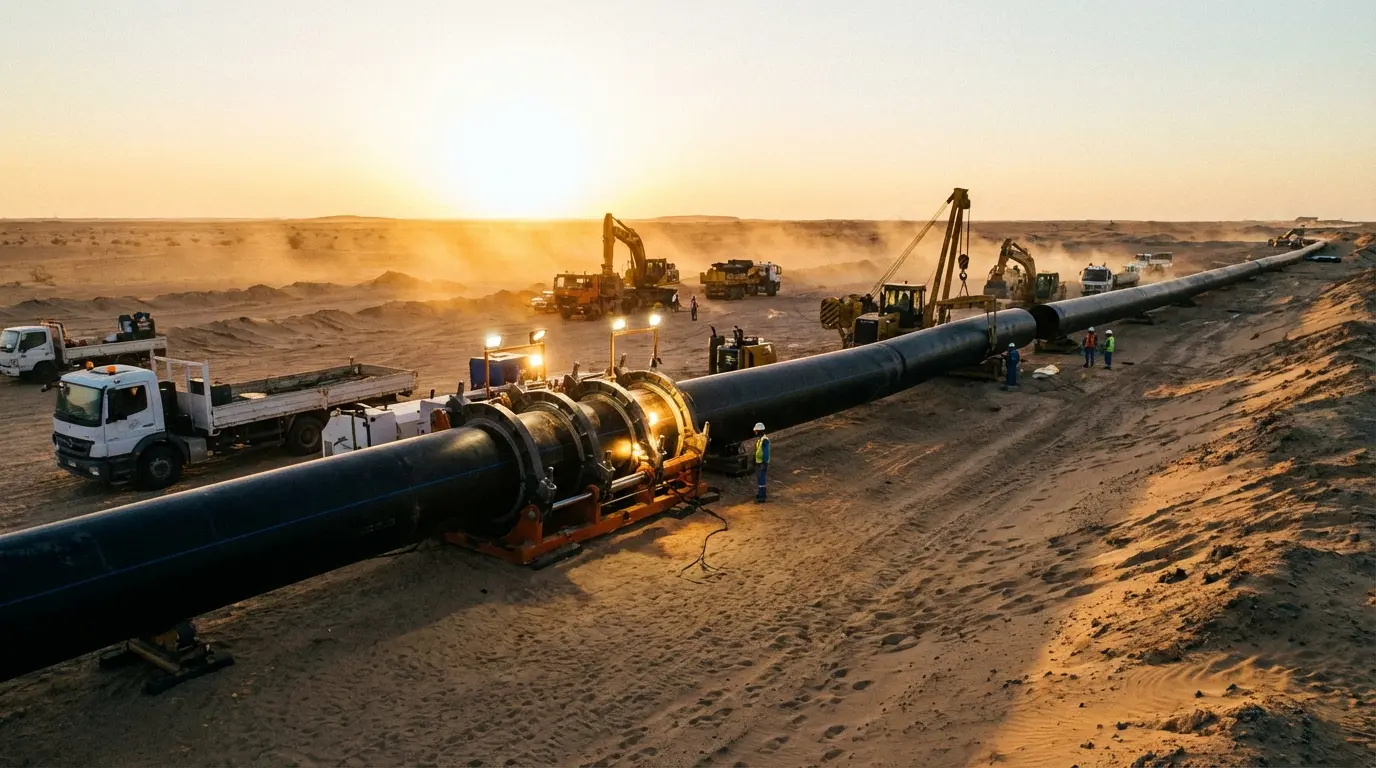
“Large diameter” is a term often tossed around loosely in the industry. However, in the context of equipment procurement, it refers to specific dimensional ranges that dictate the butt fusion machine’s chassis design and hydraulic power. Once you move beyond standard residential connections (up to 250mm), the physics of the fusion process changes, demanding exponentially more force and thermal energy.
Classifying Pipe Size Ranges (500mm to 2600mm)
For procurement managers and site engineers, it helps to categorize equipment into three distinct tiers based on OD (Outside Diameter) capacity:
- Mid-Range (500mm – 800mm): The workhorse range for municipal water mains and industrial fire loops. Machines in this class, like the Ekberg 630mm hydraulic butt fusion machine, need the versatility to handle both SDR 11 and SDR 17 pipes.
- Large Range (800mm – 1600mm): Frequently seen in mining slurry lines and major sewer trunk lines. At this scale, the sheer weight of the pipe becomes a massive variable in the welding formula.
- Mega Range (1600mm – 2600mm): Reserved for desalination intakes, hydroelectric penstocks, and major gas transmission lines.
The critical factor here is the Standard Dimension Ratio (SDR). A DN1200mm HDPE pipe with an SDR of 11 has a wall thickness of approximately 109mm. The butt fusion machine you select must not only fit the diameter but possess the structural rigidity to clamp and face a pipe wall of this magnitude without the frame flexing.
Understanding Welding Standards (ISO 21307, DVS 2207-1)
You cannot select a butt fusion welding machine without first defining the welding standard your project must meet. The two dominant global standards dictate vastly different force requirements:
- Low Pressure (DVS 2207-1): Common across Europe and Asia, this standard requires an interfacial pressure of 0.15 N/mm² (± 0.01). While this demands less hydraulic force, it requires longer cooling times.
- High Pressure (ISO 21307 SHP / ASTM F2620): Prevalent in North America and the mining sector, this “Single High Pressure” standard demands 0.52 MPa (± 0.1 MPa)—roughly three times the force of DVS.
If your project specifies ISO 21307 SHP for a DN1200 hdpe pipe, a standard butt fusion machine designed only for DVS low-pressure welding will physically fail to achieve the required interfacial pressure. You must verify that the machine’s hydraulic cylinders have the total piston area (mm²) to generate these forces while maintaining a safety buffer.
The Challenge of Ovality and Wall Thickness
Large diameter HDPE pipes are rarely perfectly round. Due to their immense weight and storage conditions, pipes larger than 630mm often exhibit significant ovality. A butt fusion machine isn’t just a welding tool; it is a re-rounding tool.
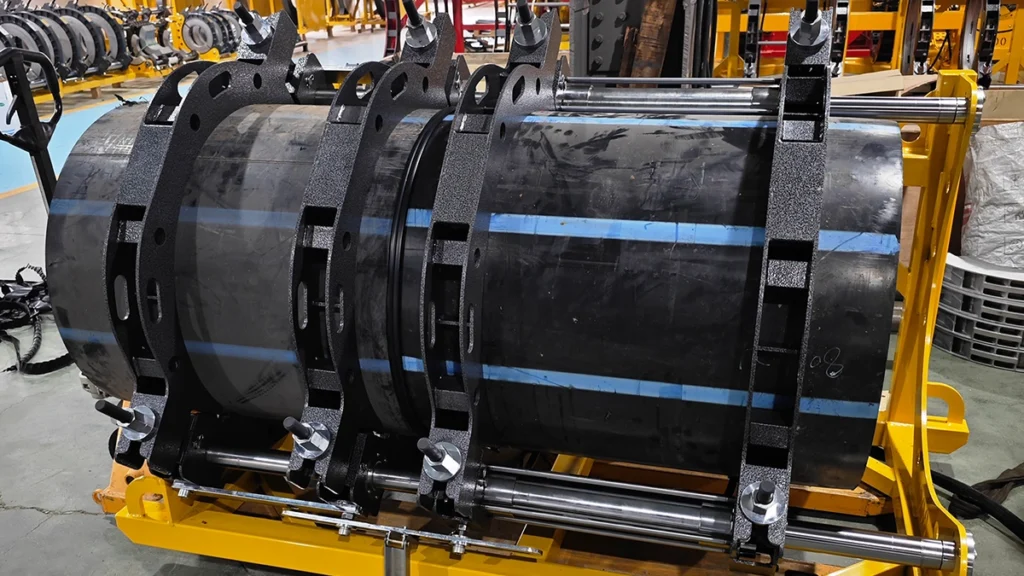
The clamps on an Ekberg 1600mm hydraulic butt fusion machine are engineered with high-tensile strength to force the pipe back into roundness. If the butt fusion welding machine chassis is weak, the plastic pipe will bend the butt fusion machine rather than the machine correcting the pipe. This leads to misalignment (high-low), a primary cause of stress concentration and eventual joint failure. For pipes with wall thicknesses exceeding 50mm, hydraulic re-rounding clamps are often necessary to ensure the pipe ends match perfectly before the facing tool is even engaged.
Critical Technical Specifications for Large Butt Fusion Machines
When reviewing technical datasheets, buyers often fixate on the welding range but overlook the subsystems that drive performance. For large diameter applications, three specific components determine whether a hdpe butt fusion machine is site-ready.
Hydraulic System Capability and Drag Pressure
The most common cause of “stalled” welds on large sites is a failure to account for drag pressure. Drag pressure is simply the force required to move the carriage and the pipe to overcome friction. In the field, a 1200mm pipe string might weigh several tons.
The butt fusion machine’s hydraulic system must generate enough force to:
1. Overcome the drag of the heavy pipe.
2. Apply the required bead-up pressure against the heater plate.
3. Apply the final fusion joining pressure.
If the machine’s hydraulic cylinders are undersized, the system may max out its pressure (e.g., 160 bar) just trying to drag the pipe, leaving no reserve force for the actual fusion. Ekberg butt fusion machines utilize large-bore cylinders with total piston areas exceeding 23,000 mm² on our larger models, ensuring that even with heavy drag, the system delivers precise interfacial pressure without straining the pump.
Heating Plate Thermodynamics and Zoning
Heating a 1600mm surface area uniformly is a thermodynamic challenge. A variance of more than ±5°C across the plate can lead to uneven melting depths. If the center of the plate is at 220°C but the outer edges drop to 200°C due to wind chill or poor element design, the resulting weld will have inconsistent strength.
High-quality butt fusion machines utilize multi-zone heating elements and thick, PTFE-coated aluminum plates that act as thermal reservoirs. For large diameters, the heater plate alone may draw 45 kW of power. The control system must aggressively monitor these zones, cycling power to ensure the entire circumference of the pipe reaches melt temperature simultaneously.
Facing Tool (Trimmer) Torque and Safety
The facing tool (trimmer) must plane the ends of the pipe to create fresh, parallel mating surfaces. On a DN1000 SDR 11 pipe, the facer cuts through nearly 100mm of solid plastic. This requires immense torque.
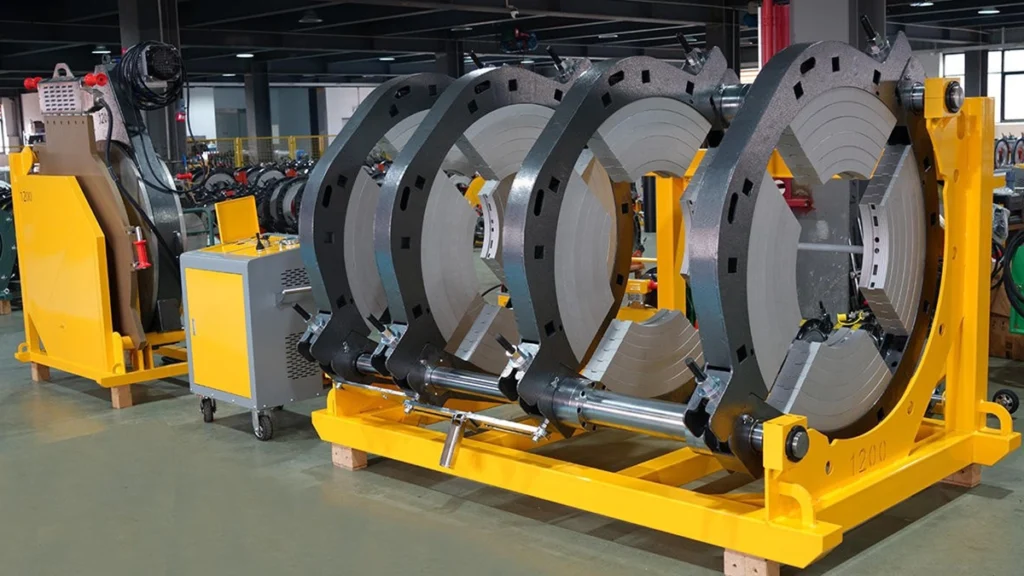
Under-powered facers will stall or “chatter,” creating a stepped surface that traps air and creates voids in the weld. Ekberg utilizes high-torque gearboxes and hardened reversible blades to ensure smooth, continuous ribbons of HDPE are removed. Furthermore, safety is paramount; large facers have enough torque to cause fatal injuries. All units must be equipped with micro-switches that physically prevent the facer from spinning if the butt fusion machine is not in the correct configuration or if the operator is in the danger zone.
Selection Guide: Hydraulic vs. CNC Automatic Models
The choice between hydraulic control and CNC (Computer Numerical Control) automation is often dictated by project criticality and operator expertise.
Basic Hydraulic Machines: Cost vs. Operator Skill
Hydraulic butt fusion machines rely entirely on the operator to calculate pressures, time the soak phase, and manage the cooling cycle.
- Pros: Lower initial capital cost; rugged design with fewer electronics to damage in harsh environments; easier to repair in the field.
- Cons: High risk of human error. An operator might cut the cooling time short to finish a shift early, compromising the joint’s long-term life.
- Verdict: Suitable for experienced crews working on non-critical infrastructure (e.g., irrigation, conduit) where budget is the primary constraint.
CNC Automatic Machines: Ensuring Repeatability
CNC automatic butt fusion machines remove the “human factor” from the welding parameters. The operator inputs the pipe diameter, SDR, and material (PE100), and the machine calculates the exact pressure and timing curves based on the selected standard (ISO/DVS).
- Process: The butt fusion machine automatically controls the drag test, bead-up pressure, heat soak time, changeover time (removing the heater), and final fusion pressure.
- Cooling: The hdpe pipe welding machine locks the hydraulic pressure during the cooling phase (which can be over 45 minutes for large pipes) and will not release the clamps until the cycle is complete.
- Verdict: Essential for gas lines, high-pressure water mains, and any project requiring 100% joint verification.
Data Logging and Traceability Requirements
Modern utility companies increasingly mandate data logging. A CNC butt fusion welding machine records every parameter of every weld: date, time, ambient temperature, pressures, and durations. This data is compiled into a PDF welding report.
For large infrastructure projects, this traceability is non-negotiable. If a joint fails five years later, the asset owner can pull the specific weld report to determine if the failure was due to installation error or material defect. Ekberg CNC automatic butt fusion machines feature integrated PLC systems with touchscreen interfaces, capable of storing thousands of weld records and exporting them via USB or remote transmission.
Jobsite Logistics: Power, Transport, and Environmental Factors
Specifying the hdpe pipe welding machine is only half the battle; getting it to work on-site requires logistical planning.
Power Supply Sizing (Generators for 3-Phase Machines)
Large fusion machines are power-hungry. A common mistake is renting a generator that matches the machine’s kilowatt rating exactly.
- The Rule: Generator capacity (kVA) should be 1.25x to 1.5x the machine’s total power rating to account for startup currents.
- Calculation: For a 1600mm hydraulic butt fusion machine with a total draw of 63 kW (Heater 45kW + Hydraulics 4kW + Facer 4kW + 10kW overhead), you generally require a 100 kVA generator.
- Voltage: These machines operate on 3-Phase 380V or 415V. Ensure your power source is stable; voltage fluctuations can cause CNC systems to reset or heater plates to drift out of tolerance.
Machine Mobility and Chassis Design
How will the butt fusion machine move along the pipeline right-of-way?
- Standard Frame: Requires a crane or forklift to move from joint to joint. Best for stationary fabrication yards or flat terrain.
- Crawler (Track-Mounted): Self-propelled units with rubber or steel tracks. These are indispensable for cross-country pipelines, muddy mining sites, or steep inclines where support equipment cannot easily reach. While more expensive, they significantly reduce cycle time by eliminating the need for a dedicated crane for every move.
Weather Protection and Tent Requirements
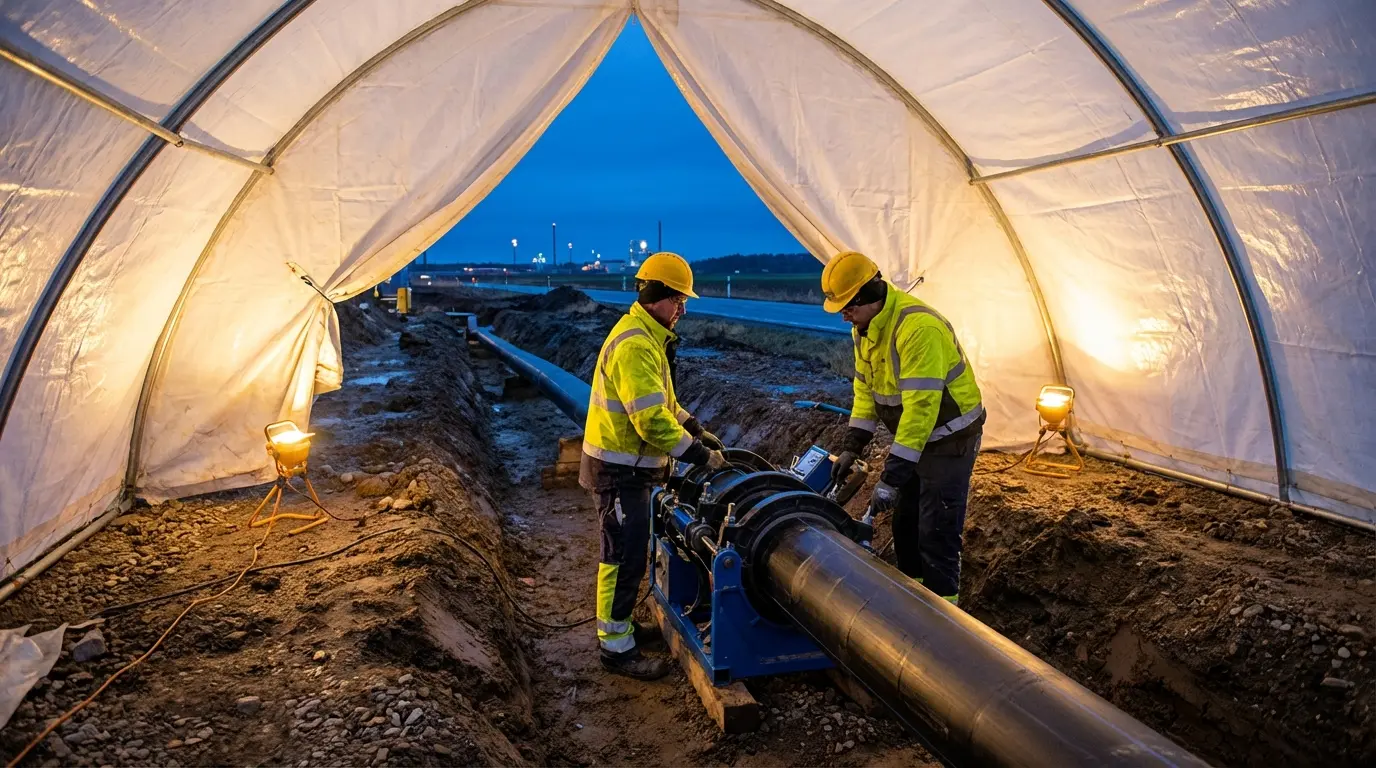
Welding large diameter pipes is strictly controlled by environmental conditions. Wind and rain are enemies of the fusion process.
- Temperature Stability: A cold wind blowing across a 1200mm heater plate can drop the surface temperature by 20°C in seconds, creating a cold weld.
- Requirement: Welding tents or shelters are mandatory. They protect the weld zone from moisture and wind, ensuring the heater plate maintains the required ±5°C uniformity.
Buyer Checklist: Evaluating ROI and Total Cost of Ownership
The purchase price of a butt fusion machine is a fraction of its total cost of ownership (TCO).
Initial Investment vs. Operational Longevity
Cheaper plastic pipe welding machines often use cast iron chassis components that are heavy and brittle. Ekberg utilizes high-grade steel and aluminum alloys that offer superior rigidity-to-weight ratios. A rigid chassis ensures that the butt fusion machine maintains alignment accuracy over thousands of cycles. A cheaper machine that warps after six months of heavy use becomes a liability, producing oval welds that fail pressure tests.
Maintenance and Spare Parts Availability
Downtime on a large pipeline project can cost tens of thousands of dollars per hour.
- Consumables: Ensure you have access to reversible facer blades, hydraulic seals, and spare heater plates.
- Support: Does the manufacturer hold inventory? Ekberg maintains a global stock of critical components for our 630, 1000, and 1600 series machines to ensure rapid dispatch.
Training and Technical Support
A 1600mm hydraulic butt fusion machine is a sophisticated piece of industrial equipment. Giving it to an untrained operator is a safety hazard and a quality risk. The ROI of the butt fusion welding machine is maximized when operators are certified in its use. Vendor training ensures that your team understands how to calculate drag pressure, how to read the CNC prompts, and how to maintain the hydraulic system.
Ekberg Factory Capability, Certification & Global Support
When you buy an Ekberg butt fusion machine, you are buying into a manufacturing ecosystem dedicated to pipeline safety.
Manufacturing Excellence and Quality Control
Our facility operates under strict ISO 9001 management systems. We do not simply assemble parts; we machine our chassis bodies using advanced CNC centers to ensure perfect alignment of the guide rods and clamps. Every hydraulic power pack is pressure-tested to 150% of its rated capacity before leaving the factory to ensure seal integrity.
Global Certifications (CE, SGS, ISO)
Compliance is key for international projects. Ekberg butt fusion machines carry CE certification, meeting European safety standards for machinery and low voltage directives. Our equipment is also verified by third-party agencies like SGS, ensuring that when you deploy our machines on a project in South America, Australia, or the Middle East, they meet the requisite safety and performance benchmarks.
After-Sales Service and Warranty Structure
We support our clients well beyond the point of sale. Our standard warranty covers main components, and our technical team provides remote troubleshooting for CNC systems and hydraulic calibration. For large-scale projects, we can offer on-site commissioning to ensure your team is ready to weld from day one.
Frequently Asked Questions (FAQ)
Q1: What is the maximum pipe diameter Ekberg butt fusion machines can handle?
Ekberg manufactures butt fusion machines capable of welding plastic pipes from 40mm up to 2600mm (approximately 102 inches) in diameter. With multiple machine models available, our equipment range covers virtually all municipal, mining, natural gas, water supply, and industrial pipeline applications worldwide.
Q2: Do I need a specific generator size for a 630mm butt fusion machine?
Yes. You should calculate the total power load (Heater + Facer + Hydraulic Pump) and add a 25-50% safety margin. For a typical 630mm machine, the total load is roughly 10kW. Therefore, a generator of at least 20-25 kVA is recommended to handle the startup current of the motors and maintain stable voltage for the heater.
Q3: Can one machine handle multiple pipe sizes (e.g., using inserts)?
Absolutely. All Ekberg butt fusion machines are supplied with a set of aluminum inserts (reducers). For example, a 1000mm hydraulic butt fusion machine can weld pipes down to 630mm by installing the appropriate layered inserts into the main clamps. This versatility allows contractors to use a single machine for various sections of a pipeline project.
Q4: What is the difference between High Pressure and Low Pressure fusion?
The difference lies in the interfacial pressure applied to the pipe ends. “Low Pressure” (DVS 2207) uses 0.15 MPa and longer cooling times. “High Pressure” (ISO 21307 SHP) uses ~0.52 MPa, requiring much higher force but offering faster cooling. Your butt fusion machine’s hydraulic cylinders must be sized correctly to achieve the force required for High Pressure welding on large diameters.
Q5: How does the CNC system prevent welding errors on large pipes?
The CNC system controls the entire welding cycle based on pre-programmed standards. It automatically calculates the required drag pressure, regulates the heat soak duration, and enforces the correct cooling time. It prevents the operator from opening the clamps prematurely, which is a common cause of joint failure, ensuring every weld meets the specified parameters.
Conclusion
Selecting the right equipment for large-diameter hdpe pipeline projects requires balancing three core pillars: hydraulic capacity, automation level, and manufacturer support. Whether you choose a robust hydraulic unit for a remote mining site or a fully automated CNC model for a municipal gas line, the goal remains the same: achieving a homogeneous, leak-free joint that lasts as long as the pipe itself.
Remember, in the world of large-diameter infrastructure, precision outweighs price. A single failed joint on a DN1000 line can cost more in excavation and repair than the initial investment in a premium butt fusion welding machine. By specifying butt fusion machines that meet ISO standards and offer verifiable data logging, you protect your project’s bottom line and reputation.
Ready to equip your next project? Contact Ekberg Welding today for a technical consultation. Our engineers can help you calculate the exact specifications for your pipeline and provide factory-direct pricing on our 500mm–2600mm fusion solutions.