
Sustainable HDPE Welding Solutions with Precision Butt Fusion Machine
Table of Contents
With global non-revenue water (NRW) rates hovering between 20% and 30% in aging utility networks, the margin for error in pipeline construction has vanished. Selecting high-precision butt fusion machines capable of delivering 100% leak-free joints at pressures up to 0.25 MPa isn’t just an operational preference anymore—it’s an environmental imperative. The old-school approach to infrastructure—heavy concrete, corrosive metals, and gasket-dependent mechanical joints—is rapidly facing obsolescence in the face of stricter environmental regulations and the soaring cost of resource loss.
This guide breaks down the environmental case for transitioning to fused HDPE systems, moving from the molecular physics of monolithic joint integrity to the carbon footprint reductions achieved through trenchless installation. We will examine the technical specifics of modern hydraulic and CNC automatic butt fusion machine, referencing ISO 21307 standards, energy efficiency metrics, and lifecycle assessment (LCA) data. The goal is to provide a clear framework for selecting equipment that not only meets green building standards but also maximizes long-term ROI for your next infrastructure project.
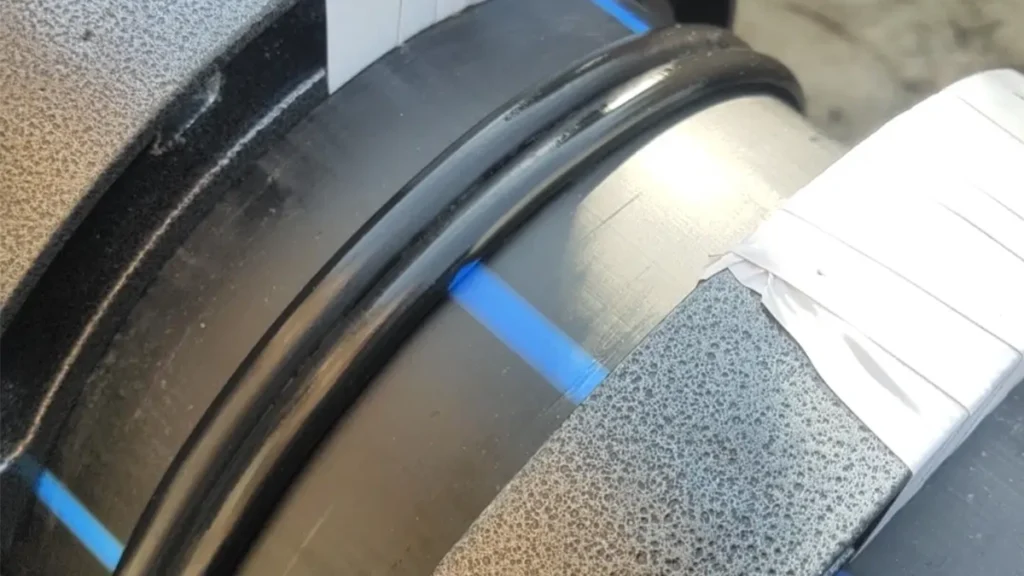
Leak-Free Integrity: Solving the Global Water Loss and Contamination Crisis
The strongest environmental argument for thermoplastic piping systems is simple: joint integrity. Unlike legacy materials that rely on mechanical interference or chemical sealants to hold water in, butt fusion creates a system where the pipe and the joint become a single, homogenous unit.
The Physics of Monolithic Joints vs. Mechanical Connections
The structural advantage of a butt fusion joint comes down to molecular bonding. When an Ekberg butt fusion machine heats two planed HDPE pipe ends to 215°C ± 15°C and applies a calculated fusion pressure (typically 0.15–0.17 MPa for bead-up), the polymer chains across the interface entangle. As they cool, they form a monolithic structure. The “joint” effectively disappears.
Compare this to mechanical couplings, bell-and-spigot joints, or flanged connections. These rely on rubber gaskets and bolts. Over time, ground shifting, thermal expansion cycles, and aggressive soil chemistry eat away at these gaskets, creating inevitable failure points. A fused joint, conversely, boasts tensile strength equal to or greater than the pipe itself. In burst pressure tests, the pipe wall will almost always fail before the fused joint does, ensuring the conveyance system remains sealed against the environment for its entire service life.
Reducing Non-Revenue Water (NRW) in Municipal Supply
We lose approximately 126 billion cubic meters of treated water annually worldwide, a staggering loss that costs the global economy roughly $39 billion. A massive chunk of this loss happens at the joints of aging distribution networks. Every liter of lost water represents wasted energy—energy used to pump, treat, and transport water that never reaches a tap.
By deploying hydraulic butt fusion machines to install HDPE pipelines, municipalities can aggressively target NRW reduction, aiming to drop from typical rates of >20% to below 5%. The continuous nature of fused HDPE prevents the “death by a thousand cuts” scenario common in iron or PVC networks, where small, undetected leaks at every bell joint accumulate into massive volume losses. For a DN630 water main project, eliminating mechanical joints saves millions of liters annually, directly lowering the electrical load on pumping stations.
Preventing Environmental Contamination in Chemical and Waste Lines
Water loss is an economic drain, but leakage in industrial chemical lines or sewage systems is an environmental hazard. In applications involving hazardous waste, leachate collection, or mining slurry, the seal must be absolute to prevent soil and aquifer contamination.
Ekberg butt fusion machines are engineered to meet strict DVS 2207 and ISO 21307 standards, which are non-negotiable for these high-risk sectors. A fused joint is immune to root intrusion—a notorious cause of sewage leaks in concrete pipes—and stands up to aggressive chemicals (pH 2–12). By guaranteeing a hermetic seal, engineers prevent toxic run-off from entering groundwater systems, satisfying stringent environmental compliance mandates for industrial facilities.

Carbon Footprint Analysis: Butt Fusion vs. Alternative Joining Methods
To truly gauge infrastructure sustainability, engineers have to look past the installation phase and consider the total Lifecycle Assessment (LCA). This view encompasses embodied energy in manufacturing, transport emissions, installation energy, and eventual disposal.
Lifecycle Assessment (LCA) of Fused HDPE vs. Steel and Concrete
Embodied carbon varies wildly between piping materials. Concrete pipes demand energy-intensive cement production and are incredibly heavy, driving up fuel consumption during transport. Steel pipes require high-temperature smelting and fabrication, generating roughly 35% more CO2 emissions over their lifecycle compared to polyolefins.
HDPE pipes joined by butt fusion machines offer a much lighter, carbon-efficient alternative. Since HDPE is about one-eighth the density of steel, contractors can load significantly more linear meters of pipe onto a single truck, slashing the project’s logistics-related emissions. Moreover, the fusion process removes the need for heavy steel fittings, thrust blocks, and concrete encasements, reducing the total volume of material needed to construct a pipeline.
Energy Efficiency in the Welding Process
The power draw of an Ekberg butt fusion machine is surprisingly low compared to the energy demands of welding steel or curing concrete. Take the Ekberg 250mm hydraulic butt fusion machine, capable of welding up to 250mm pipe; its total power consumption sits at just 5.05 kW. Even a massive 1000mm hydraulic butt fusion machine, built for 1-meter diameter pipes, operates at a peak load of roughly 24.5 kW.
Contrast this with the heavy diesel equipment, arc welders, and prolonged curing times required for metal or concrete infrastructure. Fusion is rapid. The heating cycle is localized to the pipe ends, and the hydraulic unit only draws peak power during pressure phases. This efficiency lets contractors run smaller generators, cutting down on-site diesel consumption and exhaust emissions.
Longevity and Replacement Cycles
Sustainability is ultimately a function of time. A pipeline that lasts 100 years has half the environmental impact of one replaced every 50 years. PE100 materials joined with high-quality fusion equipment have an expected service life exceeding a century, according to ISO 9080 extrapolation.
Corrosive metal pipes often need lining, cathodic protection, or full replacement within 20–40 years depending on soil acidity. By using butt fusion to build a corrosion-resistant, monolithic system, utilities bypass the carbon-intensive manufacturing and construction activities associated with premature infrastructure replacement. The “install it and forget it” capability of fused HDPE is perhaps its strongest environmental attribute.
Minimizing Jobsite Environmental Impact with Modern Butt Fusion Machines
The physical footprint of the installation process is a major factor in environmental planning, especially in dense urban areas or sensitive ecosystems.
Reducing Noise and Emissions on Site
Urban construction projects are under increasing pressure regarding noise pollution and air quality. Traditional open-cut trenching with excavators and impact tools generates noise levels that often scream past 100 dB(A).
Ekberg’s hydraulic butt fusion machines are designed for quiet operation. The hydraulic power units typically run between 70–79 dB(A), making them viable for residential zones and night work where noise ordinances are tight. Furthermore, because the HDPE pipe welding machines are electrically driven (needing only a generator or mains connection), they don’t emit direct exhaust fumes like diesel-driven excavators, improving air quality for the crew and the neighborhood.
Trenchless Technology Compatibility (HDD)
Perhaps the most significant environmental advantage of butt fusion is that it enables Horizontal Directional Drilling (HDD). Because fused HDPE creates a continuous, flexible string with high tensile strength, it can be pulled through underground bores over long distances.
HDD installation slashes surface excavation by over 90% compared to open-cut trenching. Preserving the surface environment is critical when crossing rivers, wetlands, or established urban landscapes where destroying vegetation or disrupting traffic isn’t an option. Butt fusion machines are the enablers of this technology; mechanical joints simply cannot withstand the tensile forces of the pullback operation and would snag on the borehole walls.
Zero-Chemical Installation
Unlike PVC piping systems, which often require solvent cements containing Volatile Organic Compounds (VOCs) and aggressive primers (like tetrahydrofuran and cyclohexanone), butt fusion is a purely thermal process.
The “recipe” for a fusion joint is just heat, pressure, and time. No foreign chemicals are introduced to the pipe or the soil. This eliminates the risk of chemical spills on the jobsite and prevents the off-gassing of VOCs that can harm workers and contribute to atmospheric pollution. This zero-chemical approach aligns perfectly with strict environmental safety protocols for potable water systems.
How Advanced Features in Ekberg Machines Reduce Material Waste
Material efficiency is core to sustainability. Poorly executed welds lead to cut-outs, scrapped pipe sections, and wasted plastic. Ekberg’s advanced butt fusion welding machine features are designed to minimize this waste through precision control.
Precision Control and CNC Automation
Manual welding introduces human error, which can lead to “cold welds” or excessive melt beads. Ekberg’s CNC and automatic butt fusion machines utilize closed-loop hydraulic systems to control fusion pressure within strict tolerances (e.g., maintaining 0.15 MPa bead-up pressure exactly).
By automating the critical phases of the weld cycle—heat soak, changeover, and cooling—the HDPE pipe welding machine ensures that every joint meets specific material parameters. This precision prevents overheating that degrades the polymer structure and under-heating that causes brittle joints. The result is a near-zero rejection rate, ensuring every meter of manufactured pipe is successfully utilized in the infrastructure.
Data Logging for Quality Assurance
To avoid future environmental disruptions caused by digging up failed lines, traceability is essential. Ekberg butt fusion machines integrated with ISO 12176-compliant data loggers record every parameter of the welding process: ambient temperature, heater temperature, drag pressure, fusion pressure, and cooling time.
This digital record serves as a quality guarantee. If a parameter deviates from the standard, the system alerts the operator immediately, allowing for correction before the pipe is buried. This data-driven approach reduces the need for destructive testing (which wastes pipe) and ensures the installed system performs as modeled.
Optimized Heating Plate Technology
The quality of the heating element directly impacts energy use and air quality. Ekberg heating plates feature high-grade PTFE coatings and advanced thermal engineering that ensures temperature uniformity across the entire plate surface (< ±3°C deviation).
Uniform heating prevents “hot spots” that can scorch the HDPE, releasing smoke and degrading the material, and “cold spots” that result in weak bonds. The high-quality PTFE coating also prevents molten plastic from sticking to the heater, eliminating the need for operators to scrape or clean the plate with solvents, further reducing consumable waste.
Selection Criteria: Choosing Eco-Friendly Butt Fusion Equipment
When procuring equipment, buyers should evaluate specifications not just for performance, but for energy efficiency and environmental compliance.
Energy Efficiency Ratings and Power Consumption
Selecting the correctly sized plastic pipe welding machine for your pipe range is critical for energy management. Oversizing a generator for a small machine wastes fuel. Below is a power consumption breakdown for standard Ekberg hydraulic units to assist in generator sizing:
| Machine Model | Welding Range (OD) | Total Power (kW) | Application Context |
|---|---|---|---|
| EKY250 | 63mm – 250mm | 5.05 kW | Residential connections, small mains |
| EKY630 | 315mm – 630mm | 10.1 kW | Municipal water mains, industrial lines |
| EKY1000 | 630mm – 1000mm | 24.50 kW | Major transmission lines, mining |
*Note: Total power includes Heater, Cutter, and Hydraulic Unit. Ensure generators are sized to handle the peak start-up load.*
Machine Durability and Modularity
The manufacturing of the butt fusion machine itself has an environmental cost. Ekberg prioritizes durability and modularity to extend equipment life. Butt fusion welding machines are constructed using ZL104 Aluminum Alloy, which is lightweight (reducing transport fuel) and fully recyclable.
Modular designs allow for individual components—such as the hydraulic station or planing tool—to be repaired or replaced without discarding the entire chassis. This “repair-over-replace” philosophy reduces industrial waste and ensures that the embodied carbon of the butt fusion welding machine is amortized over decades of service.
Compliance with Green Building Standards
Using compliant butt fusion machines can contribute to broader project certifications.
- LEED (Leadership in Energy and Environmental Design): Fused HDPE systems contribute to Water Efficiency credits by minimizing leakage and Materials & Resources credits via the use of recyclable materials.
- ISO 14001: Contractors seeking to maintain their own environmental management certification benefit from using equipment that eliminates VOCs and minimizes noise pollution.
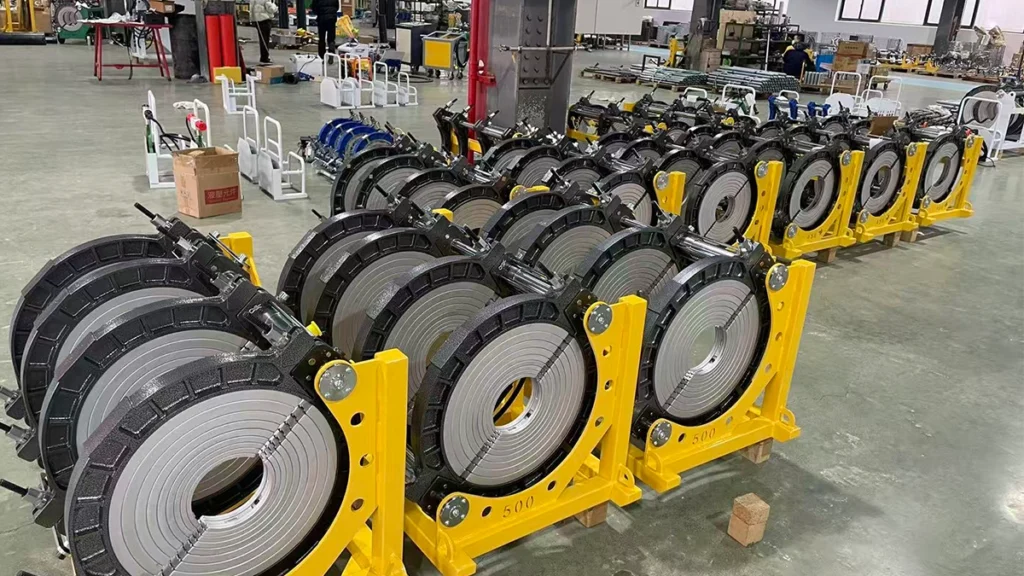
Manufacturing Excellence, Quality Control & Global Support
True sustainability extends back to the factory floor. Ekberg Welding operates with a commitment to responsible manufacturing that mirrors the efficiency of the equipment we produce.
Ekberg’s Sustainable Manufacturing Practices
Our production facilities operate under ISO 9001 and ISO 14001 management systems. We employ lean manufacturing principles to minimize scrap metal and energy usage during the fabrication of butt fusion machine frames and hydraulic cylinders. By optimizing our supply chain and production workflows, we reduce the carbon intensity of every welder that leaves our dock.
Rigorous Testing for Long-Term Reliability
Premature equipment failure is a waste of resources. To ensure longevity, every Ekberg butt fusion machine undergoes rigorous testing, including hydraulic seal pressure tests and thermal mapping of heating plates. We verify that pressure gauges and sensors are calibrated to precise tolerances. This quality control ensures that an Ekberg butt fusion welding machine purchased today will continue to facilitate eco-friendly pipeline installations for years to come, preventing the environmental cost of manufacturing replacement units.
Global Training and Maintenance Support
The most eco-friendly hdpe butt fusion machine is one that is used correctly. Ekberg provides comprehensive training resources to ensure operators understand the critical parameters of the fusion process. Proper usage prevents energy waste (e.g., running the heater longer than necessary) and prevents damage to the hdpe welding machine. Our global support network ensures that spare parts—such as PTFE-coated heating plates or hydraulic seals—are available to keep butt fusion machines in optimal condition, extending their lifecycle and performance.
Frequently Asked Questions
Q1: How does butt fusion contribute to LEED certification credits for construction projects?
Butt fusion contributes primarily through the Water Efficiency category by creating leak-free systems that eliminate water loss, a key metric for sustainable building. Additionally, HDPE piping is often recyclable, contributing to Materials and Resources credits. The reduced excavation requirements of trenchless installation (enabled by fusion) also support Sustainable Sites credits by minimizing site disturbance.
Q2: Can butt fusion machines be powered by renewable energy sources on remote sites?
Yes. Ekberg butt fusion machines run on standard electrical voltage (220V single-phase or 380V three-phase). On remote jobsites, they can be powered by battery energy storage systems (BESS) charged by solar arrays or hybrid generators. This is increasingly common in eco-sensitive mining or agricultural projects where diesel emissions must be minimized.
Q3: Does the butt fusion process release harmful fumes or microplastics?
When performed correctly at the standard temperature (200–230°C for PE), butt fusion releases no harmful fumes. It is a thermal bonding process, not a chemical reaction. Unlike cutting or grinding, the fusion process does not generate microplastic dust during the joining phase. However, the facing (planing) step produces continuous ribbons (shavings) which should be collected and recycled.
Q4: How does the energy consumption of butt fusion compare to electrofusion for large diameter pipes?
For large diameters (e.g., >DN1400mm hdpe pipe), butt fusion is generally more energy-efficient per joint. Electrofusion requires large, heavy fittings containing embedded copper coils that consume significant energy to manufacture. Butt fusion uses the pipe material itself, requiring energy only for the heating plate and hydraulics, resulting in a lower total embodied energy for the completed pipeline system.
Q5: What is the environmental impact of disposing of HDPE pipe shavings/beads?
The polyethylene shavings generated during the facing step and the external bead removed (if required) are 100% recyclable. They are non-toxic and chemically inert. Responsible contractors collect these shavings for recycling into lower-grade plastic products. Leaving them on-site is a litter issue, not a chemical contamination issue, as HDPE does not leach toxins into the soil.
Final Thoughts
The shift toward sustainable infrastructure requires a holistic view of the materials and methods we deploy. Butt fusion machines are central to this transition, offering a three-fold environmental benefit: creating leak-free systems that conserve precious resources, enabling low-impact trenchless installation methods, and providing a material-efficient joining process free of toxic chemicals.
Choosing high-quality fusion equipment is not merely an operational decision; it is a strategic compliance move that aligns your projects with global ESG goals and environmental regulations. By investing in precision-engineered, energy-efficient technology, you ensure the longevity of your water, gas, and industrial networks while minimizing your carbon footprint.
Contact Ekberg Welding today to discuss your project’s sustainability goals and request a quote for our energy-efficient hydraulic and CNC butt fusion machines. Let us help you build the durable, eco-friendly infrastructure of tomorrow.