
Industrial HDPE Butt Fusion Machine Selection Guide 2026
Table of Contents
Butt fusion machines capable of holding stable interfacial pressures of 0.17 N/mm² are the single most critical asset for preventing joint failures in modern HDPE infrastructure. For pipeline contractors, the math is simple: the cost of one failed weld during a pressure test—often triggering over $15,000 in excavation and re-work expenses—dwarfs the initial savings of buying sub-standard gear. As thermoplastic pipelines continue to replace aging metal infrastructure across water, gas, and mining sectors, the industry’s demand has shifted from “lowest price” to “highest reliability,” specifically regarding compliance with ISO 21307 standards.
This guide breaks down the engineering features, operational types, and selection criteria that define top-tier equipment in the global market, positioning Ekberg Welding as a reliable partner for industrial-grade solutions. We will look at the specific technical parameters that separate professional machinery from hobbyist tools, such as chassis rigidity, heating plate thermal consistency, and hydraulic control logic. By the end, you will have a clear, data-driven framework to select the right equipment for DN90–DN1200 HDPE projects—and avoid specification errors that can wreck project timelines.

Critical Performance Metrics: What Contractors Look for in Butt Fusion Machines
When utility engineers and contractors evaluate “top-rated” equipment, the conversation moves quickly past the sticker price to engineering precision. A butt fusion welding machine is only as valuable as its ability to pass hydrostatic pressure tests and long-term stress crack resistance evaluations. In the field, a HDPE butt fusion machine must replicate the exact welding parameters for the first joint of the day as it does for the fiftieth, regardless of the weather. This consistency relies on three non-negotiable performance metrics: thermal accuracy, structural rigidity, and hydraulic pressure retention.
Research ISO 21307 and DVS 2207 standards for welding pressure and temperature consistency
Compliance with international standards is the baseline for any professional welding operation. The two dominant standards, ISO 21307 and DVS 2207, dictate strict windows for temperature and pressure. For standard PE100 (HDPE) applications, the heating plate must maintain a surface temperature between 200°C and 230°C. However, top-rated HDPE pipe welding machines offer tighter control, typically holding 215°C ± 15°C across the entire surface area of the plate. If a heating plate fluctuates by more than 5°C across its surface, it creates uneven melt pools, leading to brittle joints.
Pressure control is equally rigorous. Under the Single Low Pressure (SLP) method common in Europe and Asia, the butt fusion machine must apply an interfacial pressure of 0.17 MPa (0.15 ± 0.01 N/mm²). For the Single High Pressure (SHP) method used in some North American applications (ASTM F2620), this jumps to 0.52 MPa. A top-rated butt fusion welding machine must feature a hydraulic system capable of dialing in these specific pressures based on the pipe’s Outer Diameter (OD) and Standard Dimension Ratio (SDR), ensuring the molten polyethylene chains entangle correctly during the fusion phase.
Analyze the importance of chassis rigidity and alignment accuracy in minimizing pipe misalignment
The physical structure of the HDPE pipe welding machine—the chassis—is often the deciding factor between a successful weld and a failure. When two pipes are pressed together under significant hydraulic force (often exceeding 100 bar on the gauge for large diameters), weak chassis frames will flex or twist. This deflection causes “Hi-Lo” misalignment, where the pipe ends do not meet flush. According to most international standards, the maximum allowable misalignment is less than 10% of the pipe’s wall thickness.
For example, on a DN400 SDR 11 pipe with a wall thickness of roughly 36mm, the misalignment cannot exceed 3.6mm. If the hdpe fusion welding machine chassis flexes, the resulting step in the joint creates a stress concentration point, significantly reducing the pipeline’s service life. Top-rated units utilize high-grade aluminum alloy or steel frames that are CNC-machined to ensure perfect axial alignment. The clamps must be robust enough to round out oval pipes—a common issue with stored HDPE—forcing them into perfect circular alignment before the facing tool is even introduced.
Evaluate hydraulic system stability and pressure retention during the cooling phase
The cooling phase is where many manual or low-quality butt fusion machines fail. Once the fusion joint is created, the pipe must cool under pressure to allow the plastic to recrystallize and gain strength. For thick-walled pipes, this cooling time can exceed 45 minutes. During this period, the hydraulic system must maintain the drag pressure plus the fusion pressure without dropping.
Top-tier butt fusion welding machines employ high-quality hydraulic seals, check valves, and accumulators that prevent pressure bleed-off. If the pressure drops during cooling, voids or “bubbles” can form in the weld zone, compromising the joint’s integrity. Operators look for hydraulic units that stabilize quickly and hold pressure within ±0.01 MPa for the duration of the cooling cycle, requiring zero manual intervention to “top up” the pressure.
Comparing Machine Types: Manual, Hydraulic, and CNC Automatic
Selecting the correct tier of technology is a balance between project scale, budget, and quality assurance requirements. While the fundamental physics of melting and fusing pipe remain the same, the method of control varies drastically. Contractors must assess whether their project requires the portability of manual units or the traceability of fully automated systems.
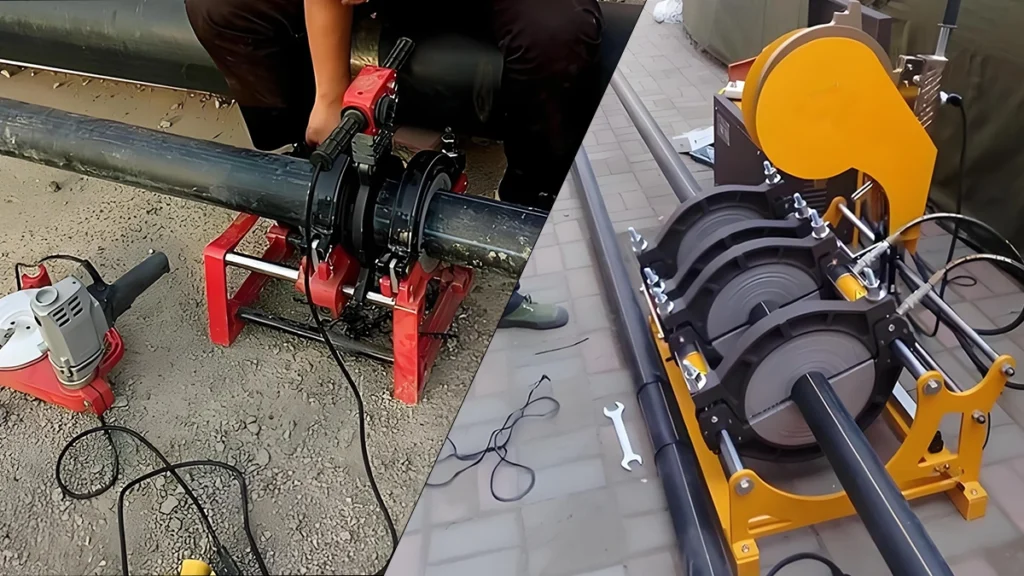
Compare Manual vs. Hydraulic Butt Fusion Machines for small to medium bore pipes (63mm-315mm)
Manual butt fusion machines are typically rack-and-pinion operated, relying on the operator’s physical strength to apply fusion force. These are generally limited to smaller diameters (63mm up to 250mm depending on SDR) and are favored for their lightweight portability. They are ideal for tight spaces, such as in-building plumbing or difficult trenches where a hydraulic unit cannot fit. However, they lack consistency; the fusion pressure is entirely dependent on the operator’s feel, making them unsuitable for critical high-pressure gas lines.
Hydraulic butt fusion machines represent the standard for professional pipeline contracting. Starting from 63mm and going up to 2600mm, these units use a hydraulic pump to generate the immense force required to fuse thick-walled pipes. The primary advantage is consistency and power. A hydraulic cylinder can apply constant, measurable force that is impossible to achieve manually. For pipes larger than 315mm, hydraulic systems are mandatory, as the drag pressure required to move the pipe and the fusion pressure required to join it exceed human capability.
Investigate the rise of CNC Automatic Butt Fusion Machines for traceability and error reduction
The industry is increasingly shifting toward CNC (Computer Numerical Control) automatic butt fusion machines. These units remove the operator from the critical control loop. Once the pipe is clamped and faced, the computer reads the RFID tag or operator input (Pipe OD, SDR, Material) and automatically calculates the welding parameters.
The butt fusion machine controls the heating plate temperature, the duration of the heat soak, the changeover time, and the cooling ramp-down. Crucially, if any parameter falls outside the standard (e.g., ISO 21307), the butt fusion welding machine aborts the weld. This technology reduces error rates by over 90%. For contractors, the ROI comes from speed and reduced liability; the butt fusion machine ensures that the cooling time is never shortened—a common shortcut taken by impatient operators that leads to joint failure.
Research the benefits of Track-Mounted (Crawler) vs. Wheeled machines for rough terrain applications
Mobility is a major logistical factor. Standard butt fusion machines are mounted on a wheeled chassis or sit in a cradle, requiring a crane or excavator to move them along the pipeline. This is acceptable for stationary fabrication yards or urban projects with flat ground.
However, for cross-country pipelines, mining sites, or agricultural irrigation projects, Track-Mounted (Crawler) butt fusion welding machines are superior. These self-propelled units feature integrated diesel engines and tank-tread tracks, allowing them to traverse mud, steep grades (up to 30%), and rocky terrain without support equipment. While the initial capital investment is higher, the elimination of a dedicated excavator to move the welder creates significant operational savings.
Essential Features of High-End Butt Fusion Equipment
Beyond the chassis and hydraulics, the specific components of a butt fusion machine dictate its longevity and ease of use. Industrial-grade equipment is designed to withstand the harsh reality of construction sites—dust, moisture, and rough handling—while maintaining laboratory-level precision.
Examine Heating Plate Technology: PTFE coating quality and digital temperature control precision
The heating plate (or heater) is the heart of the fusion process. High-end butt fusion machines utilize aluminum plates coated with industrial-grade Polytetrafluoroethylene (PTFE). This non-stick coating is critical; if molten plastic sticks to the heater during the removal phase (changeover), it ruins the joint surface. Top-rated manufacturers apply multiple layers of PTFE to resist scratching and wear.
Furthermore, precision digital temperature control is essential. Unlike simple analog dials, modern PID controllers monitor the temperature at multiple points on the plate to ensure uniformity. A variance of just a few degrees can alter the melt flow index of the plastic. The heater must also have a robust electrical connection and insulation to maintain temperature even in cold, windy environments, preventing “cold welds.”
Analyze Facing Tool (Planer) mechanisms: Safety switches, blade materials, and chip removal
The facing tool, or planer, shaves the pipe ends to create perfectly parallel surfaces. Safety is paramount here; high-torque motors spinning sharp blades pose a significant risk. Top-rated butt fusion machines include a microswitch safety interlock that prevents the planer from engaging unless it is properly seated in the chassis.
Blade material also matters. Reversible carbide blades are the industry standard because they hold an edge longer than high-speed steel, especially when shaving pipes that may have sand or grit embedded in the surface. Efficient chip removal design is also a subtle but vital feature; the planer must eject long, continuous ribbons of plastic outward, away from the pipe interior, to prevent contamination of the weld zone.
Review Data Logger integration for Quality Assurance (QA) and project reporting
In today’s regulatory environment, the saying goes: “If it wasn’t recorded, it wasn’t welded.” Utility companies and project owners increasingly mandate the use of Data Loggers (Local Fusion Records – LFR). A top-rated HDPE pipe welding machine will either have a built-in data logger or a seamless port for an external unit.
These devices record the operator ID, job location (GPS), weather conditions, and a second-by-second graph of pressure and temperature throughout the weld cycle. This generates a tamper-proof PDF report for every joint. This level of QA is often a prerequisite for bidding on municipal gas and water projects, making data logging capability a non-negotiable feature for serious contractors.
Selection Guide: Matching Specifications to Project Requirements
Choosing the right butt fusion machines requires mapping technical specifications to the realities of the job site. Over-specifying wastes budget, while under-specifying leads to equipment damage and project delays.
Create a selection matrix based on Pipe Diameter Ranges
Manufacturers categorize machines by the maximum Outside Diameter (OD) they can weld. However, the effective range is usually the top 3-4 sizes below the maximum.
| Machine Model | Welding Range (OD) | Typical Application |
|---|---|---|
| Ekberg 160 | 40mm – 160mm | Residential plumbing, small irrigation, service lines. |
| Ekberg 250 | 63mm – 250mm | Municipal water distribution, fire mains. |
| Ekberg 315 | 90mm – 315mm | Industrial process piping, sewer mains, gas distribution. |
| Ekberg 630 | 315mm – 630mm | Transmission mains, mining slurry lines, large drainage. |
| Ekberg 1200 | 630mm – 1200mm | Major infrastructure, desalination plants, hydro-power penstocks. |
Note: Always select a machine where your primary pipe size falls in the middle of the machine’s range for optimal handling and efficiency.
Calculate Generator and Power Supply requirements for different machine sizes
Remote jobsites rely on generators, and undersized power supplies are a frequent cause of heater failure. The total power load includes the heater, the facing tool, and the hydraulic pump. As a rule of thumb, the generator capacity should be 1.5 to 2.0 times the butt fusion machine’s total rated power.
For a standard 315mm hydraulic butt fusion machine (Heater ~3.1kW + Facer ~2.0kW + Hydraulic ~0.75kW = ~5.85kW), a 7.5kW to 10kW generator is recommended. For a 630mm hydraulic butt fusion machine, the load can exceed 10kW, often requiring a 20kVA 3-phase generator. Voltage drop is the enemy of electronic components; ensure extension cords are heavy-gauge and kept as short as possible.
Assess SDR Compatibility and Clamping Force limitations for high-pressure pipes
Not all butt fusion equipment can handle all pipe wall thicknesses. Standard Dimension Ratio (SDR) describes the relationship between pipe diameter and wall thickness. Lower SDR numbers (e.g., SDR 7.4 or SDR 9) mean very thick walls and high pressure ratings.
Thick-walled pipes require significantly higher fusion forces. A standard hydraulic cylinder might max out its pressure capability when trying to fuse a large diameter SDR 9 pipe. Contractors must verify that the machine’s “Effective Cylinder Area” (in cm²) is sufficient to generate the required interfacial pressure (0.17 or 0.52 MPa) for the specific pipe SDR they are installing. “High Force” models are available specifically for heavy-wall applications.
Manufacturing Excellence: Why Ekberg Welding Stands Out
Ekberg Welding has established itself as a preferred manufacturer by focusing on the intersection of durability and precision. While many brands outsource component production, Ekberg maintains strict control over manufacturing processes to ensure every unit meets the “top-rated” criteria demanded by global contractors.
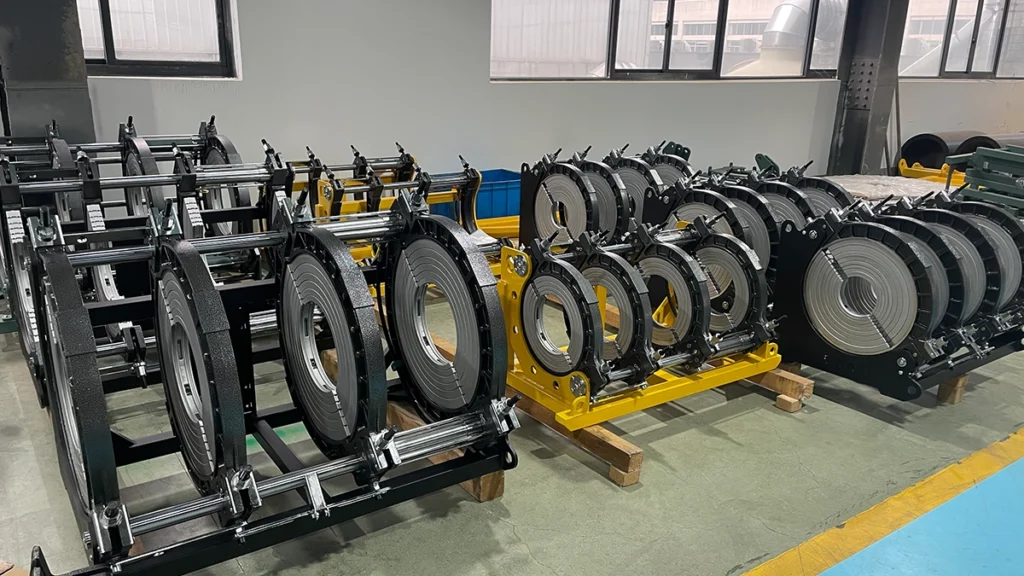
Describe the precision CNC machining of machine chassis and clamps for superior alignment
The alignment of a butt fusion machine is determined during the machining of the chassis and clamps. Ekberg utilizes advanced 5-axis CNC machining centers to mill the main butt fusion welding machine body from solid blocks of high-strength alloy. This single-piece construction eliminates the variances found in welded or bolted frames.
By machining the clamp seats to tolerances within micrometers, Ekberg ensures that when the inserts are placed, the pipe centers align naturally. This reduces the need for operators to struggle with the HDPE pipe jointing machine to force alignment, reducing setup time and preventing stress on the equipment.
List key certifications (CE, ISO 9001) and rigorous factory testing procedures before shipment
Reliability is proven through testing. Every Ekberg butt fusion machine undergoes a rigorous Pre-Delivery Inspection (PDI). This includes a hydraulic pressure hold test where the system is pressurized to maximum capacity and left for 24 hours to check for micro-leaks in seals or hoses.
Electrical components, particularly the heater plates, undergo insulation resistance testing and thermal mapping to verify temperature uniformity. Ekberg facilities are ISO 9001 certified for quality management, and all HDPE pipe welding machines carry the CE mark, ensuring compliance with European safety, health, and environmental protection requirements.
Outline the availability of spare parts, inserts, and technical support for global contractors
The true cost of a machine includes its serviceability. A broken machine that waits six weeks for a part is a liability. Ekberg maintains a massive inventory of critical spares—including hydraulic seals, planer blades, electronic relays, and reduction inserts (liners)—ready for immediate global dispatch.
Because Ekberg sells factory-direct, technical support is provided by the engineers who designed the equipment, not a third-party sales rep. This direct line of communication allows for rapid troubleshooting of complex issues, such as generator compatibility or parameter programming for non-standard pipe materials.
Frequently Asked Questions about Butt Fusion Machines
What is the difference between high-pressure and low-pressure butt fusion welding?
The difference lies in the interfacial pressure applied during the fusion phase. Low-pressure welding (ISO/DVS) uses roughly 0.17 MPa (approx. 25 psi) interfacial pressure. High-pressure welding (ASTM/North American) uses roughly 0.52 MPa (approx. 75 psi). The machine’s hydraulic cylinders must be sized correctly to achieve the required force for the specific method used.
How often should butt fusion machines be calibrated and serviced?
ISO standards and most project specifications require calibration every 12 months. This involves verifying the accuracy of the pressure gauge, temperature probe, and timer. Regular servicing, including hydraulic oil changes and checking planer blades, should be performed based on operating hours, typically every 6 months or before major projects.
Can one machine weld all pipe SDR ratings, or are there limitations?
There are limitations. While a butt fusion machine fits a specific diameter range (e.g., 160-315mm), it may not have enough hydraulic force to weld the thickest wall pipes (e.g., SDR 7.4) at the largest diameter in that range. Always check the machine’s force charts against the required fusion force for your specific pipe SDR.
Is a data logger mandatory for all municipal water and gas projects?
Increasingly, yes. Most gas distribution and municipal water authorities now require a Local Fusion Record (LFR) for every joint to ensure traceability and accountability. Even if not strictly mandated for private agricultural jobs, using a data logger protects the contractor against liability claims in the event of a future leak.
How does ambient temperature affect the butt fusion welding process?
Extreme cold (below 5°C) can cool the pipe ends too quickly during the changeover phase, causing weak joints. In these conditions, welding tents and space heaters are required. Conversely, extreme heat can affect the hydraulic oil viscosity. Top-rated butt fusion machines include temperature compensation features or charts to adjust heating times based on ambient conditions.
Conclusion
Selecting top-rated butt fusion machines is an investment in the integrity of your pipeline infrastructure. The market leaders are defined by three core pillars: precise hydraulic control that maintains pressure during long cooling cycles, robust chassis construction that prevents misalignment, and strict adherence to ISO 21307 and DVS 2207 welding standards. Whether you choose a manual unit for agility or a CNC automatic model for guaranteed traceability, the equipment must deliver repeatable, leak-free joints under field conditions.
Compromising on these specifications to save on upfront costs inevitably leads to higher expenses through joint failures, failed pressure tests, and project delays. By prioritizing engineering quality and manufacturer support, contractors can ensure their projects stand the test of time.
Ready to upgrade your fleet with industrial-grade fusion technology?
Contact Ekberg Welding today for a technical consultation. Request a factory-direct quote, explore our catalog of top-rated butt fusion solutions, and secure the reliability your next project demands.