
Custom Solutions from the Butt Fusion Machine Manufacturer
Table of Contents
Butt fusion machines that lack precise pressure control or thermal uniformity are a liability. A single joint failure caused by inadequate equipment can saddle utility contractors with excavation and repair costs averaging $50,000 per incident. When critical infrastructure projects involve high-pressure gas or potable water, standard off-the-shelf welding gear often crumbles under the demands of complex terrain and evolving material standards. While catalog units have their place, utility-grade pipelines demand engineered solutions that guarantee compliance with ISO 21307 and DVS 2207 standards, even in the harshest field conditions.
This guide explores essential customization options for utility projects, ranging from high-pressure hydraulic modifications for heavy-wall pipes to modular chassis designs built for narrow urban trenches. We will also break down the technical specifications necessary for welding modern PE100-RC materials and provide a framework for vetting a manufacturer’s engineering depth. By the end, you will have a clear roadmap to specify and procure the exact welding equipment required for your next DN40mm–DN2600 infrastructure project—avoiding costly specification errors before they happen.

Why Utilities Require Custom Butt Fusion Machine Solutions
Addressing Unique Terrain and Trench Constraints in Urban Environments
Standard welding carriages assume you are working in an open field where space is abundant. Municipal water and gas upgrades, however, often occur in congested urban zones where trench width is strictly throttled to minimize traffic disruption and excavation fees. A standard 630mm hydraulic butt fusion machine chassis is often too bulky to fit into a shored trench less than 1 meter wide. This forces contractors to weld above ground and lower the pipe in—a risky maneuver that introduces dangerous bending stresses on the cooling joint.
Custom solutions solve this geometry problem through detachable chassis systems. In these configurations, the hydraulic power unit (HPU) and control station stay at ground level, while the clamping carriage is stripped of non-essential bulk to slide into narrow shafts or vertical risers. For extreme constraints, Ekberg Welding engineers 45-degree clamp configurations or “short-frame” designs. These allow for tie-in welds in spaces where standard butt fusion welding machines physically cannot fit, eliminating the need for expensive crane support and allowing operators to work safely from the trench edge.
Adapting to Advanced Pipe Materials (PE100-RC, PE-RT, PP)
The utility sector is pivoting toward advanced materials like PE100-RC (Resistant to Crack) and PE-RT (Raised Temperature) to push pipeline lifespans past the century mark. These materials possess rheological properties that differ significantly from standard HDPE. For example, PE100-RC demands strict adherence to cooling times to ensure the crystalline structure reforms correctly; the “fast cooling” shortcuts often taken with standard butt fusion machines can result in long-term stress cracking.
Standard heating plates frequently lack the thermal precision these materials demand. A deviation of just ±5°C can compromise the melt integrity of PE-RT. Custom butt fusion machines from Ekberg are calibrated with high-precision PID controllers and industrial-grade PTFE coatings to maintain temperature uniformity within ≤ ±3°C across the entire effective working surface. Furthermore, specific firmware updates can be hard-coded into the CNC unit to handle the unique heating soak times and fusion pressures required for polypropylene (PP) or PVDF piping used in industrial water treatment, ensuring plastic pipe welding machine parameters align perfectly with material science.
The Demand for Enhanced Traceability and Data Logging (LRP)
In modern utility contracts, if the data doesn’t exist, the weld didn’t happen. Municipal gas and water projects increasingly mandate ISO 12176-compliant data recording to build a “digital twin” of the infrastructure. Off-the-shelf machines with basic data loggers often allow for manual data entry, creating a massive liability risk if operators falsify cooling times to accelerate production.
Customized utility solutions integrate “Level 4” traceability directly into the hydraulic control unit. This includes GPS tagging to pinpoint the exact joint location, barcode scanners for pipe batch traceability, and operator ID restrictions. The software is customized to lock critical parameters; if the drag pressure shifts or the cooling time is interrupted, the butt fusion machine automatically flags the weld as a failure. This encrypted data is tamper-proof, providing utility owners with a legally defensible record of installation quality for every joint from DN110 to DN1000.
Key Customization Options for Ekberg Butt Fusion Machines
Hydraulic System Modifications for High-Pressure Applications
For large-diameter transmission lines (DN1000mm to DN2600mm) or heavy-wall pipes (SDR 11, SDR 7.4), standard hydraulic cylinders often struggle to maintain the required interfacial pressure, particularly during the drag phase of heavy pipe strings. A standard 0.75 kW motor might overheat or fail to achieve the fusion pressure required for a Single High Pressure (SHP) weld according to ISO 21307.
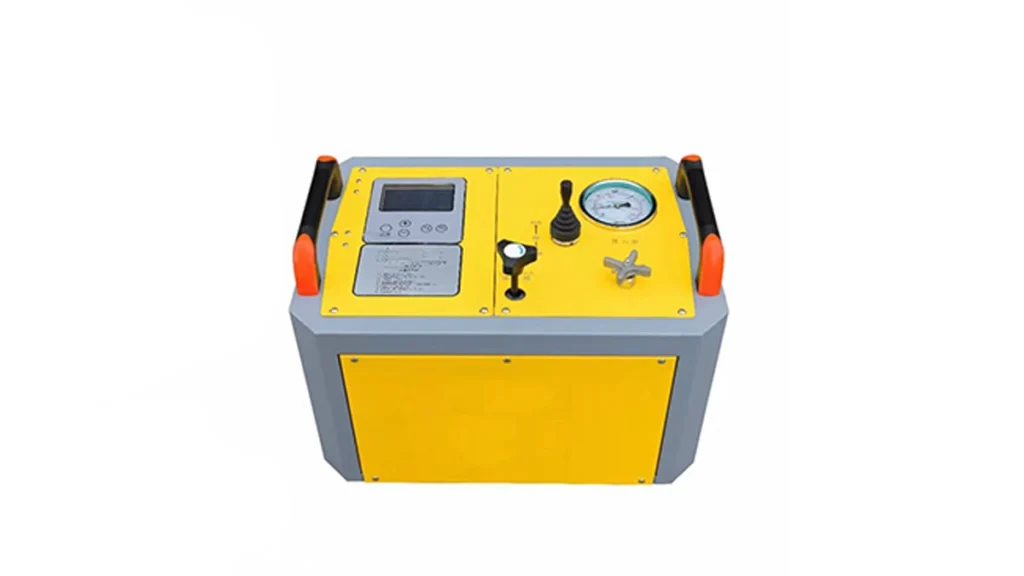
Ekberg addresses this with hydraulic system customizations that upgrade the cylinder bore size and hydraulic pump capacity to deliver pressures up to 6.3 MPa or higher. For heavy-wall pipes requiring long cooling times (often exceeding 45 minutes), standard hydraulic seals can experience “creep” or pressure drop. Custom units are fitted with heavy-duty accumulators and premium seals that lock pressure in, preventing the carriage from relaxing during the critical cooling phase. This modification is non-negotiable for high-pressure gas lines where joint integrity is paramount.
Automation Levels: CNC vs. Semi-Automatic Customizations
The choice between manual, semi-automatic, and CNC automatic butt fusion machines is often dictated by how much human error a project can tolerate. While manual machines rely entirely on the operator to calculate drag pressure and timing, custom CNC solutions eliminate this variable. Ekberg engineers software interfaces that guide the operator step-by-step, refusing to advance the process until the current parameter (e.g., bead-up height or heat soak time) is met.
For specific utility clients, we customize the software logic to create “Supervisor” and “Operator” modes. Supervisor mode allows engineers to pre-program welding standards (e.g., specific DVS 2207 parameters) for a project. The field operator then simply selects the pipe size and SDR, and the butt fusion machine locks all other variables. This prevents deviation from approved procedures, ensuring that a DN315 weld performed on a Monday morning is identical to one performed on a Friday afternoon.
Structural Enhancements and Material Selection
Utility pipelines often run through aggressive environments, from corrosive salt marshes to rocky mining terrain. A standard butt fusion welding machine with a cast aluminum frame and plastic wheels may suffer structural failure after just a few months of rough handling. Customization here extends to the metallurgy and physical design of the equipment.
For mining and agricultural irrigation clients, Ekberg replaces standard components with hardened steel frames and installs protective cages around the hydraulic unit and engine. All-terrain wheels with puncture-proof tires replace standard casters, allowing the butt fusion machine to be towed across rough grades. Additionally, electrical components can be upgraded to IP65 or IP67 standards to resist dust and moisture ingress, ensuring the onboard computer survives in tropical or desert conditions.
Technical Specifications & Compliance: Ensuring Utility-Grade Performance
Adherence to International Welding Standards (ISO 21307, DVS 2207, ASTM F2620)
Compliance is not merely a checkbox; it dictates the physics of the fusion process. Different regions and applications prioritize different standards. For example, North American projects often favor ASTM F2620, while European utilities lean toward DVS 2207. The critical difference lies in pressure parameters. ISO 21307 allows for Single High Pressure (SHP) welding at 0.52 MPa, which significantly reduces cooling times compared to the Single Low Pressure (SLP) 0.17 MPa standard.
Ekberg customizes the hydraulic calibration of butt fusion machines to align with the specific standard mandated by the utility. A butt fusion machine calibrated for SHP requires more robust hydraulic power and stiffer chassis construction to handle the increased force without frame deflection. By customizing the hdpe fusion machine to run SHP parameters safely, contractors can reduce cooling times by up to 50%, effectively doubling daily weld output without compromising joint quality.
Precision Temperature Control and Heating Plate Uniformity
The heating plate is the heart of the fusion process. For utility-grade welds, surface temperature distribution must be uniform. Ekberg specifications aim for a deviation of ≤ ±3°C across the effective working surface. This is achieved through custom-designed heating elements and high-quality industrial PTFE coating that prevents plastic from sticking and degrading heat transfer.
Regional power grids also necessitate customization. A butt fusion machine built for a German utility (230V/50Hz) will not function on a US job site (220V or 380V/60Hz) without modification. Ekberg offers custom voltage inputs (220V, 380V) to ensure compatibility with local generators. This prevents voltage drops that cause heater plates to fluctuate in temperature—a common, yet avoidable, cause of “cold welds” in the field.
Drag Pressure Compensation and Dynamic Pressure Monitoring
One of the most critical, yet often overlooked, technical factors is drag pressure—the force required to move the carriage and pipe. In a real-world scenario, dragging 200 meters of DN500 HDPE pipe creates immense friction. If the butt fusion machine does not account for this, the actual interfacial pressure at the pipe ends will be too low.
Ekberg’s custom CNC systems utilize dynamic drag pressure compensation. The plastic pipe butt welder performs a “dummy weld” movement to measure system friction and automatically adds this value to the theoretical welding pressure. This ensures that the *net* pressure acting on the molten plastic matches the standard exactly. Furthermore, dynamic pressure monitoring sensors continuously track pressure during the cooling phase. If a leak in the hydraulic system causes a pressure drop below the allowable tolerance, the data logger records the error, preventing a compromised joint from being buried.
Manufacturer Selection Criteria: How to Choose a Custom Solution Partner
Evaluating Engineering Capability and Design Flexibility
When selecting a partner for custom butt fusion machines, the ability to communicate directly with engineers is paramount. Sales teams often promise capabilities that production cannot deliver. Buyers should assess a manufacturer’s R&D depth: Do they use advanced CAD software for rapid prototyping? Can they provide 3D models of the custom modification before production begins?
Buyer Checklist for Engineering Capability:
- Direct Access: Can you speak with the lead mechanical engineer regarding your specific constraints?
- Customization Lead Time: Is the timeline for a custom build reasonable (typically 4-6 weeks) vs. standard shipping?
- Prototype Validation: Does the factory perform Finite Element Analysis (FEA) on modified frames to ensure they can handle increased hydraulic loads?
Supply Chain Stability and Spare Parts Availability
A custom butt fusion welding machine is a liability if replacement parts are proprietary and unavailable. The risk of downtime is too high for utilities to rely on “black box” components. Ekberg mitigates this by utilizing a modular design philosophy. Even in custom builds, we utilize industry-standard hydraulic seals, valves, and electrical relays wherever possible.
This approach ensures that if a minor component fails in a remote location, a replacement can often be sourced locally, rather than waiting for an international shipment. However, for critical proprietary parts, a guaranteed 10-year spare parts availability policy is essential. Utilities should demand a recommended spare parts list (RSPL) with every custom order, ensuring their maintenance teams have the necessary kits on hand for immediate repairs.
Total Cost of Ownership (TCO) vs. Initial Capital Expenditure
Procurement departments often fixate on the initial purchase price. However, the Total Cost of Ownership (TCO) reveals the true value of custom equipment. A standard, low-cost butt fusion machine might save $5,000 upfront but cost $20,000 in crane rentals because the chassis isn’t detachable. Worse, a single joint failure due to poor pressure control can cost $50,000+ in excavation, environmental fines, and reputational damage.
Hypothetical ROI Calculation (5-Year Horizon):
- Standard Machine: Higher failure rate (1%), slower cooling times (SLP), requires auxiliary lifting equipment.
- Custom Ekberg Machine: Near-zero failure rate (CNC control), faster cycle times (SHP capable), reduced labor (data logging).
Over five years, the custom solution often delivers a 30-40% operational savings despite the higher CapEx, primarily through increased daily productivity and risk mitigation.
Factory Capability, Manufacturing Excellence & Quality Control
Ekberg’s Manufacturing Process: From Raw Material to Final Calibration
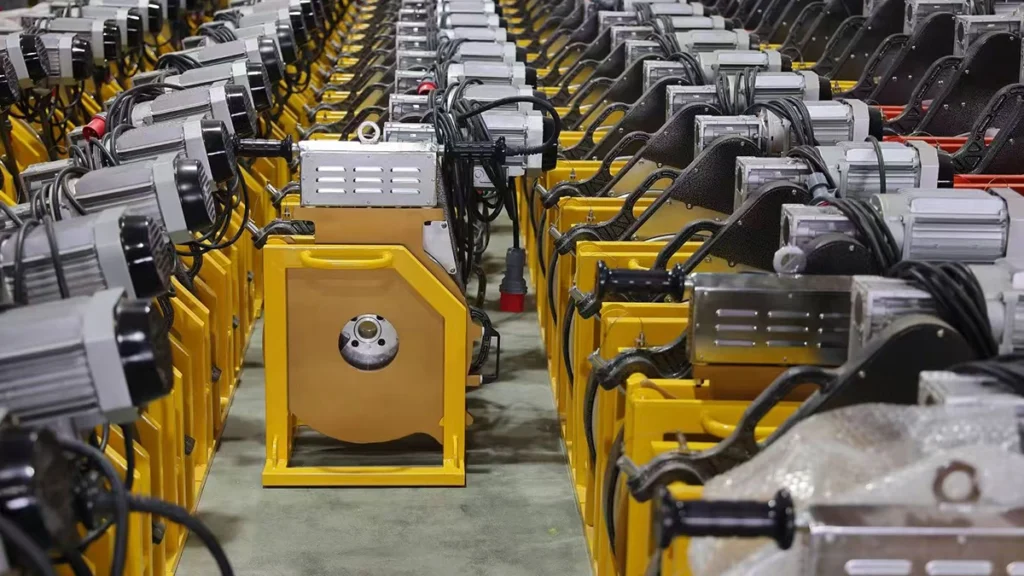
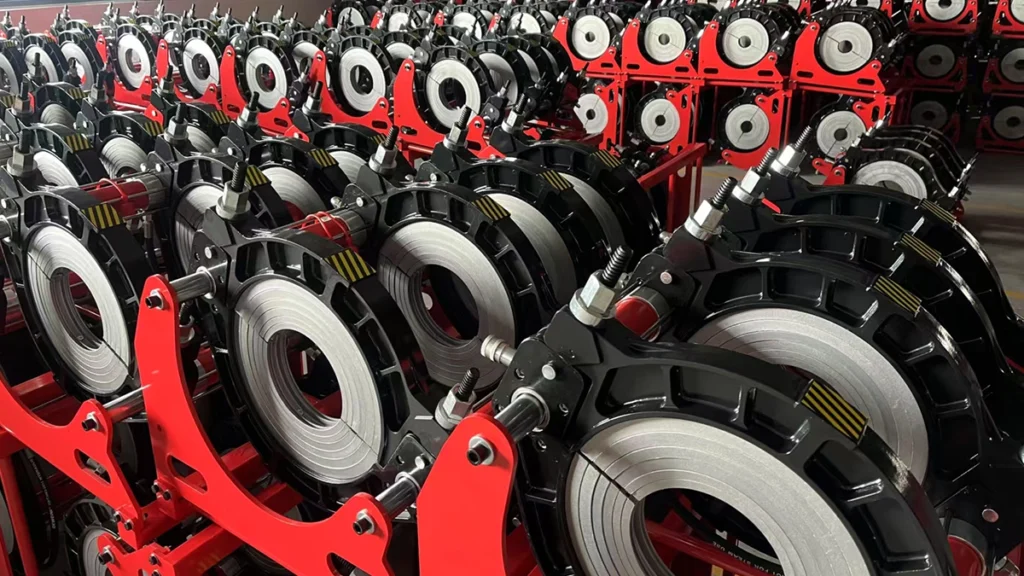
Customization requires control over the entire production chain. Ekberg does not merely assemble parts; we manufacture them. Our facility houses advanced CNC machining centers, die-casting equipment, and precision grinding tools. This vertical integration allows us to modify a chassis design or machine a custom hydraulic cylinder block in-house without relying on third-party vendors.
From the raw aluminum casting of the clamps to the final programming of the PLC, every step is monitored. This capability is what allows us to produce a butt fusion machine for a specific DN range or pressure requirement that isn’t in the standard catalog. We don’t just tweak existing models; we engineer solutions from the ground up based on client specifications.
Rigorous Quality Assurance and Testing Protocols
Before a custom butt fusion machine leaves the factory, it undergoes testing far more rigorous than standard batch checks. Every custom unit is subjected to a 24-hour hydraulic pressure holding test to ensure seal integrity. Heating plates are mapped with thermal imaging to verify the ±3°C uniformity requirement.
For structural integrity, frames undergo stress testing to simulate maximum load conditions. We also validate the software logic, simulating various failure modes (e.g., power loss, sensor failure) to ensure the fail-safes operate correctly. Our custom units are certified to CE and ISO 9001 standards, providing utilities with the documentation needed for regulatory approval.
Global Logistics and Technical Support for Utilities
Shipping heavy industrial machinery requires expertise. Ekberg ensures that custom butt fusion machines are crated in fumigated, export-grade timber with moisture protection for sea freight. But support doesn’t end at delivery. We provide comprehensive technical manuals, hydraulic schematics, and electrical diagrams—critical resources for utility maintenance teams.
For our CNC automatic butt fusion machines, we offer remote diagnostic capabilities. If a hdpe fusion machine throws an error code in the field, our engineers can often identify the issue remotely, guiding the on-site technician through the resolution process. This global support infrastructure ensures that your custom solution remains operational, regardless of where the pipeline is being built.
Frequently Asked Questions
Q1: What is the typical lead time for a custom-built butt fusion machine?
For minor modifications, such as voltage changes or specific plug types, the lead time is typically 1-2 weeks. For fully engineered custom solutions—like high-pressure hydraulic upgrades or modified chassis designs—plan for 4-6 weeks. This window includes design validation, manufacturing, and rigorous testing. We recommend engaging our engineering team early in the project planning phase to ensure delivery aligns with your construction schedule.
Q2: Can existing manual butt fusion machines be upgraded with automatic data loggers?
In many cases, yes. Ekberg offers retrofit data logging units (LRP) that can attach to compatible hydraulic systems. However, for full “Level 4” traceability where the butt fusion welding machine automatically controls the welding process based on the data, a full CNC upgrade or a new CNC automatic butt fusion machine is required. Retrofit loggers primarily record pressure and time but still rely on the operator to manually control the hydraulics.
Q3: How does Ekberg ensure custom machines meet local voltage and plug requirements?
We build machines to match the specific power grid of the destination country. During the ordering process, we verify the voltage (220V, 380V, etc.) and frequency (50Hz/60Hz). We also install industrial plugs compatible with local standards. Our heating elements and motors are selected specifically to operate efficiently at the designated voltage, preventing overheating or under-performance.
Q4: What is the warranty coverage on custom-engineered welding equipment?
Ekberg provides a standard 12-18 month warranty on all custom butt fusion machines, covering manufacturing defects and component failures. We also offer extended warranty packages for major utility projects. Crucially, our warranty includes technical support. Because we use high-quality, non-proprietary internal components where possible, many repairs can be handled locally without voiding the warranty, provided they are authorized by our support team.
Q5: Can you customize machines for specific pipe brands or non-standard diameters?
Yes. While standard machines cover ISO standard diameters (e.g., DN315mm, DN630mm), we can machine custom inserts/liners for non-standard or Imperial pipe sizes specific to certain regions or industries. If a specific pipe manufacturer has unique fusion parameters (e.g., non-standard cooling times for a proprietary polymer blend), we can program these specific profiles into the CNC software to ensure perfect compliance.
Conclusion
The integrity of global utility infrastructure relies heavily on the quality of the connections that hold it together. While off-the-shelf equipment may suffice for general irrigation, critical gas and water pipelines demand butt fusion machines tailored to specific environmental, material, and regulatory challenges. From detachable chassis for narrow urban trenches to high-pressure hydraulic systems for ISO 21307 compliance, custom solutions are not a luxury—they are a risk management necessity.
Investing in a custom-engineered solution from Ekberg Welding ensures that your project benefits from precise temperature control, automated traceability, and robust durability. The upfront investment in the right tool pays dividends by preventing catastrophic joint failures, reducing cooling times, and eliminating costly project delays.
Don’t compromise on pipeline safety with generic equipment. Contact Ekberg Welding today for a technical consultation. Our engineers are ready to discuss your specific project requirements and provide a factory-direct quote for a custom welding solution designed to perform where others fail.