
How to identify a legitimate Butt Fusion Machine supplier?
Table of Contents
Selecting butt fusion machines capable of maintaining strict 220°C heating uniformity and precise 0.15 MPa fusion pressure is the only thing standing between a leak-free pipeline and a catastrophic joint failure. In the high-stakes arena of DN160–DN1600 infrastructure projects, the provenance of your equipment is just as vital as the skill of your operators.
The global market is currently awash with unauthorized resellers pushing “grey market” equipment. These units often lack traceability, proper calibration, and safety compliance. This guide details the essential verification methods for identifying legitimate distributors, understanding the warranty implications for hydraulic components, and navigating the strategic choice between factory-direct procurement and local dealer support. By the end, you will possess a robust framework to vet suppliers, ensuring your fleet complies with ISO 21307 standards while preventing costly project downtime.

Why Sourcing from Authorized Dealers is Critical for Project Safety
Procuring welding equipment is not merely a transaction; it is the acquisition of a capability to perform critical infrastructure work. When a contractor purchases a butt fusion welding machine, they are buying the assurance that the equipment performs within the tight tolerances defined by international standards. Authorized dealers are the only entities contractually bound and technically equipped to deliver this guarantee.
The Hidden Risks of Grey Market Equipment
The “grey market” consists of genuine or imitation equipment sold outside the manufacturer’s approved distribution channels. While the initial capital expenditure (CapEx) might look 15–20% lower, the operational risks are exponential. Grey market machines frequently bypass the rigorous final calibration checks required by ISO 12176-1 traceability standards.
Consider the technical implications: a butt fusion machine intended for a market with lax regulatory standards may lack the precise PID temperature control required for high-grade PE100 pipe welding. If the heating plate fluctuates beyond the acceptable ±3°C range, the polymer melt becomes inconsistent, resulting in “cold joints” or brittle fusion zones. Should a pipeline fail, liability investigators will immediately trace the equipment’s serial number. If that machine cannot be linked to a valid calibration certificate from an authorized source, the contractor faces severe legal and financial repercussions, often voiding project insurance policies entirely.
Warranty and Spare Parts Availability
Butt fusion machines are complex assemblies of hydraulic, electrical, and mechanical systems. Critical components—such as the hydraulic power unit (delivering 0–150 bar pressure), the PTFE-coated heating plate, and the electric facing tool—require OEM-certified replacement parts to maintain performance.
Authorized dealers stock what manufacturers designate as “Tier 1” and “Tier 2” spare parts. This inventory includes specific hydraulic seals for cylinders ranging from DN160 to DN1600, electronic control boards, and quick couplers. Unauthorized resellers rarely stock these specific items. When a seal fails on a grey market machine, the buyer is often left waiting weeks for a compatible part or forced to jury-rig an ill-fitting generic substitute. Furthermore, Ekberg Welding’s manufacturer warranty—covering non-human damage to motors and pumps for 12 months—is valid only when the equipment is purchased through approved channels. A third-party reseller’s “shop warranty” is effectively worthless when a major component like a hydraulic pump fails under load.
Technical Training and Certification Support
According to DVS 2207 standards, weld quality depends on a triad: the butt fusion machine, the process, and the operator. Authorized dealers do not just sell iron; they sell competence. They are trained directly by the factory to provide operator certification courses.
Legitimate dealers can issue training certificates verifying that an operator knows how to calculate drag pressure, determine cooling times based on wall thickness [e.g., T (cool)≈10×Wall Thickness], and execute the bead-up phase correctly. On strict municipal projects or mining sites, safety officers will demand proof of operator competency. Certificates issued by unauthorized sellers are frequently rejected by project consultants, leading to expensive work stoppages until the crew can be retrained by a certified entity.
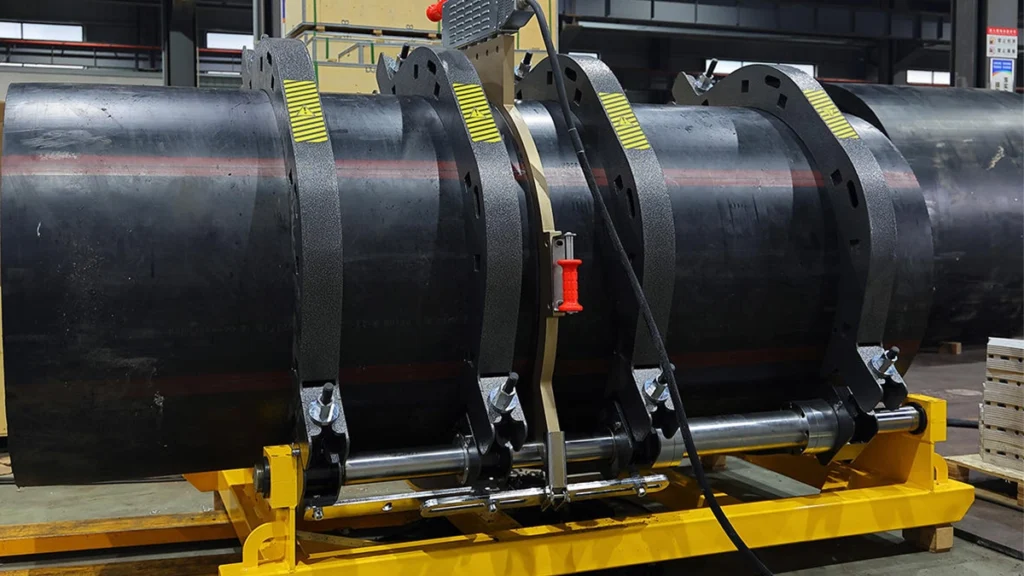
5-Step Checklist to Verify a Butt Fusion Machine Dealer
To protect your investment, you must rigorously vet potential suppliers. Do not rely on website claims alone; verify their status through documentation and technical interrogation.
1. Verifying Manufacturer Authorization Documents
The first step is to demand the “Authorized Distributor Certificate.” A legitimate document will feature a unique authorization number, the dealer’s legal entity name, a validity period, and the manufacturer’s official stamp.
Refuse low-resolution scans or generic “partner” logos on a website. Take the authorization number and contact the Ekberg Welding factory directly to cross-reference it with the global database. Manufacturers maintain strict records of who is permitted to sell specific product lines in specific territories. If the dealer makes excuses about why they cannot produce a current certificate—or if the certificate is expired—walk away immediately. This is the primary filter for eliminating grey market opportunists.
2. Assessing Technical Knowledge (The “Spec Test”)
A qualified dealer acts as a technical consultant. Test their depth of knowledge with specific engineering questions that a mere box-mover cannot answer.
Ask the following:
- “What is the temperature recovery time of the heating plate after the bead-up phase for a DN400 hdpe pipe?” (They should know it must be rapid to prevent cooling of the melt).
- “Do you stock replacement hydraulic seals for the DN630 cylinder locally, or do they ship from the factory?”
- “Can your machine switch between ISO 21307 Single Low Pressure (SLP) and Dual Low Pressure (DLP) modes?”
If the sales representative cannot distinguish between High Pressure (ASTM) and Low Pressure (ISO/DVS) welding, or if they cannot explain why drag pressure must be added to the theoretical fusion pressure, they lack the technical capacity to support your projects.
3. Inspecting Inventory and Service Capabilities
Downtime costs on a pipeline project can easily exceed $10,000 per day in idle crew time and equipment rental. Your dealer must serve as your warehouse.
Request a video tour or visit their facility to inspect their inventory. A serious distributor will have consumables on the shelf: planer blades, heating plates, hydraulic hoses, and inserts for various pipe diameters. Beyond parts, inspect their service center. Do they possess the calibration equipment necessary to verify pressure gauges and temperature probes? A dealer without a service bench is just a broker, unable to assist you when a butt fusion machine drifts out of calibration in the middle of a critical job.
4. Checking References and Past Project Performance
Ask for case studies relevant to your industry. A dealer experienced in agricultural irrigation may not understand the stringent data logging requirements of a gas distribution network.
Request contact information for three past clients who purchased similar tonnage equipment (e.g., DN800 or larger). Ask those references specific questions: “Did the dealer provide on-site commissioning?” “How fast did they respond when a hdpe fusion machine went down?” “Did the butt fusion machines pass third-party inspection?” Past performance on similar scale projects—whether municipal water, mining slurry lines, or gas transmission—is the best predictor of future reliability.
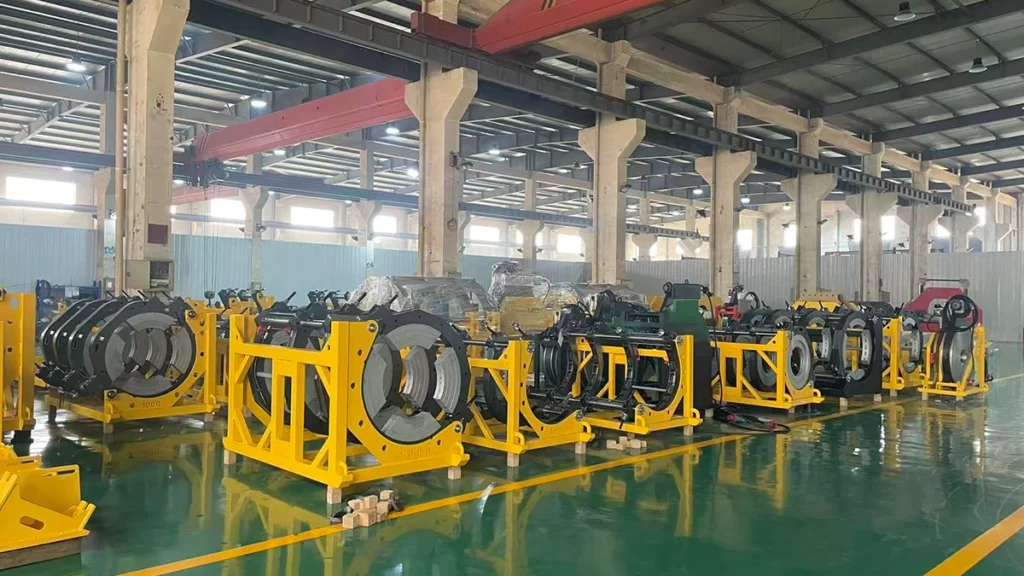
Machine Selection Criteria: What a Good Dealer Should Ask You
An authorized dealer’s goal is to ensure the butt fusion welding machine fits the application, not just to close a sale. They should interrogate your project specifications before recommending a model.
Analyzing Project Requirements (Pipe Material & Diameter)
Ekberg Welding produces hydraulic butt fusion machines ranging from 160mm to 2600mm. A proficient dealer will ask about the specific pipe materials (HDPE, PP, PVDF) and the Standard Dimension Ratio (SDR) you are welding.
For example, welding thin-walled SDR 26 pipe requires different pressure sensitivity than heavy-wall SDR 7.4 mining pipe. The dealer should guide you between Manual, Hydraulic, and CNC (Automatic) models. For critical gas lines, they should steer you toward CNC models that automate the welding phases (bead-up, heat soak, changeover, fusing, cooling) to eliminate human error. If you are welding large diameter hdpe pipes (DN1000+), they should discuss the benefits of 4-clamp versus 2-clamp configurations for stability.
Environmental Considerations and Ruggedness
Where will the machine be working? A butt fusion welding machine destined for a pristine factory floor has vastly different requirements than one heading to a muddy trench in a tropical rainforest or a freezing mining site.
A competent dealer will discuss the Ingress Protection (IP) rating of the electrical control box and the durability of the chassis. Ekberg butt fusion machines utilize ZL104 aluminum alloy for a high strength-to-weight ratio, crucial for rough terrain. If your project is in a high-altitude region, the dealer should also discuss the impact of ambient temperature and air density on cooling times and generator performance, ensuring the power supply is sufficient for the heating element.
Data Logging and Traceability Needs
Modern infrastructure projects increasingly demand “smart” welding. The dealer must ask about your data logging requirements.
Does your client require compliance with ISO 12176-4? If so, you need a hdpe pipe welding machine with an integrated Data Logger that records operator ID, GPS location, ambient temperature, and real-time pressure/temperature curves. The dealer should explain how their software exports this data (encrypted PDF or CSV) and how it integrates with your quality assurance documentation. Selling a manual butt fusion machine to a contractor who needs full digital traceability is a failure of service that an authorized dealer avoids.
Factory Direct vs. Authorized Local Distributor: Which is Right for You?
Buyers often struggle with the decision to buy directly from the manufacturer or through a local partner. Both pathways are valid, but they serve different business models.
When to Buy Factory Direct from Ekberg Welding
Purchasing factory-direct is the optimal strategy for large-scale distributors, major construction firms with centralized procurement, or buyers in regions without an established dealer network.
- Volume Pricing: Direct procurement eliminates the middleman markup, offering significant cost savings on bulk orders (e.g., equipping a full fleet for a new fiscal year).
- Customization: If your project requires specific modifications—such as extended hydraulic cylinder strokes or custom voltage configurations (e.g., 380V/50Hz vs 380V/60Hz)—working directly with the factory’s engineering team ensures these specs are met precisely.
- OEM Branding: Large distributors looking to white-label equipment can negotiate OEM agreements directly with the manufacturing source.
The Value of Local Dealer Support
For most contractors, the premium paid to a local dealer is an investment in risk mitigation and agility.
- Immediate Availability: When a project starts unexpectedly, you cannot wait four weeks for ocean freight. Local dealers hold stock for immediate deployment.
- Cash Flow & Currency: Dealing in local currency with local payment terms (e.g., Net 30) simplifies accounting and avoids the complexities of international wire transfers and exchange rate fluctuations.
- Customs & Logistics: The dealer handles import duties, customs clearance, and “last mile” delivery to the job site, removing a massive logistical burden from your team.
The Hybrid Model: Factory Support via Local Channels
The strongest ecosystem is the hybrid model. Ekberg Welding supports its global network by ensuring local dealers have direct access to R&D and engineering teams. If a local dealer encounters a complex troubleshooting issue on a 1200mm hydraulic butt fusion machine, they can escalate it directly to factory engineers for remote diagnostics. This gives buyers the best of both worlds: local presence with factory-level technical backing.
Comparison: Sourcing Channels
| Feature | Factory Direct | Authorized Local Dealer | Grey Market / Reseller |
|---|---|---|---|
| Price Point | Lowest (Volume dependent) | Moderate (Includes service) | Low (High risk) |
| Lead Time | Production + Shipping | Immediate (Stock) | Unpredictable |
| Warranty | Full Manufacturer | Full Manufacturer + Local Labor | Limited / None |
| Tech Support | Remote / Virtual | On-site / In-person | None |
| Spare Parts | Direct Shipping | Local Inventory | Generic / Mismatched |
Ekberg Welding: Manufacturing Excellence & Global Support Network
The reliability of a dealer is ultimately rooted in the quality of the manufacturer they represent. Ekberg Welding empowers its authorized partners through rigorous manufacturing standards and continuous innovation.
ISO 9001 Quality Control and Production Standards
Every butt fusion machine leaving the Ekberg factory undergoes a strict quality assurance process governed by ISO 9001. This begins with the inspection of raw materials—checking the aluminum alloy composition and the grade of hydraulic steel.
Before shipment, hydraulic systems are pressure-tested to 150% of their rated capacity to ensure seal integrity. Heating plates are tested for temperature uniformity to ensure no spot deviates more than ±3°C. Authorized dealers rely on these protocols; they know that when they uncrate a machine for a client, it will perform exactly as specified. This consistency builds trust between the manufacturer, the dealer, and the end-user.
R&D and Continuous Improvement
The welding industry is evolving toward automation. Ekberg invests heavily in R&D, developing CNC automatic butt fusion machines that automatically adjust welding parameters based on ambient temperature and pipe material.
Authorized channels are the first to receive these technology updates. Whether it is a firmware upgrade for the data logger or a new ergonomic design for the planer, official dealers are kept in the loop. Grey market sellers are often selling “New Old Stock”—outdated models that miss out on these efficiency and safety improvements.
Global Logistics and After-Sales Ecosystem
To support a global fleet, Ekberg manages a sophisticated logistics network. We understand that a seal failure in a remote mine in Chile cannot wait for a shipment from Asia. Therefore, we strategically stock regional hubs and require our authorized dealers to maintain “Tier 1” spare parts inventories. This interconnected supply chain ensures that support is never more than a courier flight away, regardless of where your project is located.
Frequently Asked Questions
Q1: How can I verify if a seller is an official Ekberg Welding distributor?
Request their “Authorized Distributor Certificate” and check the validity date and authorization number. Contact Ekberg Welding directly via our official website to cross-reference the dealer’s details with our global database. We can confirm their status and the specific territories they are licensed to serve.
Q2: What is the difference between buying a butt fusion machine online vs. through a dealer?
Buying online from general marketplaces often involves grey market equipment with no warranty, training, or local support. Buying through an authorized dealer ensures you receive a genuine, calibrated butt fusion machine with a valid manufacturer’s warranty, operator training, and access to local spare parts and service technicians.
Q3: Do authorized dealers provide on-site training for welding operators?
Yes. Authorized dealers are trained by the factory to conduct operator certification courses. They can train your crew on DVS 2207 / ISO 21307 standards, HDPE pipe welding machine operation, safety protocols, and troubleshooting. This training is often required for operators to be certified for municipal or utility projects.
Q4: Can I buy spare parts directly from the factory if my local dealer doesn’t have them?
While we encourage purchasing through local dealers for speed, Ekberg Welding supports direct factory sales for critical spares if your local distributor is out of stock. We can ship seals, blades, and electronic components via express air freight to minimize your project downtime.
Q5: What standards (ISO/DVS) should the dealer’s machines comply with?
A reputable dealer’s butt fusion machines should comply with ISO 21307 (Butt fusion jointing procedures), ISO 12176 (Traceability and equipment assessment), and DVS 2207 (German welding standard). Ensure the butt fusion welding machine can meet the specific pressure and temperature parameters required by these standards for the pipe SDR you are installing.
Final Thoughts
The cost of a butt fusion machine is insignificant compared to the cost of a failed joint. When you purchase from an authorized dealer, you are not just buying hardware; you are investing in project security, compliance, and long-term uptime. The risks of grey market equipment—ranging from legal liability to operational paralysis—far outweigh any short-term savings.
As you prepare for your next pipeline installation, use the checklist provided above. Verify the authorization certificate, test the dealer’s technical acumen, and inspect their support infrastructure. Ensure your partners are as committed to quality as you are.
Looking for a certified butt fusion machine solution? Contact Ekberg Welding today to find an authorized dealer near you or request a direct factory quote for your next pipeline project.