
Portable Butt Fusion Machine Supplier for Municipal Projects
Table of Contents
Introduction
High-performance butt fusion machines operating at 220°C with precise 0.15 MPa interfacial pressure form the backbone of modern municipal water and gas distribution networks. While massive, track-mounted fusion equipment dominates the mining sector, municipal contractors face a completely different reality: tight urban trenches, strict noise ordinances, and the urgent need to repair DN40–DN355mm HDPE pipelines in highly congested zones.
The challenge lies in finding equipment that balances lightweight portability with the hydraulic force required to meet rigorous ISO 21307 standards. A generic, underpowered welder might be easy to carry, but if it cannot maintain fusion pressure during the cooling cycle, the resulting joint failure could cost utility providers tens of thousands of dollars in excavation and re-work.
This guide explores the specific engineering requirements for portable municipal welding equipment, covering modular chassis design, generator sizing for voltage stability, and the critical differences between manual, hydraulic, and CNC automatic configurations. We will walk through the technical specifications of the Ekberg series, analyzing how features like split-frame architecture and data logging capabilities impact project ROI. By the end, you will have a clear framework to select the right equipment for your specific pipe inventory—ensuring compliance, safety, and efficiency on every job site.

—
The Critical Role of Portable Butt Fusion Machines in Municipal Infrastructure
The operational environment of a municipal utility contractor is vastly different from a greenfield industrial project. In a city environment, the right butt fusion welding machine is defined not just by its welding capacity, but by its ability to function in restricted spaces without compromising the structural integrity of the pipeline.
Analyzing urban constraints: Trench width, accessibility, and repair urgency
In municipal repair scenarios, excavation size is directly correlated with cost and public disruption. Contractors often work in trenches that are barely wider than the pipe itself—sometimes with only 300mm of clearance on either side. Large, self-propelled track machines simply cannot fit into these excavations without removing shoring boxes or damaging adjacent utility lines.
Furthermore, accessibility is often limited by existing infrastructure. A repair on a burst water main might be located in a backyard, behind a retaining wall, or down a narrow alleyway where a crane truck cannot reach. In these high-urgency situations, the ability to manually transport butt fusion machines to the point of repair is critical. If a crew has to wait four hours for a crane to lift a heavy welder into place, the downtime costs—and potential fines for service interruption—skyrocket. Specialized portable suppliers focus on reducing the butt fusion welding machine’s footprint to ensure it fits standard shoring configurations while leaving room for the operator to safely manage the heating plate and facer.
Modular design architecture: Separating hydraulic units from the chassis
The solution to the weight-versus-power dilemma lies in modular “split-frame” architecture. Generic industrial welders often feature a unified design where the hydraulic pump, electronics, and chassis are bolted together permanently. This results in a HDPE pipe welding machine that can weigh over 150 kg, making manual positioning impossible.
Specialized municipal units, such as the Ekberg M-Series, utilize a modular approach. By using quick-release hydraulic couplers and detachable electrical connections, the butt fusion welding machine is broken down into manageable components. For a DN315 unit, the chassis alone weighs approximately 48 kg. This allows a two-person crew to lift the welding frame into the trench manually, followed by the facer and heater.
The hydraulic power unit (HPU) remains outside the trench or is lowered separately. This modularity does not sacrifice performance; the chassis is still engineered to withstand the high drag forces of pulling long pipe strings, but the weight is distributed intelligently to facilitate rapid deployment.
Power supply compatibility and generator requirements for field operations
Portable operations almost always rely on field generators, introducing variables that can ruin sensitive electronics. A common failure mode in municipal welding is “cold welding” or controller reset caused by voltage drops when the heater plate ramps up or the facer engages.
For a butt fusion machine welding pipes between 63mm and 355mm, the power consumption is significant. An EKY315mm unit draws approximately 5.85 kW total (3.1 kW for the heater, 2.0 kW for the facer, and 0.75 kW for hydraulics). A standard 5 kVA generator is insufficient. When the heater cycles on, the sudden load can cause voltage to sag below the operating threshold of the hydraulic solenoid valves or the data logger.
Specialized suppliers specify generator requirements with a safety margin. For a 315mm hydraulic butt fusion machine, a minimum 8.0 kVA generator is recommended to maintain a stable 230V single-phase supply. Additionally, the extension cables must be rated correctly (e.g., 4.0mm² core for up to 50m) to prevent resistance-based voltage drop. Ignoring these electrical parameters is a primary cause of equipment malfunction in the field.
—
Technical Engineering Standards: Ensuring Joint Integrity in Compact Units
Portability cannot come at the expense of engineering rigor. A butt fusion joint in a gas distribution line must be as strong as the pipe itself. Therefore, portable butt fusion machines must generate and hold specific forces mandated by international standards, regardless of their compact size.
Compliance with ISO 21307 and DVS 2207 welding parameters
Global standards like ISO 21307 and the German DVS 2207-1 dictate precise parameters for interfacial pressure, temperature, and time. For Single Low Pressure (SLP) welding, which is common in municipal PE100 pipe applications, the HDPE pipe welding machine must maintain an interfacial pressure of 0.15 MPa (± 0.02 MPa) across the pipe ends.
Achieving this requires a hydraulic system capable of fine adjustments. During the “heat soak” phase, the pressure must drop to near zero (drag pressure only) to allow the heat to penetrate without pushing molten material out of the joint. Conversely, during the cooling phase, the machine must ramp up to joining pressure and hold it perfectly steady for the calculated time [T(cool)= 0.43*t].
Portable butt fusion machines from specialized suppliers feature hydraulic cylinders with a known, verified effective area (e.g., 20.5 cm² for the M315). This data allows the operator—or the CNC controller—to calculate the exact gauge pressure required to achieve the 0.15 MPa interfacial pressure on the pipe face. Generic butt fusion welding machines often lack verified cylinder data, making true ISO compliance mathematically impossible.
Chassis rigidity and alignment precision under high drag pressure
One of the greatest engineering challenges in portable design is chassis rigidity. When welding long strings of heavy SDR 11 pipe, the “drag pressure” required to pull the pipes together can be substantial. If the butt fusion welding machine frame is too lightweight or constructed from inferior materials, the chassis will flex or twist under this load.
Chassis flex is disastrous for joint quality. It causes high-low misalignment (where the pipe walls do not meet flush), creating stress concentrators that lead to premature failure. Ekberg’s portable units utilize a reinforced aluminum alloy chassis that resists torsion. The guide shafts are hardened and chrome-plated to ensure smooth movement without binding, even when the HDPE pipe welding machine is under maximum hydraulic load (up to 160 bar). This rigidity ensures that the pipe ends remain perfectly aligned (<10% wall thickness mismatch) throughout the cooling cycle, satisfying the stringent requirements of gas utility inspectors.
Heating plate thermal consistency and temperature control accuracy
The heating element is the heart of the fusion process. For HDPE pipe, the surface temperature must be maintained between 200°C and 230°C. However, the critical metric is consistency across the plate.
ISO standards typically allow for a variance of ±5°C. High-end portable suppliers strive for tighter tolerances, often achieving ±3°C stability. This is achieved through high-quality internal casting of the heating resistors and advanced PID (Proportional-Integral-Derivative) temperature controllers. If a heating plate has “cold spots,” the resulting weld will have zones of incomplete fusion, which will fail bead bend tests and tensile strength validation. Additionally, the heating plates on specialized municipal units are coated with a triple-layer PTFE (Teflon) system to prevent molten plastic from sticking to the heater—a common issue that contaminates welds and slows down operations.
—
Comparative Analysis: Manual, Hydraulic, and CNC Portable Configurations
Selecting the right HDPE fusion welding machine configuration depends on the criticality of the pipeline and the audit requirements of the project. While the chassis might look similar, the control method drastically changes the outcome.
Manual butt fusion machines: Lightweight solutions for small diameter drain/water lines
Manual butt fusion machines rely on a hand-wheel and a rack-and-pinion gear system to apply pressure. The operator uses physical force to bring the pipe ends together and reads a spring-loaded gauge to estimate pressure.
- Pros: Extremely lightweight (~35 kg), no hydraulic oil to leak, lower capital cost.
- Cons: Pressure consistency is entirely dependent on the operator’s strength and attention. Impossible to document specific pressures for audits.
- Best Use: These units are ideal for non-pressure applications, such as gravity drainage, electrical conduit, or low-pressure irrigation lines up to 160mm. They are generally not recommended for high-pressure gas mains where traceability is required.
Semi-automatic hydraulic units: The municipal workhorse
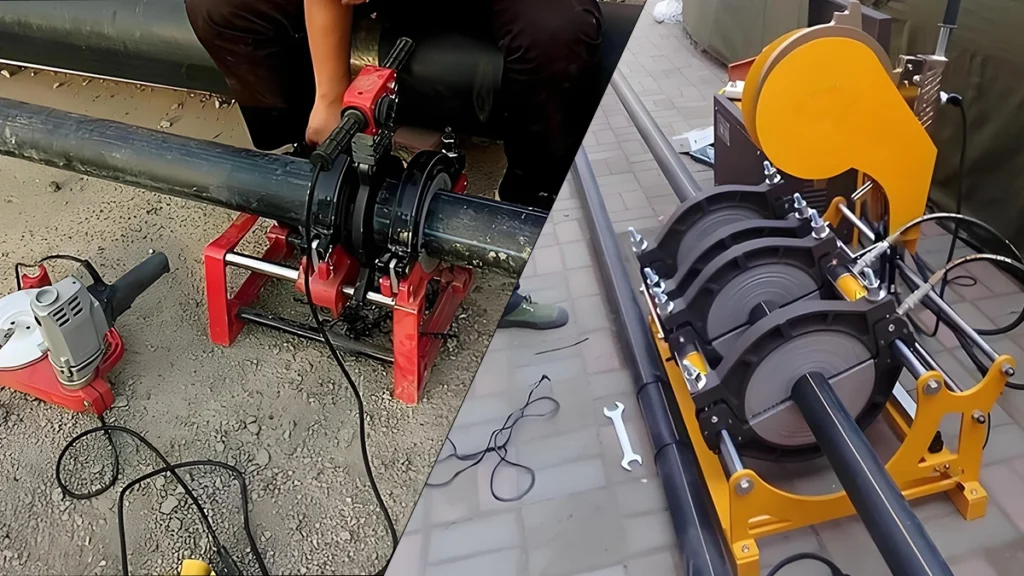
Hydraulic units (M-Series Hydraulic) represent the industry standard for municipal water and gas. An electric hydraulic pump provides the force, controlled by a lever and a precision pressure gauge. This eliminates operator fatigue and allows for the high forces needed for SDR 11 pipes up to 315mm.
Hydraulic systems provide the “holding power” necessary for the cooling cycle. Once the joint is fused, the operator locks the hydraulic pressure, ensuring the pipe faces are pressed together with consistent force as the plastic recrystallizes. This mechanical consistency is what makes hydraulic units the minimum requirement for pressure pipe applications. They offer a balance of cost-effectiveness and engineering compliance.
Automatic (CNC) machines with integrated data logging for traceability
For critical infrastructure—such as high-pressure gas transmission or nuclear cooling lines—human error must be eliminated. CNC (Computer Numerical Control) automatic butt fusion machines automate the entire process. The operator enters the pipe parameters (e.g., DN250, SDR 11, PE100), and the machine’s PLC calculates the pressures and times based on the selected standard (ISO, DVS, or ASTM).
The butt fusion welding machine controls the hydraulics, monitors the heater temperature, and automatically ejects the heater plate. Crucially, it records every variable: operator ID, ambient temperature, exact pressures, and cooling times. If any parameter deviates from the standard, the hdpe fusion welding machine aborts the weld. This data logging capability provides an unalterable audit trail, which is increasingly mandatory for municipal contracts. While the initial investment is higher, the elimination of failed welds and the assurance of 100% traceability offers a massive ROI for contractors working on regulated assets.
—
Strategic Selection Guide: Procurement Checklist for Municipal Contractors
Buying the wrong butt fusion machine specification can lead to inventory redundancy or field limitations. Here is a strategic framework for procurement.
Matching welding range to common municipal pipe inventories (SDR 11 & SDR 17)
Contractors should analyze their most frequent pipe sizes. A common mistake is buying a machine that barely covers the maximum required size.
- Service Connections (40mm – 160mm): For house connections and small distribution lines, a compact 160mm unit is ideal. It is light enough for single-man operation.
- Distribution Mains (90mm – 315mm): The 315mm hydraulic butt fusion machine is the “sweet spot” for municipal work. It covers the vast majority of urban water mains (110mm, 160mm, 200mm, 250mm). Buying a 250mm hydraulic butt fusion machine often limits flexibility, whereas a 315mm machine covers the same lower range but adds capacity for larger arterial lines.
Evaluating insert/reducer quality and clamping mechanisms
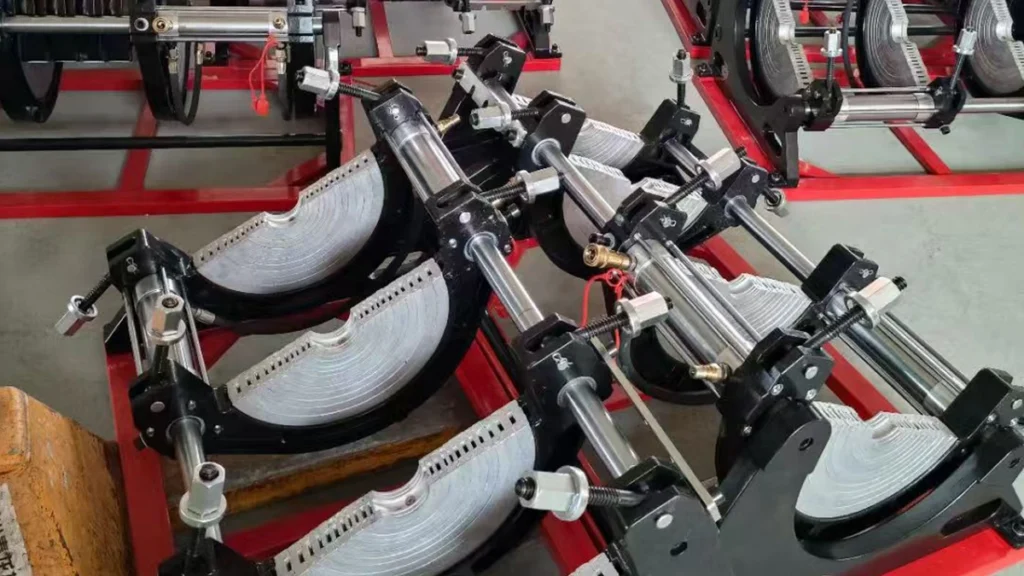
Efficiency in the trench is often dictated by how fast a crew can change pipe sizes. High-quality butt fusion machines use aluminum inserts (reducers) that clip in or use quick-release pins. Avoid hdpe fusion machines that require screws for every insert layer; changing from 315mm to 160mm on such a hdpe fusion welding machine can take 20 minutes of unscrewing, whereas quick-release systems take 2 minutes.
Furthermore, look for “narrow” or “layered” clamps. In repair situations, you often need to grip a very short stub of pipe protruding from a wall or valve. Specialized clamps are designed to grip pipes with minimal stick-out, a feature generic butt fusion welding machines often lack.
Durability features: IP ratings, PTFE coatings, and hydraulic seal quality
Municipal sites are wet, muddy, and dirty. The electronics of a portable butt fusion machine must be protected.
- IP Rating: Look for a minimum of IP54 for the hydraulic unit and data logger to protect against splashing water and dust ingress.
- PTFE Quality: The heater plate coating should be industrial-grade (often green or black), capable of withstanding cleaning with cotton cloths without peeling.
- Hydraulic Seals: For contractors in colder climates, ensure the hydraulic seals and hoses are rated for temperatures down to -20°C. Standard oils become viscous in the cold, causing sluggish movement, while cheap seals may crack.
—
Manufacturing Excellence, Quality Control & Service Capability
The reliability of a portable butt fusion machine is determined on the factory floor long before it reaches the job site.
Precision manufacturing: From aluminum die-casting to final assembly
Ekberg controls the manufacturing process from the raw casting to the final assembly. The aluminum die-casting for the chassis and clamps is performed under high pressure to eliminate porosity, ensuring high strength-to-weight ratios. Following casting, the components are machined on CNC centers to achieve tolerances within micrometers. This precision is what guarantees that when two pipes are clamped, they are perfectly concentric. Cheaply manufactured butt fusion welding machines often suffer from “step” misalignment because the clamp centers are not perfectly aligned with the chassis axis.
Rigorous testing protocols before shipment
Every butt fusion machine must undergo a battery of tests. This includes:
1. Hydraulic Pressure Hold Test: The system is pressurized to max bar and left for an extended period to check for micro-leaks in valves or seals.
2. Thermal Mapping: The heating plate is scanned to ensure temperature uniformity ($\pm 3^\circ C$).
3. Voltmeter Calibration: The onboard sensors are calibrated against master standards to ensure the data logger records reality.
4. Functional Load Test: The facer is run under load to ensure the motor and chain drive do not stall.
Spare parts availability and technical training support
In the municipal sector, downtime is measured in hours, not days. If a hydraulic quick-coupler breaks or a heater thermocouple fails, the supplier must have those parts in stock for immediate dispatch. Ekberg maintains a comprehensive inventory of consumables—facer blades, seals, switches—ready for 24-hour shipping.
Moreover, the butt fusion welding equipment is only as good as the operator. Specialized suppliers provide training certification (compliant with DVS 2212 guidelines), ensuring crews know how to calculate drag pressure, read the data logger, and maintain the equipment. This support structure is a critical component of the “product” that generic importers cannot provide.
—
Frequently Asked Questions
Q1: Can portable butt fusion machines handle SDR 11 high-pressure gas pipes?
Yes, provided they are hydraulic or CNC models. Manual butt fusion machines generally cannot generate the consistent interfacial pressure required for SDR 11 PE100 pipes, especially in larger diameters (above 110mm). A hydraulic unit like the Ekberg M315 is specifically engineered to achieve the 0.15 MPa (SLP) or even 0.52 MPa (SHP) pressure required for high-pressure gas networks, ensuring full compliance with ISO 21307.
Q2: What is the difference between a basic data logger and a fully automatic CNC machine?
A basic data logger is a passive recording device attached to a hydraulic butt fusion machine; it records what the operator does but cannot control the butt fusion welding machine. If the operator applies the wrong pressure, the logger merely records the error. A CNC (Automatic) machine actively controls the hydraulics and heater. It will not allow the weld to proceed if parameters are incorrect, eliminating human error entirely and ensuring 100% compliant joints.
Q3: How do I determine the correct generator size for a 315mm butt fusion machine?
You must account for the total power draw plus a safety margin for startup spikes. A 315mm hydraulic butt fusion machine draws approx. 4.85 kW. We recommend a generator with a minimum continuous output of 8.0 kVA. Undersized generators cause voltage drops that can trigger the butt fusion welding machine’s safety relays or cause the heater temperature to fluctuate, leading to “cold weld” faults and potential equipment damage.
Q4: Are there specific maintenance requirements for the hydraulic unit in portable butt fusion machines?
Yes. Hydraulic oil should be checked daily and changed annually (or every 1000 hours) using ISO VG 46 oil. Air must be bled from the lines weekly to ensure smooth pressure application. Additionally, the pressure gauge and temperature probe should be calibrated once a year to maintain ISO compliance. Keeping quick-couplers clean from mud is also vital to prevent hydraulic contamination.
Q5: Can one machine weld all pipe sizes from 63mm to 315mm, or are multiple units needed?
Technically, a 315mm hydraulic butt fusion machine can weld down to 90mm using inserts. However, using a large 315mm chassis for small 90mm service lines in a narrow trench is inefficient and physically difficult. Most contractors maintain a fleet mix: a 160mm hydraulic butt fusion machine for smaller service connections (40mm-160mm) and a 315mm machine for main distribution lines (90-315mm). This optimizes crew speed and trench access.
—
Wrap-Up
Selecting the right equipment for municipal pipeline projects requires balancing the logistical need for portability with the absolute necessity of engineering integrity. As we have explored, “portable” should never imply “lower quality.” Specialized butt fusion machines like the Ekberg M-Series are sophisticated engineering tools designed to deliver ISO 21307 compliant welds in the most challenging urban environments. From the modular split-frame design that enables manual trench access to the precision hydraulics that guarantee leak-free joints, these butt fusion welding machines are built for the realities of modern infrastructure.
For municipal contractors, the choice is clear: investing in robust, traceable, and supported equipment is the only way to safeguard against costly joint failures and ensure long-term network reliability. Whether you need the agility of a hydraulic unit or the audit-proof security of a CNC system, Ekberg has the solution.
Ready to upgrade your municipal welding fleet? Contact Ekberg Welding today for technical specification sheets, pricing on our M-Series portable units, or to schedule a consultation regarding your project’s specific compliance requirements.