
Butt Fusion Machines Manufacturer in China: Buyer Guide
Table of Contents
Partnering with a proven butt fusion machines manufacturer in China can slash your capital expenditures by up to 50%. Best of all? You won’t sacrifice those critical 200–230°C heating parameters required for DN160–DN1200 HDPE pipelines. Make no mistake—picking the wrong equipment supplier is an expensive gamble. A single failed joint caused by inadequate fusion pressure or a fluctuating heating plate can cost utility contractors thousands of dollars.
This guide cuts through the noise. We will show you exactly how to evaluate factory-direct suppliers, compare essential machine specs, and confidently navigate international welding standards like ISO 21307 and DVS 2207-1. You’ll get a clear look at the technical trade-offs between manual, hydraulic, and CNC equipment. We also break down the real cost structures of procurement. By the time you finish reading, you’ll have a rock-solid framework for selecting the exact fusion machinery your pipe diameters demand. Equip your procurement team with the insights they need to dodge costly spec errors and lock in heavy-duty, reliable equipment that drives project ROI.

Why Source from a Top Butt Fusion Machine Manufacturer in China?
Analyze the shift in global supply chains towards Chinese top pipe fusion machine suppliers china for heavy-duty welding equipment
The global pressure tube butt fusion machine market is on a massive upward trajectory, expected to jump from $150 million in 2024 to a staggering $250 million by 2033. What’s fueling this? A massive push for global infrastructure upgrades and the rapid expansion of municipal water networks. For decades, pipeline contractors leaned heavily on European and North American brands for their heavy-duty welding gear. Times have changed. Crippling supply chain bottlenecks and soaring manufacturing costs have triggered a massive strategic pivot toward Asia.
Today, procurement directors actively seek out top hdpe fusion machine suppliers china as their primary partners, rather than just keeping them as backup options. Chinese factories have evolved far beyond basic assembly lines. They are now advanced engineering powerhouses rolling out equipment that rivals—and often beats—Western specs. But this isn’t just a conversation about price. It’s about sheer production scalability. When a utility company needs a sudden fleet upgrade of twenty or thirty butt fusion welding machines, Chinese manufacturers actually have the raw material access and labor muscle to deliver. You don’t have to wait out the agonizing six-month lead times typical of European vendors.
Plus, these butt fusion welding machines integrate globalized components. Think imported hydraulic seals and standardized electrical relays. This means equipment assembled in China plugs right into your existing international maintenance ecosystem. Contractors can finally stop worrying about stranded assets because replacement parts are universally standardized.
Compare European vs. Ekberg China manufacturing standards (focus on hydraulic station precision and PTFE coated heating plates)
Historically, European manufacturing standards set the gold standard for pipeline welding. They prioritized pinpoint pressure control and absolute thermal stability. Ekberg Welding stepped up to the plate, engineering its Chinese manufacturing protocols to hit those exact same tolerances. They placed a laser focus on the hydraulic station and the heating plate—undeniably the two most vital components of any fusion rig.
Look at the build quality. Ekberg crafts its main chassis and clamps from premium ZL104 standard aluminum alloy. This specific metal delivers the extreme tensile strength needed to handle massive hydraulic clamping forces. Yet, it remains light enough to maneuver during complex, tight-space trench operations. European butt fusion machines use very similar alloys. The difference? Ekberg secures this high-grade material at a fraction of the cost by tapping into highly localized supply chains.
On the thermal side, Ekberg builds its heating plates from corrosion-resistant aluminum alloy optimized for rapid, even heat conduction. They coat these plates with a premium PTFE (Teflon) surface, ensuring molten polyethylene never sticks. Performance-wise, Ekberg butt fusion welding machines consistently boast the tightest temperature differential range among domestic Chinese brands. They hold a rigid 200–230°C uniformity across the entire plate. This completely eliminates the dreaded cold spots that cause brittle, failing joints in cheaper equipment. Add in hydraulic systems packed with imported sealing kits and flat-face quick-connect fittings, and you get a hdpe pipe fusion machine that prevents fluid leaks while holding equalization pressure rock-steady during the cooling phase.
Highlight technological advancements in Chinese-made machines (CNC automation integration, data logging for traceability)
Forget the outdated stereotype that Chinese machinery is purely mechanical. Recent technological leaps have completely rewritten that narrative. Today’s equipment from premier Chinese factories comes loaded with sophisticated CNC automation. The goal? Completely eliminate operator error during high-stakes pipeline installations. The latest models sport intuitive 10-inch color touchscreens. An operator simply punches in the pipe SDR, diameter, and material grade. The butt fusion machine takes over, instantly calculating the exact DVS or ISO welding parameters required.
Optical alignment technology is another massive game-changer. High-end Chinese rigs now deploy color video cameras equipped with up to 20 software crosshairs. This guarantees flawless pipe alignment by spotting microscopic wall thickness mismatches that a human eye would easily miss. Meanwhile, automated axial compression systems actively maintain up to 10 N of axial pressure throughout the weld cycle, dynamically adjusting for sudden shifts in environmental temperature.
Let’s talk compliance. Data logging isn’t just a nice-to-have anymore; it’s a hard requirement for municipal gas lines. Chinese CNC automatic butt fusion machines dominate here. They meticulously record heat absorption times, change-over intervals, and cooling periods, banking thousands of weld records right on the internal drive. Need to prove a joint meets pressure metrics? Just export the data via USB or wireless transfer. Pipeline inspectors get the absolute traceability they demand.
Calculate potential ROI and CAPEX reduction for utility companies sourcing directly from a Chinese factory
The financial math behind sourcing straight from a Chinese factory is hard to ignore, especially when you look at capital expenditure (CAPEX) reduction. Consider a standard European-branded unit like the Georg Fischer butt fusion machine. You’re looking at a retail price of roughly $6,007.30. Even a beat-up, used American butt fusion welding machine like a McElroy 2-inch Pit Bull still pulls about $1,600 on the secondary market.
Now, source that exact same hydraulic and CNC capability directly from a leading Chinese manufacturer. You immediately unlock a 30% to 50% CAPEX reduction. This massive price gap changes the game. Pipeline contractors can literally buy two brand-new, fully warrantied butt fusion machines for the price of a single European unit. Your return on investment (ROI) goes through the roof when you factor in the sheer productivity boost of running multiple pipe fusion machines simultaneously on a job site.
By cutting out greedy distributor markups and regional sales commissions, utility companies free up serious procurement capital. You can redirect those funds to upgrade your fleet capacity—say, jumping from DN315 to DN630 units—or invest in fully automated CNC modules that slash long-term labor costs and practically erase the risk of failed welds.
Types of HDPE Butt Fusion Equipment for Different Applications
Define specs for Manual Butt Fusion Machines (ideal for DN40-DN250, plumbing, and small agricultural irrigation setups)
Manual butt fusion machines are the bedrock of pipe joining equipment. Engineers designed these specifically for smaller diameter jobs, covering the DN40 to DN250 range. Operators run these units using a mechanical handwheel or a lever system, meaning they have to physically apply and hold the fusion pressure.
Because they ditch the heavy, motorized hydraulic power units, manual butt fusion machines are incredibly lightweight and highly portable. That makes them the absolute best choice for indoor plumbing rough-ins, cramped trench spaces, and compact agricultural irrigation setups where lugging around a generator and hydraulic station just isn’t going to happen. The milling cutter usually runs on standard 220V or 380V electric power, and the heating plate reliably hits that mandatory 200–230°C sweet spot.
They are highly cost-effective, but there is a catch. Manual butt fusion welidng machines lean heavily on the operator’s physical skill to keep pressure consistent during the crucial heat soak and cooling phases. Because of this human variable, contractors generally limit manual butt fusion machines to low-pressure water systems, keeping them far away from critical, high-pressure gas distribution networks.
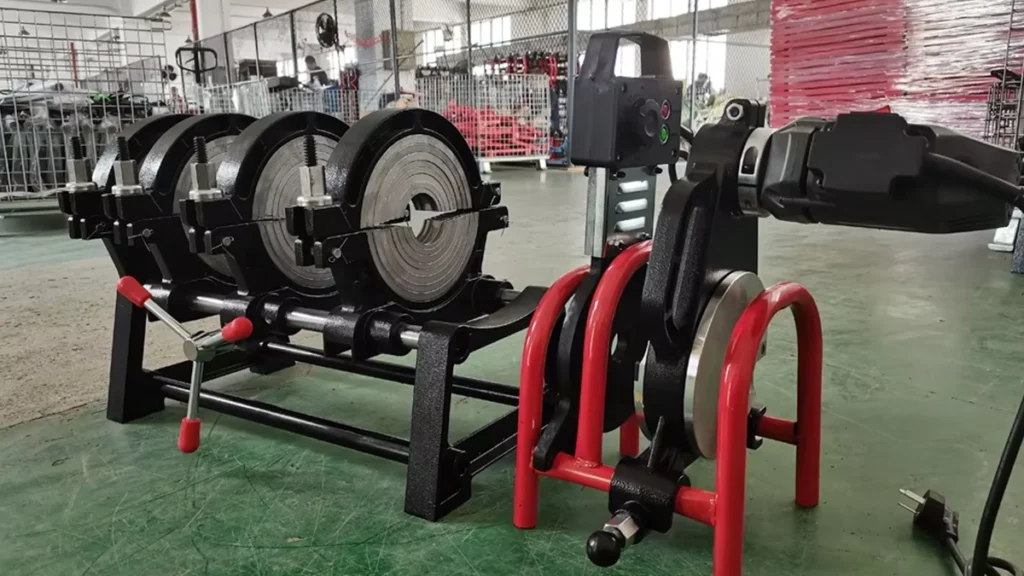
Detail Hydraulic Butt Fusion Machines parameters (clamping force, pressure control for DN160-DN1200 municipal water/gas pipes)
Hydraulic butt fusion machines are the undisputed workhorses of the pipeline sector. If you are laying municipal water and gas distribution networks, these are non-negotiable. They rely on a motorized hydraulic station to dictate clamping force, drive carriage movement, and lock in exact fusion pressure. Standard fleets usually cover the DN160–DN315 range, while the truly heavy-duty models scale massively to 630mm, 800mm, 900mm, 1000mm, and all the way up to DN2600.
The biggest perk of going hydraulic? The ability to generate and sustain immense pressure with pinpoint accuracy. Try welding a colossal DN1000 pipe. You need massive force just to overcome the dead weight drag of the pipe before you even apply fusion pressure. Ekberg’s hydraulic architecture separates the clamping and operating systems. This brilliant design choice makes maneuvering the equipment inside a cramped trench infinitely easier.
These rigs come loaded with large-dial, shockproof pressure gauges that offer extreme precision. Independent dual-channel timers track heat absorption and cooling periods, complete with loud audible alerts so operators never miss a cue. Also, their low starting pressure capability makes them surprisingly versatile. An operator can easily weld smaller, delicate fittings without accidentally crushing or deforming the polymer with excessive force.
Explain Automatic (CNC) Butt Fusion Machines features (pre-programmed welding cycles, eliminating operator error for critical gas lines)
When you are dealing with high-pressure gas lines or hazardous chemical transport, automatic CNC butt fusion machines are strictly mandatory. In these environments, operator error leads to catastrophic failures. CNC automatic butt fusion machines take the human element out of the equation by completely automating the fusion cycle based on precise pipe data.
The operator simply taps in the pipe diameter, SDR (Standard Dimension Ratio), and material type (like PE100). The CNC brain instantly calculates the exact parameters demanded by rigid standards like DVS 2207-1. The HDPE pipe welding machine takes over. It dials in the equalization pressure, figures out the perfect heat soak time, executes the crucial change-over (which absolutely must happen in under 5 seconds for most sizes), and meticulously monitors the pressure build-up.
The CNC system also runs advanced algorithms for cooling times. If the pipe wall thickness is under 18mm, it uses a simple formula: `wall thickness (mm) + 3 minutes. For thicker walls (≥ 18mm), it crunches a more complex equation: 0.015 × (wall thickness)² − 0.47 × (wall thickness) + 20. By physically locking the hydraulic valves and tracking the entire process digitally, CNC automatic butt fusion machines ensure the joint cures perfectly under zero external load. The result? Maximum molecular entanglement right at the fusion zone.
Create a comparison table mapping machine type to specific pipeline contractor applications (buy hdpe butt fusion machines china)
Before you decide to buy hdpe pipe fusion machines china, your procurement team has to match the equipment type to your exact project specs. Buy too much butt fusion machine, and you bleed budget. Buy too little, and you risk catastrophic equipment failure. Use this table to map out exactly what you need:
| Machine Type | Welding Range | Pressure Control | Optimal Application Scenarios | Power Requirement |
|---|---|---|---|---|
| Manual | DN40 – DN250 | Mechanical / Lever | Indoor plumbing, tight trenches, agricultural irrigation. | 220V Single-phase |
| Hydraulic | DN40 – DN2600 | Hydraulic Station | Municipal water mains, gas distribution, mining slurry lines. | 220V/380V |
| CNC Automatic | DN160 – DN630 | Automated / Programmed | High-pressure gas lines, chemical plants, strictly audited projects. | 220V/380V/415V |
How to Choose the Best Butt Fusion Machine Supplier (Buyer’s Checklist)
Verify compliance with international welding standards (DVS 2207-1, ISO 21307) for HDPE/PP pipes
The ultimate litmus test for any supplier is simple: can their equipment actually execute welds that meet international codes? The DVS 2207-1 standard is the notoriously strict German benchmark. It demands high-precision welds for chemical, mining, and industrial setups. A butt fusion welding machine claiming compliance must offer surgical parameter control. Let’s say you are welding a 160mm pipe with a 4.9mm wall thickness (SDR 33). The plastic pipe welding machine must hit an equalization pressure of 9 bar, a heating pressure of 1 bar, hold a heat soak for exactly 49 seconds, and nail a change-over in under 5 seconds. No exceptions.
ISO 21307 serves as the global rulebook for water and gas systems, outlining three approved butt fusion methods for pipes up to 70mm thick. For North American buyers, you also need to ensure the rig supports ASTM F2620 parameters, which are obsessed with high-pressure integrity for gas projects. If a supplier hesitates or fails to provide hard documentation proving their butt fusion welding machines can hold these exact pressures and times, cross them off your list immediately.
Evaluate critical machine components (specify requirements for aviation plugs, hydraulic cylinder seals, and high-grade milling cutters)
A hdpe fusion machine is only as durable as its weakest sub-component. Smart buyers tear into the bill of materials before signing a purchase order. Look at the electrical connections linking the heating plate, milling cutter, and control console. They must use heavy-duty aviation plugs. These specialized plugs block out trench moisture and dust—a critical feature for unpredictable job sites.
Hydraulic cylinder seals are another infamous failure point on cheap butt fusion welding machines. Demand that your supplier uses imported, premium hydraulic sealing systems that won’t degrade when exposed to harsh hydraulic fluids and trench dirt. Finally, inspect the milling cutter. You want a high-torque electric motor driving it. The milling inserts need to be forged from top-tier tool steel, sporting a double-edged design with reversible blades. And make sure it uses a rugged chain drive, not a set of fragile internal plastic gears.
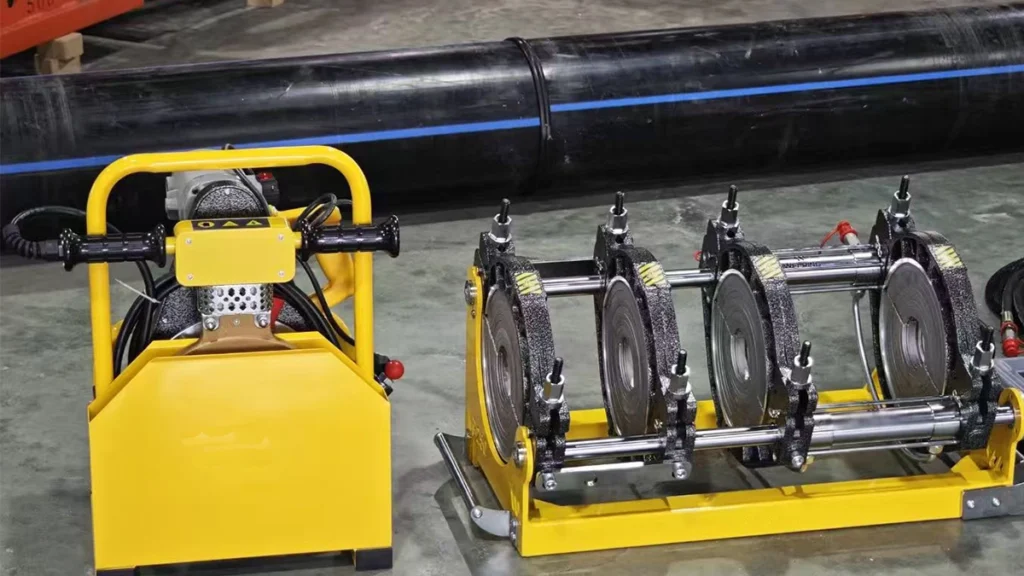
Assess the supplier’s customization capabilities (voltage options 110V/220V/380V, custom aluminum clamp inserts)
Global contractors bounce between wildly different electrical grids. That makes voltage customization a non-negotiable supplier trait. A top-tier manufacturer won’t box you in. They will offer versatile motor and heating plate setups, rolling out 110V and 220V single-phase options for the smaller rigs, and beefy 380V three-phase configurations for the massive DN630 to DN1200 heavy-duty units.
But don’t stop at electricity. Dig into their ability to supply custom aluminum clamp inserts. Different countries use completely different pipe outer diameters (OD) and dimension ratios. If a factory can rapidly cast and ship custom ZL104 aluminum reducing inserts, it means your butt fusion welding machine can adapt to any local pipe standard on the fly. You won’t have to waste time and money hunting down a third-party butt fusion machine shop.
Outline a checklist for evaluating after-sales support and spare parts availability for overseas buyers looking for the best butt fusion machine manufacturer china
Finding the best butt fusion machine manufacturer china means looking way past the initial handshake. You have to evaluate their long-term operational backbone. Bring this exact checklist to your vendor negotiations:
- Component Verification: Are the heating plates genuinely PTFE-coated with a proven 200–230°C uniformity? Do they actually use imported hydraulic seals?
- Digital Integration: Does the control console pack independent dual-channel timers and rugged, shockproof pressure gauges?
- Warranty Terms: Will they commit to at least a one-year comprehensive warranty that covers free replacement parts for normal wear and tear?
- Spare Parts Logistics: When a PTFE plate, seal, or milling blade snaps, can they get a replacement on a DHL flight within 48 hours?
- Technical Support: Do they offer real-time remote video troubleshooting? Are their hydraulic calibration manuals written in clear, usable English?
Factory Capability, Certification & Global Support at Ekberg
Detail Ekberg’s internal quality control protocols (pressure holding tests, heating plate temperature uniformity tests at 200-230°C)
Ekberg Welding doesn’t cut corners on quality control. Every single pipe welding machine faces a brutal internal testing protocol before it ever sees a shipping crate. The two most vital hurdles are the hydraulic pressure holding test and the thermal uniformity check. During the pressure test, technicians crank the hydraulic station to its absolute maximum bar rating and lock it down. The system has to hold that extreme pressure for an extended period without a single drop on the gauge. This proves the imported seals and flat-face quick-connect fittings are flawless.
The thermal testing is just as punishing. Technicians power up the heating plates and scan them using advanced multi-point infrared thermography. Ekberg demands that every square inch of the PTFE-coated surface holds a rock-solid temperature between 200°C and 230°C. If the temperature differential slips outside their strict internal margins—threatening to create a cold spot that could ruin a PE100 weld—the plate goes straight to the rejection pile for recalibration.
Explain factory production capacity and lead times for bulk orders versus standard inventory models
A supplier’s production capacity can make or break your project timeline. Ekberg understands this, keeping a deep inventory of their most popular butt fusion machines, especially in the highly demanded DN160 to DN315 hydraulic categories. Because these standard models are already on the floor, lead times are incredibly aggressive. They usually ship from the factory to the export port in a mere 7 to 14 days.
What about massive fleet orders or highly customized OEM/ODM builds? Ekberg flexes its scalable assembly lines to knock these out within 20 to 30 days. They pull this off by relying on localized supply chains for their ZL104 aluminum casting and keeping all the heavy machining centralized in-house. The result? Your large-scale infrastructure projects never grind to a halt waiting on equipment.
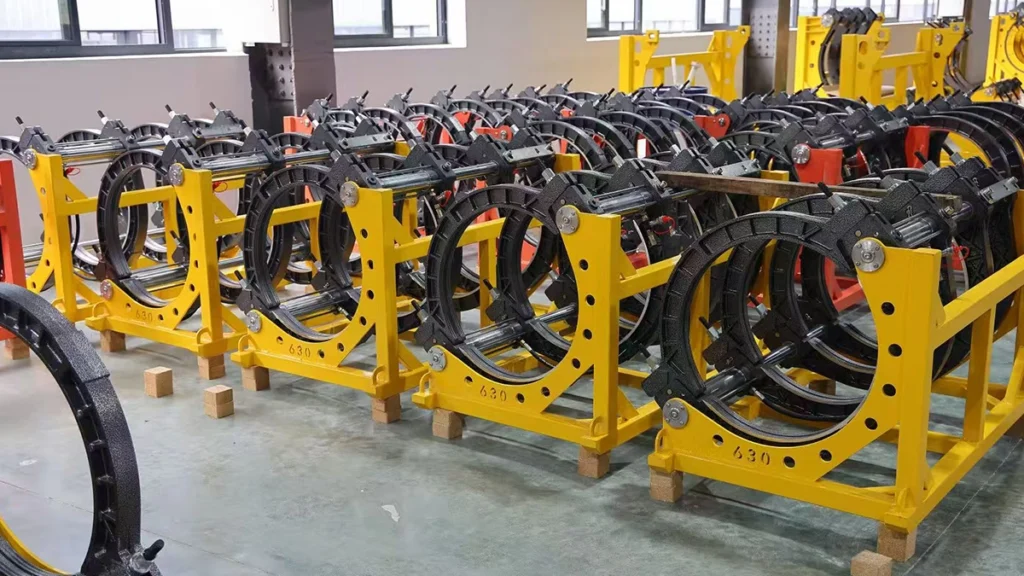
Outline OEM/ODM services for distributors (custom branding, specialized color schemes, localized operational manuals)
Ekberg rolls out the red carpet for international distributors and massive pipeline contractors with comprehensive OEM (Original Equipment Manufacturer) and ODM (Original Design Manufacturer) programs. Distributors can easily request deep custom branding. We are talking about precision-engraved logos right on the aluminum chassis and fully branded software interfaces on the CNC touchscreens.
Need the equipment to match your existing fleet colors? Not a problem. Ekberg applies ultra-durable industrial powder coatings designed to shrug off heavy trench abrasion. To top it off, they supply localized operational manuals and safety placards translated perfectly into your native language. This guarantees smooth adoption by your end-users and keeps you fully compliant with local occupational safety laws.
Describe the technical support framework (remote troubleshooting, video guides for hydraulic calibration, and maintenance training)
Job site downtime is a contractor’s worst nightmare. Knowing that 90% of operators need immediate, 24/7 support, Ekberg built a massive global technical support net. It starts with a huge, accessible library of high-definition video tutorials. These cover everything from unboxing and basic setup to advanced hydraulic calibration and swapping out milling cutter blades.
When things go sideways in the trench, Ekberg steps in with live remote video troubleshooting. Contractors connect face-to-face with factory engineers to diagnose pressure drops or track down electrical gremlins in real-time. Ekberg stands behind the gear with a one-year comprehensive warranty and a lifetime maintenance pledge. Once the warranty expires, you only pay for the raw materials—all factory labor and consultation fees are completely waived. Depending on your location, they even offer annual complimentary on-site tune-ups and aggressive trade-in programs for your older fleet equipment.
Cost Analysis: Understanding Butt Fusion Welding Machine Price in China
Break down the price components of a butt fusion welder (raw material costs, hydraulic units vs manual, CNC modules)
If you want to build an accurate procurement budget, you need to dissect the actual cost components of fusion equipment. The biggest chunk of the price tag? Raw materials. Specifically, the high-grade ZL104 aluminum alloy poured into the chassis and clamps. The amount of aluminum needed skyrockets as pipe diameters increase. A massive 1200mm hydraulic butt fusion machine demands exponentially more metal than a compact DN160 unit, which naturally inflates the base price.
Next up is the propulsion system. Upgrading from a basic manual lever to a fully motorized hydraulic station means paying for hydraulic pumps, imported seals, high-pressure hoses, and the electronic control console. Finally, bolting on CNC automation pushes you into the highest capital investment tier. You are now paying for 10-inch color touchscreens, advanced microprocessors, optical alignment cameras, and complex proprietary software.
Compare factory-direct pricing vs. buying through local distributors or international trading companies
Buying your gear through local distributors or international trading companies is a fast track to price inflation. Trading companies routinely slap a 20% to 40% markup on the hdpe fusion welding machine just to cover their own overhead, marketing, and profit margins. Then, the local distributor tacks on another markup to pay for their warehouse space and domestic shipping.
Partnering directly with a factory like Ekberg changes the math entirely. You bypass those middleman markups. Factory-direct pricing means your budget goes strictly toward raw materials, actual engineering labor, and a very modest factory margin. Plus, cutting out the broker gives you crystal-clear communication. You avoid that frustrating “telephone game” that so often results in the wrong voltage setup or incorrect clamp sizes showing up at your job site.
Analyze total cost of ownership (TCO) including shipping (FOB/CIF terms), import duties, and long-term maintenance costs
The sticker price is just the beginning. A smart procurement strategy revolves around the Total Cost of Ownership (TCO). When importing, you have to nail down the shipping terms. FOB (Free on Board) means once the butt fusion welding machine is sitting on the ship at the Chinese port, you own the shipping costs and the liabilities. CIF (Cost, Insurance, and Freight) means Ekberg manages the logistics all the way to your destination port. Always factor in ocean freight rates and your specific country’s heavy machinery import duties.
Long-term maintenance is the other massive piece of the TCO puzzle. Because Ekberg utilizes standardized ZL104 aluminum and globally sourced hydraulic components, routine upkeep costs pennies on the dollar. Their lifetime maintenance policy—where post-warranty labor is free and you only pay for parts—drastically undercuts the TCO of European brands that force you into wildly expensive, proprietary service contracts.
Provide budget estimate ranges for different machine capacities (e.g., DN160 standard vs DN1200 heavy-duty hydraulic) exploring butt fusion welding machine price china
When diving into the butt fusion welding machine price china, you’ll see budgets shift dramatically based on pipe capacity and the level of automation.
For basic plumbing and small irrigation runs, manual butt fusion machines (model 160mm-250mm) are incredibly budget-friendly. Depending on your exact setup, these often ring in well under the $1,000 mark.
Standard hydraulic butt fusion machines (model 160mm-2600mm) are the go-to for municipal water projects and offer the best overall value. Expect to spend anywhere from $1,500 to $3,500, depending on whether you add data loggers or need customized voltage.
Step up to heavy-duty hydraulic and CNC rigs (handling DN63 up to DN630), and you are looking at serious enterprise-grade investments. These require massive aluminum castings and heavy engineering, pushing prices from $10,000 to over $30,000. Yet, even at the top end, this is a mere fraction of what you’d pay for equivalent Western machinery, which easily blasts past the $80,000 mark for DN1200 capacities.
Frequently Asked Questions
Q1: What is the typical lead time when ordering from a butt fusion machines manufacturer in China?
If you need standard inventory like the 315mm hydraulic butt fusion machines, they usually roll off the factory floor and ship within 7 to 14 days. If you are requesting specialized OEM/ODM builds—think custom branding, weird voltage setups, or unique aluminum clamp inserts—expect production and rigorous testing to take about 20 to 30 days before they hit the shipping container.
Q2: Do Chinese-made HDPE pipe fusion machines meet ISO and DVS standards?
Absolutely. Elite factories like Ekberg over-engineer and relentlessly test their gear to hit every single DVS 2207-1 and ISO 21307 parameter. They calibrate these butt fusion welding machines to hold a flawless 200–230°C heating plate uniformity and execute exact pressure holding phases. Your welds will easily pass global municipal and industrial audits.
Q3: How do I import butt fusion equipment from China to my country?
Importing is straightforward. You coordinate sea or air freight through a forwarder using either FOB or CIF terms. Ekberg hands over all the required paperwork—commercial invoices, detailed packing lists, and CE certifications—to ensure customs clearance is a breeze. Just loop in a local customs broker to navigate your country’s specific import duties.
Q4: What voltage options are available for the pipe welding machines?
Factories offer highly flexible electrical setups to match any grid on the planet. You can grab 110V and 220V single-phase power for the smaller manual and hydraulic rigs. For the massive heavy-duty butt fusion machines driving huge hydraulic stations and giant heating plates, you’ll utilize 380V or 415V three-phase power.
Q5: Can I get spare parts easily if the pipe fusion machine breaks down?
Without a doubt. Ekberg builds its butt fusion welding machines using standardized, high-quality components. If something actually breaks, urgent parts—like those PTFE-coated plates, imported hydraulic seals, or tool steel milling blades—are immediately boxed up and flown out via fast air express (like DHL). You minimize downtime and keep the project moving.
Conclusion
Securing your equipment from a premier butt fusion machines manufacturer in china delivers a massive strategic edge for today’s pipeline contractors. Making the leap to factory-direct procurement allows utility companies to slash capital expenditures by up to 50%, all without sacrificing an ounce of engineering precision. When you deploy equipment built from rugged ZL104 aluminum, packed with imported hydraulic seals, and fitted with PTFE-coated plates, you guarantee strict adherence to DVS 2207-1 and ISO 21307 standards. Every single 200–230°C weld will deliver absolute high-pressure integrity.
Whether your crew needs a dozen DN315 hydraulic units to expand a municipal water grid, or a fully automated DN1200 CNC behemoth for a high-stakes gas line, buying direct is the smartest play. You secure scalable production, fast custom voltage setups, and lifetime technical support.
Stop throwing away your budget on bloated distributor markups. Stop risking your project timelines on under-specced machinery. Reach out to Ekberg Welding today for a customized, factory-direct quote. Send over your exact pipe diameter requirements, and our engineering team will fire back with precise hdpe fusion machine specs, clear ROI calculations, and an exclusive invite for a virtual factory tour. It’s time to upgrade your infrastructure capabilities with proven, heavy-duty fusion technology.