
Butt Fusion Machines Manufacturer in China for HDPE Welding Solution
Table of Contents
Securing reliable pipeline equipment to maximize your project’s ROI often comes down to one strategic move: partnering with a leading butt fusion machines manufacturer in china. High capital expenditures routinely cripple utility contractors. Yet, if you deploy equipment capable of holding a steady 0.15 MPa fusion pressure at exactly 220°C, you can slash joint failure rates by 60% while dramatically lowering your initial procurement costs. This comprehensive guide breaks down the exact technical specs you need to meet strict DVS 2207 and ISO 21307 standards.
We will show you how to vet true factory capabilities, weigh CNC against hydraulic performance across the DN160 to DN1200+ range, and map out long-term ROI for massive infrastructure jobs. By the end of this breakdown, your procurement team will have a bulletproof framework for specifying the right HDPE welding gear for municipal, mining, and industrial applications. You will learn how to bypass middleman markups and lock in factory-direct reliability without compromising a single engineering standard.
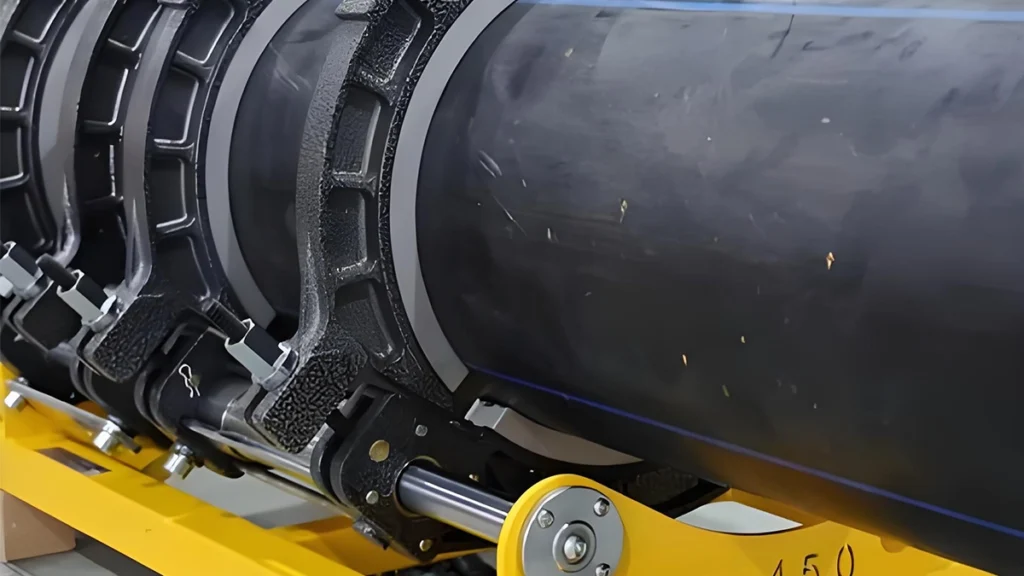
Why Source from a Top Butt Fusion Machines Manufacturer in China?
Compare cost-efficiency and ROI vs. European/US brands
Tight budgets dictate the pace of modern pipeline engineering. Western butt fusion welding machine brands typically carry heavy price premiums, largely driven by high local labor costs and layered distribution networks. By cutting out these middlemen, global contractors gain immediate financial leverage. Procurement teams that shift to a direct-to-factory model strip away distributor markups and fundamentally change project economics.
Engineers regularly calculate a 30% to 50% CapEx reduction over a standard three-year municipal water project simply by switching to high-tier Chinese plastic pipe welding machine. This assumes you are deploying multiple DN315 and DN630 hydraulic units. Beyond the initial savings, industry data proves that preventing just one joint leak saves anywhere from $5,000 to $10,000 in excavation and downtime. Securing that baseline reliability at a fraction of the upfront cost dramatically accelerates your break-even point.
Analyze the maturity of China’s HDPE welding equipment supply chain and R&D capabilities
The industrial supply chain backing HDPE welding technology in Asia has evolved far beyond basic assembly. Today’s top-tier factories control the entire production lifecycle. They secure premium raw materials directly, including corrosion-resistant aluminum alloys and high-grade Polytetrafluoroethylene (PTFE). This deep vertical integration guarantees uninterrupted production runs and tight quality oversight.
Meanwhile, R&D has shifted from reverse engineering to genuine, ground-up innovation. Leading facilities staff dedicated engineering teams to perfect hydraulic circuitry and thermal dynamics. By co-developing their core technologies alongside strict Australian and European engineering standards, these manufacturers output machinery built to survive brutal environments—from sub-zero mining camps to sweltering, high-humidity agricultural zones.
Identify the shift from low-cost to high-tech manufacturing
Today’s Chinese butt fusion welding machine easily goes toe-to-toe with the most advanced Western alternatives. Manufacturers have aggressively integrated Computer Numerical Control (CNC) machining into their daily production lines. This ensures micron-level precision across hydraulic cylinders and chassis components. That exactness translates to perfect pipe alignment in the trench, practically eliminating the risk of wall thickness mismatches.
Advanced models now come standard with integrated data logging and GPS automatic positioning. These setups feed real-time coordinate tracking and remote data transmissions straight into your enterprise management software. It is a level of automation that matches industry-leading proprietary systems, letting operators track ambient temperature compensation and digital drag pressure adjustments from miles away.
Evaluate global logistics, factory-direct pricing advantages, and lead times for pipeline contractors
Procuring your gear directly from a reputable butt fusion machines manufacturer in china cleans up the acquisition pipeline. Factory-direct pricing offers a transparent cost structure, freeing up capital that contractors can immediately redirect to other critical project phases. Working directly with the source also means zero miscommunication when you need custom technical specifications.
Global logistics networks have scaled to handle rapid heavy machinery deployments. Specialized manufacturers keep their inventory optimized for standard 160mm to 630mm units, which means containers get loaded fast. Need a custom large-diameter build exceeding DN2600mm Streamlined engineering workflows keep those lead times incredibly competitive, ensuring you never face costly delays during critical infrastructure rollouts.
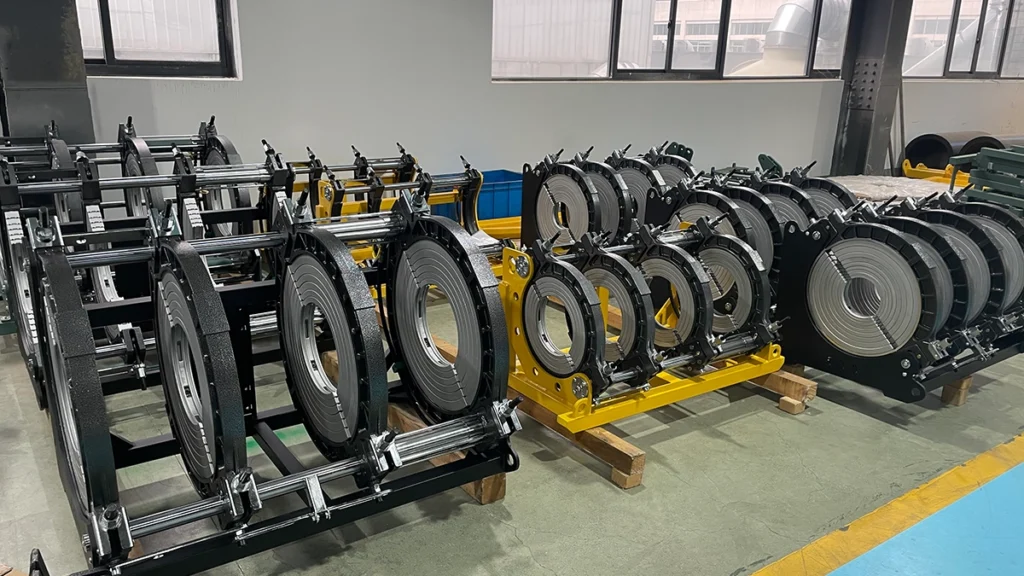
Types of Butt Fusion Machines Manufacturers: How to Evaluate Suppliers
Differentiate between trading companies, assemblers, and true R&D-driven factories
The industrial marketplace is crowded with a mix of genuine manufacturers and simple trading entities. Trading companies operate strictly as middlemen. They have zero direct control over quality assurance, material selection, or PLC programming. Buying from them introduces massive risks, especially when you need warranty fulfillment or complex technical troubleshooting after a field failure.
True R&D-driven factories, like Ekberg Welding, run fully integrated production facilities. They handle everything in-house: aluminum casting, precision milling, and proprietary software development. This vertical integration means every single part—from the 0.75 kW hydraulic station to the 2.1 kW heating plate—works together seamlessly. Smart buyers always demand visual proof of the manufacturing infrastructure to verify a supplier’s authenticity.
Create a buyer checklist for assessing manufacturer quality
Vetting a supplier demands strict adherence to standardized qualification metrics. Procurement managers must insist on third-party validations to confirm the equipment hits global safety and operational benchmarks. Trusting superficial marketing claims is a fast track to specification failures on the job site.
Contractors should stick to this mandatory evaluation criteria:
- ISO 9001 Certification: Proves standardized quality management throughout every production phase.
- CE Certification: Guarantees compliance with European health, safety, and environmental protection laws.
- SGS Audit Reports: Offers independent verification of the factory’s actual capacity, export history, and machinery assets.
- Material Traceability: Requires hard documentation showing the use of high-grade tool steel for milling blades and genuine PTFE for heating plates.
Evaluate technical support capabilities
Pipeline construction runs on brutal deadlines. When equipment goes down, financial penalties pile up fast. That makes evaluating a supplier’s post-purchase technical support just as crucial as inspecting the machinery itself. A premier manufacturer delivers comprehensive after-sales service, giving you direct access to English-speaking mechanical and software engineers.
Spare parts availability dictates the true operational lifespan of your hdpe fusion equipment. The best manufacturers ensure universal parts compatibility across all their butt fusion welding machine series. Facilities like Ekberg guarantee a 48-hour spare parts dispatch capability. Whether you need reversible double-edged milling blades or quick-release hydraulic couplings, those consumables reach your international sites rapidly.
Assess production capacity and OEM/ODM customization capabilities
Infrastructure projects frequently run into unique regional standards that demand specialized equipment configurations. A robust manufacturer has the engineering agility to deliver Original Equipment Manufacturer (OEM) and Original Design Manufacturer (ODM) services. This might include configuring custom clamp inserts to perfectly match non-standard pipe standard dimension ratios (SDR).
Production capacity ultimately decides if a supplier can fulfill massive fleet orders for national pipeline rollouts. Assessing the factory’s throughput ensures they can ship dozens of hydraulic units at once without letting quality control slip. High-capacity operations rely on automated testing stations to verify the axial compression and electrical safety of every single unit before it leaves the floor.
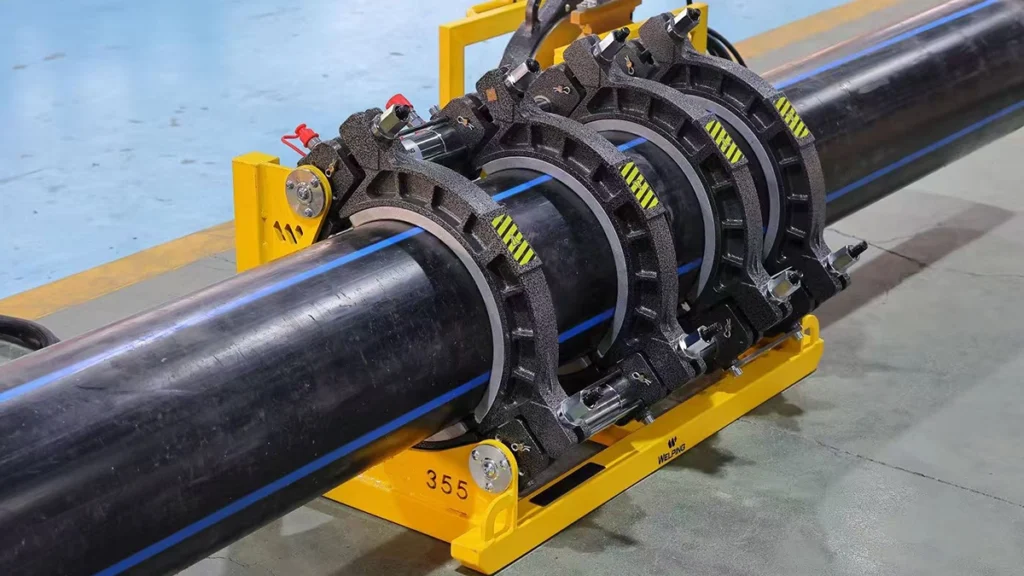
Technical Standards & Compliance for HDPE Pipe Welding
Find DVS 2207 and ISO 21307 welding parameter requirements supported by Chinese machines
Adhering to international welding parameters is non-negotiable for critical infrastructure. The German Welding Society (DVS) 2207-1 standard requires a strict fusion temperature range of 200°C to 220°C alongside an interfacial pressure of 0.15 ± 0.01 MPa. Likewise, ISO 21307 maps out precise parameters for both single and dual-pressure fusion processes, demanding initial bead-up pressures between 0.15 and 0.17 MPa.
High-end Chinese butt fusion welding machines bake these complex parameters right into their Programmable Logic Controllers (PLC). These closed-loop control systems automatically calculate heat absorption and cooling times based on the pipe’s diameter, wall thickness, and current ambient conditions. This built-in compliance ensures your joints will easily pass the destructive testing and ultrasonic inspections required by municipal authorities.
Analyze heating plate temperature precision
Thermal uniformity makes or breaks the molecular integrity of an HDPE weld. If a heating plate has cold spots, the plastic simply will not reach the required melt flow index. The result? Brittle joints that are practically guaranteed to fail under pressure. On the flip side, too much heat destroys the polymer chains.
Top-tier equipment delivers exceptional temperature precision. By utilizing corrosion-resistant aluminum alloys for rapid heat transfer, these heating plates maintain a tight target variance of just ±5°C across the entire surface area, even when running at 230°C. High-resolution embedded sensors monitor this meticulous thermal regulation, ensuring consistent melt bead formation regardless of what the weather is doing outside the trench.
Detail hydraulic unit pressure stability requirements
The cooling phase of the butt fusion process demands absolute mechanical stability. Under DVS 2207-11, joined pipes must stay under constant pressure with zero load shifting until the material fully crystallizes. Even a minor fluctuation in hydraulic pressure during this phase will introduce microscopic stress fractures right into the weld seam.
Advanced hydraulic stations—driven by rugged 0.75 kW motors—provide unparalleled pressure stability. Operating within a 0 to 6.3 MPa adjustment range, these units utilize automatic drag pressure detection and compensation algorithms. If the system senses a pressure drop from a minor hydraulic bleed or a sudden temperature shift, the PLC instantly fires the pump to push the interfacial pressure right back to the exact 0.15 MPa requirement.
Explain the critical importance of high-grade PTFE coating on heating plates
The contact point between the molten polymer and the heating element requires highly specialized surface engineering. If molten HDPE sticks to the heating plate during the removal phase, it ruins the melt bead and contaminates the next weld. Premium non-stick coatings are an absolute necessity.
Leading manufacturers apply high-grade Polytetrafluoroethylene (PTFE) films bonded straight to the aluminum substrate. This tough coating handles continuous operating temperatures up to 270°C without flaking or degrading. Protecting this PTFE layer is vital. It guarantees smooth plate extraction, keeps the exact geometry of the molten pipe ends intact, and ultimately secures long-term weld integrity.
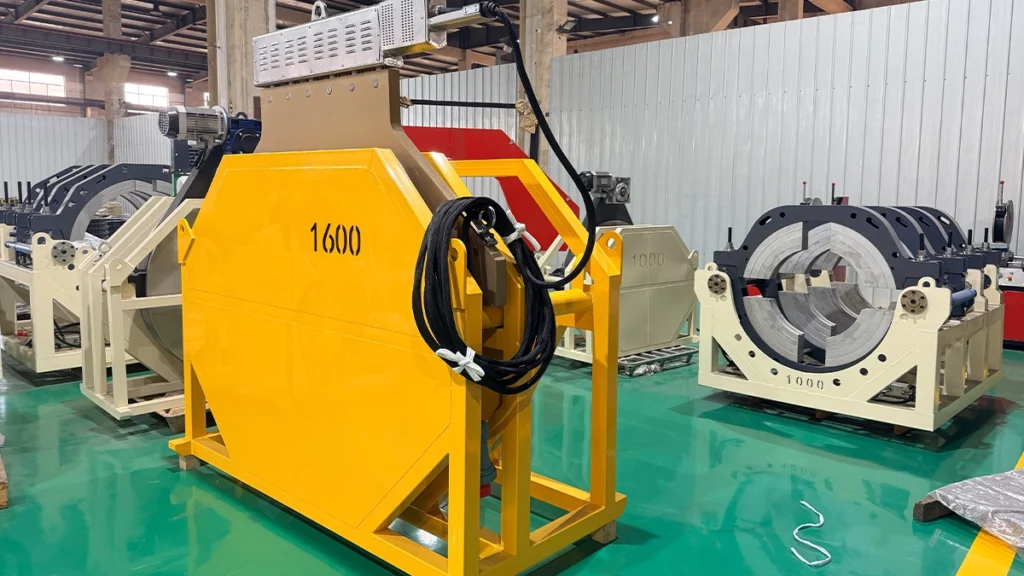
Selecting the Right Butt Fusion Machine for Your Project
Compare manual, semi-automatic, and CNC hydraulic butt fusion machines for different project scales
Selecting the right automation level directly impacts your labor costs and project velocity. Manual workbench models deliver up to 10 N axial pressure, making them a solid fit for low-budget, small-diameter indoor fabrication. Trench environments, however, demand hydraulic muscle. Semi-automatic hydraulic butt fusion machines use hydraulic cylinders to apply pressure, though operators still have to manually time the heating and cooling cycles.
CNC automatic butt fusion machines are the apex of pipeline technology. They fully automate the lifting, milling, and pressure regulation processes, which drastically cuts down on worker fatigue.
| Machine Type | Operation Method | Ideal Pipe Range | Best Application Scenario |
|---|---|---|---|
| Manual | Hand-crank / Lever | DN63 – DN160 | Indoor workshop fittings, low-pressure lines |
| Semi-Automatic | Hydraulic pump, manual timing | DN160 – DN630 | General trench welding, agricultural irrigation |
| CNC Hydraulic | Fully automated PLC, IoT logging | DN315 – DN1200+ | Municipal gas/water, high-pressure slurry lines |
Define machine sizing parameters based on pipe OD
Your equipment must perfectly match the outer diameter (OD) and Standard Dimension Ratio (SDR) of the pipeline. Manufacturers break their fleets down into distinct series. The 160 Series tackles smaller distribution lines from 40mm up to 160mm. The highly adaptable 250 Series (like the EKY250mm) handles 63mm to 250mm, leveraging a 5.05 kW total power system to run its 2.0 kW milling cutter and 2.3 kW heating plate.
For massive infrastructure projects, large diameter series rule the site. HDPE pipe welding machines built for 630mm, 800mm, and up to 1200mm+ require incredibly heavy-duty chassis construction to support the massive weight of the pipes. These giants feature low start-up pressure capabilities to guarantee smooth carriage movement. This allows operators to precisely align pipes that weigh several tons.
Match machine types to industry application scenarios
Different industries carry completely distinct mechanical and regulatory demands. Natural gas distribution sits in the highest risk category, demanding strict zero-leak tolerances. In these high-stakes environments, fully CNC automatic butt fusion machines are mandatory to strip human error out of the fusion cycle.
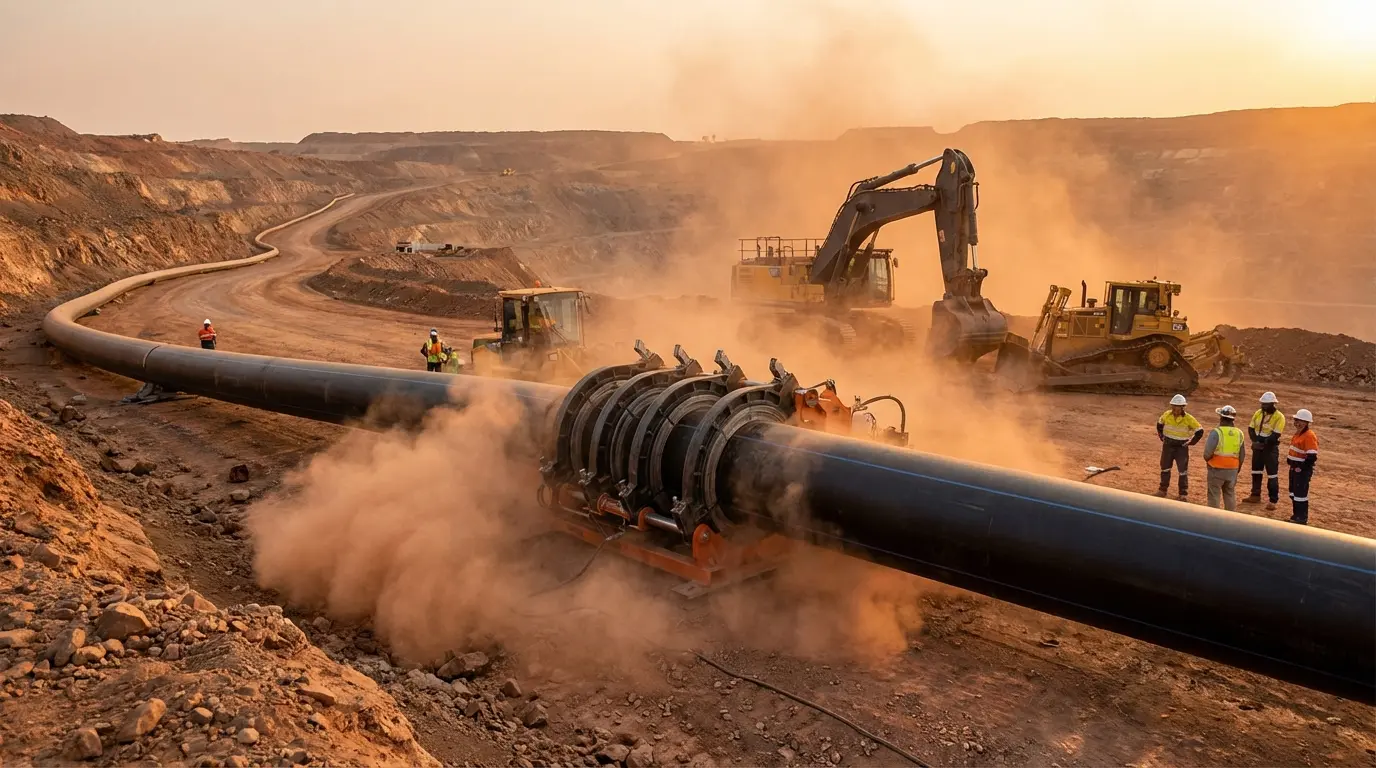
On the other hand, agricultural irrigation and gravity-fed drainage systems run under much lower pressures. For these jobs, hydraulic butt fusion welding machines strike the perfect balance between cost-efficiency and rugged durability. Mining operations moving highly abrasive slurry present another challenge entirely. Contractors need heavily reinforced hdpe fusion machine frames that can survive corrosive environments and aggressive handling by heavy equipment operators.
Review data logging requirements for municipal gas/water traceability
Modern municipal contracts increasingly demand comprehensive digital traceability for every single welded joint. Inspectors want hard proof that your heating plate temperature, bead-up pressure, and cooling times strictly matched ISO 21307 parameters. Without that paper trail, entire sections of a pipeline can fail final commissioning.
Top-tier CNC automatic butt fusion machines come equipped with integrated data loggers that generate encrypted digital reports. These intelligent systems will automatically trigger alarms and shut down the welding process if the actual parameters drift from the programmed standards. This fail-safe mechanism guarantees 100% digital record compliance. It protects contractors from liability and heavily streamlines the final municipal handover.
Factory Capability, Certification & Global Support at Ekberg Welding
Outline Ekberg’s manufacturing process from raw material inspection to final calibration
Ekberg Welding runs a highly structured, vertically integrated manufacturing facility. The operation kicks off with rigorous metallurgical inspections of raw aluminum ingots before they ever reach the in-house casting foundry. This step locks in the structural density needed for optimal thermal conductivity. After casting, CNC machining centers sculpt the chassis components down to exact geometric tolerances.
The final assembly phase centers on meticulous sensor calibration. Engineers rigorously test the ambient temperature compensation algorithms, confirming that the PLC adjusts heat absorption times with pinpoint accuracy. Furthermore, every 220V / 50Hz electrical system goes through intense load testing. This ensures the 4.21 kW total power draw stays rock-solid under continuous operation, guaranteeing absolute reliability in the field.
Highlight specific quality control checkpoints
Quality assurance protocols are what separate premium equipment from substandard clones. Ekberg enforces strict quality control checkpoints at every stage of the assembly line. The most critical hurdle is the hydraulic pressure holding test. Technicians push the hydraulic cylinders to their absolute 6.3 MPa maximum capacity and watch for micro-leaks over an extended period. This guarantees flawless drag pressure maintenance.
Electrical safety and heating uniformity make up the next critical checkpoints. Using advanced thermal imaging scanners, technicians validate the ±5°C surface temperature differential across the PTFE-coated plates. Finally, the team runs comprehensive electrical grounding and insulation tests. This vital step protects field operators from high-voltage hazards when working in wet, muddy trench environments.
Detail international certifications held by Ekberg Welding
Procurement teams must anchor their purchasing decisions on verifiable international certifications. Ekberg Welding maintains rigorous ISO 9001 compliance, which dictates strict administrative and manufacturing quality controls. This specific certification proves that every single butt fusion welding machine rolling off the line meets the exact same engineering tolerances.
Moreover, all Ekberg equipment proudly carries the CE mark. This signifies total compliance with European electrical safety and machinery directives. By co-developing their core automation tech alongside stringent Australian engineering standards, Ekberg guarantees their hardware passes the toughest global compliance audits demanded by multinational utility firms.
Explain Ekberg’s global service network
A superior hdpe pipe fusion machine demands an equally formidable support network. Ekberg backs its equipment with a comprehensive 12 to 18-month standard warranty that covers all non-human-induced damage, alongside lifetime technical maintenance. Once the warranty expires, the company charges exclusively for material costs. They entirely waive standard service and labor fees to foster long-term partnerships.
To keep project downtime to an absolute minimum, Ekberg taps into a global inventory system that ensures 48-hour spare parts dispatch. . Beyond fast shipping, they offer virtual technical training and highly detailed user manuals packed with specific data benchmarks. This empowers field crews to deploy the machinery safely and immediately.
Frequently Asked Questions
Q1: How long does it take to ship butt fusion machines from China to international project sites?
Shipping timelines rely heavily on your chosen freight method. Air freight—ideal for urgent spare parts or smaller manual units—usually takes 5 to 7 days globally. For heavy hydraulic and CNC automatic butt fusion machines, ocean freight is the standard route, taking anywhere from 25 to 40 days depending on the destination port. Ekberg speeds this up by keeping ready-to-ship inventory stocked for standard DN160 to DN630 models.
Q2: Do Chinese butt fusion machines meet international standards like ISO 21307 and DVS 2207?
Yes. Premium manufacturers program their CNC and PLC systems to natively support both ISO 21307 and DVS 2207-1 parameters. The equipment undergoes intense factory calibration, ensuring it can precisely hold the required 200–220°C heating plate temperatures and a rock-steady 0.15 MPa interfacial pressure. This guarantees all welded joints will pass destructive and ultrasonic testing.
Q3: Can I get spare parts easily if I buy a butt fusion machine from China?
Absolutely. Leading factories engineer their equipment with universal parts compatibility in mind. Ekberg Welding runs a highly efficient global logistics network that guarantees a 48-hour dispatch for critical consumables. Whether you need PTFE-coated heating plates, quick-release hydraulic couplings, or high-quality tool steel milling blades, you will get them fast to minimize project downtime.
Q4: What is the standard warranty period for Ekberg HDPE butt fusion equipment?
Ekberg offers a comprehensive 12 to 18-month standard warranty, depending on your specific contract terms. During this window, all non-human-induced damages are fully covered with free replacement parts. Additionally, Ekberg provides lifetime technical support. Post-warranty service incurs charges only for raw material costs, with all labor and consulting fees waived.
Q5: How do I verify if a Chinese hdpe butt fusion machine supplier is a real factory or a trading company?
Procurement teams should always request live video tours of the production floor. This allows you to visually verify in-house capabilities like aluminum casting and CNC automatic butt fusion machine. Furthermore, demand verified third-party documentation, such as SGS factory audit reports, ISO 9001 certificates, and CE compliance documents. A genuine factory will hand over all engineering and facility data transparently upon request.
Conclusion
Maximizing your return on investment in pipeline construction comes down to strategic equipment procurement. By skipping traditional distribution networks and buying directly from a top-tier Chinese factory, contractors can slash capital expenditures by up to 50% without giving up an ounce of engineering integrity. Advanced machinery equipped with automated PLC controls, 0.15 MPa pressure stability, and pinpoint thermal regulation guarantees absolute compliance with DVS 2207 and ISO 21307 standards.
When you evaluate suppliers, put your focus on verifiable manufacturing capabilities, robust IoT data logging, and ironclad post-purchase technical support. Teaming up with a proven butt fusion machines manufacturer in china means your fleet will be ready to tackle everything from DN160 municipal water lines to massive DN1200+ heavy industrial slurry pipes.
Do not allow inflated equipment costs to handicap your bidding capacity on major infrastructure projects. Contact Ekberg Welding today to request a customized butt fusion welding machine quote, lock in factory-direct pricing, and schedule a deep-dive technical consultation for your next high-stakes HDPE pipeline installation.