
Portable Butt Fusion Machines Manufacturer: Repair Guide
Table of Contents
Butt fusion machines that can hold 0.17 MPa interfacial pressure in a freezing, muddy trench are the only thing standing between a secure pipeline and a catastrophic environmental disaster. When a main bursts, field repair crews don’t have the luxury of a factory floor. They need equipment that is rugged, lightweight, and absolutely reliable because downtime burns through thousands of dollars every hour.
This guide strips away the marketing fluff to look at what actually matters in the field: the difference between modular and integrated chassis designs, the specific ISO 21307 technical requirements, and the smart economics of factory-direct sourcing. We’ll examine hydraulic pressure holding capabilities, how to properly size generators for DN160–DN315 units, and how to bypass the bloated markups of global distributors. By the end, you’ll have a practical framework for building a repair fleet that guarantees compliance, safety, and profitability on every single joint.

Defining Field-Optimized Portable Butt Fusion Machines
Procurement managers buying for new installations usually look for automation and data logging speed. But repair work is a different beast entirely. A butt fusion welding machine designed for a clean right-of-way will often fail miserably in the tight, chaotic reality of an emergency repair.
The Anatomy of Portability: Modular Design vs. Integrated Chassis
Modularity is the single biggest factor in repair readiness. Standard “all-terrain” hdpe fusion machines often weld the hydraulic unit, chassis, and planer into one heavy, rolling behemoth. That’s fine for long, straight pipe runs, but it’s a nightmare for repairs. A field-optimized butt fusion welding machine must be modular, allowing the hydraulic power unit (HPU) to detach from the main chassis. This lets a two-person crew lower the welding unit into a trench less than a meter wide without waiting for a crane.
Material choice dictates whether your crew is fighting the butt fusion machine or working with it. Old-school machines rely on heavy steel frames for rigidity, pushing a standard 160mm unit up to 85 kg. Modern manufacturers like Ekberg Welding have shifted to high-grade aluminum die-casting. This engineering pivot drops the weight of a 160mm unit to roughly 45–55 kg—a nearly 40% reduction. Yet, it retains the structural integrity needed to clamp SDR 11 pipes. That weight-to-strength ratio is vital when crews have to manually wrestle equipment around existing utility lines where heavy machinery can’t reach.
Critical Constraints in Field Repair Scenarios
Repairs happen in the worst conditions imaginable. Unstable ground, water seepage, and temperature swings from -10°C to +45°C are standard. Equipment needs a low center of gravity so it doesn’t tip on an uneven trench floor. Space is also at a premium. Urban water grid repairs often rely on small “keyhole” excavations to save on paving costs.
A HDPE pipe welding machine has to be compact enough to slide into these tight spots while still giving the operator room to reach the locking clamps. Then there is the power issue. Repair trucks run on portable generators, not clean grid power. If the butt fusion welding machine lacks internal voltage protection or soft-start capacitors, the voltage spikes from the generator can blow fuses or fry circuit boards the moment the inductive load hits.
Manual vs. Semi-Automatic vs. CNC for Repairs
The choice between manual and CNC (Computer Numerical Control) isn’t black and white. For pure speed, veteran crews often prefer hydraulic butt fusion machines. They are lighter, have fewer electronics to short out in the rain, and let the operator “feel” the drag pressure.
However, compliance standards are tightening. Utilities now frequently demand “Data Logger Ready” hydraulic units, even for manual operations. This setup allows an external CNC box or data logger to plug into the hydraulics, recording pressure and temperature curves to prove ISO 21307 or DVS 2207 compliance. While a fully automatic butt fusion machine guarantees the cooling cycle isn’t cut short by an impatient worker, the extra weight and delicate electronics can be a liability in deep mud. For many contractors, the sweet spot is a semi-automatic unit—or a high-end manual unit with data logging ports—combining mechanical reliability with digital accountability.
Global Manufacturer Landscape: Navigating the Supply Chain
The welding equipment market is split between massive global conglomerates and agile, specialized manufacturers. Knowing who is who helps buyers balance their budget against technical needs.
Tier 1 Brands vs. Specialized Factory-Direct Manufacturers
Tier 1 European and American brands (think McElroy, Georg Fischer, or Ritmo) dominate the spec sheets for mega-projects. Their gear is undeniably top-tier, often boasting proprietary tracked chassis systems and vast distributor networks. But you pay for that access—usually a 30–50% premium on capital expenditure (CAPEX).
For contractors watching their ROI, specialized factory-direct manufacturers like Ekberg Welding offer a smart alternative. These companies focus purely on engineering the fusion unit, skipping the expensive bells and whistles. Buying factory-direct cuts out layers of distributor markup. Plus, a shorter supply chain saves you when things break. Tier 1 brands often route parts through regional hubs, causing delays. A factory-direct relationship means you can get specific components—like hydraulic seals or a replacement heater plate—shipped straight from the manufacturing floor to your site.
The Shift Toward Cost-Effective Industrial Solutions
Utility companies and municipalities are moving away from “brand loyalty” and toward “spec compliance”. If a butt fusion machine is certified to ISO 12176-1 and passes pressure holding tests, the logo on the side matters less than the data it produces.
This shift is fueling a demand for “universal compatibility.” Contractors want hdpe fusion machines that use standard hydraulic quick-couplers (like ISO 7241-1 Series B) and standard insert sizes. Proprietary connections trap you with one vendor, making mixed-fleet management a headache. Industrial solutions that accept generic hydraulic parts let field mechanics grab replacement hoses or couplers from a local shop during an emergency, rather than waiting weeks for a proprietary part to arrive.
OEM and Private Label Manufacturing for Distributors
Many “local brands” in Europe, Australia, and North America are actually Private Label products made in industrial hubs. Distributors pay factories to paint the butt fusion machines in their colors and slap on a logo.
Savvy buyers are skipping the middleman. Going directly to an OEM (Original Equipment Manufacturer) like Ekberg opens up customization options distributors can’t touch. You can request specific voltage inputs (220V vs 380V) for your generators or reinforced shipping crates for rough terrain. Better yet, when you have a technical question, you get an answer from the engineer who designed the hydraulic circuit, not a sales rep reading a brochure.
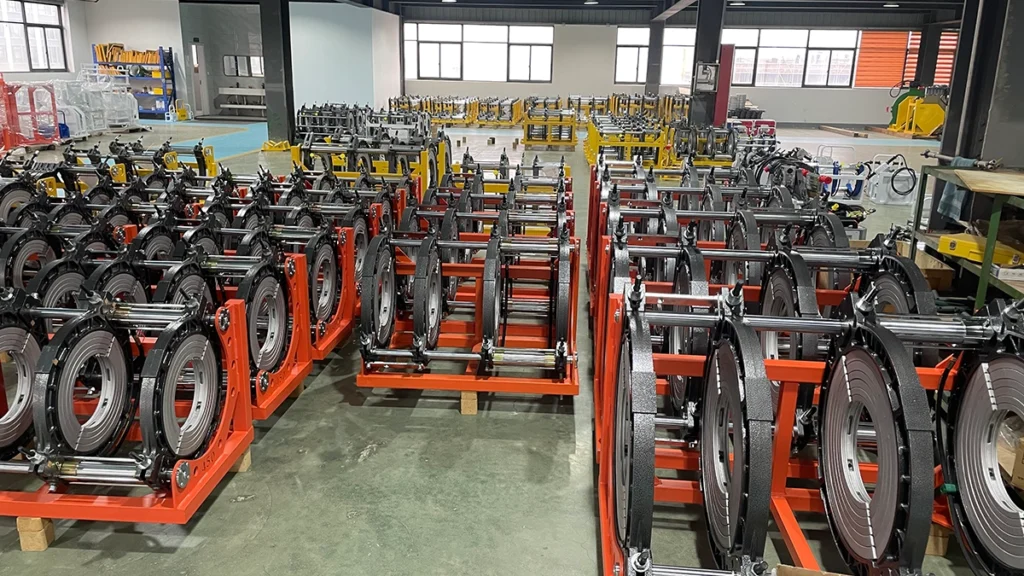
Key Technical Specifications for Field-Ready Machines
To spot a butt fusion welding machine that can actually handle field abuse, you have to look past the glossy photos and drill down into the data sheet.
Hydraulic System Performance and Pressure Holding
The Hydraulic Power Unit (HPU) is the heart of the butt fusion machine. For standard PE100 welding, the system needs to deliver and hold pressures up to 160 bar (16 MPa) to hit the required interfacial fusion pressure (usually 0.15–0.25 MPa).
The pressure accumulator is a critical, often ignored component. In premium hdpe pipe jointing machines, the accumulator holds the clamping pressure during the cooling phase—which can last 20 minutes for thick pipe—without the motor running constantly. Butt fusion machines with weak accumulators have to cycle the motor on and off to keep pressure up. This burns extra fuel and heats up the hydraulic oil, eventually killing the seals. DVS 2207 standards demand stable pressure; a butt fusion welding machine that drops more than 5% pressure during cooling produces a non-compliant joint.
Heating Plate Technology and Temperature Recovery
The heating plate has to do more than get hot; it has to stay hot evenly. For HDPE, you’re aiming for 220°C ±5°C. In the field, wind is the enemy. A 5 m/s breeze can strip heat from the plate faster than the element can replace it, causing “cold welds.”
Top-tier butt fusion welding machines use double-layer PTFE (Polytetrafluoroethylene) coatings. This non-stick layer is crucial for the “break-off” phase. When you remove the heater, it must release cleanly from the molten pipe. If the coating is cheap or damaged, the pipe sticks, ruining the melt pattern and forcing you to cut the joint out and start over. You also need a thermostat with a fast recovery rate to get the plate back up to temp immediately, minimizing idle time between welds.
Facing Tool (Planer) Torque and Safety
The facing tool, or planer, preps the pipe ends. Field pipes are often dirty, oxidized, or ovalized. The planer needs serious torque to shave continuous ribbons off thick-walled pipes (like SDR 7.4). Weak motors stall out here, forcing the operator to back off and leaving an uneven face.
Safety is non-negotiable. These planers spin sharp blades at high RPM. Field-optimized machines have micro-switches that kill the power unless the planer is properly seated and locked in the chassis. This prevents accidental activation during transport or handling—a common cause of injury in the chaos of a trench.
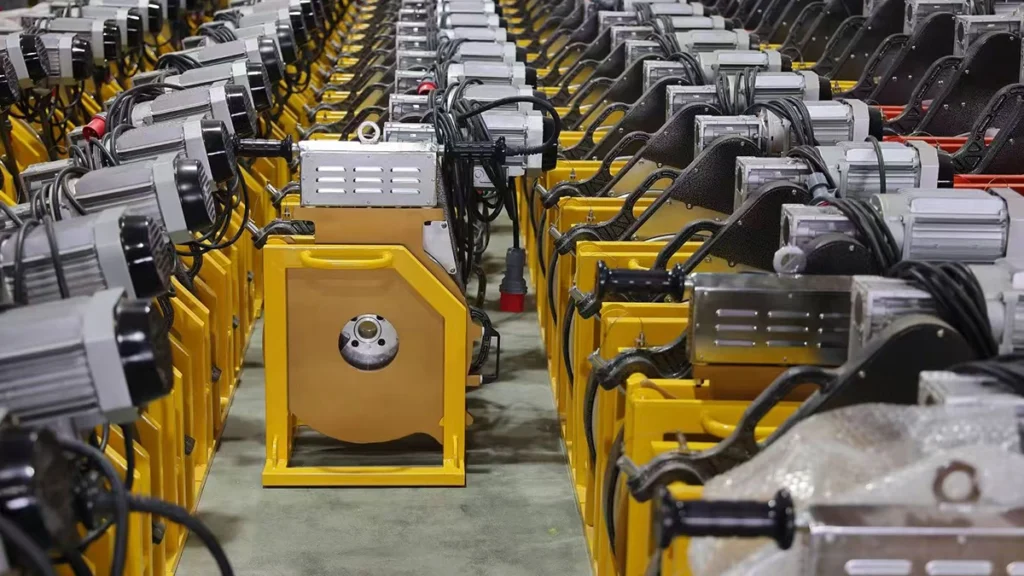
Buyer’s Checklist: Selecting the Right Machine for the Job
Picking the right butt fusion machine means matching the gear to the pipe schedule and the environment.
Sizing the Machine to the Pipe Schedule
Oversizing is a rookie mistake. Just because a 315mm hydraulic butt fusion machine can weld 90mm pipe with inserts doesn’t mean it should. hauling a massive chassis into a ditch for a small repair is inefficient and dangerous.
Selection Matrix:
- 160mm Series: The go-to for service lines and small mains (DN40mm – DN160mm). Perfect for tight urban spots.
- 250mm Series: The workhorse for municipal distribution (DN63mm – DN250mm).
- 315mm Series: For main transmission lines (DN90mm – DN315mm). You’ll need mechanical lifting help here.
Using a dedicated 160mm hydraulic butt fusion machine for smaller pipes saves the crew’s backs and ensures better alignment. Heavy clamps on a big machine can easily crush or distort thin-walled SDR 17 pipes.
Generator Compatibility and Power Requirements
The generator is the lifeline. It has to handle the combined load of the heater, planer, and hydraulic pump all running at once.
Minimum Generator Sizing (with AVR):
- 160mm Hydraulic Butt Fusion Machine: 5 kVA
- 250mm Hydraulic Butt Fusion Machine: 8 kVA
- 315mm Hydraulic Butt Fusion Machine: 10–12 kVA
Verify that the generator has Automatic Voltage Regulation (AVR). Electronic heating plates hate “dirty power.” If the generator surges when the planer kicks in, it can spike the voltage and fry the heater’s control board. Butt fusion machines with internal voltage protection add a necessary second layer of defense.
Ease of Maintenance and Spare Parts Kits
Uptime is everything. If you’re on a remote mining site, a blown seal shouldn’t shut you down for a week. Look for butt fusion welding machines with accessible hydraulic manifolds and electrical boxes.
Every field butt fusion machine needs a “First Aid Kit,” including:
- Spare Planer Blades: Dull blades create stepped facing.
- Hydraulic Quick Couplers: These get smashed by dirt and impact constantly.
- Replacement Fuses: Essential for the electrical box.
- Full Insert Sets: Make sure you have aluminum inserts for every standard diameter (e.g., 63, 75, 90, 110, 125, 140mm for a 160 unit).
Ekberg Welding: Manufacturing Excellence & Quality Control
At Ekberg Welding, we know our butt fusion welding machines are the last line of defense against pipeline failure. Our philosophy is simple: precision, durability, and direct support.
Precision Engineering and Raw Material Selection
We use high-grade aluminum alloys for our chassis castings. They are light enough to move by hand but rigid enough to stop flexing under high pressure. Rigidity matters—if a chassis flexes during fusion, pipe alignment shifts, and the weld fails. Our machining process holds clamp alignment tolerances to less than 0.5mm, beating industry standards for high-stress applications.
Rigorous Factory Testing Protocols
No butt fusion welding machine leaves our floor without passing a gauntlet of tests. This includes a 4-hour hydraulic pressure holding test to prove seal integrity and a thermal scan of the heating plate to ensure temperature uniformity within ±5°C. We validate against ISO 12176-1 specifications, so when an Ekberg butt fusion machine arrives, it’s calibration-ready and compliant with global safety standards.
Global Logistics and Technical Support
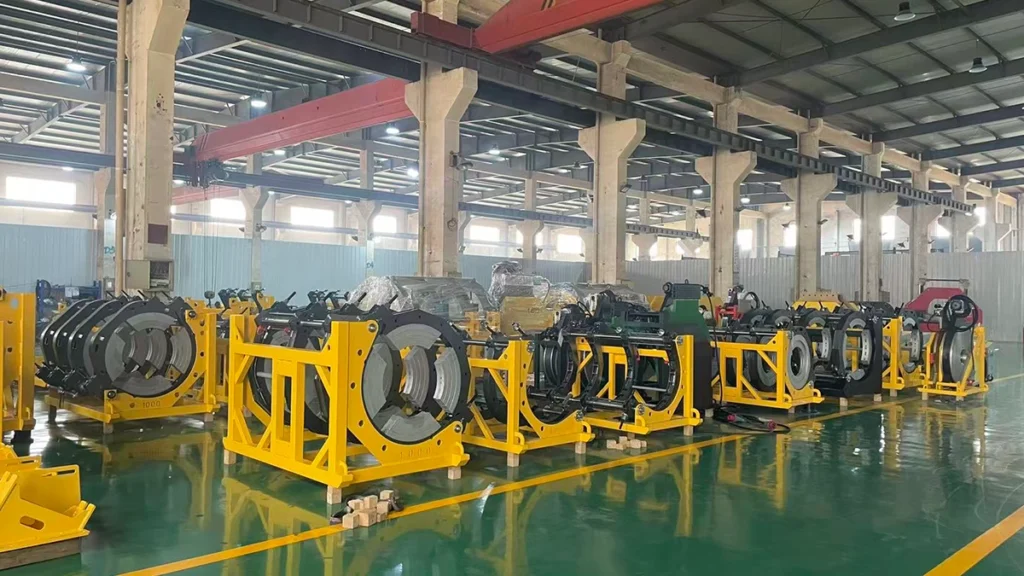
We ship globally, but we pack for reality. Our HDPE pipe welding machines travel in ruggedized crates built to survive international freight and rough handling. More importantly, we offer direct engineering support. If a contractor in a remote location has a pressure issue, they can video call our technical team. You get troubleshooting advice from an engineer who knows the hdpe fusion machine inside out, not a helpdesk script.
Frequently Asked Questions
Q1: What size generator do I need for a portable 160mm hydraulic butt fusion machine?
For a 160mm unit, stick to a minimum of 5 kVA (approx. 4-5 kW). This gives you enough overhead to run the 1.5kW heater and 0.7kW cutter at the same time without dragging the voltage down. Crucially, ensure the generator has Automatic Voltage Regulation (AVR) to shield the electronic thermostat from power surges when the motor starts.
Q2: Can Ekberg butt fusion machines weld pipes from different manufacturers (e.g., PE80 to PE100)?
Yes, Ekberg butt fusion machines handle all standard polyethylene (PE80, PE100) and polypropylene (PP) pipes. However, welding dissimilar materials (like PE80 to PE100) requires specific parameters. You need to check the pipe manufacturer’s guidelines and ISO 21307 standards. Our butt fusion welding machines provide the precise control needed to execute these tricky transition welds safely.
Q3: How does the weight of an Ekberg machine compare to traditional steel-frame models?
An Ekberg 160mm chassis weighs about 45–55 kg, thanks to the aluminum die-cast build. Older steel-frame models often tip the scales at over 85 kg. That weight difference is a game-changer for field repairs, letting a two-man crew lower the unit into a trench without waiting for an excavator.
Q4: What is the warranty coverage for machines used in rugged field environments?
Ekberg Welding provides a standard 12-to-24-month warranty on the chassis and hydraulic unit against manufacturing defects. While we build them tough, the warranty doesn’t cover consumables like planer blades or damage from negligence (like dropping it off a truck). We do, however, offer lifetime technical support to help you troubleshoot long after the warranty runs out.
Q5: Are replacement liners/inserts available for non-standard pipe sizes (e.g., IPS vs. Metric)?
Absolutely. Standard butt fusion machines ship with Metric inserts (63mm, 90mm, 110mm, etc.), but we manufacture and stock inserts for IPS (Iron Pipe Size) and DIPS (Ductile Iron Pipe Size) for North American standards. Since we are the manufacturer, we can pack the specific inserts you need right in the crate, so you’re ready to work the moment it arrives.
Conclusion
There is no margin for error in field repairs. A failed joint—and the resulting costs of re-excavation, environmental fines, and damage to your reputation—is far more expensive than the equipment used to weld it. Investing in a portable, rugged, and precise butt fusion machine is investing in the long-term integrity of your infrastructure.
While Tier 1 brands offer a famous logo, Ekberg Welding provides the perfect balance of field-proven performance, modular portability, and factory-direct savings. By choosing a butt fusion welding machine engineered specifically for the trenches, you empower your crew to work safer, faster, and with greater accuracy.
Ready to upgrade your repair fleet? Contact Ekberg Welding today for a technical consultation. We can provide a custom quote with your specific voltage and insert requirements, plus a fast-ship availability check to get your team field-ready immediately.