
Top Butt Fusion Machine Supplier You Can Trust
Table of Contents
A single failed DN800 weld can easily drain $15,000 from your project budget thanks to excavation rework and unplanned system downtime. That’s why partnering with reliable butt fusion machine suppliers isn’t just a best practice—it’s a financial necessity. Guaranteeing a 50-year pipeline lifespan across municipal and industrial applications demands strict parameters. You have to operate precisely between 200–230°C while maintaining flawlessly controlled hydraulic fusion pressure. This technical guide breaks down the exact engineering specifications required for perfect high-density polyethylene (HDPE) joints.
We cover everything from ZL104 aluminum chassis construction to CNC-automated data logging. You will learn how to navigate strict compliance mandates for ISO 21307 and DVS 2207-1 standards, match specific equipment types to your pipe diameters, and accurately calculate Total Cost of Ownership (TCO). By the time you finish reading, procurement engineers and project managers will possess a rock-solid framework for selecting the exact machinery required for high-pressure gas, water, and mining installations. Armed with this knowledge, you can bypass costly specification errors and source high-performance, factory-direct solutions from industry leaders like Ekberg Welding.

The High Cost of Compromise: Why Choosing Reliable Butt Fusion Machine Manufacturers Matters
Calculate the Financial Impact of Weld Failures
The financial fallout from a botched pipeline weld goes way beyond the initial price tag of your fusion equipment. NACE International reports that corrosion and pipeline failures cost the water and wastewater industry a staggering $36 billion every year. Over in the oil and gas sector, unplanned downtime strips offshore organizations of roughly $38 million annually. Even a tiny 1% downtime rate wipes out more than $5 million in yearly revenue. When contractors try to cut corners with subpar welding gear, they gamble with cold welds. These dangerous defects happen when inadequate heating or weak fusion pressure (falling below the mandatory 0.15 MPa threshold) stops the polyethylene chains from properly entangling at a molecular level.
These microscopic flaws don’t stay microscopic for long. Under cyclic operational loading, they inevitably expand and cause catastrophic gas or water leaks. Think about the direct costs of digging up a buried DN630 pipe, rushing emergency repair crews to the site, and bleeding money during system downtime. Those expenses instantly dwarf whatever money you saved buying budget-tier machinery. Reliable butt fusion machine manufacturers design their equipment specifically to eliminate these exact variables. They deliver the precise thermal and hydraulic control needed to ensure your weld interface ends up just as strong as the parent pipe itself.
Precision Engineering in Fusion Equipment
You can’t achieve a flawless weld without machinery built to uncompromising engineering standards. The butt fusion machine’s structural integrity directly dictates pipe alignment. That is why top-tier equipment relies on main chassis components cast from ZL104 standard aluminum alloy. This specific material delivers an incredible strength-to-weight ratio. It stays rigid enough to handle the massive drag forces involved in pulling long, heavy-wall pipes, yet remains light enough for practical trench deployment.
Hydraulic stability carries the same weight. A premium hydraulic station must apply consistent interfacial pressure throughout the critical cooling phase—without a single micro-drop. Even minor pressure fluctuations will ruin the joint’s structural integrity. Accurate milling is also entirely non-negotiable. Premium electric-driven milling cutters feature safety limit switches to block accidental starts. They utilize high-grade tool steel inserts equipped with a double-edged, interchangeable, and reversible blade design. The result? Perfectly parallel pipe ends that slash misalignment tolerances to under 10% of the pipe’s wall thickness.
International Welding Standards and Compliance
Global pipeline infrastructure operates under intense regulatory scrutiny. Top butt fusion welding machine suppliers guarantee their hardware meets—or outright exceeds—these stringent international standards. Take ISO 21307, for example. It outlines strict butt fusion jointing procedures, demanding single high-pressure fusion for wall thicknesses between 5mm and 70mm, and dual low-pressure fusion for anything over 20mm. Your equipment must seamlessly toggle between these pressure profiles the moment an operator inputs the requirements.
In Europe and other highly regulated industrial sectors, DVS 2207-1 serves as the gold standard. This German benchmark heavily emphasizes high-precision welds for gas, mining, and chemical systems, enforcing rigorous contamination control alongside exact temperature parameters. Meanwhile, North American markets lean heavily on ASTM F2620, especially regarding cold-weather fusion compensation. Advanced CNC units tackle this by automatically detecting the ambient temperature and tweaking the heat absorption time. This smart compensation ensures a weld completed at a freezing -5°C achieves the exact same molecular bond as one performed at a comfortable 25°C.
Types of Equipment Provided by Top Butt Fusion Machine Suppliers
Manual vs. Hydraulic Butt Fusion Machines
Specifying the right equipment for a project means knowing exactly where manual butt fusion machine falls short and hydraulic power takes over. Manual HDPE pipe welding machines still capture about 45% of total market revenue, hitting a valuation of $450 million in 2023. Buyers love them for their low initial capital cost and unmatched portability in cramped spaces. However, manual units rely 100% on the operator’s physical strength to generate fusion pressure. This hard limitation restricts them to smaller plumbing and irrigation jobs, generally within the DN40–DN250 range.
Hydraulic butt fusion machines, on the other hand, are built for the brutal demands of heavy civil infrastructure. They easily handle municipal pipeline ranges from DN63mm all the way up to DN2600mm. These heavy-duty units leverage motorized hydraulic stations to overpower the intense drag friction of long, thick-walled pipes, applying the exact interfacial pressure mandated by ISO standards. Try using manual leverage on a DN315 pipe, and you will consistently generate weak fusion pressure—guaranteeing an eventual joint failure.
| Feature | Manual Butt Fusion Machines | Hydraulic Butt Fusion Machines |
|---|---|---|
| Optimal Diameter Range | DN40mm – DN250mm | DN63mm – DN2600mm |
| Pressure Generation | Operator physical leverage | Motorized hydraulic station |
| Primary Applications | Indoor plumbing, light irrigation | Municipal water, gas mains, mining |
| Data Logging Capability | None | Available via digital integration |
| Capital Investment | Low | Medium to High |
CNC and Automatic Butt Fusion Machines
When you are laying critical infrastructure like natural gas distribution lines, human error simply isn’t an option. Fully CNC automatic butt fusion machines are the absolute pinnacle of current joining technology. These advanced systems utilize closed-loop control over time, temperature, and pressure. The operator simply inputs the pipe diameter, SDR, and material grade, and the machine’s computer calculates every required parameter.
The leading butt fusion machine suppliers take this a step further by integrating Beidou or GPS automatic positioning into their CNC units. This captures the exact real-time coordinates for every single joint you fuse. Independent dual-channel timers document both the heat absorption and cooling periods, tracking crucial metrics like flanging pressure, heat absorption pressure, and flanging displacement. Operators can easily export this data via USB for rigorous Quality Assurance and Quality Control (QA/QC) reviews. This creates the permanent, traceable digital footprint that modern inspectors demand before signing off on a project.
Workshop Fitting Machines vs. Field Machines
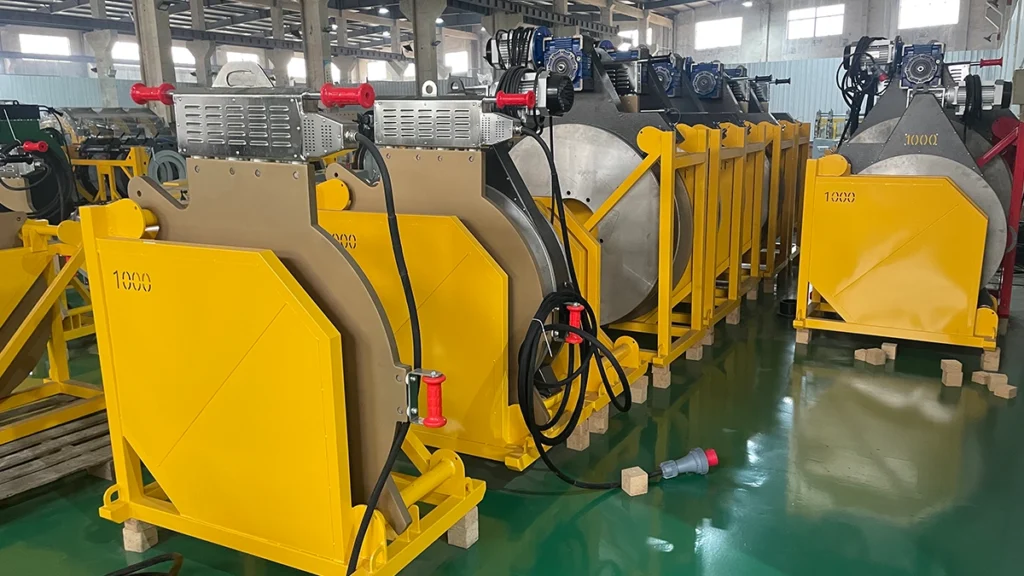
Your operational environment should always dictate the structural design of your fusion equipment. Rugged, trench-ready field butt fusion welding machines put a premium on weather resistance, frame rigidity, and portability. They have to survive mud, pouring rain, and generally rough handling by field crews. Because of this, they utilize environmentally sealed flat-type quick connectors to block contamination and prevent hydraulic fluid loss. They also feature heavy-duty, shock-resistant pressure gauges built to survive bouncy transit across terrible terrain.
Workshop fitting machines serve a completely different purpose. Designed to fabricate segmented bends, tees, and crosses inside a controlled factory, these stationary units prioritize blisteringly fast production cycles over portability. They use compact stainless steel molds capable of rapid heating—sometimes knocking out a heating cycle in just seconds to 20 seconds per weld for specific components. While field machines constantly battle uneven ground and wild temperature swings, workshop machines enjoy optimal indoor conditions. This allows for the highly efficient, repetitive mass production of pipeline fittings.
Buyer’s Checklist: How to Evaluate and Select the Best Equipment
Heating Plate Technology Specifications
The heating plate acts as the thermodynamic engine of the entire fusion process. When you evaluate new equipment, you must verify the presence of a high-quality Polytetrafluoroethylene (PTFE) coating. A premium PTFE layer stops molten polyethylene from sticking to the metal plate. Without it, you risk surface tearing and severe joint contamination the moment the plate is removed.
Temperature control has to be absolute. For HDPE, the sweet spot is 200–230°C (400–450°F). Your equipment needs to hold this temperature uniformly across the entire plate surface, allowing for a maximum variance of just ±5°C. Top-tier machines also feature an automatic retraction system for the heating plate once the heating cycle wraps up. This rapid, motorized removal drastically cuts down mold closing time and minimizes temperature loss, ensuring the molten pipe ends connect long before the material starts cooling and crystallizing.
Hydraulic Station Requirements
A professional-grade hydraulic station is the dividing line between reliable equipment and cheap knockoffs. Buyers need to look closely at accumulator performance. A high-quality accumulator holds steady pressure throughout the long cooling phase without forcing the motor to run non-stop. This simple feature saves energy and prevents the system from overheating.
Inspect the hydraulic circuit for flat-type quick connectors. Traditional poppet-style couplings are prone to leaks, but flat-face connectors are environmentally friendly. They stop hydraulic fluid drips from contaminating your trench and keep out the dirt that destroys internal pump seals. You should also verify that the station includes a large-dial, shock-resistant pressure gauge for high-precision readings. Finally, ensure the station offers low starting pressure capabilities—a mandatory feature if you want to safely fuse small-diameter fittings without accidentally crushing them.
Chassis and Clamp Quality
The HDPE pipe welding machine’s structural frame takes a massive beating in the field. Dragging a 12-meter length of DN800 pipe through a dirty trench subjects the chassis to extreme mechanical stress. Check the frame specifications to confirm it is cast from ZL104 aluminum alloy. This specific alloy resists warping and locks in the precise axial alignment of your pipes.
Look for a clamping system that uses a four-clamp sleeve structure. This setup guarantees highly accurate pipe positioning and delivers the mechanical leverage you need to fix out-of-roundness (ovality) issues before the milling process even begins. Make sure the high-quality aluminum alloy reduction inserts feature aggressive slip resistance. You don’t want the pipe sliding backward the second fusion pressure is applied.
Total Cost of Ownership (TCO) Analysis
Procurement teams make a classic mistake when they obsess over the initial ‘HDPE butt fusion equipment price’ instead of calculating the Total Cost of Ownership (TCO). Sure, standard manual butt fusion welding machines look great on a spreadsheet today. But they completely lack the QA/QC data logging required for modern municipal contracts, which can easily lock your contracting firm out of lucrative bidding wars tomorrow.
A realistic TCO calculation factors in the hdpe fusion welding machine’s total lifespan, expected maintenance frequency, and overall labor efficiency. The higher capital cost of a premium hydraulic butt fusion machine usually pays for itself within the first few years simply by slashing labor hours and wiping out expensive rework. Furthermore, securing factory-direct pricing from manufacturers like Ekberg Welding bypasses the steep distributor markups attached to legacy brands. You get superior ROI while deploying top-tier technology in the field.
- Heating Plate: Verifiable PTFE coating; maintains 204–232°C uniformly.
- Hydraulics: Flat-type quick-release couplings; shock-resistant pressure gauge.
- Chassis: ZL104 aluminum alloy casting; four-clamp sleeve structure.
- Data Logging: USB export capability for dynamic welding data.
- Red Flags: Manual butt fusion welding machines proposed for gas distribution; insufficient hydraulic force for SDR 9 mining pipes.
Industry Applications Demanding Top-Tier Butt Fusion Equipment
Municipal Water and Wastewater Networks
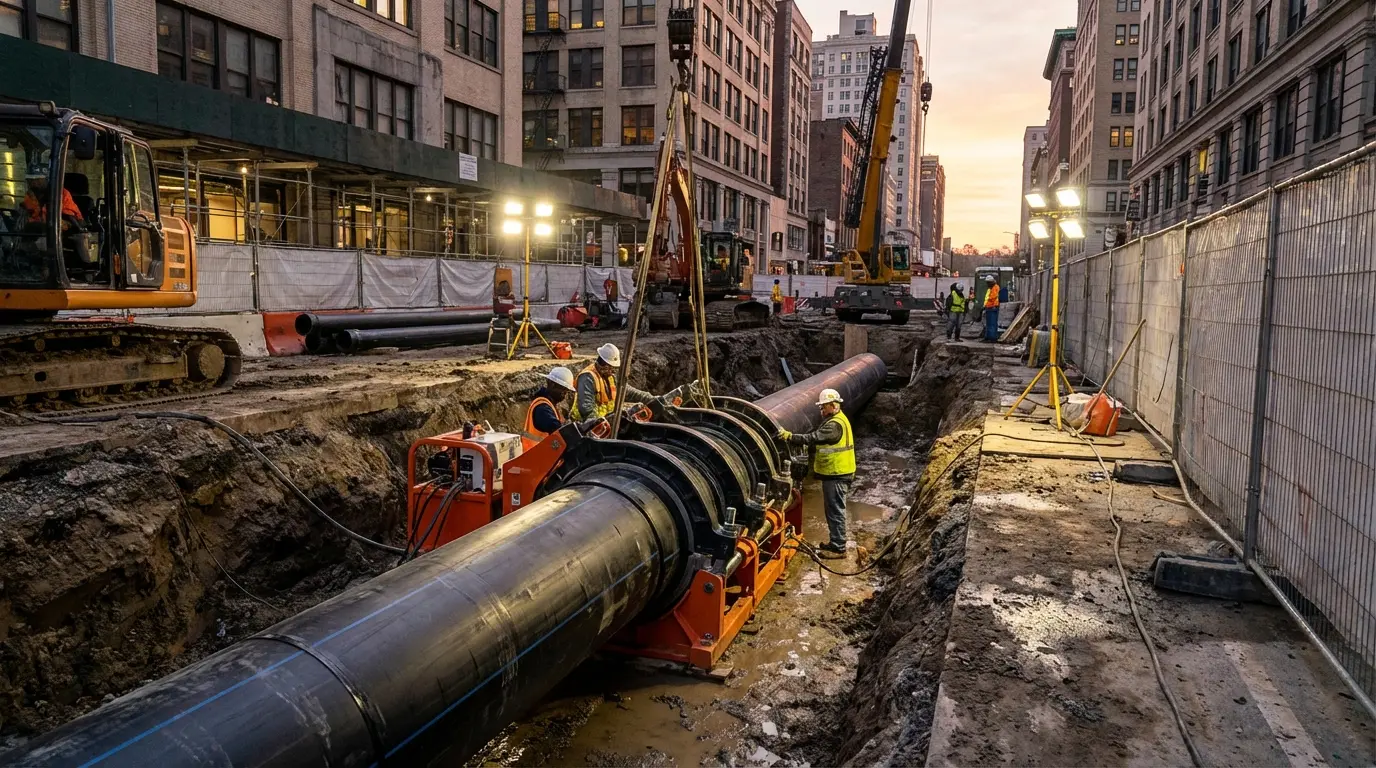
Upgrading aging urban infrastructure involves high-volume, large-diameter pipe installations that usually fall between DN160 and DN800. Municipal water authorities are aggressively switching to HDPE because of its incredible corrosion resistance and seismic flexibility. CSIRO life-cycle analysis shows that polyethylene networks boast drastically lower lifetime costs than traditional concrete or ductile iron pipes, mostly due to a massive reduction in failure and leakage rates.
Contractors need to deploy hydraulic butt fusion machines capable of holding high interfacial pressures over lengthy cooling cycles to guarantee those 50-year lifespans. The gear must be tough enough to run continuously through terrible weather, ensuring crews can lay miles of municipal water mains without a single bad joint. When you factor in the money saved by eliminating treated water loss, the payback period for premium butt fusion welding machine is surprisingly short.
Gas Distribution Systems
Natural gas distribution is arguably the most high-stakes application for fusion technology. One failed joint can trigger a catastrophic explosion. Because of this, gas network operators enforce absolute zero-leakage mandates and strict DVS 2207-1 compliance. Manual butt fusion welding machines are universally banned in these environments because human operators simply cannot guarantee consistency.
If you operate in the gas sector, you must use fully CNC automatic butt fusion machines. These systems remove operator error from the equation by taking total control over the heat absorption, changeover, and cooling phases. Gas utilities also legally require 100% traceability for every weld. CNC automatic butt fusion machines handle this by logging the operator ID, pressure graphs, ambient temperature, and exact GPS coordinates directly to a USB drive. This creates an immutable, tamper-proof digital record proving the network’s integrity.
Mining Operations and Industrial Slurries
Mineral processing plants, mining operations, and industrial slurry transport networks face brutal operational realities. They rely on thick-walled, high-pressure pipes—usually SDR 9 or SDR 11—to survive the extreme internal abrasion caused by chemical tailings and crushed rock. Fusing these massive pipes demands specialized equipment featuring oversized hydraulic cylinders and reinforced chassis capable of generating immense clamping and fusion forces.
Mining setups also frequently require joining pipes with dissimilar wall thicknesses, like fusing an SDR 11 pipe straight to an SDR 7.4 fitting. Advanced butt fusion welding machines have to navigate complex dissimilar SDR rules to pull this off. The heating time has to match the thicker wall (SDR 7.4) to guarantee an adequate melt, while the interfacial pressure must be calculated for the thinner wall (SDR 11) so the pipe end doesn’t structurally collapse. Only the absolute best HDPE pipe welding machine offers the programmable flexibility required to execute these complex parameters safely out in remote mining environments.
Ekberg Welding: Manufacturing Excellence, Quality Control & Factory Capability
Advanced Factory Production Capabilities
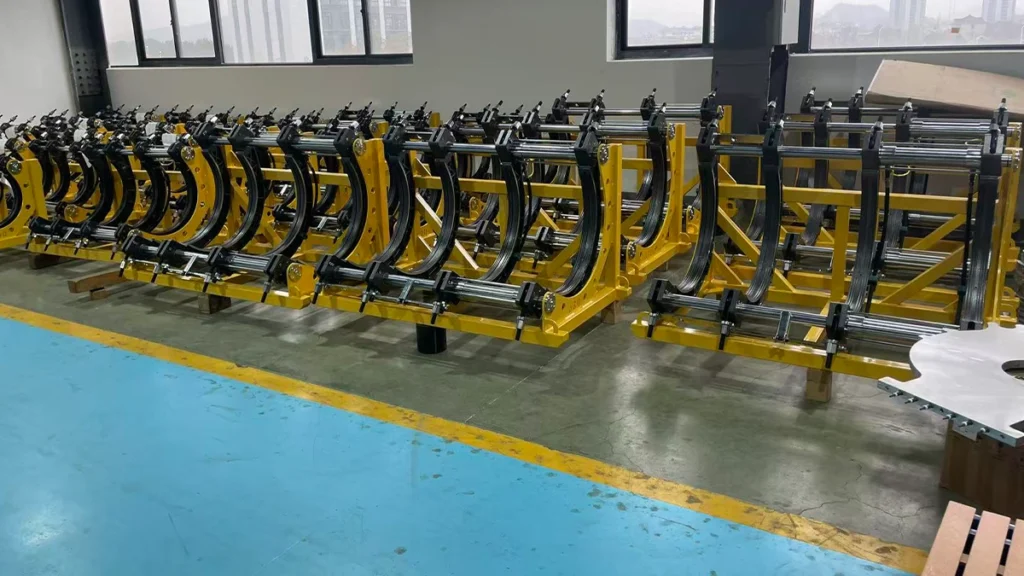
Backed by over 25 years of dedicated expertise in hot melt welding technology, Ekberg Welding represents the gold standard in manufacturing excellence. Unlike brands that merely assemble outsourced parts, Ekberg runs an advanced manufacturing facility loaded with state-of-the-art CNC machining centers. Keeping this capability in-house enables the ultra-precise fabrication of aluminum reduction clamps and ZL104 chassis frames, hitting dimensional tolerances that competitors simply cannot replicate.
By keeping a tight grip on the entire production cycle—from the initial raw material casting down to the final software integration—Ekberg guarantees every hdpe fusion welding machine aligns with exacting engineering standards. Operating as a primary manufacturer also means Ekberg can offer true factory-direct pricing. This aggressive business model strips away the bloated distributor markups you normally see with legacy European and North American brands. The result? Global contractors get superior technology at a highly competitive price.
Rigorous QA/QC Protocols
No machine leaves the factory floor before surviving a punishing battery of Quality Assurance and Quality Control (QA/QC) protocols. Heating plates go through intense thermal imaging tests to prove absolute heating uniformity across the entire PTFE surface. If a cold spot exists that could compromise a weld, the plate is rejected. Hydraulic stations face sustained pressure drop tests to ensure flat-face connectors and accumulators hold perfect seals under maximum load.
Electrical safety inspections align with strict international standards, verifying the reliability of audible alert systems and independent dual-channel timers. The CNC software is relentlessly tested to confirm it accurately records switching time, cooling pressure, heat absorption pressure, and flanging pressure. This obsessive level of detail ensures that the moment an Ekberg butt fusion machine arrives at your trench site, it is primed for flawless deployment.
Global Support Infrastructure
Buying heavy industrial gear requires the peace of mind that comes with long-term operational support. Ekberg Welding delivers a massive global support infrastructure built specifically to keep international contractors up and running. Every unit ships with a solid 1-year warranty and a firm commitment to lifetime maintenance. If you experience any non-human-induced damage during the warranty window, replacement parts are shipped completely free of charge.
Post-warranty support is incredibly fair. Clients pay only for the actual material costs—all other service and labor fees are entirely waived. Ekberg even provides regional partners with a complimentary annual on-site maintenance service to keep equipment perfectly calibrated. For international crews transitioning to CNC technology, Ekberg rolls out streamlined operator training programs. Since the closed-loop cycle handles the heavy lifting, operators simply need to learn how to power up, align the pipe, select the right parameters, and let the software execute the perfect weld.
Frequently Asked Questions
Q1: Where to buy butt fusion machines that guarantee compliance with DVS and ISO standards?
Skip the middlemen and source directly from established manufacturers like Ekberg Welding. The top butt fusion machine suppliers engineer their gear specifically to hit ISO 21307 and DVS 2207-1 parameters. You get the precise hydraulic control, uniform PTFE heating plates (204–232°C), and CNC data logging required to breeze through regulatory sign-offs.
Q2: What factors directly influence the HDPE butt fusion equipment price?
Pricing comes down to your required welding range (e.g., DN40 versus DN1200), actuation type (manual vs. hydraulic), and automation level. CNC automatic butt fusion machines equipped with automated pressure compensation, GPS tracking, and USB data logging demand a higher upfront investment. However, they deliver a drastically lower Total Cost of Ownership by eliminating defect rates and cutting labor hours.
Q3: How do I choose the correct machine size and pressure rating for SDR 11 vs. SDR 17 pipes?
You need a hydraulic butt fusion machine that generates a cylinder force greater than the total drag weight of your heaviest pipe string. Fusing thick-walled SDR 11 pipes requires intense hydraulic pressure to hit the mandatory interfacial fusion force. If you plan on fusing SDR 11 pipes to SDR 17 fittings, verify that the butt fusion welding machine’s software can automatically calculate rules for dissimilar wall thicknesses.
Q4: Can Ekberg Welding provide customized butt fusion solutions for specific trench conditions?
Absolutely. Leveraging 25 years of in-house manufacturing and CNC machining expertise, Ekberg Welding routinely customizes chassis dimensions, modifies software parameters, and adapts hydraulic quick-connectors to conquer extreme temperatures, unique environmental conditions, or highly specialized industrial mining jobs.
Q5: How often do hydraulic stations and heating plates require professional calibration?
To stay compliant with DVS and ISO standards, industrial fusion gear needs professional calibration once a year. Ekberg Welding makes this easy by offering complimentary annual maintenance services. This ensures your heating plates maintain their strict ±3°C temperature variance and your pressure gauges remain highly accurate.
Final Thoughts on Securing Your Pipeline Infrastructure
Choosing the right equipment from top butt fusion machine suppliers is easily the most consequential decision a pipeline contractor makes. Executing flawless welds dictates the efficiency of industrial mining slurries, the safety of high-pressure gas distribution, and the long-term integrity of municipal water networks. By demanding precision engineering—think PTFE-coated heating plates holding a strict 204–232°C, flat-type hydraulic connectors, and ZL104 aluminum chassis construction—you actively bulletproof your projects against the massive financial fallout of a joint failure.
Whether your crew is managing massive DN2000+ municipal installations or fusing DN160 plumbing, insisting on strict DVS 2207-1 and ISO 21307 compliance is the only way to guarantee operational success. Stop compromising your infrastructure projects with untraceable, substandard equipment. Get the CNC automation, rock-solid reliability, and factory-direct pricing your budget actually requires. Contact Ekberg Welding today for a customized equipment quote or technical consultation, and arm your team with the most robust pipeline fusion technology on the market.