
How to Choose A Reliable Butt Fusion Welding Machine Manufacturer
Table of Contents
Teaming up with a proven butt fusion welding machine manufacturer—one whose equipment reliably hits 220°C and locks in a strict 0.15 MPa fusion pressure—can slash joint failure rates by more than 60% across high-pressure municipal pipelines. Let’s face it: substandard thermoplastic welding gear is a massive liability. It triggers catastrophic project delays, fails hydrostatic pressure tests, and creates serious safety hazards for contractors on the ground. Here, we break down the exact technical parameters you need to properly vet both USA and global suppliers.
We will explore hydraulic and heating plate specs, standard compliance protocols (like ISO 21307 and DVS 2207), and the automated CNC data logging tools required for modern pipeline infrastructure. You will walk away with a clear, metric-driven framework for selecting the right equipment for DN63–DN2600 HDPE pipe projects. The result? A solid return on investment, long-term joint reliability, and zero costly procurement mistakes when building out your fleet.

1. Core Evaluation Criteria for a Top Butt Fusion Welding Machine Manufacturer
Assess production capacity and factory infrastructure
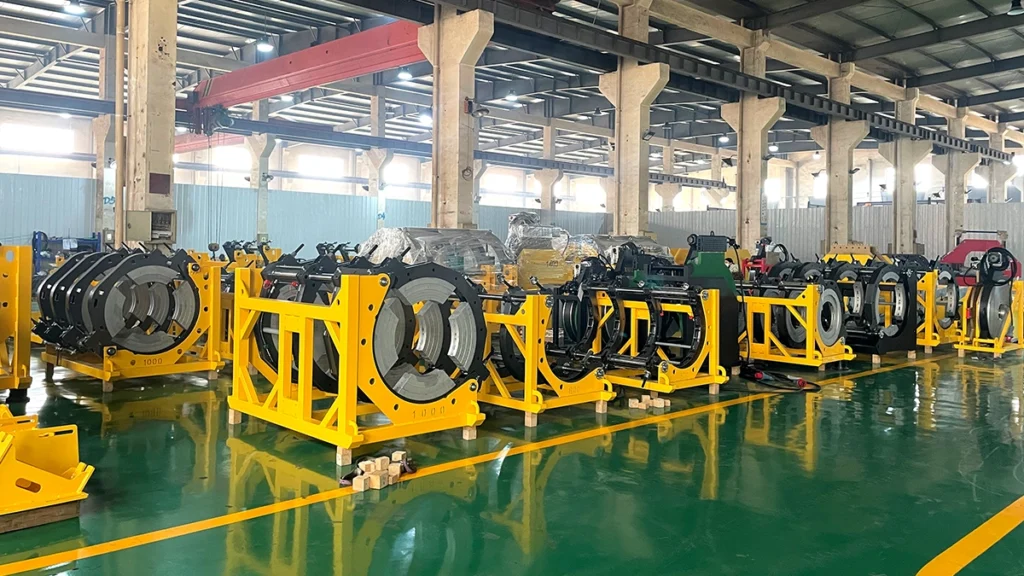
Evaluating a supplier’s physical infrastructure is your first line of defense against specialized trading companies masquerading as genuine factories. A legitimate manufacturing facility needs dedicated CNC machining centers, casting workshops, and specialized sheet metal fabrication lines. Why? Because these internal capabilities guarantee that heavy-duty frames and clamping mechanisms hold strict dimensional tolerances. Structural rigidity is non-negotiable when aligning large-diameter pipes, where even minor flexing causes fusion failure.
Furthermore, dedicated assembly lines and in-house testing labs are absolute must-haves to maintain consistent quality across high-volume orders. When you audit a facility, look for the hallmarks of Original Equipment Manufacturer (OEM) professionalism. You want to see detailed cylinder cross-section labels and proprietary hydraulic block designs. A factory handling its own machining and casting can quickly iterate on design flaws and guarantee the HDPE pipe welding machine chassis will hold up under maximum hydraulic load.
Verify international certifications and standard compliance
Buying equipment without rigorous international certification opens pipeline contractors up to massive liability. This is especially true for municipal gas and water distribution projects. At a bare minimum, you need ISO 9001 certification and CE marking to validate the manufacturer’s quality management systems and electrical safety baseline. Yet, industry-specific welding standards are what truly dictate a butt fusion machine’s field performance.
Your gear must comply with ISO 21307. This standard defines the three primary butt welding systems for polyethylene (PE) pipes: the dual low-pressure system (for wall thicknesses over 20 mm), the single high-pressure system (5 to 70 mm walls), and the single low-pressure system. Beyond that, adhering to the strict German DVS 2207-1 standard is essential for chemical, mining, and industrial systems demanding high-precision welds. Butt fusion welding machines engineered to these exact specifications ensure the heating, soaking, and cooling phases happen with mathematical precision. The end goal is simple: a fused joint just as strong as the original pipe.
Evaluate OEM/ODM capabilities for custom solutions
Off-the-shelf equipment rarely cuts it for complex, specialized infrastructure projects. That makes a custom butt fusion welding machine factory incredibly valuable. Contractors often need customized independent separate set clamping structures. These unique builds improve concentric alignment accuracy and minimize the hydraulic pressure loss you typically see with traditional stacked designs.
Customization also covers electrical configurations and highly specific pipe dimensions. Think about large-diameter transmission projects. They frequently demand localized voltage modifications—like beefing up a standard 220V 50Hz system to a robust 380V 50Hz/60Hz power supply just to handle the massive 24.5 kW draw of a 1000mm hydraulic butt fusion machine. An agile manufacturer will engineer these localized electrical needs, HDPE fusion welding machine custom reducing inserts for non-standard wall thicknesses, and even tweak the machine footprint so it actually fits inside confined trench environments.
2. Technical Capabilities: What the Best Butt Fusion Welding Machine Manufacturer Provides
Investigate hydraulic unit reliability and pressure stability
The hydraulic control unit acts as the beating heart of any fusion operation. Standard hydraulic systems need to punch out a working pressure range from 0 to 6.3 MPa. This provides the massive brute force required to forge large-diameter pipes together, while still offering the delicate, low starting pressures needed for smaller fittings.
Pressure stability is the ultimate test of hydraulic quality. During the critical cooling phase of high-density polyethylene (HDPE) welding, the system must hold a dead-steady pressure of 0.15 MPa without a single drop or leak. Top-tier manufacturers achieve this rock-solid stability using imported hydraulic seals and precision-machined valves. Field engineers can easily verify this by running three consecutive drag pressure measurements. A reliable system spits out identical results every single time, proving the hydraulic circuit is completely free of internal bypass leaks.
Analyze heating plate technology and PTFE coating quality
Temperature control directly dictates the molecular bond strength of a thermoplastic joint. The absolute best butt fusion welding machine manufacturer will supply heating plates featuring a robust 0–300°C control range, easily handling PE, HDPE, PP, PB, and PVDF materials. High-precision models ditch traditional AC contactors in favor of PT100 modular sensor designs. This swap delivers an incredible temperature uniformity of ≤ ±5°C across the entire surface of the plate.
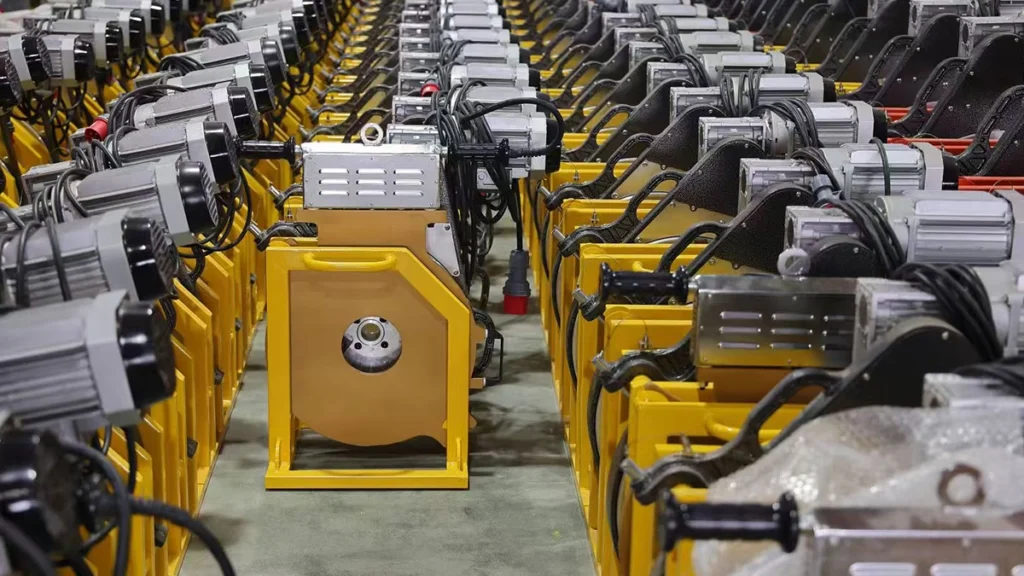
The physical coating on the heating element matters just as much. Industrial-grade Polytetrafluoroethylene (PTFE) must be applied flawlessly. If it isn’t, molten plastic will stick to the plate, causing micro-contaminations right in the weld zone. A degraded PTFE coating creates uneven heat distribution and localized cold spots, severely weakening the pipeline’s integrity. Manufacturers that leverage advanced thermal imaging during quality control can guarantee their plates deliver uniform thermal saturation straight to the pipe ends.
Review CNC and automatic data logging integration capabilities
Today’s gas distribution and municipal water projects demand absolute traceability for every single fused joint. Manual parameter recording just doesn’t cut it anymore. Advanced CNC automatic butt fusion machines must pack integrated data loggers capable of storing at least 1000 weld records, fully complete with GPS coordinates for precise joint mapping.
These automated systems actively detect ambient temperatures ranging from -5°C to 50°C and automatically adjust the heat absorption time. This completely removes human error from the equation. Also, electronic enclosures need IP54 protection levels to survive the harsh, muddy reality of trench environments. Features like automatic hot plate lift-off and color video cameras featuring software crosshairs for optical alignment represent the gold standard of CNC integration. They guarantee flawless repeatability across miles of pipeline.
3. Comparing Equipment Lines: Evaluate Butt Fusion Welding Equipment Suppliers
Compare manual, semi-automatic, and fully automatic CNC machines
When you evaluate butt fusion welding equipment suppliers, grasping the automation hierarchy helps align your procurement strategy with your project budget. Manual butt fusion machines are highly cost-effective. However, they rely entirely on the operator’s skill and stamina to calculate soak times and physically actuate pressure valves.
Semi-automatic models bridge that gap. They integrate electromagnetic valve-controlled electric operation for cylinder advancement and retraction, drastically reducing operator fatigue. At the top of the food chain, fully automatic CNC butt fusion welding machines boast 10-inch color touchscreen panels, automated heating plate extraction, and closed-loop hydraulic control.
| Feature | Manual | Semi-Automatic | Fully Automatic CNC |
|---|---|---|---|
| Pressure Control | Manual Valve | hydraulic | Closed-loop Automated |
| Data Logging | External Add-on | Optional Integration | Built-in (GPS + 1000 records) |
| Plate Extraction | Manual | Manual / Assisted | Fully Automatic Lift-off |
| Best For | Low-budget, rural water | Mid-scale municipal | Gas distribution, strict compliance |
Match machine sizes to specific industry applications
Picking the right butt fusion welding machine chassis size dictates how efficiently your entire pipeline crew operates. Distribution network HDPE fusion welding machines usually cover ranges like DN63-160mm, DN90-250mm, and DN160-315mm. These units are compact and highly maneuverable, making them perfect for urban environments and commercial plumbing jobs. Keep in mind: butt fusion is strictly prohibited for pipe components with an outside diameter (dn) ≤ 63mm or a wall thickness (e) < 6mm. In those cases, electrofusion is mandatory.
On the flip side, heavy-duty transmission pipeline equipment tackles massive diameters spanning DN450-800mm, DN630-1000mm, and even up to 1200mm+. These monolithic plastic pipe welding machines demand specialized heavy-duty 4-clamp sleeve structures to prevent pipe ovality. Running these giants requires site cranes or integrated hoists just to extract the heating plate and facer. You’ll also need massive 26.2 kW power supplies to handle the intense hydraulic and heating loads.
Assess material compatibility and insert availability
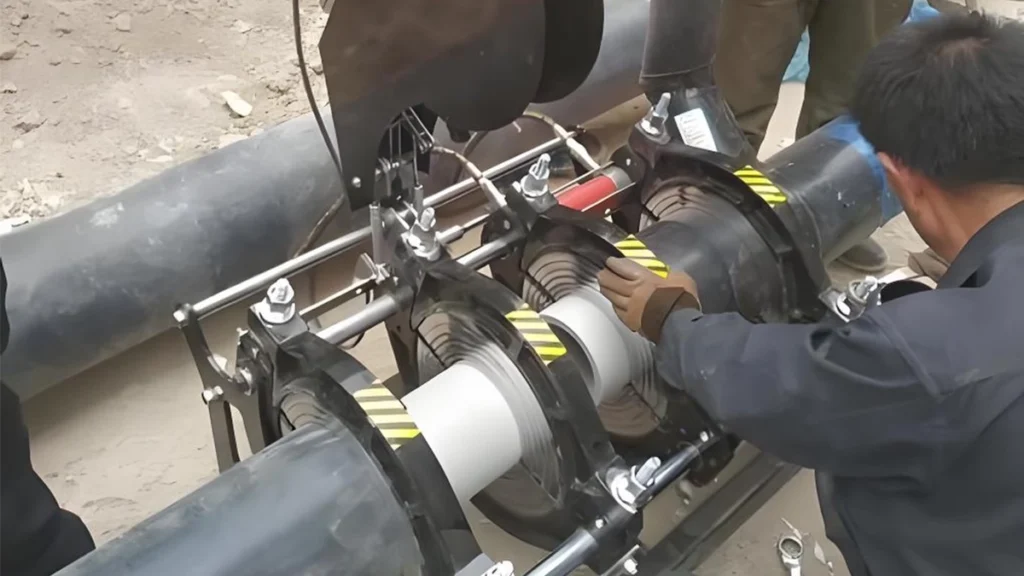
A single pipeline project frequently requires transitioning between different pipe schedules and materials. Because of this, your equipment must seamlessly handle PE, HDPE, PP, PB, and PVDF polymers. To manage fluctuating pipe wall thicknesses, suppliers need to provide comprehensive sets of reducing inserts. These inserts let a 315mm hydraulic butt fusion machine securely clamp a DN200 pipe without losing concentricity.
Contractors also need to verify the butt fusion welding machine’s Standard Dimension Ratio (SDR) compatibility ranges. When welding pipe components from different SDR series, the milling unit must perform precise facing. You need to control the chip thickness strictly between 0.5–1.0 mm to guarantee the oxidized layer is completely removed. Finally, the clamping system must ensure that any misalignment between the two pipe sections never exceeds 10% of the pipe wall thickness. This is the only way to guarantee a structurally sound fusion zone.
4. Supply Chain & Support: Reliable Butt Fusion Machine Manufacturers USA & Globally
Analyze spare parts availability and inventory management
Equipment downtime on a pipeline spread burns through thousands of dollars per hour in idle labor and missed milestones. Because of this, local stocking of critical wear parts is a major metric for evaluating suppliers. The most frequently swapped components include imported hydraulic seals, PTFE-coated heating plates, and high-torque facer blades.
A dependable manufacturer keeps strategic inventory reserves so replacement parts can ship overnight. When buying equipment, procurement managers should always ask for a recommended spare parts list. Make sure the supplier uses standardized, easily sourced electrical components—like standard PT100 sensors and common electromagnetic valves—rather than proprietary parts that take weeks to track down.
Evaluate global logistics and local distributor networks
A supplier’s logistics strategy heavily impacts your initial capital deployment and project scheduling. Reliable butt fusion machine manufacturers USA and globally operate using a blend of factory-direct shipping and localized distributor networks. Factory-direct orders usually require a 30% T/T deposit and come with a 6-8 week lead time.
While buying direct bypasses local inventory shortages and distributor markups, localized USA distribution channels offer immediate availability and localized currency transactions. Buyers need to weigh the lower Total Cost of Ownership (TCO) of factory-direct procurement against the rapid deployment speeds of a localized supply chain. The right choice ultimately depends on the urgency of your pipeline contracts.
Review technical training programs and onsite commissioning
Even the most advanced CNC butt fusion welding machine becomes a massive paperweight in the hands of an untrained operator. Industry data shows that 75% of construction teams need comprehensive operation manuals, video tutorials, and active support to successfully transition to automated systems. Manufacturer-provided operator certification and maintenance training are vital for field safety and joint compliance.
Top-tier suppliers deliver robust after-sales support. This includes 24/7 remote video solutions to troubleshoot hydraulic faults or software bugs in real-time. For massive heavy-duty transmission projects, manufacturers will often send factory engineers out for onsite commissioning. They ensure the 26.2 kW power supplies and heavy-duty cranes integrate safely and smoothly into the contractor’s daily workflow.
5. Factory Capability, Quality Control & Service (The Ekberg Advantage)
Detail rigorous in-house Quality Control (QC) processes
Quality control separates premium industrial equipment from disposable tools. Ekberg Welding enforces a brutal factory QC checklist that starts before a single piece of steel is even cut. Raw material metallurgical testing ensures the chassis can handle maximum clamping forces without bending or warping.
During assembly, every single hydraulic unit goes through a punishing 72-hour hydraulic pressure holding test. This validates seal integrity and ensures zero drag pressure loss. Furthermore, heating plates face advanced thermal imaging analysis to lock in that critical ±3°C temperature uniformity. This meticulous testing is exactly why confident manufacturers can offer a 3-year warranty for non-human-induced damage, alongside a standard 1-year comprehensive warranty with lifetime maintenance support.
Explain the advantage of factory-direct engineering support
When complex field challenges pop up—like welding unique SDR profiles in sub-zero mining environments—contractors need fast answers, not an automated customer service ticket. Factory-direct engineering support offers a massive operational advantage. Talking directly to the engineers who designed the hdpe pipe welding machine resolves complex challenges exponentially faster than playing telephone through third-party distributors.
Brands like McElroy, Ritmo, and Georg Fischer certainly dominate the premium tier. However, factory-direct manufacturers like Ekberg Welding deliver equivalent CNC 4.0 hydraulic controllers and top-tier imported hydraulic seals. This direct-to-engineer pipeline ensures large-scale utility and mining contractors get bespoke technical advice, custom clamping solutions, and rapid software updates specifically tailored to their project parameters.
Calculate ROI and Total Cost of Ownership
Buying high-quality fusion equipment isn’t just an expense; it’s a capital investment that pays off through higher productivity and drastically reduced liability. Upgrading from manual rigs to fully automatic CNC butt fusion machines typically triggers a 10-15% drop in project cycle times within the first 12 months.
Over a standard 3-5 year lifespan, contractors routinely see a 20-25% boost in operational efficiency. This ROI comes from slashed labor costs, the death of manual logging, minimized rework, and significantly lower joint failure rates in brutal environments.
Buyer Decision Checklist:
- Verify Factory Infrastructure: Does the facility actually have dedicated casting and machining workshops? (Look for OEM cylinder labels).
- Check Component Origins: Are the hydraulic seals and electrical relays top-tier or cheap knockoffs?
- Data Logging Capabilities: Is GPS fully integrated, and can you export records directly to enterprise systems?
- Pressure Stability: Can the hydraulic unit hold a dead-steady 0.15 MPa across three consecutive tests?
- Warranty Terms: Does the supplier back their gear with at least a 1-year standard warranty and lifetime maintenance?
Frequently Asked Questions
Q1: How do I verify if a butt fusion welding machine manufacturer is a true factory or just a trading company?
Check out their physical infrastructure via video tours or in-person audits. A genuine factory operates dedicated CNC machining centers, casting lines, and sheet metal workshops. Look closely for proprietary cylinder cross-section labels and internal testing labs. Trading companies generally lack in-house metallurgical testing, 72-hour hydraulic pressure holding setups, and direct engineering design teams.
Q2: What is the typical lead time when ordering from a custom butt fusion welding machine factory?
Factory-direct orders for custom configurations or heavy-duty butt fusion welding machine usually take about 6 to 8 weeks. This window allows for custom CNC machining, localized electrical tweaks (like 380V setups), and intense quality control testing. Payment terms typically require a standard 30% T/T deposit to kick off manufacturing.
Q3: Do reliable butt fusion machine manufacturers in the USA and globally offer data logging as a standard feature?
Absolutely, especially for CNC and semi-automatic models used in heavily regulated sectors. Premium manufacturers integrate IP54-rated data loggers that store a minimum of 1000 weld records. These setups feature GPS receivers for accurate joint mapping and actively compensate for ambient temperatures between -5°C and 50°C to guarantee compliance with strict gas and water standards.
Q4: How should I evaluate butt fusion welding equipment suppliers for large diameter (1000mm+) water transmission projects?
Your supplier needs to prove their expertise in heavy-duty engineering. Make sure their butt fusion welding machines utilize robust 4-clamp sleeve structures to stop pipe ovality dead in its tracks. They should also use high-capacity 24.5 kW power supplies and provide specialized cranes or integrated hoists to safely extract the heating plate and facer. Finally, confirm their hydraulic systems can handle massive clamping forces without any pressure decay.
Q5: What kind of warranty should the best butt fusion welding machine manufacturer provide for heavy-duty equipment?
A top-tier manufacturer will back their equipment with a 3-year warranty covering non-human-induced damage and structural chassis failures. On top of that, they should include a 1-year comprehensive standard warranty for electrical and hydraulic components, rounded out by lifetime maintenance support where post-warranty repairs only cost you the price of raw materials.
Conclusion
Securing the right equipment directly impacts both the financial success and structural safety of your pipeline projects. By carefully vetting a supplier’s CNC machining infrastructure, their strict adherence to ISO 21307 and DVS 2207 standards, and their hydraulic pressure stability (specifically the ability to hold 0.15 MPa with zero leakage), contractors can make a highly profitable investment. Whether you need a nimble DN63 distribution unit or a colossal DN1200+ transmission system, prioritizing automated data logging and factory-direct engineering support leads to long-term operational efficiency and zero-defect welds.
Aligning with a dedicated butt fusion welding machine manufacturer ensures your fleet hits the field armed with precision temperature controls and relentless hydraulic power. Never compromise an infrastructure project by relying on substandard tools. Contact Ekberg Welding today to grab a comprehensive technical spec sheet, book a customized equipment consultation, and lock in factory-direct pricing built around your specific pipeline requirements.