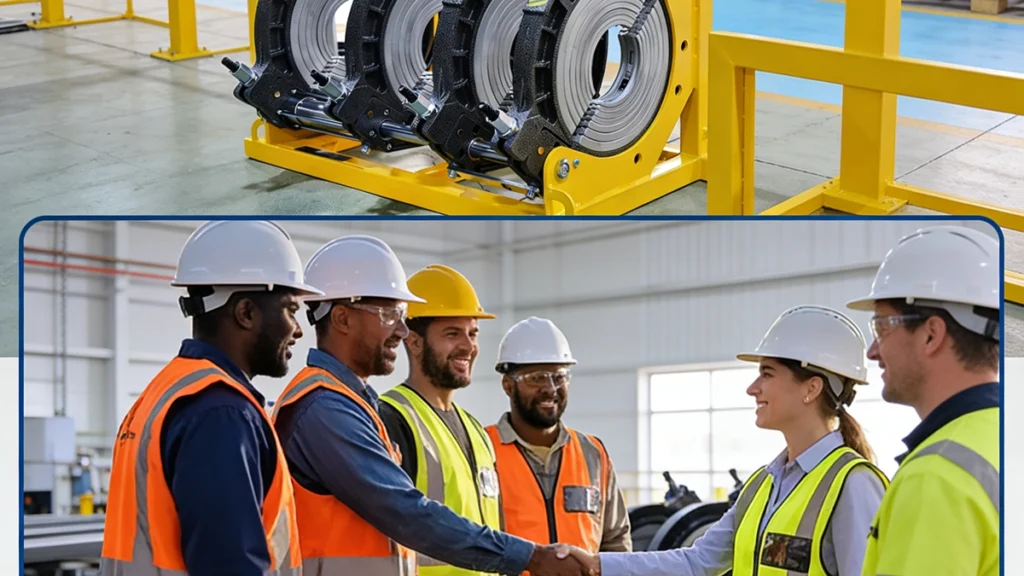
Top-Rated Industrial Butt Fusion Machine: Technical
Table of Contents
Introduction
In the unforgiving world of industrial piping—whether you are moving potable water, volatile natural gas, or abrasive mining slurries—a single joint failure is never just an inconvenience. It is a liability. A leaking flange or a brittle weld can trigger catastrophic environmental damage, bring production to a grinding halt, and create safety hazards that put personnel at risk. At the center of joint integrity sits the butt fusion machine, the critical piece of hardware responsible for turning thermoplastic pipe sections into a monolithic, leak-free system.
For procurement officers and project engineers, however, the market presents a confusing array of options. Choices range from low-cost, generic units to high-precision, automated systems. The technical complexity is immense, involving variables such as interfacial pressure, heater plate thermodynamics, and drag force calculations.
Industrial fusion welding for thermoplastics like High-Density Polyethylene (HDPE), Polypropylene (PP), and Polyvinylidene Fluoride (PVDF) is now the dominant joining method for modern infrastructure, prized for its corrosion resistance and longevity. Yet, these benefits are only realized if the equipment is capable of rigorous consistency. This article outlines a technical, standards-based framework for selecting top-rated fusion welding equipment, moving past surface-level specifications to the engineering principles that drive long-term reliability and Return on Investment (ROI).

The High Cost of Compromise: Why Your Butt Fusion Machine Choice Matters
Quantifying the Cost of Failure in Network Operations
The financial bill for poor weld quality is staggering. Industry data suggests that a significant percentage of Non-Revenue Water (NRW) loss in municipal utility networks stems from joint failure rather than pipe wall degradation. In gas distribution, the tolerance for error is effectively zero. Insurance claim data from major infrastructure projects indicates that repairing a failed buried joint can cost 20 to 50 times more than the initial installation once you factor in excavation, dewatering, and service interruption penalties. When a butt fusion machine lacks the precision to maintain parameters, it introduces a systemic weakness into the network. For a mining operation, a blown tailings line caused by a weak weld can halt production for days, costing hundreds of thousands of dollars per hour in lost revenue. These are not theoretical risks; they are the direct consequences of prioritizing initial sticker price over performance capability.
Anatomy of a Defect: The Impact of Inferior Control
Inferior machinery often fails to maintain the delicate balance between temperature, pressure, and time. This leads to specific, detectable defects that compromise the pipe’s pressure rating. A common issue is the “cold weld,” which occurs when the heating plate temperature fluctuates below the material’s melt flow index requirements (e.g., dropping below 205°C for HDPE). This results in a bond that lacks molecular entanglement, failing brittlely under pressure. Conversely, excessive fusion pressure caused by sloppy hydraulic control can push the molten material out of the joint completely, leaving a “dry” interface known as a cold kiss. Furthermore, bead asymmetry—caused by misalignment in the HDPE pipe welding machine chassis—creates stress concentrators. Over time, these minor defects propagate cracks under fatigue loading or pressure surges, slashing the system’s design life from the expected 50-100 years to a mere fraction of that time.
Total Project Cost: Risk Mitigation vs. CAPEX
When evaluating capital expenditure (CAPEX), buyers often view the butt fusion welding machine as a static line item. However, a true economic analysis must include the Total Cost of Ownership (TCO) and risk mitigation. An incrementally higher investment in a top-rated butt fusion machine—one with automated data logging and rigid chassis construction—acts as an insurance policy. If a high-performance butt fusion machine costs $10,000 more than a budget alternative but prevents a single joint failure on a 10-kilometer pipeline, the ROI is immediate. The cost of rework, including cutting out the bad joint, facing the pipe ends again (losing pipe length), and re-welding, consumes labor and machine hours. Therefore, selecting a top-rated pipe butt welder isn’t about buying “premium” features; it’s about securing the project’s profitability by eliminating the variables that lead to expensive rework.
Decoding Performance: The 5 Technical Pillars of a Top-Rated Butt Fusion Machine
Heating Plate Thermodynamics and Accuracy
The heating plate is the catalyst for the fusion process. For a butt fusion welding machine to be considered top-rated, it must offer temperature control accuracy within ±1°C across the entire surface of the plate. This is critical because thermoplastics have specific processing windows; for instance, HDPE typically requires a surface temperature of 210°C ±5°C. If the heating element has “cold spots” due to poor coil design or inferior conductivity, the pipe face will not melt uniformly. This leads to uneven bead formation and potential joint weakness. Advanced butt fusion machines use PID (Proportional-Integral-Derivative) controllers and high-grade aluminum alloys with non-stick PTFE coatings to ensure heat transfer is both uniform and consistent, regardless of ambient wind or temperature conditions.
The Physics of Pressure: Drag vs. Fusion
Pressure control is perhaps the most misunderstood aspect of fusion welding. A pipe welding machine must be capable of distinguishing between “drag pressure” (the force required to move the carriage and pipe) and “fusion pressure” (the interfacial pressure required to join the pipes). Standards like ISO 21307 dictate specific interfacial pressures—often around 0.15 N/mm² for HDPE. A top-rated butt fusion machine provides a hydraulic system that allows the operator to precisely calculate and set these values. For a DN630 pipe, the force required is exponentially higher than for a DN63 pipe. The hydraulic system must be robust enough to hold this pressure without fluctuation during the cooling phase. If the hydraulics “bleed off” pressure during cooling, vacuums form within the melt, creating voids that destroy joint integrity.
Structural Rigidity and Alignment
The machine’s chassis (frame) must withstand tons of force without flexing. When clamping pipes that may be slightly out-of-round or under tension from the pipeline string, the HDPE pipe jointing machine must force them into perfect alignment. If the frame twists under the load of the hydraulic cylinders, the pipe faces will not meet squarely. This results in a “high-low” misalignment, which is strictly limited by standards (often to <10% of the wall thickness). Top-rated equipment features heavy-duty hardened steel guide shafts and rigid clamping jaws that correct pipe ovality. This mechanical rigidity ensures that the force applied by the hydraulics is transferred 100% into the fusion zone, rather than being lost to frame distortion.
Data Logging and Traceability (ISO 21307)
In modern regulated industries, if the weld data wasn’t recorded, the weld didn’t happen. Compliance with standards like ISO 21307 and ASTM F2620 requires detailed data logging. A top-tier butt fusion machine acts as a “black box,” recording critical parameters every second: heating plate temperature, drag pressure, bead build-up pressure, heat soak time, fusion pressure, and cooling time. This data is encrypted and tied to operator ID and job location. This capability allows project managers to audit quality remotely and provides the asset owner with a digital birth certificate for every joint in the network. It shifts the process from relying on operator “feel” to relying on verifiable engineering data.
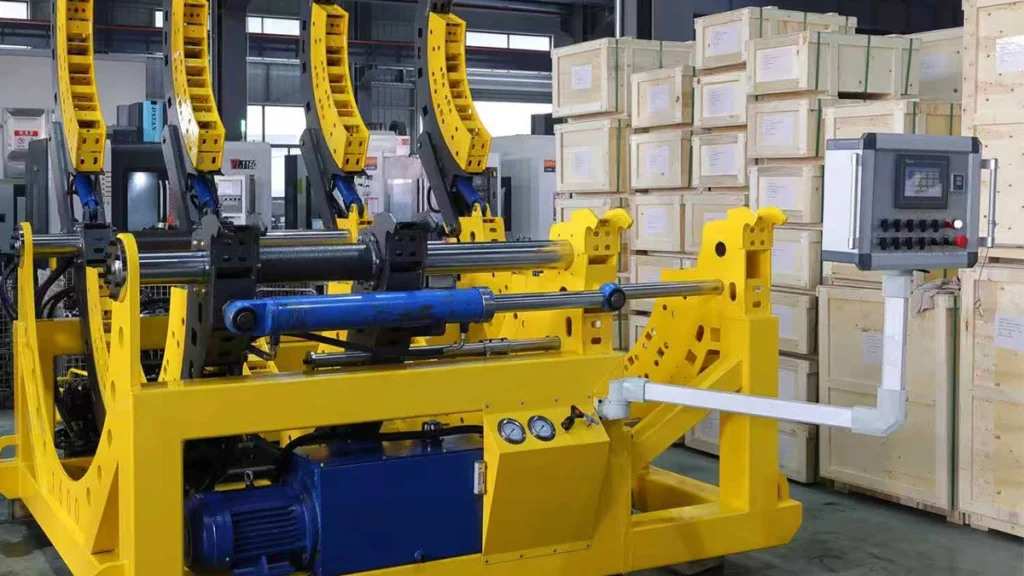
Machine Selection Matrix: Matching Equipment to Your Project Profile
Operator Control: Manual vs. Semi-Auto vs. CNC
Selecting the right level of automation is a balance between operator skill and project strictness.
- Manual Butt Fusion Machine: Rely heavily on the operator to read gauges and time the phases manually. Best suited for skilled crews on smaller, lower-pressure repair jobs.
- Semi-Automatic Hydraulic Butt Fusion Machine: The machine manages the pressure and timing phases after the operator initiates them. Good balance for general contracting.
- Fully Automatic Butt Fusion Machine(CNC): The HDPE pipe welding machine reads the pipe code, calculates parameters, and controls the entire cycle. If the process drifts (e.g., heating plate cools down), the machine aborts the weld. Essential for high-risk gas and water mains where human error must be eliminated.
| Feature | Manual | Semi-Automatic/Hydraulic | Fully Automatic (CNC) |
|---|---|---|---|
| Consistency | Low (Operator Dependent) | Medium | High (Process Controlled) |
| Data Logging | External Device Often Needed | Integrated | Integrated & Encrypted |
| Ideal Pipe Size | DN40mm-DN250mm | DN63mm-DN2600mm | DN63mm- DN630mm |
| Typical App | Irrigation, Drainage | General Water, Industrial | Gas, High-Pressure Water |
| Cost | $ | $$ | $$$ |
Compatibility Checklist: Diameter and SDR
Buyers must match the butt fusion machine not just to the pipe diameter (OD), but to the Standard Dimension Ratio (SDR). A butt fusion machine might fit a DN630 pipe physically, but if that pipe is a thick-walled SDR 7.4 used for high-pressure mining, a standard butt fusion welding machine may lack the hydraulic cylinder force to achieve the required interfacial pressure.
- Jaw Sets: Ensure the butt fusion machine includes reducing inserts (layered clamps) for the full range of pipe sizes you intend to weld (e.g., a DN315mm butt fusion machine should have inserts down to DN90mm).
- High-Pressure Capability: Verify the machine’s max clamping force (in Newtons) against the requirements of your thickest wall pipe.
- Material Compatibility: While most butt fusion machines weld HDPE, welding PP or PVDF often requires specialized heating plates or different pressure protocols.
Power Source and Site Conditions
The operating environment dictates the power requirements. Industrial butt fusion machines typically run on 380V 3-phase power (spanning 50-400A depending on size).
- Remote Sites: For mining or cross-country pipelines, generator compatibility is key. The butt fusion welding machine must have power conditioning to handle voltage spikes from generators without frying the circuit boards.
- Urban/Plant: Electric units are standard.
- Confined Spaces: For in-trench work, consider “track” mounted butt fusion machines that can drive themselves into position, versus “ditch” machines that require a crane.
ROI of Essential Accessories
A top-rated butt fusion equipment is only as good as the pipe preparation. Investing in integrated accessories yields high ROI by speeding up the cycle time.
- Pipe Rollers: Reduce drag pressure significantly, saving wear on the butt fusion machine and ensuring accurate fusion pressure.
- Electric Facers/Planers: Essential for shaving the pipe ends to be perfectly parallel and removing oxidized material.
- Internal Bead Removers: For fluid flow efficiency in sewer or slurry lines, removing the internal bead is sometimes required.
- Data Loggers: If not built-in, an external logger is a mandatory accessory for compliance.
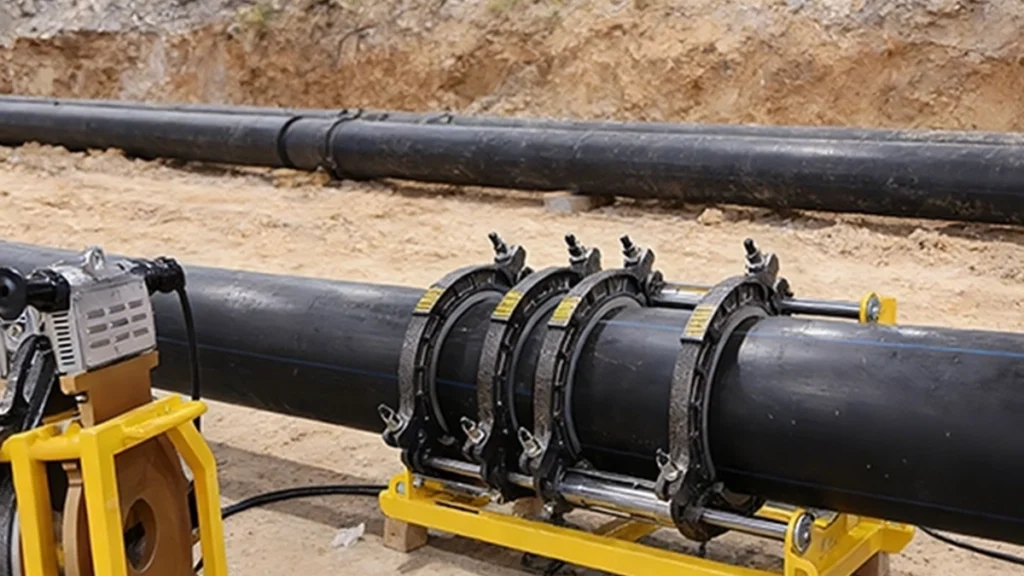
Beyond the Weld: Applications Demanding Certified Performance
Gas Distribution: The EN 12007 Standard
Gas distribution networks operate under the strictest safety regulations, often adhering to EN 12007. Here, a leak is a potential explosion. Consequently, the Welding Procedure Specification (WPS) is non-negotiable. Machines used in this sector must support “Traceability 2.0″—recording not just the weld data, but the batch number of the pipe, the ID of the certified welder, and the GPS coordinates of the joint. Top-rated equipment for gas applications often features lockout mechanisms that prevent the butt fusion machine from starting if the operator’s badge is invalid or if the service calibration date has passed.
Mining: Abrasion and Chemical Resistance
In mining applications, pipes transport aggressive slurries and acids. The welds must be as strong as the pipe itself to resist abrasion. If a weld bead is slightly recessed or protrudes excessively, it creates turbulence that accelerates wear, leading to premature failure. Mining-grade butt fusion welding machines are built with reinforced chassis to handle the rough handling of mine sites and are capable of welding extra-thick SDR pipes used for tailings lines. They must also be resistant to dust and moisture ingress (IP54 or higher rating).
Municipal Water and Agriculture
For water infrastructure and large-scale irrigation, the challenge is volume. Contractors may need to complete dozens of welds per day on DN160mm or DN315mm lines. Here, cycle time and ease of use are paramount. Semi-automatic hydraulic butt fusion machines are often the preferred choice, offering a blend of speed and consistency. The equipment must be durable enough to withstand constant transport and setup/teardown cycles. Reliability here translates directly to the contractor’s profit margin; a machine down for repairs means a crew standing idle.
Semiconductor and Pharma: The Purity of PVDF
In semiconductor manufacturing and pharmaceutical plants, piping systems transport ultra-pure water or aggressive chemicals. Materials like PVDF and PP are common. These applications require “beadless” or “crevice-free” welding technologies (often IR fusion or BCF) to prevent bacterial growth or particulate contamination. While standard butt fusion creates a bead, specialized high-purity fusion machines use balloon bladders or infrared technology to create a perfectly smooth internal profile. These machines operate in cleanroom environments and require validation protocols that far exceed standard industrial requirements.
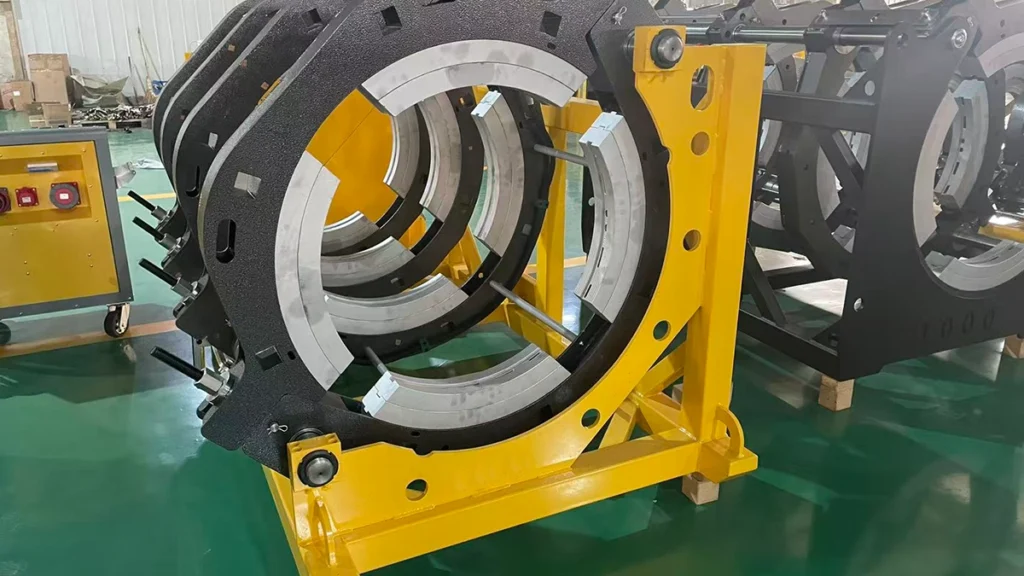
Manufacturing Excellence, Quality Control & Global Support
In-House Manufacturing vs. Assembly
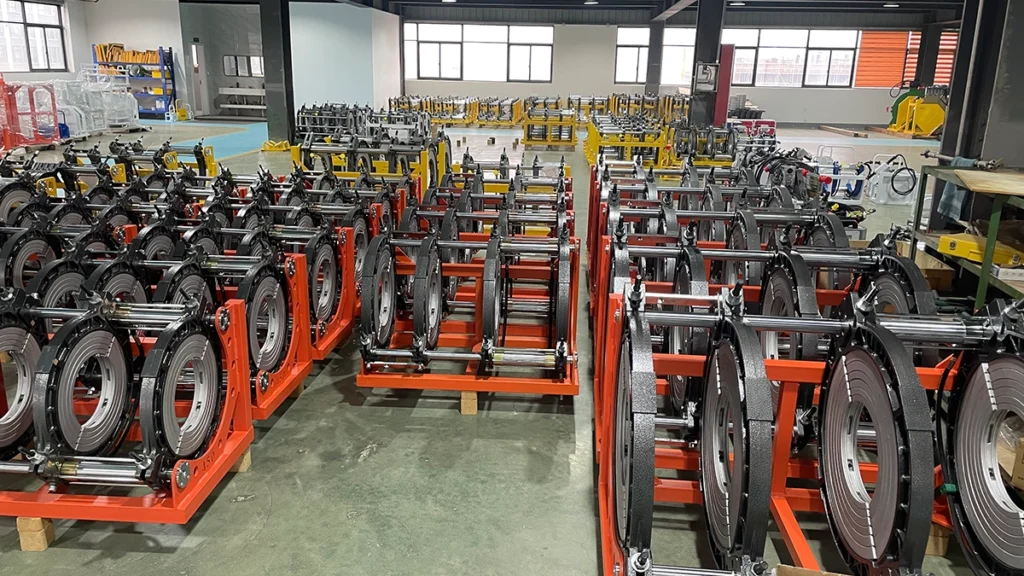
The distinction between a “manufacturer” and an “assembler” is vital. Ekberg Welding prides itself on in-house manufacturing of critical components. We don’t just buy generic hydraulic cylinders; we machine our chassis and heating plates to precise tolerances. This vertical integration ensures that the steel frame has the requisite tensile strength and that the heating elements are embedded correctly for uniform thermal distribution. When a manufacturer controls the production of the core components, they can guarantee the alignment and rigidity that cheap, assembled units cannot.
Standards and Calibration
A top-rated butt fusion machine is born from a factory that adheres to global standards. Look for manufacturers certified to ISO 9001 for quality management. Furthermore, the pipe welding machines themselves should be CE certified and calibrated according to DVS 2207 or ISO 21307 protocols. Calibration is not a one-time event; top-tier manufacturers provide calibration certificates with every new butt fusion machine and offer recalibration services to ensure the sensors (pressure transducers, thermocouples) remain accurate over years of service.
Post-Sales Support Logistics
The best butt fusion machine in the world is useless if you can’t get a spare seal kit in a remote location. Top-rated equipment is backed by a global logistics network. This means availability of certified training programs to ensure your operators know how to use the advanced features. It also means a commitment to spare parts availability—keeping stock of critical wear parts like facer blades, hydraulic couplers, and electronic control units.
Warranty and Performance Guarantees
Finally, examine the warranty. A standard warranty covers defects, but a partnership warranty covers performance. Ekberg offers comprehensive warranty terms that cover not just the main body, but the hydraulic components and electronic systems. We stand behind the weld quality our machines produce, provided they are operated according to trained standards. This assurance gives buyers the confidence that their investment is protected.
Frequently Asked Questions
Q1: What is the main difference between a butt fusion machine and an electrofusion welder, and how do I choose?
Butt fusion joins pipes by heating the ends and pressing them together, making it ideal for long, straight trenches and larger diameters (DN63mm to DN2600mm). It is cost-effective as it requires no fittings. Electrofusion uses special fittings with built-in heating coils. It is better for tight spaces, repairs, or connecting pipes where movement is restricted. Choose butt fusion for new main lines and electrofusion for tie-ins and repairs.
Q2: How often does a butt fusion welding machine need calibration, and what does that process involve?
Most standards (like ISO 21307) and manufacturers recommend calibration every 12 months. The process involves verifying the accuracy of the pressure gauges/transducers, the temperature of the heating plate (at multiple points), and the timer functions against a certified master standard. This ensures the butt fusion welding machine’s readings match the actual physical forces applied to the pipe, which is critical for compliance and safety.
Q3: Can one machine weld different plastic materials like HDPE and PP? What needs to change?
Yes, high-quality butt fusion machines can weld various thermoplastics. However, the welding parameters change significantly. You must adjust the heater plate temperature (e.g., PP usually requires a lower temp than HDPE Pipe) and the interfacial pressure settings. You may also need to change the cleaning agents used. Always consult the pipe manufacturer’s guidelines and the machine’s parameter tables before switching materials.
Q4: What are the most critical daily maintenance steps to ensure consistent weld quality?
Cleanliness is priority one. The heating plate must be cleaned with non-shedding cloth to remove plastic residue (never use metal scrapers on PTFE). The facer blades must be sharp to ensure a clean cut without smearing. Check hydraulic fluid levels and inspect hoses for leaks. Finally, ensure the clamping inserts are clean so they grip the pipe firmly without slipping, which would alter the drag pressure.
Q5: For a contractor working on varied projects, is it better to have one versatile machine or several specialized ones?
While “all-in-one” machines exist, they often compromise on weight or capability. A better strategy is usually to have a dedicated smaller machine (e.g., up to DN315) for agility and a larger, heavy-duty unit (e.g., DN630+) for main lines. However, a pipe butt welder with a wide range of inserts (e.g., a DN315 unit that can clamp down to DN90) offers excellent versatility for mid-range utility contractors.
Conclusion & Next Steps
Selecting the right butt fusion welding machine is a decision that reverberates through the lifespan of your pipeline infrastructure. It is a choice between the peace of mind that comes from certified, data-backed joint integrity and the constant risk of leaks, environmental penalties, and costly rework. As we have explored, a “top-rated” butt fusion welding machine is defined by its ability to deliver precise temperature control, unyielding structural rigidity, and full compliance with international standards like ISO 21307 and DVS 2207.
At Ekberg Welding, we believe that high-performance equipment is the foundation of a safe and profitable project. Our machines are engineered not just to meet specifications, but to withstand the harsh realities of the job site while delivering laboratory-grade precision.
Don’t leave your pipeline integrity to chance.
Take the next step in securing your project’s success. [Click here to download our comprehensive Technical Selection Guide] or [Schedule a complimentary 1-on-1 consultation] with an Ekberg specialist today. We will review your specific project requirements—pipe materials, diameters, and terrain—to configure the optimal solution and provide factory-direct pricing.