
Automated HDPE Pipe Jointing Machine: Tech-Specs for Global Utilities & Mining
Table of Contents
Selecting the right hdpe pipe jointing machine is arguably the single most critical decision in pipeline construction. With the average cost of a compromised joint hitting $15,000 for mining and utility operators, the stakes are incredibly high. While High-Density Polyethylene Pipe (HDPE Pipe) is celebrated for its durability and corrosion resistance, the network is only as strong as its weakest fuse.
Historically, the industry relied on manual hydraulic units. These manual butt fusion machines depended heavily on the operator’s “feel,” often resulting in inconsistent inputs and weak bonds. Today, the landscape has changed. Automated solutions now guarantee strict compliance with ISO 21307 and ASTM F2620 standards, removing the guesswork. This guide explores the shift in welding technology, details the specifications of Ekberg’s Series, contrasts mining versus municipal applications, and provides a hard-nosed ROI analysis for contractors. By the end, you will have the technical framework needed to specify equipment that ensures zero-leak performance.

The Evolution of HDPE Joining: From Manual to CNC Automation
Moving from manual butt fusion to Computer Numerical Control (CNC) automation isn’t just an upgrade; it is a paradigm shift for infrastructure. For decades, success depended on a craftsman’s ability to read hydraulic gauges and manually time cooling cycles. However, as pipeline diameters expanded and pressure requirements tightened, the margin for human error evaporated.
Research the shift from manual hydraulic units to CNC systems
Field data paints a stark picture: operator error accounts for over 80% of joint failures. The culprits are usually incorrect interfacial pressure, rushing the heat soak time to speed up production, or jostling the pipe during the delicate cooling phase. Manual hydraulic units leave the operator to calculate drag pressure and physically add it to the theoretical welding pressure—a recipe for inconsistency.
CNC systems remove these variables entirely. An automated hdpe pipe jointing machine features an onboard computer pre-loaded with global welding standards (ISO, DVS, ASTM). The operator simply scans the pipe’s barcode or inputs the SDR and diameter. From there, the HDPE pipe welding machine calculates exact pressure and timing. Crucially, the system locks the hydraulic pressure during cooling, physically preventing the operator from opening the clamps too soon. This transforms welding from a variable craft into a repeatable, science-based manufacturing process right in the trench.
Define the three critical welding phases controlled by automation
To create a joint that matches the strength of the virgin pipe, three phases must be executed with millisecond precision. Automation handles this seamlessly:
1. Bead-up (Alignment): The hydraulic butt fusion machine drives the pipe ends against the heater plate under high pressure until a specific bead height forms (typically $1 + 0.15 \times \text{wall thickness}$ in mm). Sensors detect exactly when the bead is achieved and automatically drop the pressure to the soak level.
2. Heat Soak: This is the molecular relaxation phase. Pressure must drop to near zero (drag pressure only) to let heat penetrate the pipe wall without squeezing molten plastic out of the joint. CNC units hold this low-pressure state for the exact duration dictated by the standard ($11 \times \text{wall thickness}$ seconds).
3. Cooling under Pressure: This is the make-or-break moment. The molten ends are brought together, and pressure ramps up linearly. The machine maintains this force while the polymer recrystallizes. A pressure drop here creates voids; releasing clamps too early causes brittleness.
Cite standards: ISO 21307 (High Pressure) and DVS 2207/1 (Low Pressure)
Modern equipment must be agile enough to toggle between conflicting global standards.
- DVS 2207-1 (German Standard): The traditional “Low Pressure” standard common in Europe. It calls for an interfacial pressure of $0.15 \text{ N/mm}^2$. It’s gentle, but the process is slow.
- ISO 21307 (High Pressure): The standard of choice for mining and North American projects. It utilizes an interfacial pressure of $0.52 \text{ N/mm}^2$. The higher force allows for significantly shorter cooling times, boosting productivity by up to 30%.
Ekberg CNC automatic butt fusion machines allow engineers to select the desired standard directly from the interface. The hydraulic system is engineered to deliver the high forces needed for ISO 21307 SHP (Single High Pressure) without stressing the chassis—a feat manual machines often struggle to achieve.
Compare data logging capabilities
In the manual era, quality assurance was often just a handwritten log, susceptible to loss or fabrication. An automated hdpe pipe jointing machine creates a tamper-proof digital fingerprint for every single weld.
- Manual Recording: Prone to “pencil whipping,” where operators guess parameters after the fact to fill out paperwork.
- Automated Reporting: The CNC unit records time, temperature, and pressure curves every second. If a parameter drifts—say, a pressure drop during cooling—the HDPE pipe jointing machine immediately flags the weld as “FAILED.” These reports export as encrypted PDFs, satisfying the strict traceability requirements of Tier 1 utility contracts.
Core Technical Specifications of Ekberg Automated HDPE Pipe Jointing Machines
When specifying industrial equipment, vague terms like “heavy duty” don’t cut it. Buyers need to scrutinize the quantitative capabilities of the hydraulic, thermal, and mechanical systems.
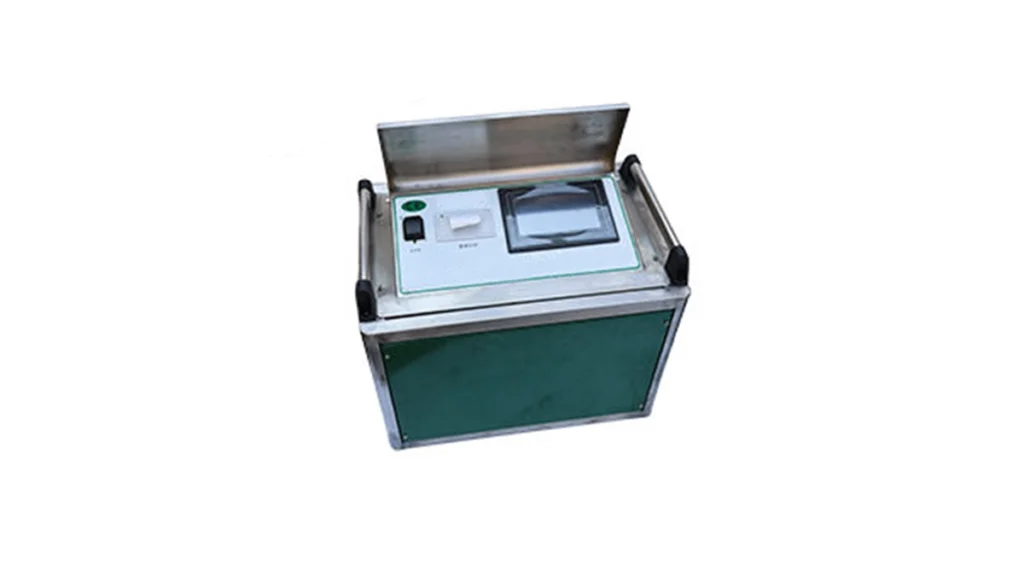
Analyze the Hydraulic HDPE Pipe Jointing Machine Control Unit
The brain of the Ekberg H-Series is its closed-loop hydraulic control unit. Unlike open-loop manual systems, the CNC unit employs pressure transducers to monitor applied force continuously.
- Pressure Stability: The system holds clamp pressure with $\pm 1$ bar accuracy. If the pipe shrinks while cooling, causing a pressure drop, the accumulator kicks in to restore force without the operator lifting a finger.
- Drag Pressure Compensation: Before every weld, the Hydraulic HDPE pipe jointing machine runs a “drag test” to measure the force needed to move the carriage. The computer adds this real-world value to the theoretical welding pressure, ensuring the force at the pipe interface is accurate.
- Max Pressure: The 630mm model delivers up to 60 bar of hydraulic system pressure, providing ample power to achieve the 0.52 MPa interface pressure required for thick-walled SDR 7 pipes.
Detail the Heating Plate technology
Thermal consistency is non-negotiable. A variance of more than $10^\circ\text{C}$ across the plate can result in “cold welds” (no fusion) or material degradation (burning).
- Coating: Ekberg’s heating plates use a triple-layer PTFE (Polytetrafluoroethylene) coating. This prevents molten PE from sticking during removal, which is vital for a clean “changeover.”
- Uniformity: High-grade aluminum alloy casting ensures even heat distribution. Our specifications guarantee a surface temperature uniformity within ±5°C across the entire surface.
- Control: A digital PID controller maintains the set temperature (typically 200°C–230°C for HDPE) with ±2°C accuracy, significantly outperforming traditional analog bimetallic thermostats.
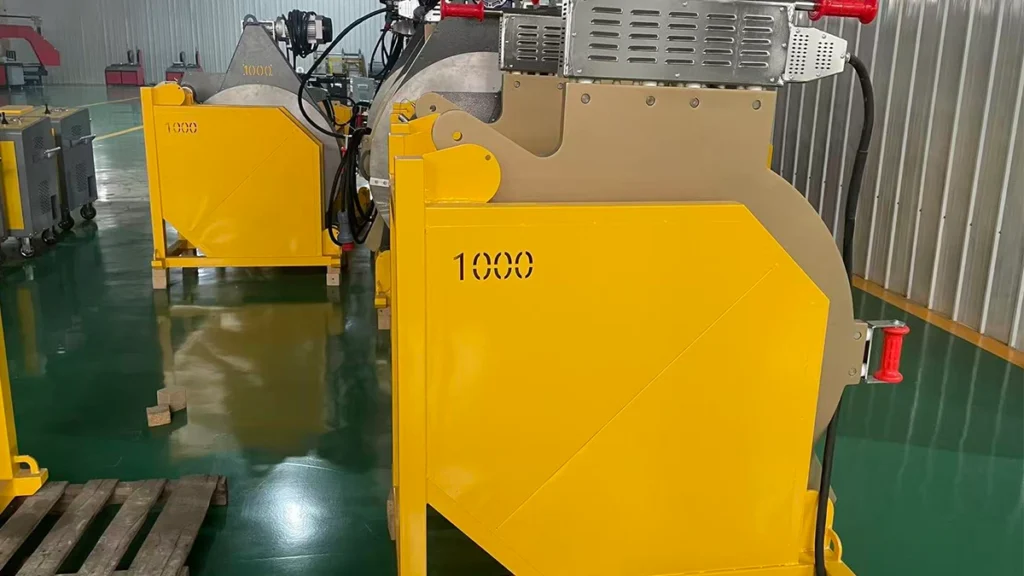
List Chassis and Planing Tool specs
The machine body (chassis) must resist immense forces without flexing. If the chassis twists, the pipes misalign (High-Low mismatch), creating stress points in the pipeline.
- Rigidity: Ekberg H-Series 160-630mm units utilize high-pressure die-cast aluminum for an optimal strength-to-weight ratio. For the 800mm-1200mm giants, we use a reinforced steel-aluminum hybrid design to handle the massive drag forces of heavy-wall mining pipes.
- Planing Tool (Facer): The facer includes safety micro-switches preventing motor engagement unless properly seated. It features reversible carbide blades for clean, parallel pipe ends—essential for eliminating air gaps before heating.
Specify power requirements
Site engineers must size generators correctly. An undersized generator leads to voltage drops that can reset the CNC computer or fail the heater.
- Voltage: Machines come in 220V (single phase up to 315mm) and 380V/415V (3-phase for 355mm+).
- Generator Sizing:
- 160mm – 315mm: Requires ~5-8 kVA.
- 355mm – 630mm: Requires ~15-20 kVA (Heater draws ~8-12 kW).
- 800mm – 1200mm: Requires ~30-40 kVA (Heater draws ~24-30 kW).
- *Note:* Always buffer generator capacity by 20% to handle startup surges from the hydraulic motor and facer.
Application-Specific Requirements: Global Utilities vs. Mining Sectors
A “one-size-fits-all” mentality fails in butt fusion. The operational reality of a remote Chilean copper mine is worlds apart from a municipal water upgrade in downtown Berlin.
Research Mining constraints
Mining operations typically utilize HDPE for tailings, slurry transport, and process water.
- Pipe Specs: Sites use thick-walled pipes (SDR 7, SDR 9, SDR 11) to fight abrasion. The hdpe pipe jointing machine requires high-pressure hydraulic cylinders to fuse these thick walls effectively.
- Terrain: Equipment is dragged through mud, rock, and steep grades. The chassis needs a hardened steel frame or skid to survive.
- Environment: Dust destroys electronics. Mining-spec Ekberg butt fusion machines feature IP55 or IP65 control boxes and military-grade connectors to resist slurry ingress.
Research Utility & Water constraints
For potable water and sewage, the priorities are hygiene and data.
- Traceability: Utility operators often mandate ISO 12176-4 compliance. The HDPE pipe welding machine must scan the pipe barcode and the operator’s badge, linking weld data to a specific GPS location. This lets future crews scan a joint and instantly see when and how it was welded.
- Hygiene: Contamination is a major risk. Automated heater plate ejection systems are preferred because they remove the plate without the operator touching the melt zone, keeping dirt and oil out of the water stream.
- Compactness: Urban trenches are tight. HDPE pipe jointing machine designs must allow for the removal of the outer fixed jaw (converting a 4-jaw machine to a 3-jaw) to weld fittings in confined spaces.
Discuss Gas Distribution needs
Polyethylene is the standard for low-pressure natural gas distribution.
- Safety: While electrofusion handles house connections, butt fusion builds the mains. In live gas environments, equipment must meet ATEX (Explosive Atmosphere) directives.
- Zero-Leak Mandate: A gas leak is catastrophic. Consequently, gas utilities are the strictest adopters of fully automated CNC butt fusion machines. They require “lock-out” protocols: the machine refuses to weld if the heater temp is off by even 1 degree or alignment mismatch exceeds 10% of the wall thickness.
Evaluate environmental factors
Global projects expose equipment to extremes.
- Temperature: Standard electronics fail below $0^\circ\text{C}$ (LCD screens freeze) or above $40^\circ\text{C}$ (overheating). Ekberg units are rated for $-10^\circ\text{C}$ to $+50^\circ\text{C}$, utilizing active cooling fans for electronics and hydraulic oil coolers for tropical climates.
- Altitude: High-altitude mining (e.g., >3000m) impacts generator efficiency and heater plate physics. HDPE pipe jointing machines destined for these heights require recalibrated heating algorithms.
Hydraulic vs. Fully Automated CNC: A Cost-Benefit Analysis for Contractors
Contractors often hesitate at the price tag of a CNC hdpe pipe jointing machine, which can run 30-50% higher than a manual hydraulic equivalent. However, when viewed over a 3-year project lifecycle, the CNC unit offers a superior Return on Investment (ROI).
Calculate ROI
Consider a 5km pipeline project using 630mm SDR 11 pipe.
- Cycle Time: An automated butt fusion machine using ISO 21307 High Pressure parameters completes a weld cycle 30% faster than a manual butt fusion machine using standard low pressure. Over thousands of joints, this saves weeks of crew time and rental costs.
- Labor: Automation frees the operator to perform other tasks—like prepping the next pipe or updating logs—during the cooling cycle, optimizing crew utilization.
Analyze Quality Assurance savings
The hidden cost of manual welding is testing.
- Destructive Testing: On critical lines with manual machines, engineers may require destructive testing (cutting out a joint) every 50 welds to verify integrity. Each test costs thousands in downtime and materials.
- Verified Parameters: With CNC data logging, every joint is “virtually tested.” Consistent, verified parameters allow you to reduce physical destructive testing to a random sampling (e.g., 1 in 500), saving tens of thousands of dollars per project.
Discuss skill gap reduction
The welding industry is facing a skilled labor shortage. A manual butt fusion welding machine demands a craftsman who understands plastic rheology. A CNC butt fusion welding machine requires a trained technician. The HDPE pipe jointing machine guides the user with on-screen prompts: *”Insert Pipe,” “Close Clamps,” “Insert Heater.”* This slashes training time from weeks to days, mitigating labor risks.
Research project tender requirements
Looking ahead, buying manual equipment is a strategic risk. Tier 1 utility and mining tenders increasingly mandate “Automated data logging according to ISO 12176.” Contractors with only manual fleets are being disqualified from bidding on premium infrastructure projects. Investing in automation is investing in market access.
Manufacturing Excellence, Quality Control & Service
The reliability of an hdpe pipe jointing machine is engineered on the factory floor. Ekberg Welding employs rigorous manufacturing standards to ensure field readiness.
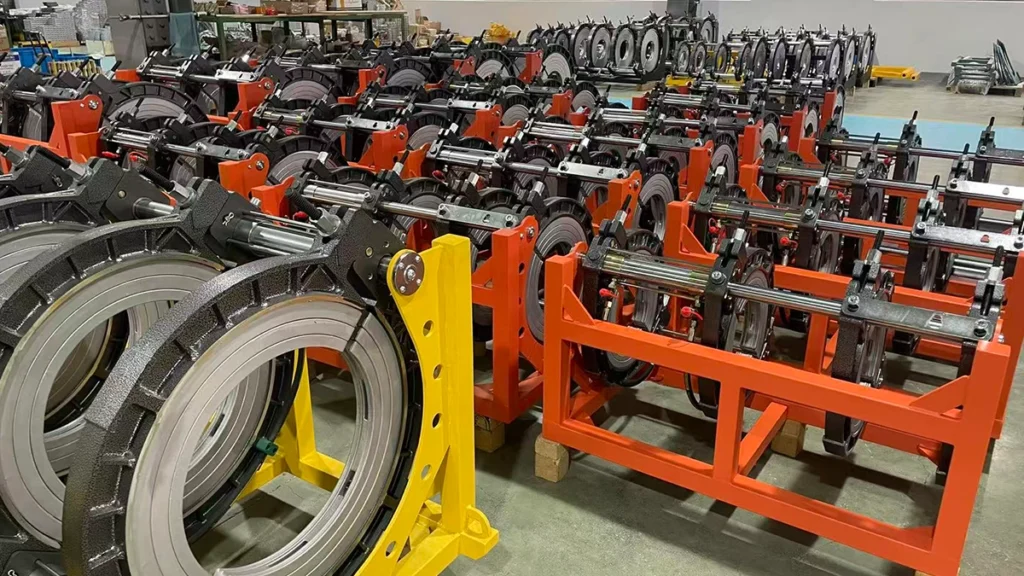
Detail Ekberg’s manufacturing process
Precision alignment is the critical mechanical feature. The center line of the two pipe clamps must match perfectly.
- CNC Machining: We don’t rely on cast tolerances. Every HDPE pipe jointing machine body is post-processed on 5-axis CNC milling centers to ensure clamp bores are perfectly concentric.
- Tolerance: This design guarantees end-face alignment accuracy within 0.5 mm for machines up to 630 mm. Pipe ends meet flush without forcing the operator to use excessive clamping pressure to correct alignment.
Explain rigorous factory testing
Before crating, every unit undergoes a “torture test.”
- Hydrostatic Testing: The hydraulic system is pressurized to 1.5x its maximum operating pressure (e.g., 90 bar for a 60 bar system) and held for 24 hours to check for seal leaks.
- Thermal Imaging: Heating plates are powered up and scanned with thermal cameras to verify internal heating coils are functioning and the PTFE surface has no cold spots.
Describe the Global Support ecosystem
A butt fusion welding machine is only as good as the support behind it.
- Spare Parts: Ekberg maintains a global hub of standardized parts. Critical items like hydraulic seals, planing blades, and electronic inserts are stocked for immediate dispatch.
- Remote Diagnostics: Our CNC units feature USB ports for data export and firmware updates. If a HDPE pipe jointing machine throws an error code, site engineers can export the log file and email it to Ekberg support. Technicians can often diagnose a sensor fault or calibration issue remotely, getting the machine back online without a site visit.
Outline warranty and certification
- CE Certification: All units comply with the Machinery Directive 2006/42/EC.
- Warranty: We offer a standard 12-month warranty on all parts. An extended 24-month warranty is available for CNC electronic components and hydraulic pumps, reflecting our confidence in their durability.
Strategic Buyer’s Guide: Selection Checklist for HDPE Pipe Jointing Machines
To assist procurement managers and engineers, use this checklist to match the butt fusion machine to the project needs.
Create a Sizing Matrix
Select the HDPE pipe jointing machine model based on the *maximum* pipe diameter you intend to weld.
| Machine Model | Welding Range | Main Application |
|---|---|---|
| EKY160 | 40mm – 160mm | Small water supply & irrigation |
| EKY200 | 63mm – 200mm | Residential plumbing projects |
| EKY250 | 63mm – 250mm | Municipal water pipelines |
| EKY315 | 90mm – 315mm | Urban water & drainage |
| EKY355 | 90mm – 355mm | Sewage & infrastructure |
| EKY400 | 160mm – 400mm | Industrial pipeline systems |
| EKY450 | 180mm – 450mm | Gas & water distribution |
| EKY500 | 180mm – 500mm | Large municipal projects |
| EKY630 | 315mm – 630mm | Main water transmission lines |
| EKY800 | 450mm – 800mm | Large infrastructure works |
| EKY1000 | 630mm – 1000mm | Industrial & mining pipelines |
| EKY1200 | 630mm – 1200mm | Major water supply projects |
| EKY1400 | 1000mm – 1400mm | Trunk pipeline construction |
| EKY1600 | 1000mm – 1600mm | Large diameter water pipelines |
| EKY1800 | 1200mm – 1800mm | Mega infrastructure projects |
| EKY2000 | 1600mm – 2000mm | Super large pipeline systems |
| EKY2250 | Customizable | Custom industrial projects |
| EKY2600 | Customizable | Ultra-large engineering pipelines |
Check for Insert/Liner compatibility
A common mistake is buying a 630mm hydraulic butt fusion machine and forgetting the inserts for smaller pipes. Ensure the package includes a full set of aluminum reduction inserts (liners) for all intermediate sizes (e.g., 315, 355, 400, 450, 500, 630mm). For mining applications, request “wide” inserts that provide better grip on heavy pipes.
Verify Data Logger formats
Not all data loggers are created equal.
- Output: Ensure the system exports to universal formats like PDF (for humans) and CSV (for GIS integration).
- Connectivity: Modern units should support USB transfer at a minimum. Premium units offer Bluetooth or Cloud connectivity for real-time upload to the project manager’s dashboard.
Assess Safety Features
Safety is paramount, especially in heavy industry.
- RCD: The HDPE pipe jointing machine should have a built-in Residual Current Device to prevent electric shock.
- E-Stop: A large, accessible Emergency Stop button must be present on both the hydraulic unit and the chassis.
- Thermal Overload: The motor should have protection to cut power if it overheats during heavy facing operations.
Frequently Asked Questions
Q1: What is the main difference between butt fusion and electrofusion for HDPE pipes?
Butt fusion joins pipes by heating the ends and pressing them together, requiring no additional fittings. It is the cost-effective choice for long, straight pipelines and large diameters (up to 2500mm). Electrofusion uses special fittings with built-in heating coils. While more expensive per joint, it is ideal for tight spaces, repairs, or connecting pipes where a butt fusion machine simply won’t fit.
Q2: Can an automated hdpe pipe jointing machine weld pipes with different SDR ratings?
Generally, no. Butt fusion requires the two pipe ends to have the same wall thickness (SDR) to ensure proper alignment and pressure distribution. If you must join different SDRs (e.g., SDR 11 to SDR 17), use a machined transition fitting or electrofusion. The machine’s automation calculates parameters based on a single SDR input.
Q3: How often do the heating plate and pressure gauge need calibration?
According to ISO and DVS standards, calibration is required every 12 months. Pressure sensors and temperature probes must be verified against a certified master gauge. Ekberg HDPE pipe welding machines display a “Calibration Due” warning on the screen when the date approaches. Regular calibration is often mandatory for the weld data reports to remain valid.
Q4: What size generator is needed for a 630mm butt fusion machine?
For an Ekberg 630mm butt fusion machine, we recommend a generator with a minimum capacity of 20 kVA. The heating plate alone draws approximately 8-10 kW, with the hydraulic motor and facer adding to the load. Using an undersized generator causes voltage fluctuations that can damage CNC electronics or cause heater failure during the critical soak phase.
Q5: Does Ekberg Welding provide training for CNC butt fusion machine operation?
Yes. While CNC butt fusion welding machines lower the barrier to entry, training remains essential for safety and maintenance. We offer virtual certification programs for operators and on-site commissioning for large-diameter machines (800mm+). We also provide “train the trainer” sessions for large contractors to ensure their entire workforce complies with ISO 21307 procedures.
Conclusion
The infrastructure beneath our feet—from urban water lines to remote mining slurry pipelines—depends entirely on the strength of the connections we build. While manual welding served the industry for decades, the future belongs to the automated hdpe pipe jointing machine. The shift to CNC technology offers undeniable advantages: strict adherence to ISO 21307/DVS 2207 standards, tamper-proof data logging for total traceability, and a massive reduction in human error.
For contractors and utility operators, the choice is clear. Although the initial capital investment for automated equipment is higher, the long-term ROI is secured through faster cycle times, reduced testing costs, and the elimination of expensive joint failures. Don’t leave your pipeline integrity to chance.
Ready to upgrade your projects? Contact Ekberg Welding today for a technical consultation, customized specification sheets, or factory-direct pricing on our latest CNC HDPE pipe jointing machines.