
HDPE Pipe Jointing Machine for Irrigation Projects in Africa
Table of Contents
HDPE Pipe Jointing Machine for Irrigation Projects helps buyers in Africa choose the right fusion method, compare technical specs, and avoid costly joint failures in farm and water pipeline installations.
What Is an HDPE Pipe Jointing Machine and Why It Matters in Irrigation Projects
What does an HDPE pipe jointing machine do?
Think of an HDPE Pipe Jointing Machine for Irrigation Projects as the ultimate heavy-duty welder for high-density polyethylene pipes. This specialized equipment works by heating the cleanly prepped ends of two pipes until they melt—usually hitting a sweet spot between 220°C and 240°C. Once it reaches that precise temperature, the machine drives the ends together using strictly controlled hydraulic pressure. The plastic molecules literally interlock and fuse. The result? A single, monolithic joint boasting the exact same strength and pressure rating as the original pipe.
Why is joint quality critical for irrigation reliability?
A farm’s pipeline network acts as its vascular system. Joint quality makes or breaks the entire water supply, directly dictating operational efficiency, safety, and lifespan. A flawlessly fused joint locks in pressure and banishes leaks. This keeps pumps running at peak efficiency so crops get the exact flow rate they need. When you fuse joints correctly using a top-tier HDPE pipe jointing machine for irrigation projects, the resulting pipeline easily shrugs off thermal expansion, shifting soil, and the intense pressure demands of modern agriculture.
Which problems does poor joining create in farm water systems?
Substandard fusion joints are ticking time bombs for agricultural infrastructure. Bad welds trigger immediate leaks, sudden pressure drops, and eventual system blowouts. This wreaks havoc on water delivery schedules and puts crop yields in serious jeopardy. The financial hit is just as brutal. Industry data shows that fixing a single botched joint in heavy infrastructure can drain up to $15,000. You have to factor in deep excavation, massive system downtime, and heavy equipment mobilization. In remote African farming regions, these preventable failures obliterate project timelines and send maintenance budgets through the roof.
How does butt fusion work for HDPE pipe?
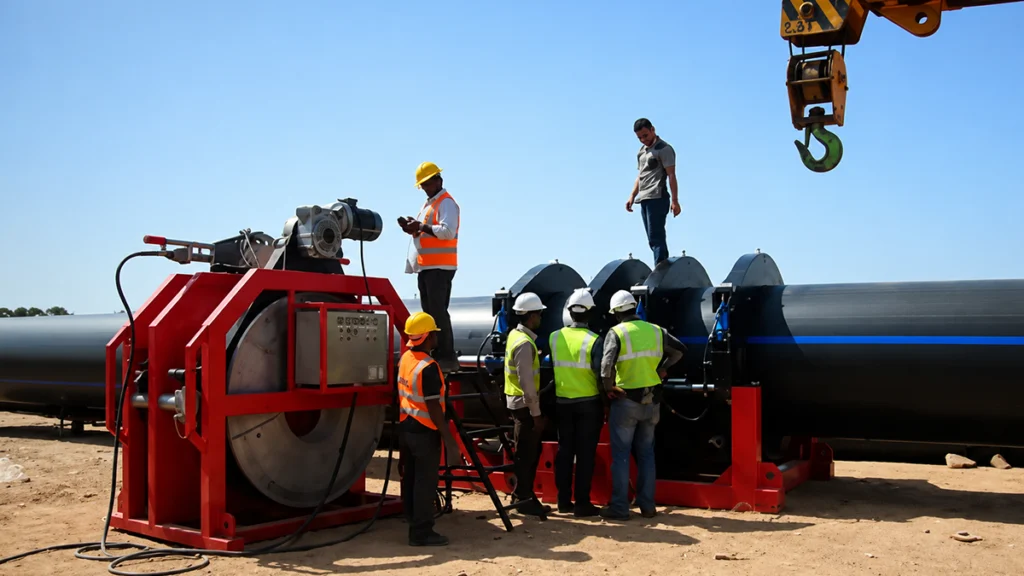
Butt fusion relies on a highly controlled thermomechanical process balancing temperature, pressure, and time. First, the butt fusion machine locks the pipes into heavy-duty hydraulic clamps. A rotating facer then shaves the ends until they are perfectly flat and parallel. Next, the operator drops a PTFE-coated heating plate between the pipe ends to melt the surfaces. As soon as the correct melt bead forms, the heater comes out. The butt fusion welding machine instantly drives the molten ends together under calculated pressure—usually around 0.2MPa to 0.4MPa. It holds that exact pressure while the plastic cools, locking in a permanent, leak-proof bond.
Which Jointing Methods Are Used for HDPE Irrigation Pipelines?
When is electrofusion the better choice?
Electrofusion shines in specific situations where dragging in a butt fusion carriage just isn’t practical. This technique relies on specialized fittings packed with embedded electrical resistance wires. Run a current through them, and the wires heat up, melting the fitting directly onto the pipe’s exterior. You want electrofusion for small-diameter PE pipes, cramped trenches, emergency repairs, or complex layouts loaded with tight-angle fittings where a bulky butt fusion machine physically cannot fit.
Which method fits large-diameter irrigation lines?
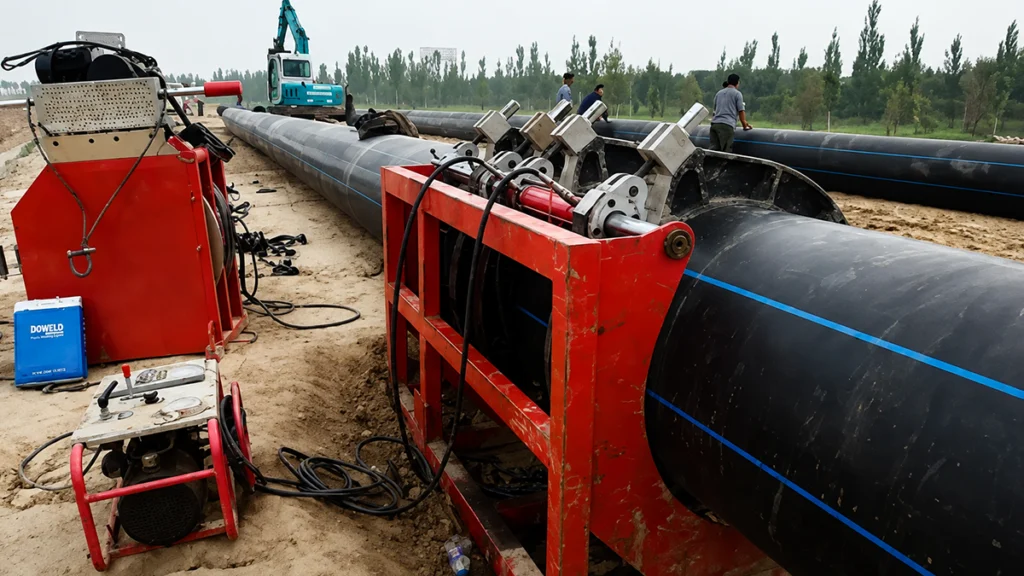
When you are dealing with large-diameter irrigation lines—like primary water transfer networks pumping fluid from massive reservoirs to crop zones—butt fusion is the undisputed heavyweight champion. It delivers unmatched joint strength and incredible cost-effectiveness at scale. Because the process skips the need for pricey consumable fittings, a butt fusion machine for agricultural water pipelines slashes total material costs. This is especially true for long, straight open-trench runs handling pipes anywhere from 315mm up to a massive 1200mm.
What method is most common in field irrigation projects?
Across sprawling field irrigation projects, butt fusion stands as the go-to method for building main water transfer lines and primary distribution manifolds. Its knack for quickly and dependably joining miles of pipe makes it the true backbone of farm pipeline installation. Electrofusion, on the other hand, usually takes a backseat. Contractors typically reserve it for final tie-ins, intricate valve assemblies, or post-installation patch jobs.
What are the main parts of a fusion machine?
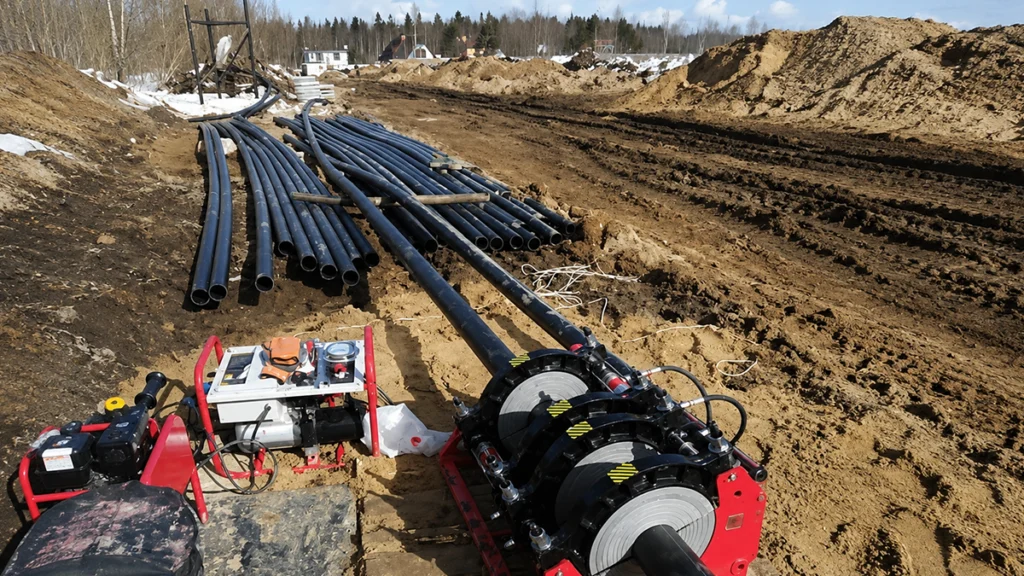
A standard hydraulic butt fusion rig breaks down into four core components. First, the chassis (or carriage) houses the hydraulic clamps that grip and align the pipes. Next is the facer tool, a motorized rotary planer that squares up the pipe ends. Then you have the heating plate, often called the mirror—a precision-controlled, non-stick element that actually melts the polyethylene. Finally, the hydraulic control unit drives the clamps and meticulously regulates the pressure throughout the fusion and cooling cycles.
Factory-direct pricing with technical consultation included
Get Your Free QuoteKey Machine Components and How the Process Works
How does heating, alignment, and pressure control work?
Nailing a perfect weld demands a flawless balancing act between heating, alignment, and pressure control. Alignment happens right at the start. Heavy-duty pipe fusion machined aluminum clamps lock the pipes in place, ensuring absolutely zero offset between the walls. Heating falls to a thermostatically controlled plate, which must hold a rock-steady temperature within ±3°C to meet ISO 21307 standards. Meanwhile, the hydraulic power unit takes charge of pressure. It applies the exact force needed during the bead-up, heat-soak, and cooling phases. Holding a steady 0.2MPa to 0.4MPa while the joint cools is non-negotiable—that is what forces the molten material to cure into a structurally indestructible bond.
What steps are involved in a proper jointing cycle?
A fully compliant jointing cycle marches through five rigid phases:
1. Preparation: Inspect the pipe, lock it into the clamps, face the ends until you see continuous plastic shavings, and wipe the surfaces down with an approved solvent.
2. Heating: Drop in the 220°C–240°C heating plate under initial pressure until the correct bead size forms. Then, back off to a drag pressure for the heat-soak phase (figure your melt time as pipe wall thickness × 10 seconds).
3. Transition: Yank the heating plate out quickly, being careful not to bump or damage the molten ends.
4. Fusing & Cooling: Slam the ends together at the target joining pressure. Hold them dead still until the plastic fully cures.
5. Inspection: Eyeball the joint to verify a uniform double-roll bead and log the fusion data.
Which pipe sizes should the machine support?
Machine capacity has to match your project’s hydraulic design perfectly. Standard hydraulic units usually handle ranges like 63mm to 315mm or 315mm to 630mm. These brackets cover the vast majority of in-field agricultural distribution lines. Stepping up to heavy civil water transfer projects? You will need heavy-duty HDPE pipe welding machines built to tackle massive diameters—think 1200mm, 2000mm, or even 3000mm. Smart buyers always pick a rig whose optimal clamping range aligns with the pipe sizes they lay most often.
What power supply options are available for African projects?
African infrastructure projects frequently push into off-grid or power-unstable territory. Because of this, an HDPE pipe jointing machine for irrigation projects must play nice with mobile diesel generators. Most equipment runs on either 220V single-phase or 380V three-phase power, depending heavily on the heater plate’s size and the hydraulic motor’s draw. Premium suppliers step up by offering OEM customization. This includes regional voltage tweaks and rugged electrical components designed to shrug off the minor voltage spikes that happen when running off field generators.
Technical Specifications to Check Before Buying
Why do temperature and pressure accuracy matter?
Dead-on temperature and pressure accuracy draw the line between a pipeline that survives 50 years and one that blows apart during commissioning. Run the heating plate too hot, and the polyethylene degrades and oxidizes. Run it too cold, and the plastic molecules refuse to mix, leaving you with a weak “cold weld.” The same rule applies to hydraulics. If the pressure wavers or drops while the joint is cooling, internal voids and stress fractures will form. Hitting strict benchmarks like ISO 21307 or DVS 2207-1 absolutely requires gear that delivers flawless parameter control.
What accessories should be included in the kit?
A proper procurement package goes beyond just the main carriage, hydraulic unit, facer, and heating plate. Buyers need to verify the kit packs essential accessories. Look for a complete set of reduction inserts so you can clamp smaller pipes within the butt fusion machine’s primary range. You also want a dedicated storage stand to safely hold the scorching heating plate and facer, plus a crane hoist if you are buying a larger rig. To handle modern quality control, insist on an integrated or bundled ISO 12176-4 compliant data logger to track the exact parameters of every single weld.
Is the project for small farms or large water distribution lines?
Project scale dictates the hardware you need. Small farming setups running 63mm to 160mm pipes can usually get by with manual or lightweight hydraulic butt fusion machines. You can easily toss these into the back of a standard pickup. On the flip side, sprawling water distribution networks laying 315mm to 1000mm pipes demand serious, heavy-duty hydraulic machines. Moving these beasts requires flatbed trucks, crane support for loading the pipes, and high-capacity industrial generators.
Should the machine be manual, semi-automatic, or fully hydraulic?
For water projects across Sub-Saharan Africa, hydraulic butt fusion machines hit the sweet spot for cost-effectiveness and raw reliability. Manual rigs only really work for tiny diameters (under 160mm) where human muscle can actually hold the cooling pressure. Fully automated CNC butt fusion machines? They deliver incredible data logging and virtually eliminate failed joints, but they also command a 30% to 50% price premium over standard hydraulic models. Semi-automatic hydraulic machines offer the perfect middle ground. They bring the heavy mechanical force required for large pipes while staying budget-friendly and easy to wrench on in remote locations.
Get detailed specs and custom configuration options
Request Technical SpecificationsHow to Choose the Right Machine for African Irrigation Projects
How do terrain, transport, and site access affect the choice?
African farm sites constantly throw logistical curveballs at contractors—think washed-out dirt roads, deep mud, and brutal gradients. A massive, rigidly built butt fusion machine will quickly throttle production if crews cannot easily drag it down the trench line. Buyers should hunt for equipment engineered with lightweight aluminum frames, wheeled carriages, and modular, detachable hydraulic units. Breaking the pipe fusion machine down into lighter, manageable chunks lets field teams move the gear across punishing terrain without waiting for heavy lifting equipment at every single joint.
What matters most: price, durability, or after-sales support?
Upfront price always matters, but durability and after-sales support actually drive your project’s Return on Investment. Snagging the cheapest rig on the market usually triggers catastrophic downtime the second a cheap hydraulic seal blows or a heating element shorts out miles from civilization. Buyers have to prioritize tough builds—think heavy-duty cylinder seals and scratch-resistant PTFE plates—backed by rock-solid supplier support. Fast access to spare parts and a no-nonsense 24-month warranty will save you from agonizing project delays that bleed thousands of dollars a day.
How is it used in drip irrigation systems?
In massive drip irrigation setups, an HDPE pipe jointing machine for irrigation projects does the heavy lifting to build the primary distribution manifolds and sub-mains. The final drip lines themselves are usually just thin-walled PE tubing snapped together with mechanical barbs. However, the high-pressure backbone feeding those delicate lines has to be thick-walled HDPE. Butt fusion guarantees these vital sub-mains can take the relentless, pulsing pressurization cycles from automated drip controllers without springing a leak.
Can it support sprinkler and pivot irrigation networks?
Absolutely. Center pivot and heavy-duty sprinkler arrays rely on high-pressure water delivery to spin their mechanical drives and launch water over massive areas. The mainlines feeding these setups take a beating from severe water hammer effects and non-stop high pressure. A premium butt fusion machine for agricultural water pipelines welds joints tough enough to absorb those violent hydraulic forces. This keeps sprawling pivot systems running flawlessly across hundreds of hectares.
Typical Applications in Africa’s Irrigation and Water Infrastructure
Where does it fit in water transfer and pumping lines?
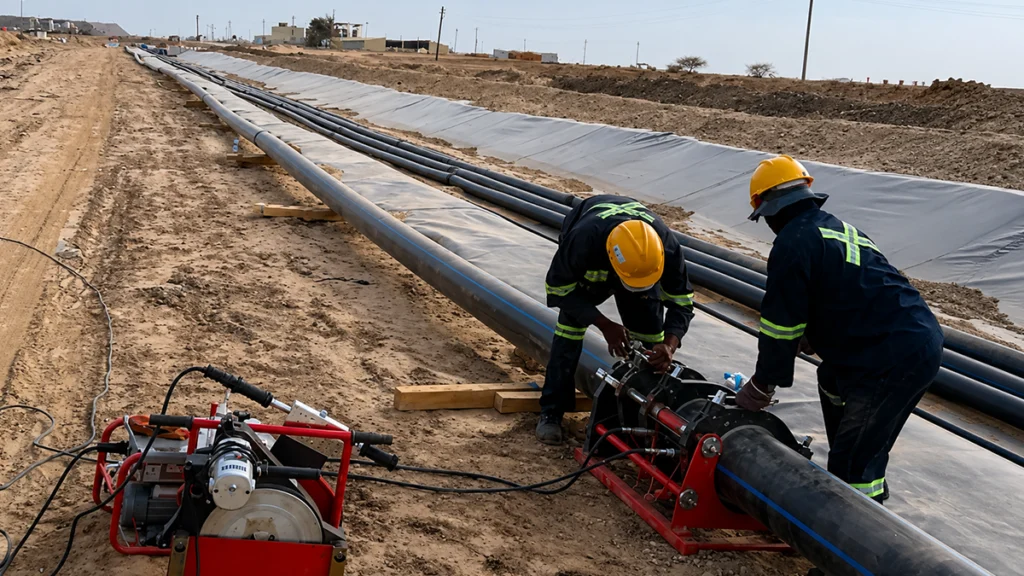
Before a single drop of water hits the crops, it often travels kilometers from rivers, dams, or deep boreholes to reach central farm reservoirs. HDPE dominates these water transfer lines because it flexes easily and ignores corrosion. Contractors deploy pipe fusion machines right along these cross-country trenches, continuously welding massive 500mm to 1200mm pipes. The resulting monolithic joints stop seepage dead in its tracks. In arid African zones where pumping every gallon burns expensive energy, preventing water loss is paramount.
Which project types need frequent on-site joining?
High-frequency on-site joining is the name of the game for government-backed farm modernization, municipal wastewater upgrades, and rural clean water initiatives. Contractors on these jobs drop kilometers of pipe into the dirt every single day. Navigating rolling hills or jagged property lines means constant cutting and fusing to match the topography. This brutal, high-tempo workflow demands rugged butt fusion welding machinery that can knock out dozens of fusion cycles per shift without overheating or drifting out of calibration.
What drives the price of an HDPE pipe jointing machine?
Maximum pipe diameter dictates the price tag more than anything else. A butt fusion machine built to wrestle 1200mm pipe demands exponentially more raw steel, hydraulic muscle, and structural engineering than a compact 315mm unit. Automation ranks as the second biggest cost driver, with slick CNC models demanding a hefty premium over standard manual hydraulics. Finally, component quality—like swapping standard parts for European-made hydraulic seals or advanced PTFE coatings—and brand origin heavily influence the initial capital layout.
How should buyers compare total project cost, not just machine price?
Savvy procurement teams look past the sticker price and focus on Total Cost of Ownership (TCO) and Return on Investment (ROI). Shelling out a bit more for a highly reliable hydraulic rig can easily shrink a five-day welding job down to three and a half days. By dodging equipment breakdowns and wiping out failed joints, contractors routinely save upwards of $5,000 per 100 welds in labor and rental fees. Buy a cheap butt fusion machine that blows a single $15,000 joint, and your upfront “savings” vanish instantly.
Cost, Lead Time, and Procurement Factors Buyers Should Expect
What lead time and logistics issues are common for African delivery?
Bringing heavy industrial gear into Africa takes serious logistical foresight. Expect lead times from international manufacturers to stretch anywhere from 4 to 8 weeks. Add in slow ocean freight and tangled customs clearances at major ports like Mombasa, Durban, or Dar es Salaam, and the clock keeps ticking. Buyers also have to plan for brutal inland transport over battered roads. That means demanding heavy-duty export crating to shield fragile heating plates and sensitive hydraulic gauges from impact and choking dust.
Which supplier support items reduce project risk?
To bulletproof the project schedule, buyers need to hammer out a comprehensive support package with their HDPE pipe jointing machine supplier for Africa. Essential risk-killers include bundling high-wear spare parts directly with the HDPE pipe welding machine shipment—think extra facer blades, hydraulic seals, and temperature sensors. Furthermore, demanding a 24-month warranty, access to remote video troubleshooting, and crystal-clear English operational manuals is non-negotiable if you want to maintain uptime out in the bush.
What happens if pipe ends are not aligned correctly?
Force misaligned pipe ends into the clamps, and you will end up with an asymmetrical fusion bead. That structural defect acts like a magnet for stress inside the pipeline wall. The moment the irrigation system pressurizes, that lopsided joint becomes the weakest link, practically guaranteeing a premature fracture and a massive blowout. Operators absolutely must use the hydraulic clamps and reduction inserts correctly to nail the zero-offset alignment demanded by international welding codes.
Why do contamination and temperature errors cause failures?
Polyethylene fusion only works if the polymer chains integrate perfectly. Dirt, dust, agricultural chemicals, or even a little moisture on the pipe ends act like a brick wall, blocking molecular bonding. Temperature errors are just as lethal. A “cold weld” happens when the heat is too low or the operator takes too long during the transition phase. The plastic cools and solidifies before properly fusing. The joint might look fine to the naked eye, but it lacks all internal strength and will snap the second it faces real pressure.
Common Installation Mistakes and How to Avoid Failed Joints
How can operators prevent weak or uneven fusion joints?
Preventing weak joints comes down to fanatical adherence to welding standards like ISO 21307 or DVS 2207-1. Operators have to obsess over preparation: wiping ends with lint-free rags and approved alcohol, running the facer until it kicks out continuous plastic ribbons to ensure dead-flat surfaces, and shielding the weld zone from wind and rain. Rushing the cooling phase is the ultimate sin. Dropping the hydraulic pressure before the joint naturally cures down to ambient temperature will instantly ruin the weld’s integrity.
What daily checks should operators perform?
Before firing up the generator, operators need to run through a strict pre-shift checklist. They must inspect the heating plate for deep scratches or leftover melted plastic, scraping off any residue with a wooden tool and alcohol. Facer blades need a quick check to ensure they are sharp enough to slice the plastic cleanly without tearing it. Finally, the crew should pressure-test the hydraulic system, watching the gauges carefully to confirm they hold steady without slowly bleeding off pressure.
How often should heating plates and clamps be inspected?
Inspection shouldn’t be an occasional chore; it needs to be continuous. Operators should visually scan the heating plate before every single weld to verify the PTFE coating is flawless. Once that coating degrades, plastic sticks to it, and the weld is ruined. Clamps and reduction inserts require a deep clean weekly to clear out packed dirt and plastic shavings that ruin pipe alignment. For the big stuff—like calibrating temperature sensors and hydraulic pressure gauges—bring in a qualified technician once a year.
Why is operator training essential for consistent results?
Butt fusion is a highly technical dance of temperature, pressure, and timing. Ultimately, the butt fusion machine is only as good as the hands running it. An untrained worker will invariably rush the heat-soak phase or dial in the wrong joining pressure, leaving behind invisible, ticking-time-bomb cold welds. Thorough operator training guarantees that field crews actually grasp the science behind polyethylene fusion, know how to read pressure charts correctly, and have the discipline to execute standard operating procedures without cutting corners.
Maintenance, Training, and Best Practices for Long-Term Performance
What records should be kept for project quality control?
Today’s agricultural and municipal water projects demand bulletproof traceability. Contractors need to run data logging systems that meet ISO 12176-4 standards to capture the exact parameters of every single weld. These digital files must track ambient temperature, heater plate temp, drag pressure, joining pressure, heat-soak time, and the final cooling duration. Keeping this detailed ledger proves the work met strict engineering specs, shields the contractor from liability if a pipe ever bursts, and locks in long-term quality control.
FAQ
Q1: What size HDPE pipe can an irrigation jointing machine handle?
An HDPE Pipe Jointing Machine for Irrigation Projects covers a broad spectrum of diameters, depending entirely on the specific model. Standard hydraulic units easily tackle 63mm to 630mm pipes, which handles the bulk of farm distribution lines. If you are building massive water transfer infrastructure, heavy-duty machines step in to weld pipes up to 1200mm, 2000mm, or even 3000mm. Matching the machine’s capacity to your mainline design is step one.
Q2: Is butt fusion or electrofusion better for irrigation projects in Africa?
For long, straight irrigation mainlines and bulky water transfer pipes, butt fusion wins easily on both performance and cost. It skips the need for expensive consumable fittings, driving down project expenses. Electrofusion is a fantastic backup, but contractors should save it for small-diameter pipes, cramped trenches, intricate network layouts, and emergency patch jobs where dropping a massive butt fusion carriage just isn’t feasible.
Q3: How much does an HDPE pipe jointing machine cost for farm use?
Pricing swings wildly based on the maximum pipe diameter, the level of automation (manual, hydraulic, or CNC), and where the brand is manufactured. A basic manual rig for small pipes won’t break the bank, whereas a heavy-duty hydraulic beast for massive mainlines requires serious capital. However, dropping cash on reliable hydraulic gear delivers massive ROI by stopping $15,000 joint failures before they happen.
Q4: What power supply is needed to run the machine on site?
Most hydraulic butt fusion rigs pull either 220V single-phase or 380V three-phase power. The exact draw depends on the size of the heating plate and the hydraulic motor. Because African irrigation sites often sit miles off the grid, crews usually run these machines off mobile diesel generators. Just make sure your generator outputs stable voltage to keep the machine’s sensitive electronics from frying.
Q5: How do I know if a joint is strong enough for irrigation pressure?
A joint is structurally sound if the operator followed strict welding parameters like ISO 21307 or DVS 2207-1 to the letter. Visually, a perfect joint rocks a uniform, symmetrical double-roll bead entirely around the pipe’s circumference. If you want absolute proof, hook up an ISO 12176-4 compliant data logger during the process. It guarantees the operator nailed the correct temperature, pressure, and cooling times.
Q6: Can one machine be used for both drip and sprinkler pipeline projects?
Yes, a single hydraulic butt fusion machine can easily bounce between different irrigation setups. By swapping out the reduction inserts, crews can clamp and weld the massive mainlines needed for heavy-duty pivot sprinklers, then quickly reconfigure the rig to fuse the medium-diameter sub-mains feeding sprawling agricultural drip networks.
Q7: What maintenance does an HDPE fusion machine need in dusty field conditions?
Operating in the dust demands a relentless daily maintenance routine. Operators have to scrub the heating plate with alcohol and lint-free rags before every single weld to stop contamination. They also need to wipe down the hydraulic cylinder rods so abrasive dust doesn’t chew through the seals, and keep a close eye on facer blade sharpness. Finally, always throw a heavy tarp over the machine when it’s not running.
Conclusion
Picking the right HDPE Pipe Jointing Machine for Irrigation Projects isn’t just a basic purchasing decision; it is the foundation of your entire agricultural water infrastructure. The survival of your pipeline network—whether it is pumping water cross-country, feeding massive pivot sprinklers, or supplying delicate drip manifolds—hinges completely on the structural integrity of those fusion joints. When procurement teams grasp the stark differences between butt fusion and electrofusion, and dig deep into technical specs like clamping ranges, temperature stability, and hydraulic control, they secure gear that actually meets brutal ISO standards.
Operating out in the remote, punishing terrains of Africa means contractors have to prioritize tough, semi-automatic hydraulic butt fusion machinery. You need that perfect mix of field portability, rugged engineering, and seamless compatibility with mobile generators. Always let Total Cost of Ownership drive the conversation, not just the sticker price. Dropping capital on premium equipment—backed by bulletproof warranties, fast spare parts access, and real operator training—wipes out the devastating financial fallout of failed joints. At the end of the day, if you stick rigidly to welding parameters, obsess over daily maintenance, and track your quality with data loggers, your agricultural pipelines will deliver relentless, leak-free performance for decades.
Let our experts help you choose the right equipment for your project
Contact Our Engineering Team