
Leading Butt Fusion Welding Machine Suppliers for HDPE Pipe Projects
Table of Contents
Pipeline contractors face massive financial and reputational risks from weld failures. Subpar equipment often causes these disasters, making the selection of a reliable butt fusion welding machine supplier a critical risk-management decision. Think about it: a single failed DN630 joint can force utility system shutdowns that hemorrhage upwards of $1 million per day in lost revenue. The stakes for procuring high-precision equipment—capable of operating flawlessly at 220°C and 4-6 MPa fusion pressure—have never been higher.
This comprehensive guide exposes the hidden costs of equipment failure. We will show you exactly how to evaluate factory-direct manufacturing partners. You will learn about essential butt fusion machine specifications, strict welding parameter standards like ISO 21307 and DVS 2207, and selection criteria tailored to different project scales. We also break down Total Cost of Ownership (TCO) considerations specifically for pipeline contractors.
By the end of this read, you will have a clear, data-driven framework to select the right equipment for any DN40 to DN1200+ HDPE project. Armed with this technical knowledge, your procurement team can avoid costly specification mistakes, guarantee strict municipal compliance, and squeeze the highest possible return on investment from your infrastructure fleet.

The Crucial Role of Reliable Butt Fusion Welding Machine Suppliers
Research the hidden costs of weld failures in HDPE pipe projects
System shutdowns caused by weld failures in utility or industrial pipelines carry brutal financial consequences. Imagine an unexpected rupture in a high-pressure municipal water main or a toxic chemical transport line. Lost revenue and emergency repair bills easily top $1 million daily. And that doesn’t even touch the secondary financial blows. Environmental remediation penalties and long-term reputational damage can cripple a contracting firm.
Environmental penalties represent a distinct, highly scrutinized risk category. Leaks in gas distribution networks or chemical slurry lines trigger immediate regulatory investigations. Heavy fines usually follow. A pipeline’s structural integrity relies entirely on the molecular entanglement achieved during fusion. That entanglement is dictated entirely by the precision of your welding equipment.
To mitigate these severe risks, industry procurement standards are shifting fast. Recent industrial surveys show that 60% of pipeline construction teams now demand built-in welding quality detection systems. Using butt fusion machines equipped with data logging, ultrasonic scanning compatibility, or automated parameter validation stops catastrophic failures long before the pipeline gets buried.
Compare the strategic advantages of working with wholesale butt fusion welding machine suppliers versus third-party retail distributors
Partnering directly with wholesale butt fusion welding machine suppliers offers distinct strategic advantages over buying through localized, third-party retail distributors. The biggest win? Factory-direct access. This unlocks massive OEM (Original Equipment Manufacturer) and ODM (Original Design Manufacturer) customization capabilities. Contractors can specify exact hydraulic pressure ranges, electrical configurations, and branding requirements directly with the engineers building the machinery.
Bypassing third-party dealers also guarantees direct technical support from the manufacturer. When field operators hit complex troubleshooting snags or need urgent calibration help, talking directly to factory engineers ensures rapid, accurate fixes. This direct line cuts out the frustrating delays and miscommunications that happen when you rely on retail middlemen who lack deep engineering knowledge.
Plus, factory-direct relationships deliver the critical value-added services necessary for large-scale infrastructure operations. Top-tier manufacturers offer trade-in programs for aging fleets, expedited global shipping for urgent deployments, and the ability to engineer custom backup equipment for highly specific, non-standard pipeline jobs.
Detail the importance of supplier compliance with international welding standards
Winning municipal and industrial project approvals demands strict adherence to international welding standards. Supplier compliance is a non-negotiable procurement factor. ISO 21307 is the globally recognized standard dictating single high-pressure fusion jointing parameters for pipes with wall thicknesses between 5mm and 70mm. It also covers dual low-pressure fusion protocols for walls exceeding 20mm. Your equipment must mechanically sustain these precise pressure profiles without the slightest deviation.
For projects requiring extreme precision—like chemical processing plants or aggressive mining environments—DVS 2207-1 compliance is mandatory. This rigorous German standard demands absolute temperature uniformity and exact cooling phase management. Recent updates (DVS 2207-11) optimized these cooling times. Contractors can now reduce cooling duration by up to 61% under specific ambient conditions, but only if the hdpe fusion welding machine’s hydraulic accumulators can hold perfectly stable pressure.
Equipment must also facilitate compliance with ASTM F2620, the standard practice for heat fusion joining of polyethylene pipe and fittings. This ensures leak-proof joints specifically tailored for North American gas and water applications. Butt fusion welding machines that automatically log data to prove compliance with these standards shield contractors from massive liability during municipal inspections.
How to Choose HDPE Fusion Suppliers: A Buyer’s Checklist
Create a checklist for evaluating equipment range and pipe diameter capabilities
Procurement teams must ensure a supplier can handle the full spectrum of project requirements. You might need equipment for small-diameter indoor plumbing one day and massive municipal water mains the next. Standardizing your fleet with a single manufacturer simplifies operator training and streamlines spare parts inventory.
Use this buyer’s checklist to evaluate a supplier’s diameter capabilities:
- Model 160: Verifiable clamping and fusion for DN40mm to 160mm.
- Model 250: Capable of handling DN63mm to 250mm.
- Model 315: Heavy-duty frame for DN90mm to 315mm.
- Model 450: Industrial capacity for DN180mm to 450mm.
- Model 630: High-pressure hydraulics for DN315mm to 630mm.
- Model 800: Municipal scale for DN450mm to 800mm.
- Model 1200: Custom-engineered chassis for DN630mm to 1200mm and beyond.
Outline how to assess technical parameters
Evaluating the core technical parameters of the butt fusion welding machine quickly separates premium equipment from unreliable alternatives. The heating plate must maintain industry-standard temperatures, typically sitting between 200°C and 230°C for PE100 materials. More importantly, the temperature variance across the plate’s entire surface must stay < ±3°C. Localized cold spots cause brittle, failure-prone joints.
Hydraulic pressure stability during the cooling cycle holds equal weight. The hydraulic unit needs a large-dial, high-precision shockproof pressure gauge. Working pressures usually range from 2-4 MPa for 220V single-phase pipe welding machines (up to 315mm) to 4-6 MPa for heavy-duty 380V three-phase butt fusion machines (450mm and above). The system must use high-quality accumulators to hold this pressure completely static while the polymer cools and crystallizes.
Detail the criteria for choosing between manual, semi-automatic, and fully CNC automated butt fusion machines
Selecting the right level of automation directly impacts your project timelines and labor costs. Manual and semi-automatic hydraulic butt fusion machines rely heavily on the operator. They have to calculate drag pressure, monitor heat soak times, and manually adjust hydraulic valves. These units are highly cost-effective and work perfectly for smaller, less critical water distribution or irrigation projects where budgets are tight.
Conversely, fully CNC automatic butt fusion machines are absolute necessities for large-scale, high-liability projects. These advanced systems come with pre-set optimal parameters based on pipe diameter, SDR (Standard Dimension Ratio), and material type.
Equipment Automation Comparison:
| Feature | Manual / Hydraulic | Fully CNC Automated |
|---|---|---|
| Drag Pressure Calculation | Manual estimation | Automatic measurement |
| Parameter Control | Operator dependent | Closed-loop (Time, Temp, Pressure) |
| Data Logging | None / External | Built-in GPS & USB Export |
| Best Application | Agriculture, minor repairs | Municipal gas, mining, chemical |
Explain the importance of evaluating spare parts availability and after-sales support networks
Even the toughest industrial equipment needs periodic maintenance and consumable replacements. Industry benchmarks show that 90% of institutional buyers require guarantees of 24-hour online technical support and comprehensive global warranty services before they sign off on a vendor. A butt fusion welding machine sitting idle in the dirt while you wait weeks for a replacement hydraulic valve destroys project profitability.
When evaluating a supplier, dig into their logistics infrastructure. Can they rapidly dispatch spare parts? Also, assess their training materials. Today, 75% of construction teams demand comprehensive operation manuals and detailed video tutorials to quickly onboard new field technicians. A supplier’s ability to deliver localized support, backed by global engineering resources, proves their reliability.
Understanding the Cost of Butt Fusion Welding Machines vs. Long-Term ROI
Provide a breakdown of upfront equipment costs based on machine type and size tiers
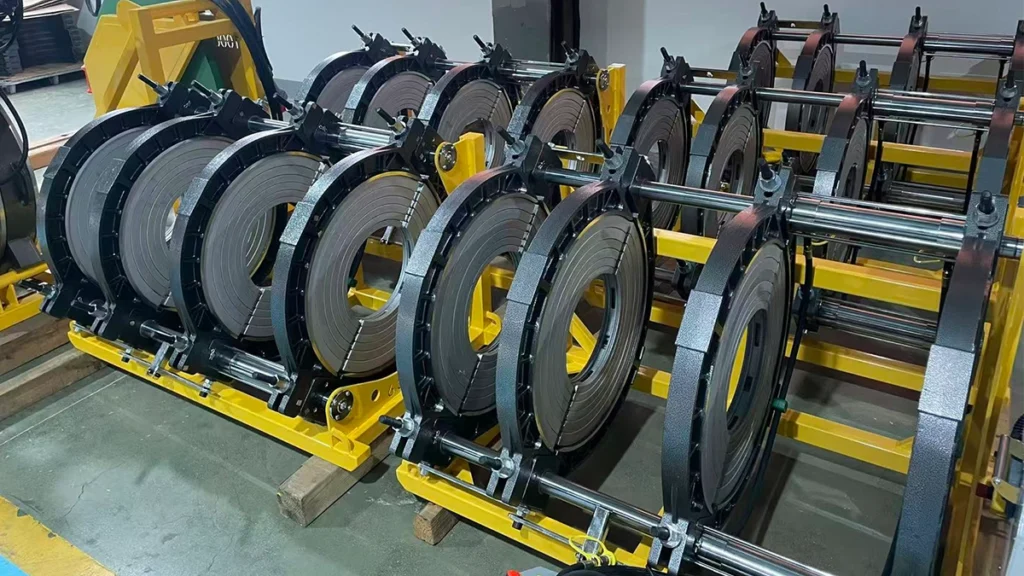
Understanding capital expenditure means analyzing upfront costs across different butt fusion machine tiers. Prices fluctuate based on the actuation method, automation level, and shipping logistics. Entry-level manual machines for DN160 pipes usually range from $200 to $500. They serve as great economical solutions for basic plumbing.
Stepping up the scale, standard hydraulic butt fusion machines for DN315 applications represent a moderate investment of $1,000 to $1,800. Heavy-duty hydraulic or semi-automatic units for DN630 pipes command $2,500 to $4,200. This higher price tag reflects their massive steel frames and powerful 380V power units. Finally, fully CNC automatic butt fusion machines for massive DN1200 utility projects require custom pricing. These generally start at $10,000 and scale upward based on data-logging capabilities.
Calculate labor and time savings when upgrading to advanced CNC butt fusion machines
Upgrading to advanced CNC butt fusion welding machine completely transforms operational efficiency. It drastically reduces cycle times and eliminates operator error. Automatic butt fusion machines use environmental sensors to detect ambient temperature, automatically compensating the heat absorption time. Field operators no longer need to manually calculate complex thermodynamic adjustments in freezing snow or blistering heat.
The labor reduction is highly measurable. By automating the fusion sequence and using pre-fused setups, contractors save up to 52 hours of active labor on large-scale municipal pipeline assemblies compared to traditional manual jointing. This massive acceleration in pipe-laying speed allows contractors to finish projects ahead of schedule, slash overhead costs, and free up crews for the next contract.
Analyze the Total Cost of Ownership (TCO) over a 5-year lifecycle
Buying based solely on the sticker price ignores the Total Cost of Ownership (TCO). TCO accounts for maintenance, calibration, and consumable parts over a standard 5-year lifecycle. High-quality plastic pipe welding machines keep TCO low by using superior materials. Premium electric milling cutters, for example, feature double-edged, interchangeable reversible blades forged from high-grade tool steel. This effectively doubles the lifespan of the consumable before you have to buy a replacement.
The quality of the heating plate also heavily impacts maintenance costs. Plates coated with high-grade Polytetrafluoroethylene (PTFE) over an aluminum alloy stop molten plastic from sticking. This robust coating dramatically cuts down the daily downtime operators waste cleaning the plate. It also extends the interval between costly factory recoating services, keeping the butt fusion welding machine in the trench where it belongs—generating revenue.
Explain bulk pricing structures and long-term partnership benefits from wholesale suppliers
Establishing a long-term partnership with wholesale butt fusion welding machine suppliers unlocks sophisticated pricing structures you simply cannot get through retail channels. Manufacturers offer tiered bulk pricing for contractors outfitting entire new fleets or regional distributors buying inventory by the shipping container.
Beyond raw discounts, these partnerships open the door to OEM/ODM manufacturing agreements. Large contractors and regional supply houses can brand the equipment with their own corporate colors and logos while enjoying factory-direct profit margins. This strategic alignment secures priority production scheduling, locking in your equipment availability even during the chaotic peak global construction seasons.
Key Technical Specifications to Demand from Top HDPE Butt Fusion Machine Suppliers
Research precision requirements for PTFE-coated heating plates
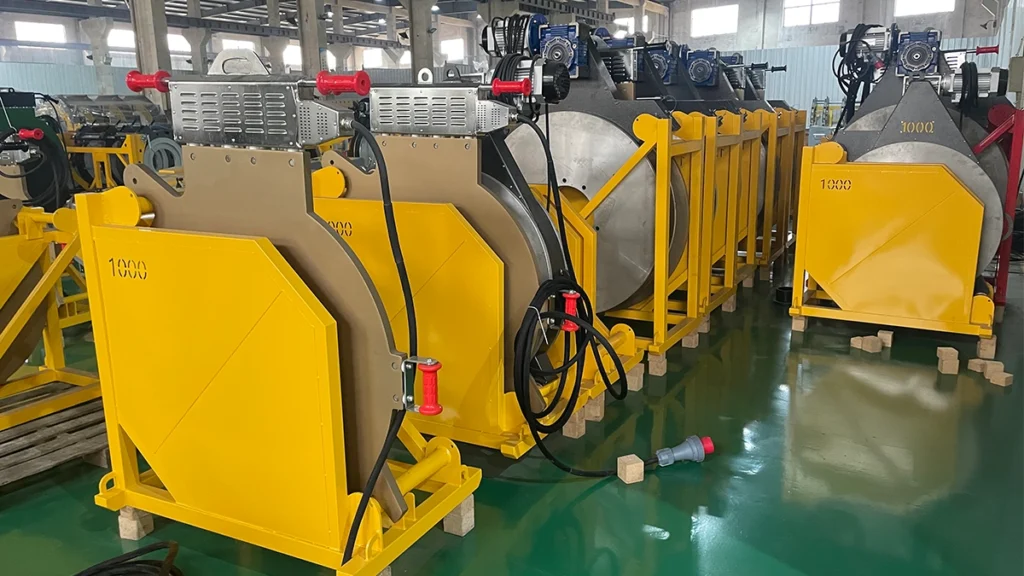
The heating plate acts as the thermodynamic heart of the fusion process. Top-tier equipment uses corrosion-resistant aluminum alloy for the plate’s core, ensuring rapid, uniform heat conduction. Engineers then treat this core with a high-grade PTFE film to prevent sticky polymer buildup.
Power specifications must be robust. A standard 315mm hydraulic butt fusion machine needs a minimum of 3.0 kW operating on a 220V circuit to achieve optimal melt rates. Above all, the engineering tolerance for temperature variation must remain strictly < ±5°C across the plate’s entire surface area. Any deviation beyond this strict threshold creates asymmetrical melt zones, completely compromising the molecular integrity of the final joint.
List hydraulic unit performance metrics
The hydraulic power unit governs the exact application of force during the critical bead-up and cooling phases. High-precision pressure regulation is mandatory. Specifically, the butt fusion welding machine must maintain a low starting pressure. This sensitivity is vital for welding small-diameter pipes and delicate fittings without causing ovality or structural distortion.
During the fusion and cooling phases, the hydraulic cylinders must deliver up to 10 N of consistent axial pressure. The system has to incorporate reliable pressure accumulators to hold this exact force static while the hydraulic pump motor powers down. This ensures the polymer crystallizes under perfect, unwavering compression.
Detail planer/trimmer motor power specifications and blade durability
Precise pipe end facing is the absolute prerequisite for a successful weld. Any gap between the pipe ends traps air and causes a critical failure. The planer (or trimmer) needs a high-torque motor capable of shaving thick-walled HDPE without stalling or chattering.
Safety and durability take priority here. The trimmer must feature a safety limit switch to prevent accidental start-up when the unit isn’t securely locked into the butt fusion welding machine chassis. The cutting mechanism should use high-quality tool steel inserts with a double-edged design. This provides a clean, continuous ribbon of plastic during the facing process, ensuring perfectly parallel, gap-free pipe ends.
Explain the necessity of data logging and weld traceability features
Modern utility contracts—especially in the gas and pressurized water sectors—demand absolute weld traceability to satisfy regulatory compliance. Advanced HDPE pipe welding machine must feature integrated data logging systems controlled via a rugged, 10-inch color touchscreen interface.
These systems record the exact time, temperature, and pressure of every single joint. Premium butt fusion machines go a step further, incorporating Beidou or GPS automatic positioning to tag each weld with real-time geographic coordinates. This data then exports via USB or transmits remotely to enterprise management systems. The result? Utility inspectors get an immutable digital twin of the pipeline’s construction quality.
Application Scenarios: Where High-Quality Ekberg Machines Excel
Describe applications in municipal water and gas distribution networks
Municipal gas and water distribution networks represent the most unforgiving environments for pipeline contractors. These applications demand absolute zero-leakage standards. Operators often work in cramped, muddy trench welding conditions.
Ekberg’s CNC automatic butt fusion machines are engineered specifically to dominate these high-stakes environments. The automated systems continuously monitor all environmental and mechanical variables. If actual welding parameters deviate from the pre-programmed standard due to sudden weather changes or power fluctuations, the system triggers an immediate alarm and aborts the sequence. This fail-safe mechanism ensures 100% joint integrity, protecting the municipality from catastrophic gas leaks or water main blowouts.
Detail solutions for mining operations and slurry transport
Mining operations require pipelines tough enough to transport highly abrasive chemical slurries and sharp rock tailings. To survive this internal abrasion, engineers specify high-SDR (Standard Dimension Ratio), thick-walled HDPE pipe. Welding this massive, dense material requires extraordinary mechanical force.
Ekberg provides heavy-duty 380V three-phase butt fusion welding machines (specifically Models 630 through 1200) designed explicitly for these harsh, remote environments. These hdpe fusion welding machines boast reinforced steel chassis and high-capacity hydraulic pumps delivering 4-6 MPa of stable working pressure. This immense force ensures thick-walled pipes fuse securely, holding their structural integrity even when subjected to the intense vibrations and pressure spikes common in mining slurry transport.
Explain the equipment’s role in industrial chemical plants and agricultural irrigation
Industrial chemical processing plants rely heavily on corrosion-resistant piping networks built from PE, PP, and PVDF materials. Ekberg butt fusion machines feature adjustable temperature zones, making them incredibly versatile for fusing these different high-performance polymers. They deliver the precise thermal control required to prevent polymer degradation while welding sensitive chemical transport lines.
In large-scale agricultural irrigation, contractors need rapid, reliable equipment to quickly lay miles of pipe across vast acreages. Note a specific technical limitation here: standard protocols do not permit butt fusion for pipes with DN ≤ 63mm or a wall thickness < 6mm. Electrofusion is recommended for those specific dimensions. However, for all main irrigation arteries and industrial lines above that threshold, Ekberg’s hydraulic butt fusion machines deliver unmatched speed and reliability.
Manufacturing Excellence, Quality Control & Global Service
Provide an overview of Ekberg Welding’s ISO-certified manufacturing facility
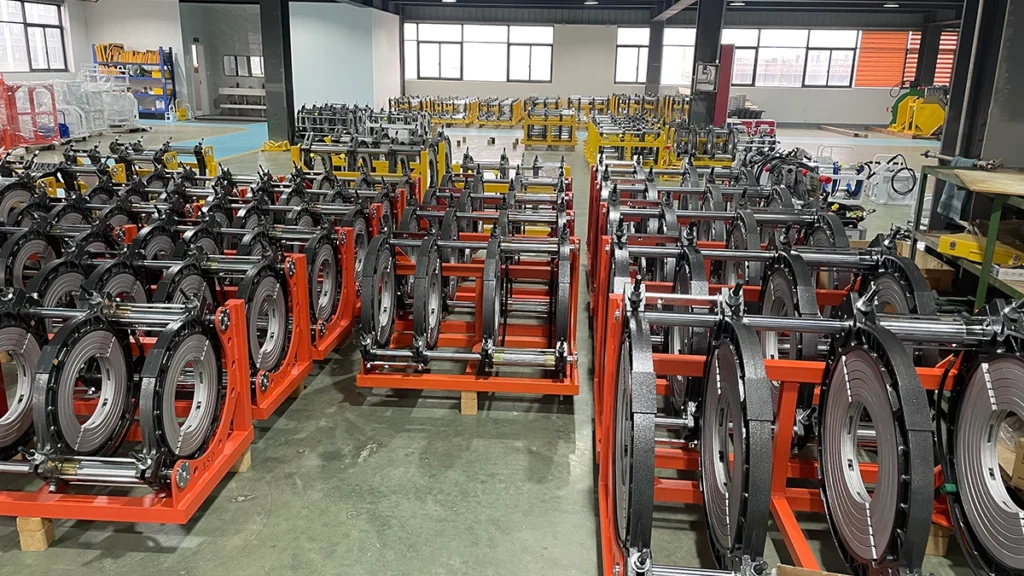
Ekberg Welding operates a state-of-the-art, ISO-certified manufacturing facility built for high-volume production capacity. This massive scale allows the company to rapidly fulfill large wholesale orders and execute complex OEM/ODM requests without ever compromising build quality.
Engineering design integrity is maintained at every single stage of assembly. Internal fixtures strictly comply with rigorous national and international standards. For example, butt fusion welding machines operating under 400 amps are meticulously configured for a maximum of 3 layers of electrical winding. This specific manufacturing protocol prevents uneven flange formation and guarantees consistent power delivery to the heating plate over thousands of duty cycles.
Detail rigorous QA/QC protocols
Quality assurance isn’t just a random sampling process at Ekberg; it is a comprehensive, unit-by-unit validation. Before any butt fusion machine gets approved for shipment, it undergoes 100% factory testing. Every single hydraulic unit faces strict pressure holding tests to guarantee zero internal fluid bypass during the critical cooling phase.
Heating unit calibration is equally intense. Ekberg provides technical guarantees ensuring absolute consistency between the data instrument readings on the control panel and the actual thermal output on the PTFE plate. This precise calibration minimizes the impact of instrumental error. Field operators can fully trust the data they rely on to build compliant pipelines.
Explain Ekberg’s OEM/ODM capabilities for wholesale distributors
For wholesale distributors and major regional suppliers, Ekberg serves as a silent, high-quality manufacturing partner. The company’s ODM and OEM capabilities allow distributors to deliver customized butt fusion solutions directly to their local markets.
This includes custom paint formulations to match corporate branding, localized software interfaces translated into regional languages, and modified chassis designs to fit specific local transport regulations. By leveraging Ekberg’s manufacturing excellence, distributors can rapidly scale their product offerings without the massive capital expenditure required to build their own factory infrastructure.
Outline global logistics, comprehensive technical training, and 24/7 engineering support capabilities
A HDPE pipe welding machine is only as reliable as the support network standing behind it. Ekberg Welding provides a standard 1-year warranty featuring lifetime maintenance support. For non-human-induced damage, you can extend this warranty up to 3 years, giving procurement teams exceptional financial security.
The company’s global logistics network ensures expedited shipping for urgent project needs, slashing costly downtime. Furthermore, Ekberg offers 24/7 remote video guidance. Field technicians can connect directly with factory engineers for real-time troubleshooting. To ensure long-term equipment health and DVS 2207 compliance, Ekberg also provides comprehensive technical training and annual complimentary on-site maintenance services for qualifying fleet operators.
Frequently Asked Questions
Q1: What is the typical lead time when ordering from wholesale butt fusion welding machine suppliers like Ekberg Welding?
While standard equipment orders process and dispatch rapidly from existing inventory, Ekberg also offers expedited global shipping for urgent project deployments. If you have a critical infrastructure project facing tight deadlines, we can even provide temporary backup equipment. This ensures your construction timeline stays on track while your custom CNC fleet is being manufactured.
Q2: How often do I need to calibrate my HDPE butt fusion machine to maintain DVS 2207 standard compliance?
The DVS 2207 standard mandates regular calibration to ensure absolute temperature and hydraulic pressure accuracy. Industry best practices require formal calibration every 12 months. Ekberg fully supports this compliance requirement by offering annual complimentary on-site maintenance and precision calibration services to validate your equipment’s data logging accuracy.
Q3: What factors influence the cost of butt fusion welding machines the most?
The primary cost drivers are the maximum pipe diameter capacity (e.g., a compact DN160 frame versus a massive DN1200 chassis), the actuation method (manual hand-pump versus electric hydraulic), and the level of computer automation. Fully CNC automated machines with built-in GPS data logging and closed-loop parameter control require the highest capital investment but yield the greatest long-term labor savings.
Q4: Can Ekberg butt fusion machines weld both HDPE and PP (Polypropylene) pipes effectively?
Absolutely. Ekberg butt fusion machines are engineered with highly accurate, adjustable temperature zones. This thermal flexibility makes our equipment fully capable of welding PE (Polyethylene), PP (Polypropylene), and PVDF pipes. Operators simply adjust the CNC parameters to match the specific melt flow index of the polymer they are fusing.
Q5: Why should pipeline contractors buy directly from the manufacturer rather than local third-party dealers?
Procuring equipment factory-direct from Ekberg Welding eliminates costly middleman markups. More importantly, it gives your field teams direct access to OEM engineers for 24/7 troubleshooting. Direct buyers also unlock exclusive benefits, including trade-in programs for upgrading older butt fusion welding machines and the ability to order customized equipment configurations tailored to specific jobs.
Conclusion
Choosing the right butt fusion welding machine suppliers goes far beyond a simple purchasing task. It is a foundational risk-management strategy that dictates the ultimate success or failure of your infrastructure projects. The hidden costs of catastrophic weld failures, environmental fines, and idle labor vastly outweigh the initial capital savings of buying subpar, uncalibrated equipment.
By partnering with a top-tier, factory-direct supplier, pipeline contractors guarantee strict compliance with ISO 21307 and DVS 2207 welding standards. Upgrading to advanced CNC automation maximizes labor efficiency, slashes cycle times, and provides the immutable data logging required by modern municipal utility inspectors. This ultimately secures a superior long-term ROI for your equipment fleet.
Do not leave the integrity of your next major pipeline to chance. Contact Ekberg Welding today for factory-direct quotes, in-depth technical consultations, and to request a comprehensive catalog of professional HDPE welding solutions tailored exactly to your project demands.