
Reliable HDPE Pipe Welding Machine Supplier: What to Know
Table of Contents
Selecting a reliable HDPE pipe welding machine manufacturer isn’t just a procurement task. It is the most critical decision a contractor makes to prevent catastrophic blowouts in DN40–DN2600 HDPE pipe networks. Think about it. Sub-standard equipment that drifts outside the critical 200–220°C heating window—or fails to lock in that essential 0.15 MPa fusion pressure—directly causes joint failures. And those failures carry a massive price tag. Case in point: the EPA recently slapped a single operator with a staggering $3.25 million fine for pipeline leaks.
This guide cuts through the marketing noise. You will learn exactly how to vet butt fusion machine technical specifications, enforce strict compliance with ISO 21307 and DVS 2207 welding parameters, and map out a hard-dollar return on investment (ROI) across various project scales. We will track the industry’s massive shift from manual hydraulics to fully automated CNC systems. We will also break down why precision auxiliary tooling is non-negotiable, alongside the sheer financial leverage of factory-direct procurement.
You will possess a data-driven framework for sourcing the exact equipment needed for high-pressure municipal and industrial jobs. No more costly specification errors. When you partner with industry heavyweights like Ekberg Welding, you unlock factory-direct pricing, bulletproof engineering, and global technical support. The result? Secure, standard-compliant, leak-free pipeline networks.

The Role of Top Pipe Welding Machine Manufacturers in Infrastructure
Identify the cost of equipment failure in high-pressure pipeline projects
The financial fallout from a blown pipeline joint goes way beyond simply replacing a busted HDPE or PP segment. When high-pressure gas or water grids rupture due to sloppy fusion integrity, contractors and utility operators get hit with severe regulatory penalties. Operational chaos follows. Recent data paints a grim picture: the EPA handed down a $3.25 million fine to a Colorado gas processor specifically for leaks tied to structural pipeline failures.
But look past the fines. The municipal burden of failing infrastructure is absolutely staggering. U.S. fire departments spend over $564 million annually just responding to gas leaks and compromised utility lines. And that massive figure completely ignores the secondary economic shockwaves—shutting down public roadways or throttling industrial facilities to excavate and fix the mess.
A standard municipal pipe repair eats up 5 to 7.5 hours per incident. That doesn’t even count the logistical nightmare of mobilizing heavy iron and crew travel time. Every minute of downtime bleeds heavy labor costs while utility companies hemorrhage unrecoverable revenue. If your crews run equipment that cannot hold precise hydraulic pressure or maintain dead-on heating plate temperatures, you are virtually guaranteeing these catastrophic failures.
Explain the technological shift from manual tools to CNC and automated hydraulic control
For decades, pipeline contractors leaned hard on manual butt fusion machines. Operators had to crunch drag pressure numbers in their heads, watch the clock for heating times, and manually throw hydraulic levers. Naturally, this heavy reliance on human input invited massive variability. The results? Cold welds and degraded materials. Today, the landscape looks entirely different. The industry has aggressively pivoted to Computer Numerical Control (CNC) and automatic hydraulic systems to strip human error out of the equation entirely.
Modern automated rigs don’t just sit there; they actively monitor and tweak the fusion process on the fly. Advanced CNC automatic butt fusion machines, for example, lock down fitting ovality at <5‰dn, blowing past stringent national standards. They also enforce ruthless bead inspection protocols. This guarantees that double-edged flanging forms perfectly and wall thickness deviation stays well below 10% to ensure absolute concentricity.
By automating the pressure application, these smart HDPE pipe welding machines ensure the minimum crimping on both sides hits the precise mathematical requirement: 0.1 × pipe wall thickness + 0.5mm. This leap in technology means every single joint is mathematically identical. Quality control no longer rests on an operator’s gut feeling—it lives safely inside the butt fusion welding machine’s calibrated algorithms.
Detail the importance of manufacturing compliance with international standards
Meeting international welding standards isn’t just about ticking a regulatory box. It forms the core physics framework that guarantees a pipeline will last for generations. ISO 21307 serves as the global blueprint for Single Low Pressure (SLP), Dual Low Pressure (DLP), and High Pressure welding parameters. Elite manufacturers hardwire their equipment to execute these exact parameters autonomously. Take the ISO high-pressure cooling time formula, where minimum cooling under pressure equals `0.43 × wall thickness` in minutes. For a 315mm SDR 11 HDPE pipe The HDPE fuison machine locks in exactly 14 minutes of uninterrupted cooling time. No shortcuts.
For chemical plants, mining operations, and aggressive industrial environments, DVS 2207-1 compliance is an absolute mandate. This rigorous German standard demands high-precision welds and enforces razor-thin tolerance bands for heating plate temperatures and changeover times. If a butt fusion machine cannot rapidly separate the heating plate and snap the carriage shut within the strict DVS-specified seconds, you get oxidized, brittle joints.
On the electrofusion side, equipment must align with ISO 12176.2-1998. This standard lays down systematic rules for classification, safety thresholds, and technical indicators. Top-tier manufacturers also ensure their gear carries CE certifications for European electrical safety. This proves the internal transformers and control boards can handle punishing, continuous heavy-duty cycles without thermal overload.
Core Equipment Lines Offered by Leading Suppliers
Top pipe welding machine manufacturers deliver complete equipment ecosystems. These lineups are engineered to tackle diverse thermoplastic materials across brutal environmental conditions.
Compare butt fusion machine specs for different project scales
Butt fusion machines need to scale seamlessly with project demands. Standard fleets cover operational ranges from DN50 up to DN630, while custom heavy-duty rigs push all the way to DN2000. No matter the size, heating plate specifications remain the ultimate dealbreaker. Industrial-grade plates must hold a relentless operating temperature range of 200–220°C, pushing uniform heat across every square inch of the surface. These plates utilize industrial PTFE non-stick coatings engineered to block molten polymer adhesion. Strict maintenance is required here; a single deep scratch can ruin a weld.
Hydraulic pressure controls determine how well the machine forges those melted pipe ends together. Premium machines pack selectable pressure transducers calibrated for either 100 bar or 250 bar maximum working pressure, dictated by the carriage cylinder size and the pipe’s SDR rating.
Detail electrofusion welder requirements for gas/water distribution
Electrofusion welding shines in tight spots. Think manholes or narrow trenches where bulky butt fusion carriages simply won’t fit. These specialized units handle everything from DN63 up to DN2600mm. A true industrial electrofusion welder runs on a standardized 40V welding voltage, pumping precise electrical current directly into the fitting’s embedded resistance wires.
To block operator fat-finger errors, premium electrofusion machines deploy optical barcode scanners. The scanner zaps the 24-digit barcode on the fitting and instantly feeds the butt fusion welding machine the optimal voltage, heating time, and cooling time. Even better, these fully automatic units boast ambient temperature compensation. Using external thermistors, they read the trench temperature and automatically dial the welding parameters up or down. Whether you are fusing in freezing winter mud or baking summer heat, the energy delivery remains flawless.
Explain why top suppliers must also manufacture auxiliary tools
Even the strongest fusion joint will snap if the pipe surface prep is garbage. Elite suppliers like Ekberg Welding understand this, which is why they manufacture mission-critical auxiliary tools right alongside their main rigs. You must strip the surface oxide layer off an HDPE pipe before welding. Skip this step, and you are left with a weak, superficial bond waiting to fail.
Industrial rotary pipe scrapers—built tough with aluminum alloy bodies and heavy-duty ratchet mechanisms—are designed to tackle DN110mm to 400mm plastic pipes. These tools shave off the oxide layer to an exact depth of 0.1–0.2mm, ensuring the scraped zone clears the fitting’s insertion depth by at least 10mm. Suppliers also provide chrome-plated steel support rollers featuring a 190mm hand-crank height adjustment. These rollers guarantee dead-on coaxial alignment and kill drag friction, saving your hydraulic cylinders from burning out during carriage movement.
How to Evaluate Pipe Welding Machine Manufacturers (Buyer Checklist)
Assess machine technical specifications
When auditing a supplier, throw out the glossy marketing brochures and dig straight into the hard technical specs. Pressure output accuracy is everything. The hydraulic power unit has to hold target drag and fusion pressures without any micro-fluctuations—because those tiny drops create weak boundary layers. You also need to verify the toughness of the PTFE coating on the heating plates. Can it survive hundreds of cycles in a gritty, dusty trench without degrading? Finally, look closely at the CNC data logging capacity. Any butt fusion machine claiming to be municipal-grade must be able to cache up to 4,000 complete welding cycles in its internal memory before you ever need to offload the data.
Verify welding data traceability features
For municipal gas and water jobs, weld traceability isn’t a nice-to-have; it is a strict legal mandate. Grade your HDPE pipe welding machine manufacturers on their software ecosystem. Every single weld record must capture the product model, software version, serial number, project manager ID, operator info, construction number, and ambient temperature. The rig should sport a 7″ HMI touch screen with built-in GPS positioning to drop an exact geographic pin on the joint. Furthermore, you need to be able to rip that data straight to a USB drive in unalterable PDF formats to keep third-party inspectors and utility engineers happy.
Evaluate spare parts availability and after-sales service response times
Sitting around waiting for a $50 replacement part can bleed thousands of dollars a day in idle labor costs. You must audit the manufacturer’s supply chain efficiency. Buying factory-direct from outfits like Ekberg Welding ensures you get immediate access to genuine spare parts. We are talking high-strength replaceable scraper blades, facing tool inserts, and fresh PTFE plates. This direct pipeline completely bypasses the brutal 3-to-4 week backorders you typically suffer when dealing with third-party distributors who refuse to stock adequate inventory.
Review material and pipe compatibility
A versatile fleet drives massive ROI. Make sure the equipment plays nice with a wide range of thermoplastic materials, including PE (HDPE, MDPE), PP, and PVDF. The butt fusion machine’s clamping jaws and hydraulic pressure algorithms must adapt effortlessly to different Standard Dimension Ratios (SDR). A rig that can jump straight from fusing thin-walled SDR 17 water mains to thick-walled SDR 9 industrial chemical lines gives you an unbeatable edge in operational flexibility.
Quick Buyer Selection Checklist
- Data Capacity: Can the unit store >4,000 weld cycles?
- Export Protocol: Does it output secure PDF/CSV files via USB?
- Automation: Is ambient temperature compensation built-in?
- Coating: Are heating plates coated with industrial-grade PTFE?
- Power Supply: Does the electrical draw match local site generators (220V AC standard)?
Custom Pipe Welding Machine Suppliers: Meeting Specialized Demands
Analyze requirements for large-diameter custom machines
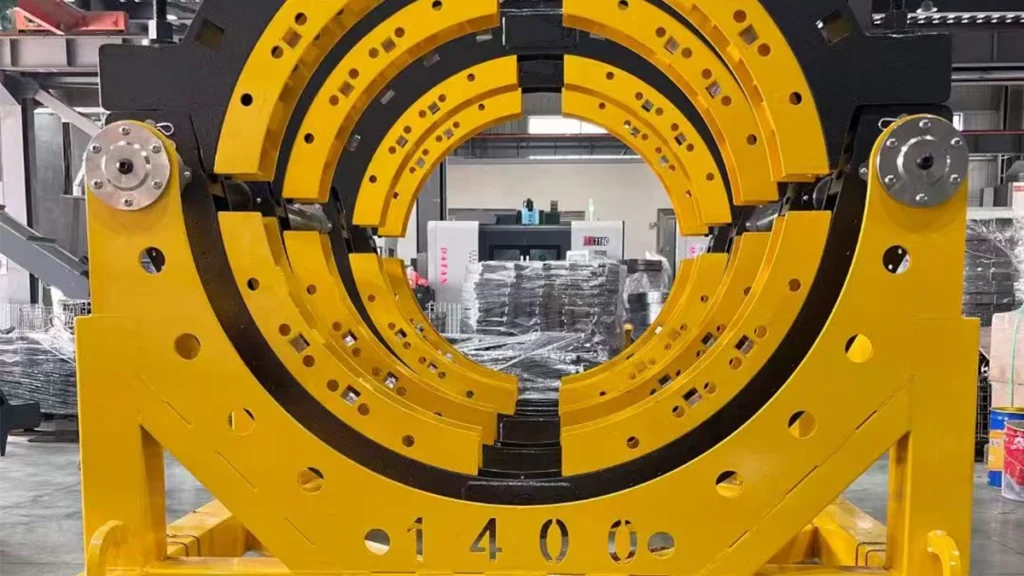
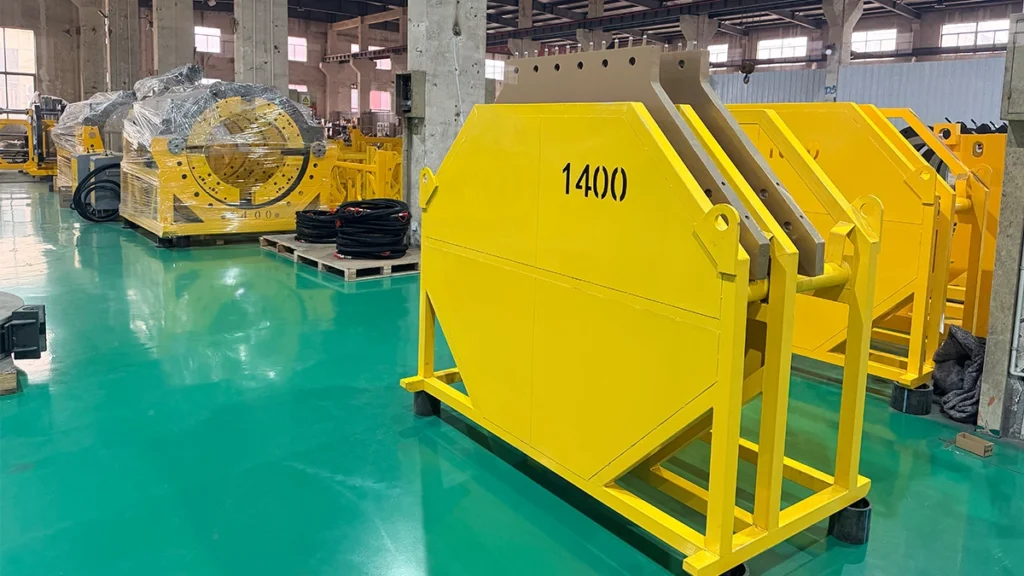
Off-the-shelf gear simply won’t cut it for mega-infrastructure builds like mining slurry lines or coastal desalination plants. These brutal environments demand custom pipe welding machine suppliers who can engineer heavy-duty chassis to wrestle DN1200+ pipes. Massive pipes generate immense drag forces. To handle that, custom builds require reinforced steel frames, oversized hydraulic cylinders, and high-capacity power units that can pump out massive fusion pressures without boiling the hydraulic fluid. The engineering tolerances here are unforgiving. At DN1200, even a single millimeter of misalignment triggers a catastrophic joint failure.
Detail custom clamp configurations and multi-angle fitting capabilities
Industrial fabrication shops constantly deal with complex pipe geometries that standard straight-line carriages cannot touch. Top-tier manufacturers solve this by designing custom clamp configurations. This includes multi-angle workshop fitting machines built to fabricate elbows, tees, and crosses right on the factory floor. They also engineer specialized saddle hdpe fusion machines to weld branch outlets directly onto main lines. These highly specific setups demand custom heating plates, contoured perfectly to match the exact curvature of the main pipe. This guarantees uniform heat penetration straight across the saddle interface.
Explain OEM/ODM partnership opportunities
Industry leaders like Ekberg Welding do a lot more than just sell to end-users; they act as strategic OEM/ODM partners for regional equipment distributors. This means modifying butt fusion welding machine specs to perfectly match local market demands. For example, standard units run on 220V AC mains, but Ekberg can custom-build electrical control boards to safely interface with the 380V three-phase power found on heavy industrial sites. OEM partnerships also let distributors apply custom branding, load up localized software languages, and tweak the chassis aesthetics. It empowers regional distributors to build their own brand equity, fully backed by Ekberg’s battle-tested engineering.
Manufacturing Excellence, Quality Control & Service
Document Ekberg Welding’s ISO-certified manufacturing facility processes
A butt fusion welding machine’s reliability starts at the raw material stage. Ekberg Welding runs an ISO-certified manufacturing facility where absolute precision gets baked into the chassis from day one. Using state-of-the-art CNC machining centers, they mill raw aluminum and high-tensile steel blocks down to exacting tolerances. This precision machining ensures the carriage guide rods sit perfectly parallel. Why does that matter? It is the foundational requirement for hitting that crucial <5‰dn fitting ovality during the fusion process. By keeping the entire manufacturing process locked down in-house, Ekberg completely eliminates the structural weak points that plague mass-produced, cast-metal knockoffs.
Detail strict QC testing protocols
Before any HDPE pipe welding machine gets crated up for global shipping, it endures a punishing battery of Quality Control (QC) tests. Hydraulic cylinder pressure holding tests confirm the system can lock in maximum fusion pressure during long cooling periods without a single micro-leak in the seals. Engineers run infrared thermography scans across the heating plates to prove the 200–220°C temperature holds steady across the entire PTFE surface—zero cold spots allowed. Finally, rigorous CE electrical safety checks verify that the transformers, grounding protection, and HMI control boards are fully isolated and safe to run in soaking wet trench environments.
Outline global technical support infrastructure
Moving heavy industrial iron requires an equally heavy-duty support network. Ekberg Welding delivers comprehensive operator training programs tailored specifically for B2B buyers. They make sure field crews actually understand the physics behind thermoplastic fusion and know exactly how to drive the CNC interfaces. Detailed, highly technical maintenance manuals make on-site troubleshooting straightforward. Plus, Ekberg’s rapid-response logistics network ensures that whether your crew is stuck on a remote mining site or working in a dense urban center, replacement parts and expert technical consults are always within reach.
Industrial Pipe Welding Machine Price Guide & ROI Analysis
Break down initial capital expenditure (CAPEX) factors
Getting a grip on the industrial pipe welding machine price means taking a hard look at the specific technology tier your project actually requires. Basic manual butt fusion machines built for 90-250mm pipes carry a lower initial capital expenditure (CAPEX), usually landing between $500 and $1000. Fully automatic CNC butt fusion machine, however, demand a steeper upfront check. That price jump pays for 250 bar pressure transducers, GPS-enabled data logging touchscreens, automated hydraulic power units, and high-precision temperature control boards. Smart buyers weigh this initial CAPEX directly against the aggressive data logging mandates pushed by their utility clients.
Calculate ROI using labor savings and risk mitigation
You measure the true cost of heavy equipment over its entire operational lifecycle. Yes, automatic CNC butt fusion machines require more cash upfront, but they deliver a highly trackable ROI across a standard 3-year municipal project lifecycle. Automated rigs wipe out the need for highly specialized, high-hourly-rate manual welders. Because electrofusion and CNC butt fusion systems control the parameters autonomously, contractors see a massive drop in rework and busted joints. Factor in the total elimination of a potential $3.25 million EPA fine or a $500,000 municipal repair bill, and the risk mitigation alone pays for the CNC upgrade on the very first major pipeline run.
Explain the financial advantage of factory-direct purchasing
Your procurement strategy heavily dictates your project’s bottom line. Sourcing gear through local hardware distributors usually means swallowing a 30% to 50% markup just to cover the middleman’s overhead. Buy factory-direct from Ekberg Welding, and you instantly vaporize those markups. This strategy slashes your initial CAPEX and radically drops your Total Cost of Ownership (TCO). Factory-direct buyers secure immediate warranty access, rapid-fire engineering support, and locked-in factory pricing on critical consumables like PTFE plates and scraper blades. That is how you drive long-term financial efficiency.
Frequently Asked Questions
Q1: How do I evaluate pipe welding machine manufacturers for large-scale gas distribution projects?
Grade manufacturers heavily on their ability to meet strict standards like DVS 2207-1. Check that their equipment runs CNC data logging capable of holding 4,000+ welds, tracks GPS coordinates, and exports unalterable PDFs via USB for municipal audits. Also, verify they run ruthless in-house QC testing, including hydraulic leak-down tests and heating plate temperature uniformity scans.
Q2: What factors influence the industrial pipe welding machine price?
The biggest price driver is the level of automation (manual hydraulic versus fully automated CNC). Other major factors include the maximum pipe diameter capacity, the integration of 250 bar high-pressure transducers, advanced GPS data tracking features, and the overall quality of the PTFE non-stick coatings applied to the heating plates.
Q3: Do top manufacturers operate as custom HDPE pipe welding machine suppliers?
Absolutely. Industry leaders like Ekberg Welding engineer bespoke solutions for highly specialized industrial and mining jobs. This covers everything from fabricating custom clamp sizes for massive DN1200+ pipes, to rewiring electrical systems for 380V three-phase power, right down to building multi-angle workshop fitting machines for complex factory floor assemblies.
Q4: Why is buying factory-direct better than buying from local hardware distributors?
Buying factory-direct instantly kills the 30-50% middleman markup, which drastically lowers your initial CAPEX. It also grants you a direct line to OEM technical support, much faster troubleshooting response times, guaranteed stock of genuine spare parts like scraper blades, and the ability to request custom chassis modifications straight from the engineering team.
Q5: What quality control tests should a reliable manufacturer perform?
A trustworthy manufacturer has to run hydraulic cylinder pressure holding tests to prove the seals won’t blow under maximum drag force. They also need to execute infrared heating plate uniformity testing to lock in that strict 200–220°C range, verify the actual PTFE coating thickness, and run aggressive CE electrical safety checks for grounding and transformer stability.
Conclusion
Choosing the right HDPE pipe welding machine manufacturer ultimately dictates the success, safety, and long-term profitability of your thermoplastic infrastructure projects. Relying on sub-standard equipment is a massive gamble that exposes contractors to severe financial liabilities, crippling municipal fines, and devastating project downtime. By demanding strict QC testing, advanced CNC automation, and absolute adherence to ISO 21307 and DVS 2207 standards, procurement engineers can lock in leak-free, mathematically perfect fusion joints every single time.
Whether your crews are fusing standard DN110 water mains or laying down custom DN1200 desalination pipelines, the operational efficiency and risk mitigation delivered by advanced data-logging equipment easily justify the initial capital expenditure.
Stop leaving your major infrastructure builds to chance. Contact Ekberg Welding today for a deep-dive technical consultation. Request the detailed product catalog, walk through your specific pipeline demands with the engineering team, and lock in custom, factory-direct pricing to supercharge your project’s ROI.