
Engineer’s Guide to Select the HDPE Welding Machine for Large Projects
Table of Contents
The integrity of modern pipeline infrastructure rests on a single variable: the reliability of the HDPE welding machine. In high-pressure gas transmission, mining slurry lines, and municipal water grids, a single joint failure isn’t just a maintenance issue—it’s a catastrophe that can trigger millions in environmental cleanup costs and legal liabilities. The welding equipment functions as the primary guardian of the system.
This guide dissects the critical distinctions between hydraulic and CNC systems, breaks down adherence to ISO 21307 welding parameters, and analyzes the mechanical physics required for large-diameter HDPE pipes up to DN2600mm. By the end of this article, you will possess the technical framework to specify equipment that guarantees zero-defect welds and maximizes project ROI, bypassing the specification errors that frequently derail under-equipped contractors.

—
Categorizing HDPE Welding Machines: Matching Technology to Application
Selecting the correct HDPE welding machine starts with a rigorous analysis of the project scope. While every butt fusion machine operates on the principle of heating and fusing thermoplastic interfaces, the engineering demands of a cross-country pipeline are worlds apart from those of a tight-quarter urban repair.
Butt Fusion vs. Electrofusion Machine
For large-scale infrastructure, engineers must balance structural integrity against cost-efficiency. Butt fusion remains the undisputed standard for long-distance transmission lines (DN630 and above). The joint strength in a butt fusion weld equals or exceeds that of the pipe itself, creating a continuous, monolithic system.
Economically, the break-even point typically hits around DN110. Below this diameter, electrofusion couplers offer speed. However, as diameters increase, the cost of PE electrofusion fittings becomes prohibitive—often exceeding $500 per coupler for large sizes. In contrast, butt fusion requires no additional fittings; the butt fusion machine itself does the work.
Electrofusion machine finds its specific niche in tie-ins, repairs, and difficult-to-access trenches where a butt fusion carriage simply cannot fit. Yet, for primary installation of long runs, an HDPE welding machine utilizing butt fusion technology delivers superior flow characteristics—eliminating internal heating coils—and significantly lower long-term CAPEX.
Hydraulic vs. CNC Automatic Butt Fusion Machines
The industry is pivoting from manual hydraulic units to fully automatic CNC systems. Standard hydraulic butt fusion machines rely entirely on the operator to interpret pressure gauges and manually time the drag, heat soak, and cooling cycles. While effective in skilled hands, this introduces human error as a constant variable.
CNC (Computer Numerical Control) systems remove that variable. By automating the pressure/time cooling cycles defined in ISO 21307, a CNC automatic butt fusion machine ensures the critical “changeover time” (removing the heater and joining pipe ends) executes within the strict second-count limits required to prevent oxidation. For projects demanding 100% traceability, CNC units are often mandatory; they physically prevent operators from bypassing cooling times, ensuring the polyethylene crystalline structure reforms correctly.
Workshop Fabrication vs. Field Trench Machines
Not all butt fusion machines are built for the trench. Workshop fabrication machines are stationary units engineered to manufacture segmented fittings—elbows, tees, and wyes—from straight pipe segments. These units feature pivoting clamps and high-clearance jaws to handle complex angles.
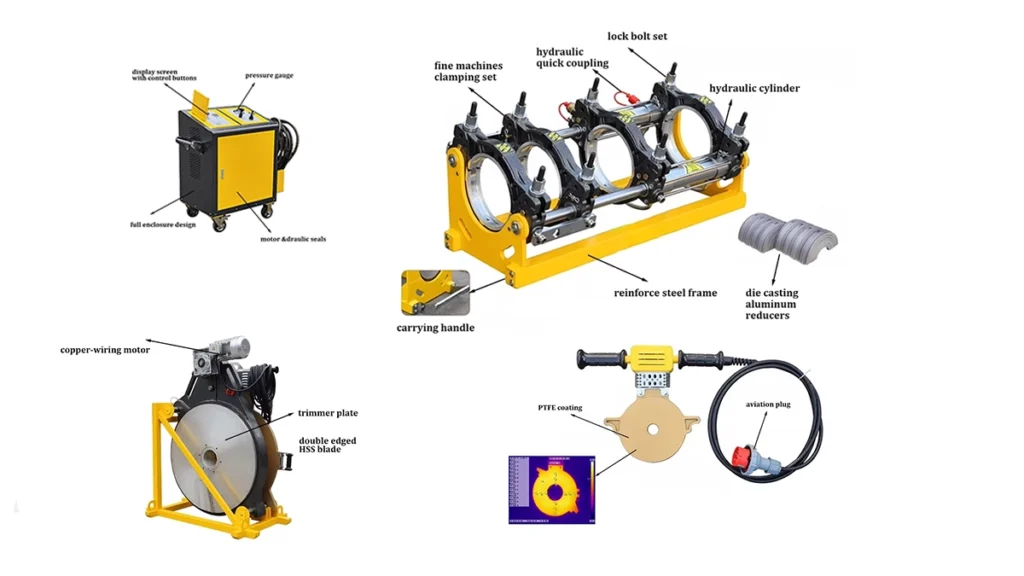
Conversely, field trench hdpe welidng machines prioritize ruggedness and modularity. A vital feature for field units, particularly in urban retrofit projects, is the ability to detach the 3rd and 4th clamps. This allows the welding carriage to drop into tight excavations for “tie-in” welds, connecting a new pipeline string to an existing stub. Ekberg’s field units feature a specific chassis geometry that permits easy removal of the heating plate and facer, even inside confined shoring boxes.
Large Diameter Considerations (DN1000 to DN2600)
Welding plastic pipes with diameters between DN1000 and DN2600 introduces physics that smaller butt fsuion welding machines cannot handle. The primary challenge is managing the immense drag force required to move heavy wall thickness pipes (e.g., SDR11).
For these applications, the hydraulic cylinder surface area ($A_{cyl}$) is a critical specification. A butt fusion machine may physically clamp a DN1200 pipe, but if its hydraulic cylinders do not provide sufficient effective piston area, it cannot achieve the required interfacial pressure (0.15 MPa ± 0.01) without exceeding the system’s maximum hydraulic pressure. Ekberg’s large-diameter series addresses this by utilizing high-capacity cylinders (typically >190 cm² for the DN630 class), ensuring that even heavy-wall SDR11 pipes can be fused while maintaining adequate pressure reserve during the cooling phase.
—
Critical Technical Specifications for Engineering Approval
When evaluating an HDPE pipe jointing machine for procurement, audit the specification sheet against the physical realities of the welding process.
Thermal Precision and Heating Plate Homogeneity
The heating plate is the heart of the fusion process. Standard PE100 welding requires a surface temperature between 200°C and 230°C. However, the critical metric is homogeneity. A low-quality heating plate may display 220°C at the sensor but drop to 190°C at the edges due to poor element distribution.
Ekberg butt fusion machines feature a triple-layer PTFE (Teflon) coating to prevent molten plastic adhesion, supported by an electronic temperature control system that maintains surface uniformity within ±5 °C. This level of precision helps prevent “cold welds”—brittle joints caused by insufficient heating—as well as material degradation resulting from localized hot spots.
Hydraulic System Pressures and Drag Force Management
Engineers must understand how to calculate the actual gauge pressure required for a weld. The formula is:
P(gauge)=P(drag)+P(fusion)
Where P(fusion) is derived from the pipe’s annular area and the standard interfacial pressure (0.15 MPa for ISO).
The butt fusion machine’s hydraulic pump must have the capacity to maintain this pressure consistently. For thick-walled SDR11 pipes, the “soak” phase puts little strain on the pump, but the “cooling” phase requires the system to hold high pressure for extended periods—often 45+ minutes for large diameters. Ekberg hydraulic butt fusion machines are equipped with high-quality accumulators and seals designed to prevent pressure decay during this critical crystallization phase.
Alignment Accuracy and Chassis Rigidity
Misalignment, or “Hi-Lo,” significantly reduces the service life of a pipeline by creating stress concentrators. DVS 2207 standards dictate that misalignment must not exceed 10% of the wall thickness.
Achieving this requires a chassis with exceptional torsional rigidity. Cheaply manufactured frames flex under the high clamping forces needed for large pipes, resulting in ovality issues at the joint. Ekberg frames are machined from high-grade aluminum alloys and hardened steel guides to ensure pipe ends meet perfectly flat, maintaining alignment even when dragging long pipe strings over rough terrain.
Power Requirements and Generator Sizing
Insufficient power supply is a leading cause of heater failure and weak welds. The total power consumption includes the heater, the facer (trimmer), and the hydraulic unit.
- Heater: 8kW for DN630mm
- Facer: 1.5kW
- Hydraulic Unit: 1.5kW
To prevent voltage drops that cause temperature fluctuations, sizing the generator correctly is vital. A general rule of thumb is:
Minimum Generator (kVA)=Total Machine Power (kW)×1.5
For a DN630 butt fusion machine consuming 11kW, a 17-20 kVA generator is the minimum safe specification.
—
Compliance, Data Logging, and Quality Assurance Standards
In today’s regulatory environment, a weld is only as good as the data proving it was done correctly.
Navigating International Welding Standards (ISO, DVS, ASTM)
The HDPE welding machine must be programmable to specific regional standards.
- ISO 21307: The global standard, offering Single Low Pressure (SLP), Single High Pressure (SHP), and Dual Pressure options.
- DVS 2207: The German standard, known for stricter alignment tolerances and longer cooling times under pressure.
- ASTM F2620: Common in North America, specifying different interfacial pressures (60-90 psi).
Ekberg HDPE pipe welding machines come pre-loaded with these parameters. Crucially, the butt fusion machine’s computer calculates specific parameters based on the pipe diameter and SDR entered by the operator, preventing the use of “universal” or guessed settings that lead to joint failure.
The Necessity of Data Logging (LVS) in Modern Utilities
Municipal water and gas authorities increasingly mandate the use of data loggers (LVS – Low Voltage Systems). These devices record the “fingerprint” of every weld:
1. Heater temperature
2. Drag pressure
3. Fusion pressure
4. Heat soak time
5. Cooling time
6. Operator ID and Date
This data serves as a legal certificate of quality. If a joint fails ten years later, the utility can retrieve the log to determine if the failure was due to operator deviation or environmental factors.
Smart Welding and Traceability
Beyond basic logging, modern HDPE welding machines are integrating into the broader IoT ecosystem. Advanced units feature QR code scanners that read raw material data from the pipe (manufacturer, batch, resin type) and GPS tagging to record the exact location of the joint. This data can be exported directly into Building Information Modeling (BIM) software or GIS asset management systems, providing a digital twin of the pipeline as it is constructed.
—
Operational Ergonomics and Field Durability Factors
A HDPE pipe welding machine spec’d perfectly on paper must still survive the mud, dust, and rough handling of a job site.
Weight-to-Strength Ratio and Modular Design
For projects in mountainous regions or mining sites, butt fusion machine weight presents a logistical challenge. Ekberg utilizes aircraft-grade aluminum alloys for the butt fusion welding machine body, offering a high strength-to-weight ratio. This allows a 630mm butt fusion machine (approx. 1,200 kg) to be positioned by standard site equipment without requiring the heavy cranes often needed for older, steel-heavy designs.
Environmental Protection (IP Ratings)
Electronics and hydraulics are vulnerable to the elements. An industrial HDPE pipe welding machine should carry a minimum electrical protection rating of IP54 (dust protected, splash-proof). Ekberg ensures that all hydraulic quick-couplers and electronic enclosures are sealed against moisture and dust ingress. Furthermore, hydraulic seals are selected to withstand temperature extremes from -20°C (arctic conditions) to +50°C (desert environments), ensuring the carriage moves smoothly without “stick-slip” behavior.
Safety Features for Operators
Operator safety is non-negotiable. Essential safety features include:
- Unwanted Start-up Protection: Prevents the facer from spinning if the butt fusion machine resets after a power cut.
- Galvanic Isolation: Protects the operator from electrical faults in the generator.
- Emergency Stops: Accessible red “E-Stop” buttons on both the hydraulic unit and the butt fusion welding machine chassis.
- Micro-switches: The facer should not engage unless it is properly seated in the carriage.
—
Manufacturing Excellence & Global Support: The Ekberg Advantage
Purchasing a butt fusion welding machine is the beginning of a long-term partnership. The butt fusion machine manufacturer’s capability to support the equipment is just as vital as the hardware itself.
Vertical Integration and Quality Control
Ekberg Welding maintains strict vertical integration. We don’t simply assemble parts bought from third-party vendors; we machine our frames, coat our heating plates, and program our PCBs in-house. This allows for rigorous Quality Control (QC) checkpoints, including hydraulic pressure holding tests that exceed ISO requirements and thermal mapping of every heating plate to ensure zero cold spots.
Supply Chain and Spare Parts Availability
Downtime kills project profitability. A broken hydraulic seal or a dull facer blade can halt an entire pipeline crew. Ekberg maintains a robust global logistics network with high stock levels of critical consumables (blades, thermocouples, seals, quick-couplers). Unlike distributors who may wait weeks for import shipments, our factory-direct model ensures rapid dispatch of spares to keep your project moving.
Training, Commissioning, and After-Sales Service
Even the best HDPE welding machine fails if operated incorrectly. Ekberg provides comprehensive training modules aligned with ISO 12176-2 certification for welding operators. We offer video diagnostics and field manuals that help contractors troubleshoot common on-site issues, such as pressure adjustment or generator compatibility, ensuring your team is qualified and confident.
—
Frequently Asked Questions
Q1: What is the difference between High Pressure and Low Pressure butt fusion parameters?
High Pressure (ISO 21307 SHP) utilizes higher interfacial pressures (up to 0.17 MPa) to reduce cooling times significantly, increasing productivity. Low Pressure (SLP) is the traditional method (0.15 MPa) with longer cooling cycles. The choice depends on the pipe manufacturer’s recommendation and the machine’s hydraulic capacity to sustain high force.
Q2: How often does an HDPE pipe welding machine require calibration and servicing?
Butt fusion machines should undergo calibration and servicing annually (every 12 months) or after significant transport damage. Calibration ensures the pressure gauges and temperature sensors read accurately. Regular servicing includes checking hydraulic oil levels (ISO 68), sharpening facer blades, and inspecting PTFE coating integrity.
Q3: Can one machine handle both SDR11 and SDR26 pipes effectively?
Yes, provided the hdpe welding machine has a hydraulic system capable of fine adjustments. SDR11 (thick wall) requires high pressure, while SDR26 (thin wall) requires very low pressure. The butt fusion machine must have a sensitive pressure relief valve to avoid crushing thin-walled pipes during the drag phase.
Q4: What size generator is needed for a DN630 HDPE pipe jointing machine?
For a standard 630mm hydraulic butt fusion machine, you typically need a generator between 17kVA and 20kVA. The formula is the total power of the butt fusion machine (Heater + Facer + Hydraulic) multiplied by 1.5. This accounts for startup surges and prevents voltage drops that could trigger heater errors.
Q5: How does the data logger export files, and are they tamper-proof?
Modern data loggers export files via USB or Bluetooth in encrypted formats (often PDF or binary files) that cannot be edited. This ensures the integrity of the welding record. Some systems also offer CSV exports for data analysis, but the encrypted PDF serves as the official quality certificate.
—
Final Thoughts
Selecting the right HDPE welding machine is a multi-dimensional engineering decision. It requires balancing strict compliance with international standards (ISO/DVS), ensuring mechanical robustness for large-diameter applications, and leveraging automation to eliminate human error.
Buyer Selection Checklist:
- Compliance: Does the butt fusion welding machine support ISO 21307 / DVS 2207 parameters?
- Documentation: Is a Data Logger (LVS) included or available?
- Thermal: Is the heating plate PTFE-coated with temperature uniformity within ±5 °C?
- Hydraulics: Does the hydraulic cylinder area ($A_{cyl}$) provide sufficient capacity to support high-pressure fusion at the machine’s maximum pipe size?
- Support: Is there factory-direct access to spare parts and training?
The cost of premium welding equipment is negligible compared to the liability of a single failed joint in a critical infrastructure project. Do not compromise on the integrity of your pipeline.
Ready to equip your next project with precision-engineered solutions? Contact Ekberg Welding today for a technical consultation, detailed specification sheets, or a factory-direct quotation tailored to your specific pipeline requirements.