
Butt Fusion Machine Manufacturer for Large Municipal Project
Table of Contents
Introduction
When municipal infrastructure projects demand joint integrity across DN1600 HDPE pipelines, standard butt fusion machines often fail to deliver. Off-the-shelf equipment frequently lacks the hydraulic capacity to maintain the stable 0.15 MPa interfacial pressures necessary for long-term safety. Relying on catalog models for complex, large-diameter installations is a gamble that can lead to catastrophic joint failures—costing contractors upwards of $50,000 per incident in excavation and rework fees.
This engineering guide explores why custom hydraulic configurations, strict adherence to ISO 21307 welding parameters, and integrated data logging are non-negotiable for modern projects. We will analyze how tailored chassis designs navigate difficult trench terrain, how to evaluate a manufacturer’s true engineering depth, and why the long-term ROI of high-performance custom units far outweighs the initial savings of standard models. By the end of this article, you will have the technical framework needed to specify heavy-duty fusion equipment that guarantees both compliance and operational efficiency.

The Necessity of Customization in Large-Scale Municipal Piping
Municipal water and gas infrastructure projects introduce variables that standard catalog equipment simply cannot handle. While a local distributor might stock units up to 630mm, the engineering realities of cross-country transmission lines or major sewage treatment outfalls often dictate equipment tailored to specific environmental and physical constraints.
Addressing Unique Pipe Diameters and SDR Ratings
The primary driver for customization is the sheer scale of modern municipal piping. Standard butt fusion welding machines usually cap out at DN800 or DN1000. However, major metropolitan water projects frequently utilize HDPE pipes ranging from DN1200 to DN2000+. At these diameters, the physics of the fusion process changes drastically depending on the Standard Dimension Ratio (SDR).
For example, a DN1600 pipe with an SDR 11 rating (common in high-pressure gas or water lines) features a significantly thicker wall than an SDR 17 pipe. The cross-sectional area of the pipe face requires immense force to achieve the required bead-up pressure. A standard HDPE pipe welding machine designed for SDR 17 might physically fit a DN1600 pipe but lack the hydraulic cylinder cross-section to apply the necessary interfacial pressure (typically 0.15–0.52 MPa). Custom-designed butt fusion machines solve this by pairing the chassis with upsized hydraulic cylinders and power units capable of delivering drag forces exceeding 100 bar, ensuring even thick-walled, heavy pipes fuse without compromising bead formation.
Adapting to Challenging Terrain and Trench Conditions
Municipal projects rarely happen on flat, paved surfaces. Pipelines snake through narrow city trenches, uneven rural terrain, or steep gradients. A standard rigid-frame HDPE pipe jointing machine becomes a liability in these environments. Customization allows for chassis configurations engineered specifically for site logistics.
For narrow trench work, manufacturers like Ekberg Welding can engineer “four-column” designs where the hydraulic unit is detachable, or the chassis is slimmed down to fit within restricted rights-of-way. In more rugged terrain, crawler-mounted chassis (track systems) replace standard wheeled carts, allowing the hdpe fusion machine to self-propel over mud and gravel. This eliminates the need for constant crane support—a massive cost saver. Furthermore, for vertical riser installations or tie-ins, custom butt fusion machines can feature removable jaws or lightweight aluminum alloy frames, allowing operators to perform welds in-situ where a standard steel frame would be too heavy or bulky to position.
Integration of Advanced Data Logging and Traceability
In the past, manual recording of welding parameters was acceptable. Today, municipal tenders—particularly those adhering to ISO 21307 or local utility standards—mandate 100% traceability. This isn’t just about recording the final pressure; it requires a second-by-second log of the entire fusion cycle: bead-up, heat soak, dwell time, and cooling.
Custom butt fusion machines integrate Programmable Logic Controllers (PLCs) tailored to the municipality’s specific reporting requirements. For instance, a European project might require adherence to DVS 2207 parameters, while a North American site might demand ASTM F2620 compliance. A custom-programmed PLC guides the operator through the specific standard’s workflow, locking out the next step if the previous parameter (e.g., heater plate temperature of 220°C ±5°C) wasn’t met. Additionally, these custom units often include GPS modules to stamp the exact location of every weld, creating a “digital twin” of the pipeline for future asset management.
Technical Specifications Defining High-Performance Butt Fusion Machines
When specifying a butt fusion welding machine for a critical project, a “black box” approach is dangerous. Buyers must understand the internal specifications that separate a high-performance custom unit from a basic operational tool.
Hydraulic System Customization for Precise Pressure Control
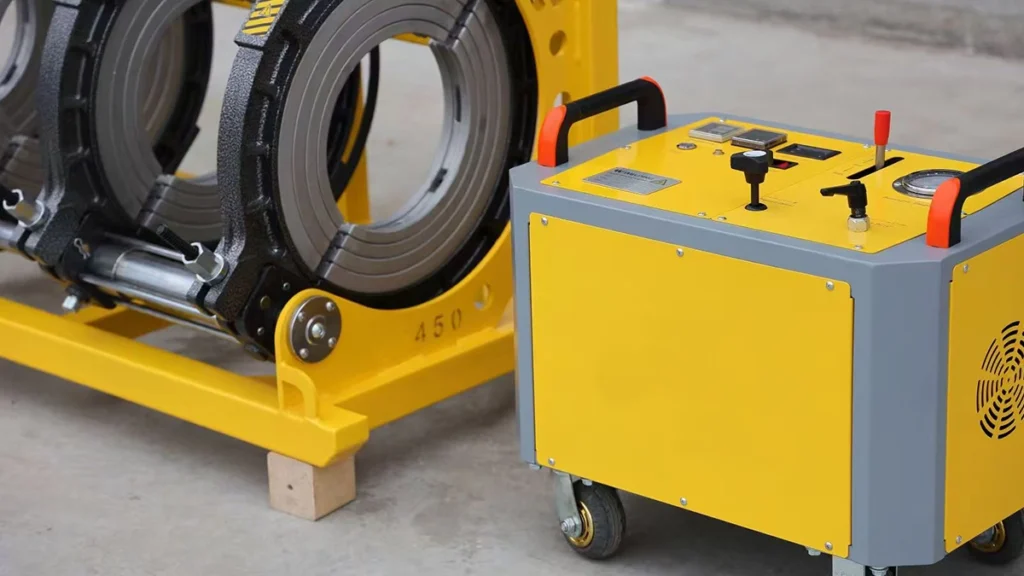
The heart of any butt fusion machine is its hydraulic system. For large-diameter pipes (DN1000+), the system must operate within a pressure range of 0-160 bar to handle both the movement of heavy pipes (drag pressure) and the precise application of fusion force.
Standard pumps often struggle with the “dual-stage” requirement: high speed for opening/closing clamps to minimize dwell time, and high precision for holding steady pressure during the cooling cycle. Custom high-performance butt fusion machines utilize dual-stage hydraulic pumps and, crucially, accumulator systems. An accumulator stores hydraulic energy, allowing the system to maintain the required interfacial pressure during the long cooling phase (which can exceed 45 minutes for thick-walled pipes) without the pump running continuously. This saves energy, reduces noise, and prevents hydraulic oil overheating—a common cause of pressure fluctuations and joint failure.
Heating Plate Technology and Temperature Uniformity
The heating plate is the critical variable in achieving a homogeneous melt. For a DN1600 HDPE pipe, the heating plate has a massive surface area. Standard electrical resistance heaters can suffer from “cold spots” at the edges or “hot spots” near the element coils.
Ekberg Welding specifies custom heating plates with multi-zone electronic temperature control systems. These monitor surface temperature at multiple points, adjusting power delivery to maintain a uniform temperature typically between 200°C and 230°C (for PE100). The standard requires uniformity within ±5°C across the entire face. Achieving this on a 1.6-meter diameter plate requires advanced engineering and high-quality PTFE coatings that prevent polymer adhesion without inhibiting heat transfer. A custom hdpe welding machine will often feature an automated “pop-up” mechanism for the heater plate, ensuring it removes instantly and cleanly once the heat soak phase is complete, minimizing the critical “changeover time” that can compromise weld quality.
Automation Levels: CNC vs. Semi-Automatic Configurations
The choice between CNC (Computer Numerical Control) and semi-automatic operation is a major specification decision. Manual hydraulic operations rely heavily on operator skill, introducing a margin of error estimated to cause nearly 80% of all joint failures.
For municipal projects where liability is high, specifying a fully automatic CNC automatic butt fusion machine is often the most strategic choice. These butt fusion welding machines utilize closed-loop feedback systems. The operator inputs pipe data (e.g., DN1200, SDR 17, PE100), and the machine calculates the exact drag pressure, bead-up height, and cooling time based on the selected standard (ISO 21307). The machine then controls the hydraulics and heater plate autonomously. If drag pressure changes (e.g., the pipe slips), the CNC system detects it and aborts the weld. While semi-automatic options offer cost efficiency for less critical lines, CNC customization provides the mathematical certainty required for high-pressure gas and water transmission mains.
How to Evaluate Manufacturers for Custom Welding Solutions
Not all manufacturers possess the engineering depth to deliver a custom solution. Many are simply assemblers of standard parts. To ensure project success, buyers must evaluate potential partners based on their ability to engineer, not just assemble.
Assessing R&D and Engineering Capabilities
A true manufacturing partner maintains an in-house R&D team capable of CAD/CAM design and rapid prototyping. When requesting a custom butt fusion welding machine, ask for hydraulic schematics and chassis stress analysis. A manufacturer like Ekberg, which co-develops core technologies with international partners, can modify hydraulic logic to suit specific project needs—for example, increasing flow rate for faster cylinder actuation in cold climates. Buyers should look for suppliers who act as engineering consultants. If they don’t ask about your pipe wall thickness or site conditions before quoting a price, they aren’t engineering a solution; they are selling a catalog number.
Supply Chain Stability and Spare Parts Availability
Custom butt fusion machines are long-term assets, but they are useless without support. A custom design should not mean “custom parts that take six weeks to manufacture.” The best manufacturers utilize standard, high-quality industrial components (e.g., seals, motors, valves) within their custom designs.
Investigate the manufacturer’s inventory strategy. Do they stock replacement heating elements and hydraulic seals for the specific large-diameter unit you are purchasing? For municipal projects where downtime penalties accrue daily, the manufacturer must demonstrate a supply chain capable of dispatching critical spares within 24-48 hours. Ekberg Welding, for instance, emphasizes a stock-heavy approach for critical components to ensure a custom HDPE pipe welding machine in the field remains operational throughout the project lifecycle.
Compliance with International Standards (ISO, DVS, ASTM)
Compliance is non-negotiable in municipal infrastructure. Manufacturers must provide certification that their custom designs meet global safety and performance benchmarks. Key standards include ISO 12176-1 (Equipment for fusion) and DVS 2207 (Welding of thermoplastics).
A reputable manufacturer will have their custom units type-tested. This means a third-party validator has verified that the butt fusion welding machine can apply the stated pressures and maintain required temperatures under load. Be wary of manufacturers who claim compliance but cannot produce a certificate of conformity for the specific model range you are buying. In the event of a pipeline failure, equipment compliance traceability is the first thing investigators will audit.
Ekberg Welding: Manufacturing Excellence, Quality Control & Service
Ekberg Welding positions itself not merely as a vendor, but as a strategic partner for large-scale infrastructure development. This positioning is built on a foundation of rigorous manufacturing processes and a service-first philosophy.
Advanced Production Facilities and Quality Assurance
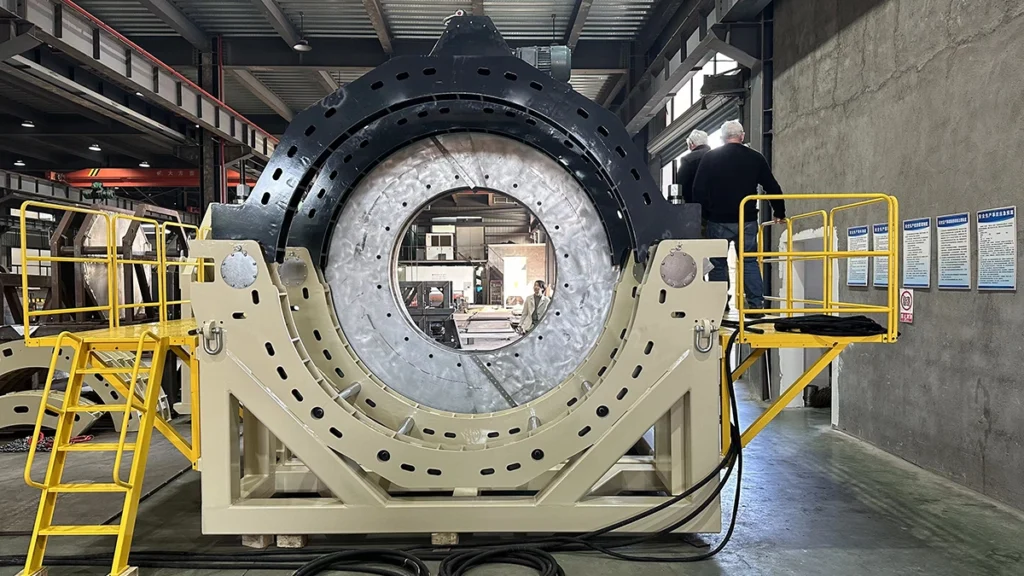
The production of a custom butt fusion machine at Ekberg begins with precision CNC machining of chassis components to ensure perfect alignment. Misalignment of even 1mm on a DN1200 HDPE pipe can lead to high-low mismatch, creating stress concentrators in the weld.
Quality assurance extends beyond dimensional checks. Every hydraulic unit undergoes a rigorous pressure test cycle, simulating the maximum load conditions of an SDR 11 weld. Electronic temperature controls are calibrated using thermal imaging to verify uniformity across the heating plate. Ekberg’s commitment is that no machine leaves the factory without a 100% operational test, ensuring that when the crate is opened on the job site, the butt fusion machine is ready to weld.
Tailored Solutions for Global Infrastructure Projects
Ekberg’s engineering flexibility is demonstrated in its global footprint. From cross-country water transmission lines in arid environments to industrial sewage treatment plants in humid coastal zones, the equipment is adapted to the locale.
This includes electrical customization—configuring motors for 380V/50Hz, 380V/60Hz power supplies—and interface localization. A butt fusion welding machine deployed in South America can be pre-loaded with Spanish language software and ASTM F2620 welding standards, while a unit for Southeast Asia might feature ISO 21307 parameters. This level of factory-direct customization eliminates the need for third-party retrofits, preserving the warranty and integrity of the system.
Comprehensive After-Sales Support and Technical Training
The complexity of custom CNC automatic butt fusion machines requires skilled operation. Ekberg supports clients through the lifecycle of the butt fusion welding machine, starting with commissioning and on-site training. This training goes beyond button-pushing; it covers welding physics, parameter selection, and troubleshooting.
Furthermore, modern Ekberg butt fusion welding machines often feature remote diagnostic capabilities. If a pipe welding machine in the field reports a pressure error, Ekberg technicians can analyze the data log remotely via cloud integration to identify whether the issue is a hydraulic leak, a sensor fault, or an operator error. This capability drastically reduces downtime, as problems can often be diagnosed without waiting for a technician to travel to the site.
Strategic Buyer’s Guide: Selecting the Right Machine for Your Project
Procuring a custom butt fusion welding machine is a capital-intensive decision that impacts the profitability of the entire project. Here is a strategic framework for making the right choice.
Defining Project Parameters and Welding Requirements
Before engaging a manufacturer, buyers must aggregate specific data. Inaccurate initial data is the leading cause of specification mismatch.
Buyer Checklist:
- Pipe Outer Diameter (OD): Exact range (e.g., DN630 to DN1200).
- Material Grade: PE80, PE100, or PP (Polypropylene).
- SDR Rating: The thickest wall pipe determines the maximum hydraulic force required.
- Welding Standard: Does the tender require ISO 21307 High Pressure (0.52 MPa) or Low Pressure (0.15 MPa)? High pressure requires significantly more robust hydraulics.
- Power Supply: Is 3-phase power available, or will the site rely on generators? (Generators must be sized to handle the peak load of the heater and pump simultaneously).
Comparing Total Cost of Ownership (TCO) vs. Initial Purchase Price
While custom butt fusion machines carry a higher upfront cost than standard units, the Total Cost of Ownership (TCO) analysis often favors the high-performance option.
Consider the productivity gains of High Pressure (ISO 21307) welding. By increasing the interfacial pressure to 0.52 MPa, the cooling time for thick-walled pipes can be reduced by up to 50%. On a 10km pipeline project, halving the cooling time per joint can shave weeks off the schedule, saving tens of thousands in labor and equipment rental costs. Additionally, the reliability of a custom-engineered butt fsuion machine reduces the risk of breakdown. A single day of downtime on a municipal crew can cost more than the price difference between a premium Ekberg butt fusion welding machine and a budget alternative.
Validating Warranty Terms and Service Level Agreements (SLAs)
Finally, scrutinize the warranty. Standard industry warranties are often 12 months. For large fleet purchases, buyers should negotiate extended warranties that cover major components like the hydraulic pump and PLC.
Ekberg Welding offers a compelling service model that includes a standard 1-year warranty paired with lifetime maintenance support. Crucially, verify if the SLA includes free spare parts for non-human damage during the warranty period. This protects the buyer from “hidden” maintenance costs in the first year of operation.
Frequently Asked Questions
Q1: What is the lead time for a custom-designed butt fusion machine for municipal projects?
Typically, the lead time for a custom large-diameter butt fusion welding machine (DN1000+) is between 4 to 8 weeks, depending on the complexity of hydraulic modifications and chassis fabrication. While standard catalog models may ship faster, custom engineering requires rigorous testing. Ekberg Welding prioritizes production scheduling for urgent municipal infrastructure projects to minimize delays.
Q2: Can Ekberg butt fusion machines weld both HDPE and PP pipes?
Yes. The butt fusion welding machines are versatile and can weld HDPE (PE80/PE100), PP (Polypropylene), and PVDF pipes. The key lies in temperature control and pressure parameters. Ekberg’s CNC systems allow operators to select the specific material type from the menu, automatically adjusting heating plate temperature (e.g., ~210°C for PP vs. ~220°C for HDPE) and fusion pressures accordingly.
Q3: What is the difference between High Pressure and Low Pressure welding parameters in ISO 21307?
High Pressure (Single High Pressure) utilizes an interfacial pressure of 0.52 MPa, significantly higher than the Low Pressure standard of 0.15 MPa. The primary benefit of High Pressure is speed; it allows for much faster cooling times, increasing daily productivity. However, it requires a butt fusion welding machine with a much stronger chassis and hydraulic system to sustain higher forces without deflection.
Q4: Do custom machines require specialized operator training compared to standard models?
While the fundamental physics of fusion remain the same, custom CNC or hydraulic butt fusion machines do require training on the specific software interface and safety protocols. Ekberg provides comprehensive operation manuals, video tutorials, and options for on-site commissioning training to ensure your crew is proficient in using advanced data logging and automation features effectively.
Q5: How does Ekberg ensure spare parts availability for older custom models?
Ekberg maintains a “lifetime maintenance” philosophy. We utilize standardized industrial components (seals, valves, electronics) within our custom designs wherever possible to ensure global availability. For proprietary parts, we maintain a backstock inventory and offer rapid air-freight options to ensure that even butt fusion welding machines deployed for 5+ years can be serviced quickly to minimize project downtime.
Conclusion
The success of large-scale municipal infrastructure relies heavily on the integrity of every pipeline joint. Choosing a manufacturer with strong engineering capabilities to deliver custom butt fusion machines is not a luxury—it is a risk management strategy. Standard equipment often fails to meet the rigorous demands of DN1600+ diameters, complex terrain, and strict ISO compliance.
Ekberg Welding offers the ideal balance of bespoke engineering, robust manufacturing quality, and comprehensive global support. By selecting a partner that understands the nuances of high-pressure fusion and data traceability, you ensure the safety and longevity of your water and gas networks.
Contact Ekberg Welding today to discuss your municipal project requirements. Request a technical consultation and get a custom quote for your fleet.